
How Celebrities and Billionaires Are Rewriting the Rules of Philanthropy in 2026
From Taylor Swift's creative royalty donations to MacKenzie Scott's unprecedented $26 billion quiet-giving strategy, high-profile figures are bypassing traditional charity models to deliver direct, unrestricted impact.
By Factlen Editorial Team
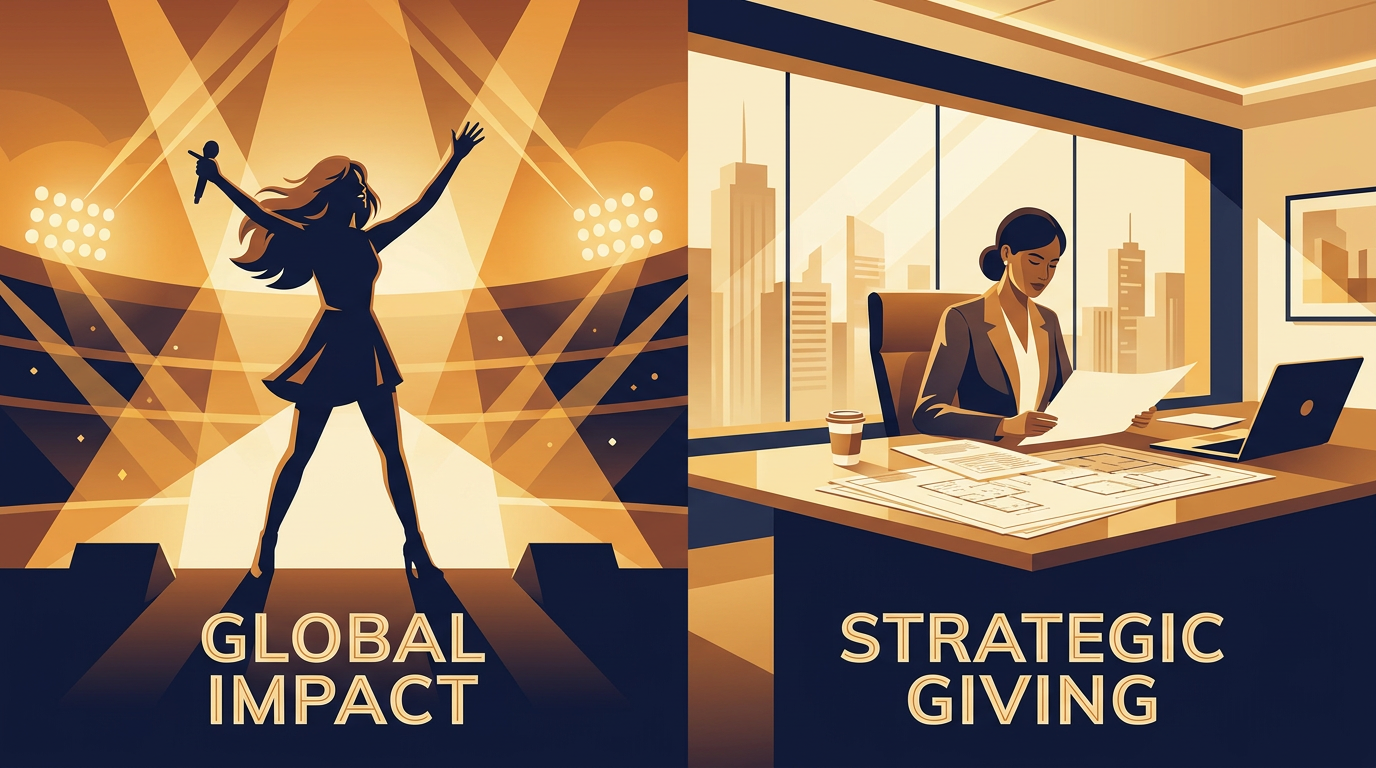
- Direct-Impact Advocates
- Supporters of unrestricted, immediate giving that bypasses traditional philanthropic red tape.
- Next-Generation Fundraisers
- Creators and entertainers leveraging viral internet culture and direct fan engagement to raise massive sums.
- Traditional Philanthropy Trackers
- Organizations and analysts who value transparency, public reporting, and structured verification of charitable funds.
What's not represented
- · Small Grassroots Nonprofits
- · Tax Policy Analysts
Why this matters
This shift in giving means billions of dollars are reaching on-the-ground organizations faster and with fewer restrictions, fundamentally changing how global crises, health initiatives, and local communities are funded.
Key points
- Taylor Swift pledged all streaming royalties from her 'Elizabeth Taylor' music video to the late actress's AIDS foundation.
- MacKenzie Scott was omitted from a major top-donor list despite giving away $7.1 billion in 2025, due to her secretive 'Quiet Research' model.
- Scott's Yield Giving has donated $26 billion since 2019, focusing on unrestricted grants that give nonprofits total financial flexibility.
- Entertainers like Kevin Hart, MrBeast, and SZA are pioneering viral, high-engagement charity events to reach younger demographics.
In April 2026, Taylor Swift released a surprise music video for 'Elizabeth Taylor,' a standout track from her recent album The Life of a Showgirl. But the pop star didn't appear in a single frame of the new release. Instead, the video was a carefully curated supercut of the late Hollywood icon's life on and off the screen, released with a unique philanthropic hook: all streaming royalties from the video are being donated directly to the Elizabeth Taylor AIDS Foundation. The initiative seamlessly blended pop culture with targeted charitable action.[1][2]
The move drew immediate praise from Taylor's estate, which commended Swift for spotlighting a woman who was arguably the first globally recognized celebrity activist for HIV and AIDS awareness. Representatives for the estate noted that the video was a pure devotion to Taylor's legacy, celebrating her trailblazing efforts in the philanthropic space. It also highlighted a rapidly growing trend in 2026: high-profile figures are increasingly bypassing traditional, red-tape-heavy charity models in favor of direct, creative, and highly targeted giving that reaches beneficiaries faster.[2][6][7]
Swift's royalty donation is just the latest in a string of massive, quiet contributions from the singer. During the recent holiday season, she distributed over $2 million across major organizations, including $1 million each to Feeding America and the American Heart Association. She also directed substantial, undisclosed funds to the Monroe Carell Jr. Children's Hospital at Vanderbilt. That donation specifically bolstered their Adolescent and Young Adult Cancer Program, which serves a critical portion of the 1,800 families the Tennessee-based hospital treats every single day.[1][3]
While Swift leverages her massive cultural footprint to fund specific causes, billionaire philanthropist MacKenzie Scott is quietly rewriting the financial architecture of the nonprofit sector entirely. Through her organization, Yield Giving, Scott has adopted a radically different approach to wealth distribution. Since signing the Giving Pledge in 2019, Scott has donated a staggering $26 billion to more than 2,700 organizations, focusing heavily on education, equity, and environmental resilience. Rather than building a massive foundation with her name on the door, she has systematically dismantled her fortune by identifying high-impact groups and wiring them funds directly.[4][8]

In 2025 alone, Scott gave away $7.1 billion to hundreds of organizations. Yet, in a twist that sparked intense debate within the nonprofit world this spring, she was entirely omitted from the Chronicle of Philanthropy's prestigious 'Philanthropy 50' list for 2026. The annual ranking is widely considered the definitive scorecard of American generosity, making the absence of the world's most prolific living donor a glaring anomaly that forced the industry to reckon with how it measures charitable impact.[4][5][8]
In 2025 alone, Scott gave away $7.1 billion to hundreds of organizations.
The omission certainly wasn't due to a lack of generosity—her $7.1 billion total would have easily eclipsed the list's official number one donor, Michael Bloomberg, who gave $4.3 billion. Instead, Scott was left off because of her famously secretive 'Quiet Research' model. She consistently declines to provide the traditional reporting, press releases, and verification metrics that major philanthropy trackers require to officially log the funds. For Scott, the focus is entirely on the recipient, not the recognition.[4][8]

This friction highlights a fundamental shift in how modern wealth approaches charity. Traditional grantmaking often involves grueling application processes, strict spending guidelines, and exhaustive follow-up reporting that can drain a nonprofit's limited resources. Scott's Yield Giving model does the exact opposite: her team identifies high-impact nonprofits quietly and awards them massive, unrestricted grants—typically ranging from $1 million to $2 million. Once the check clears, the organizations are allowed to spend the money exactly as they see fit, with zero reporting requirements.[5]
Nonprofit leaders have universally praised this 'no strings attached' approach. It frees organizations from the administrative burden of constantly proving their worth to wealthy donors year after year, allowing them to focus entirely on their on-the-ground missions. Scott herself has noted in her rare public essays that the ripple effects of empowering local leaders far outweigh the need for public recognition, named buildings, or endowed chairs. The trust-based model assumes that the people doing the work know best how to allocate the capital.[5]
As billionaires like Scott optimize for quiet, frictionless efficiency, a new generation of entertainers is optimizing for viral visibility and mass engagement. In early 2026, comedian Kevin Hart partnered with YouTube giant MrBeast to host a massive celebrity charity competition. The collaboration represented a stark departure from the stuffy black-tie galas and silent auctions of the past, turning philanthropy into high-stakes digital entertainment designed to capture the attention of younger demographics. By broadcasting the event to millions of viewers globally, they effectively gamified the act of giving.[6]
The event, which kicked off the second season of MrBeast's reality show 'Beast Games,' featured stars like Tiffany Haddish, Howie Mandel, and Diplo competing in physical challenges and creative logic puzzles. The ultimate prize was a $1 million donation directed to the winning celebrity's charity of choice. By leveraging the massive built-in audiences of digital content creators, these events generate immense awareness and capital for causes that might otherwise struggle to cut through the noise of the modern news cycle.[6]

Similarly, music artists are leveraging direct fan access to raise funds in highly personalized ways. R&B star SZA recently auctioned off a one-on-one Zoom hangout session to support the Freedom for Sudan campaign. Rather than a formal meet-and-greet, she promised to do yoga, make mood boards, or just talk about current events with the winner. It is a deeply intimate form of fundraising that relies on parasocial relationships rather than corporate sponsorships. This approach democratizes the fundraising process, allowing fans to pool their resources for a chance at a unique experience while driving significant capital toward urgent humanitarian crises.[6]
Whether it is through the quiet deployment of billions of dollars, the creative redirection of music video streaming royalties, or massive viral internet spectacles, the landscape of giving has fundamentally changed in 2026. The common thread uniting these disparate approaches is a desire for immediate, tangible impact. By stripping away the performative bureaucracy of traditional charity, today's most influential figures are ensuring that their resources actually reach the communities and causes that need them most, faster than ever before.[5][7]
How we got here
May 2019
MacKenzie Scott signs the Giving Pledge, committing to give away the majority of her wealth.
December 2025
Taylor Swift makes a series of million-dollar holiday donations to Feeding America and the American Heart Association.
January 2026
Kevin Hart and MrBeast launch a viral $1 million celebrity charity competition.
March 2026
The Chronicle of Philanthropy releases its top 50 list, sparking debate by omitting MacKenzie Scott's record-breaking $7.1 billion in donations.
April 2026
Taylor Swift releases the 'Elizabeth Taylor' music video, pledging all streaming royalties to the late actress's AIDS foundation.
Viewpoints in depth
Direct-Impact Advocates
Supporters of unrestricted, immediate giving that bypasses traditional philanthropic red tape.
This camp, championed by figures like MacKenzie Scott and supported by numerous nonprofit leaders, argues that traditional grantmaking is fundamentally flawed. They believe that forcing charities to spend immense resources applying for funds and proving their worth detracts from their actual missions. By providing massive, unrestricted grants, they argue that wealth can be deployed much more efficiently, trusting local leaders to know exactly where the capital is needed most.
Traditional Philanthropy Trackers
Organizations and analysts who value transparency, public reporting, and structured verification of charitable funds.
Traditional tracking organizations, such as those compiling the Philanthropy 50 list, emphasize the importance of public accountability in charitable giving. They argue that when billions of dollars are moved privately, it becomes difficult to measure the true impact of the funds or hold donors accountable to their pledges. While they acknowledge the generosity of quiet donors, they maintain that public reporting sets a standard that encourages others to give and ensures the integrity of the nonprofit sector.
Next-Generation Fundraisers
Creators and entertainers leveraging viral internet culture and direct fan engagement to raise massive sums.
This perspective views traditional black-tie charity galas as outdated and inaccessible. By gamifying philanthropy through massive YouTube competitions or offering intimate digital hangouts, these creators argue that they can engage a much younger, wider demographic. They believe that making charity highly visible, entertaining, and interactive is the key to sustaining long-term philanthropic engagement among Gen Z and millennial audiences.
What we don't know
- It remains unclear exactly how much MacKenzie Scott will donate through the remainder of 2026, as Yield Giving does not announce its grants on a set public schedule.
- The long-term financial impact of Taylor Swift's streaming royalty donation to the Elizabeth Taylor AIDS Foundation has not yet been publicly quantified.
Key terms
- Unrestricted Grant
- A charitable donation given without strict guidelines on how the funds must be used, allowing nonprofits maximum flexibility.
- Yield Giving
- The philanthropic organization founded by MacKenzie Scott, known for its quiet research model and massive, unrestricted donations.
- Quiet Research Model
- A philanthropic approach where donors privately identify and vet organizations to fund, rather than requiring nonprofits to submit lengthy public applications.
Frequently asked
Why wasn't MacKenzie Scott on the Philanthropy 50 list?
Despite donating $7.1 billion in 2025, Scott was omitted because her 'Quiet Research' model does not provide the traditional public reporting and verification metrics required by the Chronicle of Philanthropy.
Where do the royalties for Taylor Swift's 'Elizabeth Taylor' video go?
All streaming royalties from the music video are being donated to the Elizabeth Taylor AIDS Foundation, supporting HIV advocacy and education.
What is an unrestricted grant?
An unrestricted grant is a financial donation given to a nonprofit without specific rules on how it must be spent, allowing the organization to allocate the funds where they are needed most.
Sources
Source coverage
8 outlets
3 viewpoints surfaced








[1]Good Good GoodDirect-Impact Advocates
Taylor Swift donates proceeds from 'Elizabeth Taylor' music video to Elizabeth Taylor AIDS Foundation
Read on Good Good Good →[2]HeavyDirect-Impact Advocates
Taylor Swift Makes Unprecedented Move With Donation Honoring Elizabeth Taylor
Read on Heavy →[3]CBS NewsDirect-Impact Advocates
Taylor Swift donates $1 million to Feeding America, group says
Read on CBS News →[4]Inc. MagazineTraditional Philanthropy Trackers
MacKenzie Scott Gave Away $26 Billion. So Why Wasn't She on the Philanthropy 50 List?
Read on Inc. Magazine →[5]TIMEDirect-Impact Advocates
How MacKenzie Scott's Quiet Giving Is Changing Philanthropy
Read on TIME →[6]LoveBScottNext-Generation Fundraisers
Celebrities finding new ways to make an impact in 2026
Read on LoveBScott →[7]The BoarNext-Generation Fundraisers
Why celebrities should be a transformative force for charity in 2026
Read on The Boar →[8]Financial ExpressTraditional Philanthropy Trackers
Mackenzie Scott's pledge to give away her wealth sparks debate over Philanthropy 50 list
Read on Financial Express →

Every angle. Every day.
Get entertainment stories with full source coverage and perspective breakdowns delivered to your inbox.