
How Millions of Abandoned Oil Wells Could Become the Next Geothermal Powerhouses
Startups and governments are testing technologies to convert depleted oil and gas wells into zero-emission geothermal energy sources, potentially unlocking gigawatts of clean baseload power while solving a massive environmental liability.
By Factlen Editorial Team
- Geothermal Innovators
- Focus on leveraging existing infrastructure to rapidly scale baseload clean energy.
- Academic & Government Researchers
- Focus on the technical feasibility, thermodynamics, and pilot testing of well conversion.
- Energy Transition Analysts
- Focus on the economic and regulatory shifts required to safely bridge fossil fuels and renewables.
What's not represented
- · Local communities living near abandoned wells
- · Traditional geothermal drilling companies
Why this matters
There are millions of abandoned oil and gas wells worldwide that leak methane and cost billions to plug. Repurposing them into geothermal wells could solve this environmental crisis while providing a massive new source of continuous, zero-emission electricity to the grid.
Key points
- Millions of abandoned oil and gas wells worldwide pose environmental risks and cost billions to plug.
- Startups and researchers are retrofitting these wells to extract deep-earth heat for zero-emission geothermal power.
- Reusing existing wellbores eliminates the massive upfront drilling costs that traditionally hinder geothermal projects.
- The U.S. alone has over 500,000 disused wells suitable for conversion, representing up to 13 gigawatts of clean energy potential.
- Challenges include degraded well casings, low-grade heat requiring advanced turbines, and regulatory hurdles regarding well abandonment timelines.
The global fossil fuel industry has left behind a staggering, subterranean footprint: millions of depleted, abandoned, and orphaned oil and gas wells scattered across the planet. In the United States alone, environmental experts estimate there are between two and three million disused wells dotting the landscape from Texas to North Dakota. For decades, these deep, steel-lined holes have been viewed strictly as environmental liabilities. They are prone to leaking potent methane gas into the atmosphere, threatening local groundwater supplies, and costing energy companies and taxpayers billions of dollars to safely plug with cement and abandon.[2][5]
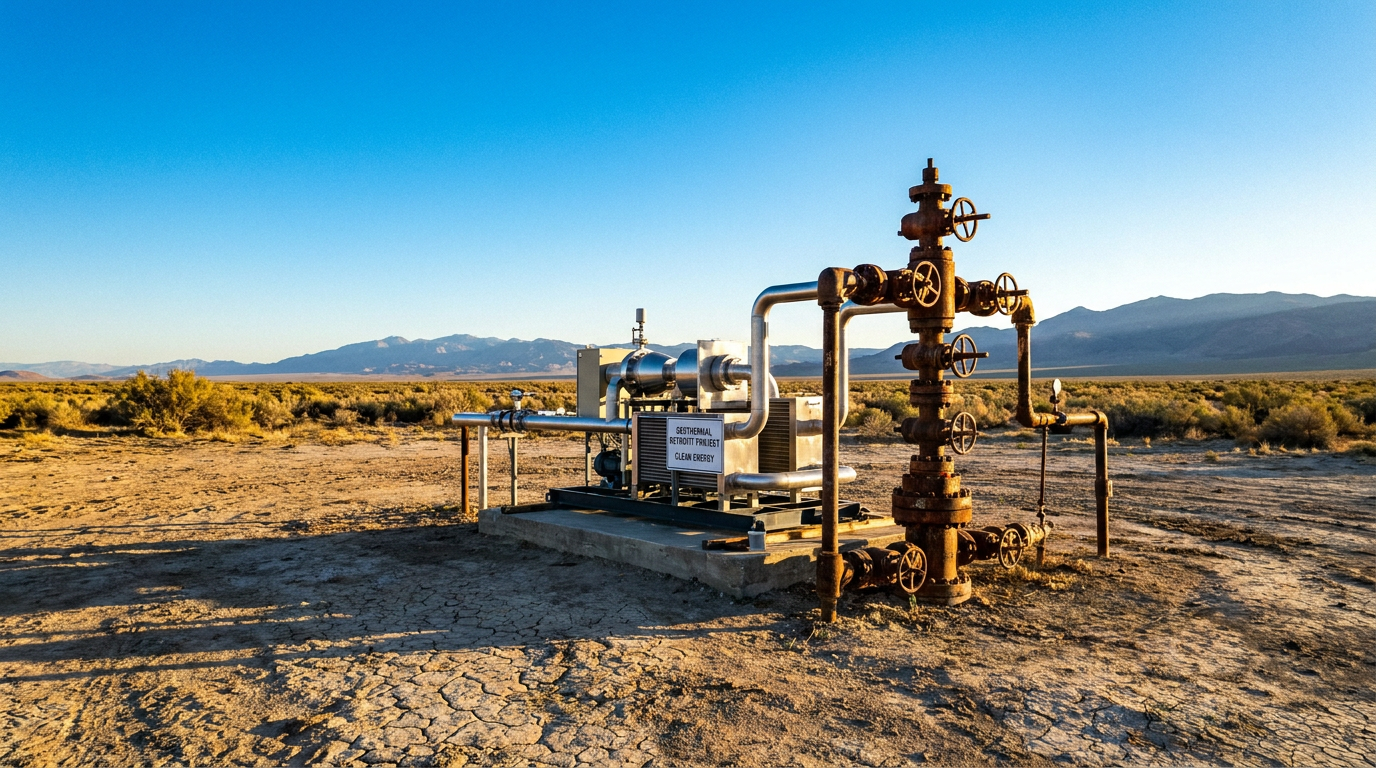
But a growing coalition of energy startups, academic researchers, and government agencies is advancing a radical pivot to rewrite this legacy. Instead of spending millions of dollars simply to bury these stranded assets, they are developing technologies to transform them into zero-emission geothermal energy powerhouses. By tapping into the natural, inexhaustible heat trapped deep underground, these abandoned wells could be repurposed to provide continuous, baseload renewable electricity and direct heating to local communities, turning a massive environmental liability into a critical grid asset.[1][7]
The economic logic driving this transition is simple and compelling for both the fossil fuel and renewable energy sectors. In traditional geothermal energy development, the single largest financial hurdle is the upfront cost of drilling deep into the Earth's crust. Drilling and casing a new geothermal well can account for 40% to 60% of a project's total capital expenditure, often running into the tens of millions of dollars with absolutely no guarantee that the resulting well will produce viable heat.[5]
Repurposing existing oil and gas infrastructure entirely bypasses this massive capital barrier. The holes are already dug, the geological formations are thoroughly mapped by decades of seismic data, and the surface infrastructure—such as access roads, pipelines, and grid connections—is frequently already in place. By retrofitting these mature sites, developers can slash the levelized cost of geothermal electricity generation by an estimated 11% to 60%, depending on the specific extraction technology used, the depth of the reservoir, and the geographic location of the well.[5][7]

“This project demonstrates how legacy fossil fuel infrastructure can be repurposed for the clean energy era,” noted researchers at the Indian Institute of Technology Madras (IIT Madras), which is currently leading India's first major pilot project to convert depleted hydrocarbon wells into geothermal assets. The initiative, funded by the Ministry of New and Renewable Energy, is targeting an abandoned Oil and Natural Gas Corporation (ONGC) well in Ankleshwar, aiming to generate continuous clean power and prove the model for nationwide scaling.[3]
The mechanics of extracting heat from an old oil well generally fall into two primary engineering categories: open-loop systems and closed-loop systems. In an open-loop or “co-production” system, operators pump up the hot brine—water naturally heated by the Earth's core—that already exists in the deep reservoir. Toward the end of a traditional oil well's economic life, it often produces a fluid mixture that is up to 98% hot water and only 2% usable oil, making it an ideal candidate for heat extraction.[2][5]
Instead of treating this massive volume of hot water as a nuisance byproduct that requires expensive disposal, geothermal operators run it through a binary cycle power plant at the surface. The hot brine passes through a heat exchanger to warm a secondary working fluid with a much lower boiling point. This secondary fluid flashes into vapor to spin a turbine and generate electricity, while the cooled brine is safely reinjected back into the earth to maintain reservoir pressure and reheat.[5]
Closed-loop systems, conversely, do not exchange any fluids with the surrounding underground rock. Instead, a continuous pipe—often configured as a deep U-tube or a coaxial “pipe-within-a-pipe”—is inserted deep into the existing wellbore. A clean working fluid is circulated down the pipe, where it absorbs ambient heat from the deep geological formation purely by conduction, and returns to the surface hot enough to generate power. This sealed method prevents issues like mineral scaling and corrosive damage that often plague open-loop brine systems.[4][5]

Closed-loop systems, conversely, do not exchange any fluids with the surrounding underground rock.
Beyond direct power generation, researchers are also exploring how abandoned wells can serve as massive underground batteries for the broader renewable grid. A project recently funded by the U.S. Department of Energy is testing “GeoTES” (Geothermal Thermal Energy Storage) in California's San Joaquin Valley. The innovative concept involves capturing excess heat from concentrated solar power plants during the day and injecting that thermal energy into multi-acre underground sandstone reservoirs via old oil wells, effectively banking the sun's energy in the earth for later use.[6]
Because the deep sandstone acts as a giant, naturally insulated blanket, the thermal energy can be stored underground for over 1,000 hours—far longer than the 24-hour discharge limits of traditional surface-level thermal storage tanks or utility-scale lithium-ion batteries. When the electrical grid needs power during the night or during cloudy winter months, the stored heat is drawn back up to run surface turbines, effectively turning depleted oilfields into massive, long-duration energy storage facilities that help balance intermittent renewable sources.[6]
The momentum behind these retrofitting technologies is accelerating globally as governments recognize the dual environmental benefits. In the United States, the Department of Energy's “Wells of Opportunity” initiative has distributed millions of dollars in grants to pilot projects across Texas, California, Nevada, and Oklahoma. One highly localized project aims to repurpose an Oklahoma oilfield to provide direct geothermal heating and cooling for three public schools, saving the local school district significant energy costs while eliminating their reliance on natural gas heating.[1]
Private startups like Gradient Geothermal are already proving the commercial viability of the model in the field. The company recently took over a series of wells in Colorado that had been abandoned for six years after running dry of hydrocarbons. By applying geothermal co-production techniques, they are now generating zero-emission electricity to power the nearby town of Pierce. Experts estimate that of the millions of disused wells in the U.S., over 500,000 possess the precise depth and temperature profiles suitable for immediate geothermal conversion.[2]
If scaled nationally, the environmental impact of this transition would be profound and twofold. First, tapping those 500,000 suitable wells could generate up to 13 gigawatts of clean baseload energy—enough to power millions of homes continuously, regardless of weather conditions or time of day. Second, actively managing and monitoring these wells prevents an estimated 16.5 million tonnes of carbon dioxide equivalent emissions by stopping fugitive methane leaks from degrading well casings that would otherwise go ignored by bankrupt operators.[2][7]

The concept is also gaining significant traction in offshore environments, where decommissioning costs are astronomically high. At Heriot-Watt University in Scotland, researchers are actively investigating the geothermal potential of the North Sea. As the region's historic offshore oil and gas platforms approach their end of life, retrofitting them for geothermal power could extend the utility of the multi-billion-dollar infrastructure, generate clean power for coastal grids, and provide a seamless, localized transition for the existing highly skilled offshore workforce.[4]
Despite the immense promise, the transition from extracting hydrocarbons to harvesting heat faces significant technical and regulatory hurdles. Technically, many abandoned wells suffer from severely degraded steel casings and compromised cement jobs, raising serious concerns about well integrity and the risk of shallow groundwater contamination during high-pressure fluid circulation. Thorough acoustic inspections, rigorous pressure testing, and expensive mechanical workovers are often required before an aging well can be certified as safe and reliable for decades of continuous geothermal use.[5]
Furthermore, the temperatures found in typical oil and gas wells—often ranging between 90°C and 150°C—are considered “low-grade” heat compared to the 250°C and higher temperatures found in traditional volcanic geothermal hotspots like Iceland or California's Geysers. Extracting viable, grid-scale electricity from this low-grade heat requires highly efficient, advanced binary cycle engines and specialized chemical working fluids. While these technologies are rapidly improving, they are still coming down the cost curve to compete economically with cheap natural gas and subsidized solar power.[5][7]

Regulatory frameworks also severely lag behind the engineering technology. In many jurisdictions, strict environmental laws mandate that oil and gas wells must be permanently plugged with cement within a tight timeframe after they cease economic hydrocarbon production. These rigid abandonment windows often force operators to permanently destroy the wellbore before geothermal developers have the chance to assess its thermal viability, secure project funding, and navigate the complex, multi-agency permitting process required to legally convert the site for renewable energy generation.[4][6]
To unlock the full potential of this hybrid energy model, policymakers will need to create entirely new regulatory pathways that allow for the safe, legal transfer of well liability from fossil fuel operators to renewable energy developers. This includes streamlining the permitting process for reinjection wells, standardizing environmental surveys, and creating targeted tax incentives that financially reward oil companies for keeping viable wellbores open for geothermal assessment rather than rushing to pour cement to meet outdated regulatory deadlines.[6][7]
Ultimately, repurposing abandoned oil and gas wells represents a rare, highly pragmatic bridge in the global energy transition. It offers a tangible way to decarbonize the electrical grid using the exact tools, specialized workforce, and heavy infrastructure built by the fossil fuel era over the last century. By turning massive environmental liabilities into clean, baseload energy assets, the energy industry has the unprecedented opportunity to write a sustainable, profitable final chapter for millions of holes already drilled deep into the Earth.[4][7]
How we got here
2011
China successfully pioneers a low-temperature geothermal pilot using co-produced water from the Huabei Oilfield.
2020
The U.S. Department of Energy launches the 'Wells of Opportunity' initiative to fund research into repurposing hydrocarbon infrastructure.
2024
Startups in California begin testing 1,000-hour thermal energy storage by injecting solar-heated water into depleted sandstone oil reservoirs.
April 2026
IIT Madras and ONGC launch India's first major pilot project to convert an abandoned oil well in Ankleshwar into a continuous geothermal power source.
Viewpoints in depth
Geothermal Innovators
Startups and engineers view abandoned wells as a massive sunk-cost infrastructure advantage.
For geothermal developers, the Earth's crust is an abundant battery, but accessing it is prohibitively expensive. By taking over abandoned oil wells, these innovators argue they are skipping the riskiest and most capital-intensive phase of development—drilling. They believe that with advancements in low-temperature binary cycle turbines and closed-loop pipe designs, millions of legacy wells can be transformed into decentralized, baseload power stations that run 24/7, unlike wind or solar.
Environmental Regulators
Authorities balance the promise of clean energy against the immediate threat of methane leaks.
Regulators acknowledge the elegance of repurposing fossil fuel infrastructure, but their primary mandate is environmental protection. Millions of orphaned wells are currently leaking potent methane gas into the atmosphere and threatening local groundwater. Regulators worry that allowing oil companies to delay plugging these wells under the guise of 'geothermal assessment' could become a loophole to avoid expensive cleanup liabilities. They insist on strict well-integrity testing before any retrofitting begins.
Oil and Gas Operators
Fossil fuel companies see an opportunity to erase massive decommissioning liabilities.
For the hydrocarbon industry, an end-of-life well is a pure liability. Safely plugging a single deep well can cost upwards of $75,000, yielding zero return on investment. Operators view geothermal retrofitting as a financial lifeline. By transferring the well to a geothermal startup or co-producing electricity to power their own ongoing operations, they can slash their decommissioning backlog, generate ESG (Environmental, Social, and Governance) goodwill, and keep their specialized drilling workforce employed during the energy transition.
What we don't know
- How long the steel casings in decades-old wells will hold up to the continuous circulation of highly corrosive geothermal brines.
- Whether the localized cooling of the underground rock over decades of heat extraction will eventually diminish the power output of retrofitted wells.
- How quickly environmental regulators will adapt rigid well-plugging mandates to allow for geothermal feasibility testing.
Key terms
- Binary Cycle Power Plant
- A geothermal power system that uses hot water from the earth to heat a secondary fluid with a lower boiling point, which turns into vapor to spin a turbine.
- Open-Loop System
- A geothermal method where hot water or brine is pumped directly out of the underground reservoir, used for heat, and then reinjected back into the earth.
- Closed-Loop System
- A system where a sealed pipe is inserted into a well, and a fluid circulates inside the pipe to absorb the earth's heat without ever touching the underground rock or water.
- Levelized Cost of Energy (LCOE)
- A metric used to measure the average net present cost of electricity generation for a generating plant over its lifetime, allowing comparison across different energy technologies.
- Orphaned Well
- An inactive oil or gas well that has no solvent owner of record, leaving the government responsible for the cost of safely plugging it.
Frequently asked
Can any abandoned oil well be used for geothermal energy?
No. The well must be deep enough to reach high temperatures (typically over 90°C), have intact steel casing to prevent leaks, and be located close enough to a power grid or local heating demand to be economically viable.
Does this process involve fracking?
Generally, no. Most retrofits use the existing permeability of the rock (open-loop) or circulate fluid entirely within a sealed pipe (closed-loop). However, some 'enhanced geothermal systems' do use hydraulic fracturing to create new pathways for water to flow through hot rock.
How much power can one well produce?
A single retrofitted well typically produces between 100 kilowatts and 1 megawatt of electricity—enough to power a few hundred to a thousand homes. While small individually, the aggregate potential of thousands of wells is massive.
Why hasn't this been done on a large scale yet?
The technology to efficiently generate electricity from 'low-grade' heat (under 150°C) has only recently become cost-effective. Additionally, strict regulations often require oil companies to permanently plug wells immediately after they stop producing oil, leaving no time for geothermal conversion.
Sources
Source coverage
7 outlets
3 viewpoints surfaced






[1]U.S. Department of EnergyAcademic & Government Researchers
Wells of Opportunity: Reusing Abandoned Oil Wells for Geothermal
Read on U.S. Department of Energy →[2]Gradient GeothermalGeothermal Innovators
Repurposing Oil and Gas Wells for Clean Energy
Read on Gradient Geothermal →[3]The New Indian ExpressAcademic & Government Researchers
IIT Madras to lead India's first geothermal power project using abandoned oil wells
Read on The New Indian Express →[4]Heriot-Watt UniversityAcademic & Government Researchers
Geothermal potential of the North Sea
Read on Heriot-Watt University →[5]Renewable and Sustainable Energy ReviewsAcademic & Government Researchers
Repurposing hydrocarbon wells for geothermal energy extraction
Read on Renewable and Sustainable Energy Reviews →[6]SolarPACESGeothermal Innovators
1000-hour thermal energy storage in abandoned oil wells
Read on SolarPACES →[7]Factlen Editorial TeamEnergy Transition Analysts
Synthesis by Factlen editorial team
Read on Factlen Editorial Team →
Every angle. Every day.
Get energy stories with full source coverage and perspective breakdowns delivered to your inbox.