
The Iron Way: How Via Ferrata is Democratizing the World's Vertical Frontiers
Once a niche European mountaineering tool, fixed-cable climbing routes are surging globally in 2026, offering hikers a safe but thrilling bridge into technical alpinism.
By Factlen Editorial Team
- Tourism & Accessibility Advocates
- Argue that via ferratas democratize mountaineering and provide vital economic boosts to rural mountain towns.
- Alpine Route Managers
- Focus on the logistics of route maintenance, seasonal openings, and standardizing difficulty ratings for public safety.
- Technical Safety Analysts
- Emphasize the severe physics of static falls and the necessity of proper gear usage and historical context.
What's not represented
- · Search and Rescue Operators
- · Local Wildlife Conservationists
Why this matters
Via ferrata routes are opening up the world's most dramatic vertical landscapes to everyday hikers, offering a highly engineered way to experience the physical and psychological thrills of mountaineering without decades of technical training.
Key points
- Via ferrata ('iron path') routes use fixed cables and rungs to allow hikers to safely traverse vertical cliff faces.
- The 2026 travel season is seeing a massive boom in new route developments outside of Europe, including Utah and Tenerife.
- Specialized safety lanyards with energy absorbers are mandatory to mitigate the severe physics of a static cable fall.
- Lower-elevation routes are extending tourism seasons for mountain towns by opening months before high-alpine snow melts.
The 2026 travel landscape is defined by a distinct shift toward "soft adventure"—experiences that deliver high thrills and deep immersion without requiring decades of specialized athletic training. At the forefront of this movement is the rapid global expansion of the via ferrata, or "iron path."[4]
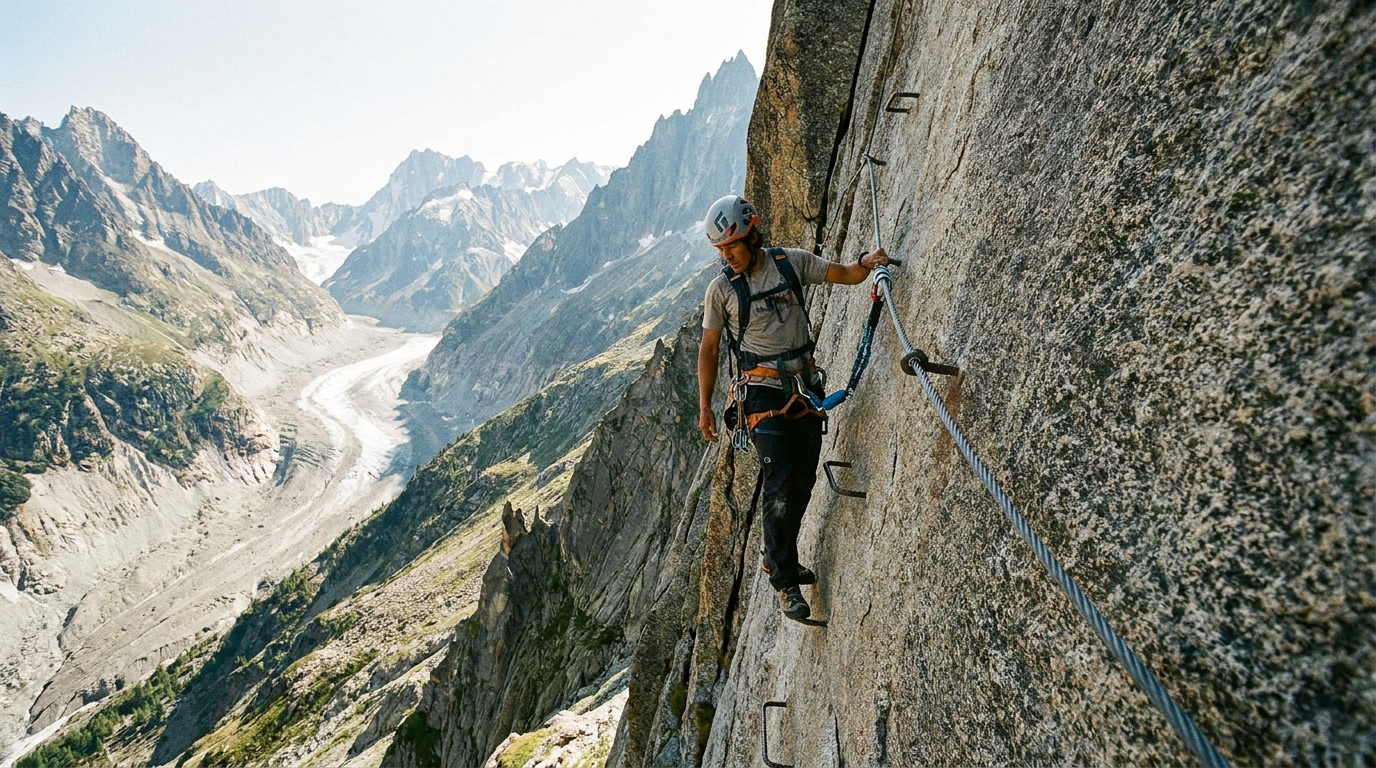
Originating in the Italian Dolomites, a via ferrata is a protected climbing route equipped with fixed steel cables, iron rungs, ladders, and suspension bridges. These permanent installations allow hikers to traverse sheer cliff faces and vertical drops while remaining securely clipped to the mountain at all times.[3]
Historically utilized by soldiers during World War I to move troops and supplies across the treacherous Alpine front, the infrastructure has evolved into a booming recreational sector. Today, it bridges the intimidating gap between standard trail hiking and technical rock climbing, allowing amateurs to safely navigate terrain that was once the exclusive domain of elite alpinists.[7]
The mechanism relies on a specialized via ferrata set. Climbers wear a standard climbing harness attached to a Y-shaped lanyard equipped with two specialized, auto-locking carabiners. As the climber moves upward or laterally along the rock, they slide the carabiners along the fixed steel cable.[6]

When reaching an anchor point where the cable is bolted directly into the rock face, the climber unclips and re-clips the carabiners one at a time. This continuous belay system ensures that the climber is always attached to the safety cable by at least one point of contact, eliminating the risk of becoming entirely unanchored during transitions.[7]
While the European Alps remain the spiritual home of the sport, 2026 has seen a massive geographic expansion. In the United States, the Ashley Gorge Via Ferrata recently opened in northeastern Utah. Billed as the longest public route of its kind in the country, it represents a major push to make vertical terrain accessible on American public lands.[1]
The Utah route, managed by Uintah County, features multiple lines tailored to different comfort levels. It ranges from introductory traverses for beginners to highly exposed technical segments for those seeking a severe physical challenge, signaling a growing appetite among American land managers to embrace European-style mountain infrastructure.[1]

The Utah route, managed by Uintah County, features multiple lines tailored to different comfort levels.
Meanwhile, non-traditional environments are adopting the format to showcase their unique geology. In the Canary Islands, a new route in Tenerife takes climbers across volcanic cliffs and through coastal canyons. In the Balkans, the city of Mostar has developed routes like the Hum and Fortica, integrating suspension bridges and "sky walks" directly above the historic urban center.[5][6]
Despite the approachable framing, the physics of a via ferrata fall are severe. Unlike traditional rock climbing where a dynamic rope stretches to absorb the energy of a fall, a via ferrata involves falling down a static steel cable until the carabiner violently hits the nearest anchor bolt.[7]
This creates a uniquely high "fall factor," generating massive shock loads that could easily snap standard climbing slings or cause severe spinal injuries. To mitigate this, modern via ferrata lanyards are equipped with an Energy Absorbing System (EAS)—a block of stitched webbing designed to tear open progressively, cushioning the impact and saving the climber's life.[7]
Understanding route difficulty is crucial for safety, though the grading systems remain somewhat fragmented globally. The two primary metrics are the Hüsler scale, which ranges from K1 (easy walking) to K6 (extremely difficult, overhanging), and the Schall scale, which uses letters from A to F.[2]

A route rated K1 or A is essentially a steep hike with a handrail, suitable for active families and beginners. Conversely, a K5 or E route requires significant upper body strength, featuring overhanging sections with minimal artificial footholds where climbers must pull their entire body weight up the cable.[2]
The boom in via ferrata tourism is fundamentally reshaping mountain economies. Because lower-elevation routes dry out much faster than high-alpine trails, they allow mountain towns to drastically extend their tourism seasons. In regions like Tyrol and Lake Garda, routes are opening as early as April and May, drawing visitors long before the high-altitude snowpack melts.[2]
However, the rapid proliferation of fixed iron on pristine rock faces has sparked an ongoing ethical debate. Traditional alpinists argue that mountains should be climbed on their own terms, expressing concern over permanently altering the rock with heavy drilling, epoxy, and steel installations.[7]

Conversely, adventure tourism advocates argue that via ferratas democratize the outdoors, allowing a broader demographic to experience the profound psychological rewards of vertical exposure. By concentrating heavy foot traffic on heavily reinforced routes, they also argue it minimizes the broader ecological footprint on fragile alpine environments.[4]
As 2026 progresses, the via ferrata stands as the ultimate symbol of the modern adventure travel ethos: highly engineered, deeply thrilling, and profoundly accessible. It is an iron bridge into the sky, inviting anyone with a harness and a steady nerve to step off the horizontal plane.[7]
How we got here
1914–1918
Italian and Austro-Hungarian troops install the first iron cables and ladders in the Dolomites to move soldiers across high-altitude fronts.
1930s–1950s
The Italian Alpine Club begins restoring wartime routes for recreational hikers, birthing the modern via ferrata network.
2000s
The concept spreads beyond the Alps, with purpose-built recreational routes appearing in North America, Asia, and South America.
2026
Via ferrata becomes a cornerstone of the global 'soft adventure' travel trend, with massive new installations opening in non-traditional environments.
Viewpoints in depth
Tourism & Accessibility Advocates
Argue that via ferratas democratize mountaineering and provide vital economic boosts to rural mountain towns.
Proponents of the via ferrata boom view the infrastructure as a triumph of accessibility. By installing fixed cables and rungs, land managers can open up world-class vertical terrain to everyday hikers, families, and older adventurers who lack the time or physical ability to master technical rock climbing. Furthermore, tourism boards emphasize the economic benefits: because via ferratas can be built at lower elevations that dry out quickly, they allow mountain communities to attract visitors in the 'shoulder seasons' of spring and autumn, stabilizing local economies that traditionally rely on short summer and winter peaks.
Alpine Route Managers
Focus on the logistics of route maintenance, seasonal openings, and standardizing difficulty ratings for public safety.
For the organizations tasked with maintaining these routes, the primary concern is managing the sheer volume of new climbers. Route managers advocate for stricter adherence to standardized grading systems—like the Hüsler or Schall scales—to prevent inexperienced hikers from becoming paralyzed by fear on overhanging K5 sections. They also face the logistical challenge of inspecting miles of steel cable and thousands of epoxy-drilled anchors for winter ice damage, ensuring the infrastructure remains structurally sound before the spring rush begins.
Technical Safety Analysts
Emphasize the severe physics of static falls and the necessity of proper gear usage and historical context.
Safety experts and climbing instructors often express concern over the 'theme park' illusion of via ferratas. Because the climbing feels so secure, many beginners fail to realize that a fall on a static steel cable generates a massive shock load—far more violent than a fall on a dynamic climbing rope. These analysts focus heavily on public education, stressing that the Energy Absorbing System (EAS) on a via ferrata lanyard is a last-resort life-saving device, not a tool designed to provide a soft catch for climbers who want to push their physical limits and take practice falls.
What we don't know
- How the influx of inexperienced climbers on newly opened global routes will impact local search and rescue resources.
- Whether the environmental impact of drilling permanent steel fixtures into pristine rock faces will lead to stricter regulations on future route developments.
Key terms
- Via Ferrata
- Italian for 'iron path,' a mountain route equipped with fixed ladders, cables, and bridges to make climbing accessible.
- Energy Absorbing System (EAS)
- A specialized component of a via ferrata lanyard that tears open under heavy load to cushion the severe impact of a fall.
- Fall Factor
- A mathematical ratio used in climbing to determine the severity of a fall; via ferrata falls have uniquely high fall factors due to static cables.
- Stemple
- An artificial iron rung or step drilled directly into the rock face to provide a foothold where natural features are absent.
- Continuous Belay
- A safety system where the climber is always attached to the safety cable by at least one carabiner during transitions.
Frequently asked
Do I need prior rock climbing experience?
No. Most beginner and intermediate routes are designed for hikers with good fitness and a head for heights, requiring no technical rock climbing skills.
What equipment is mandatory for a via ferrata?
You must have a climbing helmet, a standard climbing harness, and a specialized via ferrata lanyard equipped with an energy absorber.
Is it safe to fall on a via ferrata?
Falling on a via ferrata is highly discouraged and much more violent than a standard rock climbing fall. The safety gear is designed to save your life, not to provide a soft catch.
When is the best time of year to climb?
While high-alpine routes typically open in June, lower-elevation routes in places like Utah, Lake Garda, and Tenerife are accessible as early as April or even year-round.
Sources
Source coverage
7 outlets
3 viewpoints surfaced







[1]TownLiftTourism & Accessibility Advocates
Ashley Gorge Via Ferrata opens for 2026 climbing season in Utah
Read on TownLift →[2]Inspired By SportsAlpine Route Managers
Seven Via Ferrata that will be open by May 2026
Read on Inspired By Sports →[3]The Hiking ClubAlpine Route Managers
Popular via ferrata routes along the Alta Via 1 Dolomites
Read on The Hiking Club →[4]Travel CounsellorsTourism & Accessibility Advocates
Adventure travel trends set to shape 2026
Read on Travel Counsellors →[5]Explore MostarTourism & Accessibility Advocates
Three guided via ferrata routes around Mostar
Read on Explore Mostar →[6]Tenerife AdventuresTourism & Accessibility Advocates
Via Ferrata in Tenerife: Adrenaline and Stunning Scenery
Read on Tenerife Adventures →[7]Factlen Editorial TeamTechnical Safety Analysts
Synthesis by Factlen editorial team
Read on Factlen Editorial Team →

Every angle. Every day.
Get travel stories with full source coverage and perspective breakdowns delivered to your inbox.