
The 2026 EV Road Trip: How NACS and the 80% Rule Eliminated Range Anxiety
With universal charging standards now a reality and software managing battery temperatures on the fly, the electric vehicle road trip has evolved into a highly optimized, stress-free experience.
By Factlen Editorial Team
- EV Drivers & Advocates
- Value the seamless integration of NACS and the time-saving benefits of optimized charging curves.
- Automakers & Engineers
- Focus on thermal management software, battery longevity, and standardizing hardware to boost EV adoption.
- Charging Network Operators
- Prioritize station turnover, hardware reliability, and educating drivers to reduce congestion.
What's not represented
- · Rural EV Drivers
- · Grid Infrastructure Planners
Why this matters
Understanding the physics of EV charging and the new NACS landscape transforms a potentially stressful road trip into a seamless experience. By mastering the 80 percent rule and battery preconditioning, drivers can cut hours off their travel time and eliminate range anxiety.
Key points
- The widespread adoption of the NACS plug has unified the North American charging network for most major automakers.
- EV batteries charge rapidly up to 80 percent, then slow down significantly to protect the lithium-ion cells from heat damage.
- Unplugging at 80 percent saves drivers significant time and improves station turnover for network operators.
- Battery preconditioning automatically warms or cools the battery to its optimal temperature before arriving at a charger.
- Using the vehicle's built-in navigation system is essential to trigger automated preconditioning and achieve maximum charging speeds.
For years, the electric vehicle road trip was viewed as an extreme sport reserved for early adopters willing to endure broken chargers and complex route planning. But as the summer travel season of 2026 gets underway, the landscape has fundamentally shifted. The anxiety that once defined long-distance EV travel has been largely engineered out of the experience, replaced by a highly optimized ecosystem of universal plugs and intelligent thermal management.[8]
The most visible catalyst for this transformation is the widespread adoption of the North American Charging Standard (NACS). Originally designed as a proprietary connector for Tesla's Supercharger network, the sleek plug was open-sourced and formalized as the SAE J3400 standard. Over the past two years, nearly every major automaker selling vehicles in North America has committed to abandoning the bulkier Combined Charging System (CCS) in favor of NACS.[1][3]
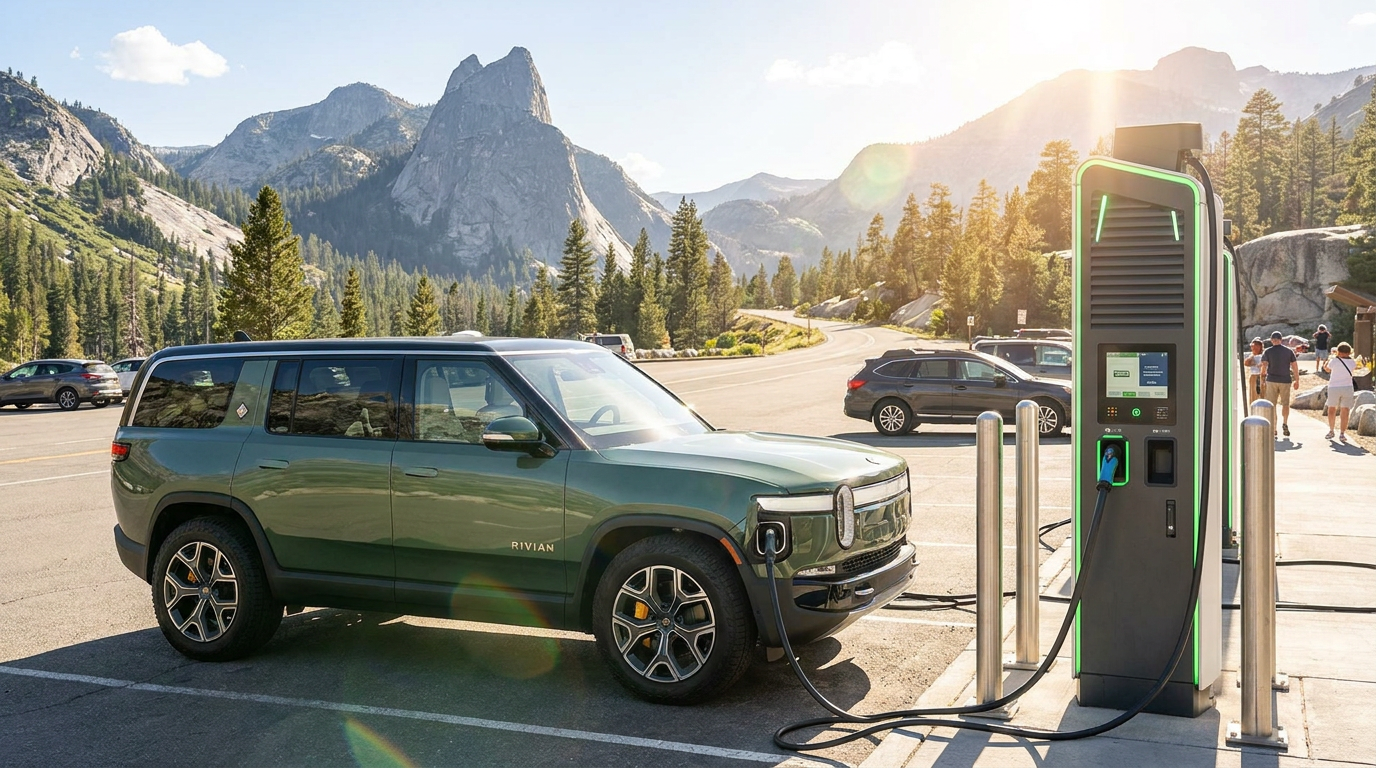
For drivers hitting the highway in 2026, this standardization means unprecedented access to reliable infrastructure. Many newer models are now rolling off assembly lines with native NACS ports built directly into the chassis, allowing them to plug straight into Tesla Superchargers and other compatible public networks. Meanwhile, owners of slightly older EVs are utilizing automaker-provided adapters to bridge the gap, effectively unifying the continent's charging map.[1][3]
The infrastructure side is racing to catch up with this vehicle-level shift. According to first-quarter data from industry analytics firm Paren, NACS deployments by non-Tesla networks reached 606 new ports in early 2026, capturing roughly 21 percent of all new installations. While CCS still dominates the legacy installed base, the rapid deployment of high-capacity NACS stations is steadily eroding the boundaries between different vehicle brands.[2]

Yet, while universal hardware solves the problem of where to plug in, mastering the modern EV road trip requires understanding the software and physics that dictate how a battery actually absorbs energy. The most crucial concept for any driver to grasp is the "80 percent rule"—a guideline that dictates unplugging and hitting the road long before the dashboard reads full.[4][8]
Unlike a traditional gas tank that fills at a constant rate until the pump clicks off, an electric vehicle's charging profile is decidedly non-linear. Lithium-ion batteries accept direct current rapidly when they are nearly empty, but the vehicle's battery management system intentionally throttles the charging speed as the state of charge increases. This tapering is a necessary protective measure to prevent the battery cells from overheating and degrading over time.[4][5]
Industry experts often compare this phenomenon to finding a seat in a movie theater. When the theater is entirely empty, a large group of people can rush in and find seats almost instantly. However, as the theater reaches 80 percent capacity, the remaining attendees must slow down, navigate crowded aisles, and carefully squeeze into the few remaining empty chairs. Electrons entering a battery pack face a remarkably similar bottleneck.[4][8]
Industry experts often compare this phenomenon to finding a seat in a movie theater.
In practical terms, this means the time it takes to charge from 80 to 100 percent can often equal or exceed the time it took to charge from 10 to 80 percent. For a modern EV equipped with an 800-volt architecture, replenishing the bulk of the battery might take an incredibly quick 18 minutes, while topping off those final few percentage points could demand an additional half hour.[4][5]

For road-trippers, waiting for a 100 percent charge at a fast-charging station is generally a strategic error. By unplugging at 80 percent, drivers maximize their travel efficiency, spending less time tethered to a cable and more time covering miles. Furthermore, network operators actively encourage this practice, as faster turnover at the plug reduces congestion and ensures that limited high-speed chargers remain available for the next arriving driver.[4][8]
But achieving those blistering 18-minute charge times requires more than just pulling up to a high-powered station with a low battery; it requires the battery to be at the perfect temperature. This is where the hidden magic of "battery preconditioning" comes into play.[6][7]
An EV battery does not store electricity in a traditional sense; it relies on chemical reactions to generate and absorb power. These reactions are highly sensitive to temperature, operating most efficiently when the battery core sits between 15 and 35 degrees Celsius. If a battery is too cold, its internal resistance spikes, forcing the vehicle to drastically limit the incoming charging speed to prevent permanent damage to the cells.[6][7]
To solve this, modern EVs feature sophisticated thermal management systems that can actively warm or cool the battery pack while the car is in motion. When a driver uses the vehicle's built-in navigation system to route to a specific DC fast charger, the car's computer calculates the estimated time of arrival and automatically triggers the preconditioning process.[6][7]

Roughly 30 to 45 minutes before reaching the plug, the vehicle begins drawing a small amount of energy to heat or cool the battery coolant loop. By the time the driver shifts into park and connects the heavy NACS cable, the battery is already at its optimal thermal state, allowing it to accept the maximum possible wattage from the very first second of the session.[6][8]
This automated preparation is especially critical during winter road trips or in extreme summer heat, where an unprepared battery might sit at a charger for 20 minutes just trying to regulate its temperature before any meaningful charging can begin. While preconditioning does consume a minor amount of driving range, the massive reduction in charging time makes it a highly favorable trade-off.[6][7]
It is important to distinguish this automated battery management from cabin preconditioning, which is a comfort feature used to warm or cool the interior before leaving the house. Cabin preconditioning is best utilized while the car is still plugged in at home on a Level 2 charger, drawing power from the grid rather than the battery to ensure the vehicle departs with a full 100 percent charge and a comfortable climate.[7]

Ultimately, the combination of NACS accessibility, the 80 percent rule, and automated thermal management has given rise to a new paradigm of travel known as "hopscotch charging." Rather than driving until the battery is nearly dead and enduring a grueling hour-long stop to fill it completely, savvy EV drivers now make more frequent, highly efficient 15-minute stops.[4][8]
This rhythm aligns perfectly with natural human travel patterns—allowing just enough time to use the restroom, grab a coffee, and stretch before the car is ready to hit the highway again. As the infrastructure continues to mature through 2026, the electric road trip has evolved from a test of patience into a masterclass in efficiency.[1][8]
How we got here
Late 2022
Tesla open-sources its proprietary charging connector, renaming it the North American Charging Standard (NACS).
May 2023
Ford becomes the first major automaker to announce a transition to NACS, triggering an industry-wide domino effect.
Dec 2023
SAE International formally standardizes the NACS connector as SAE J3400.
Early 2025
Automakers begin distributing NACS-to-CCS adapters to existing EV owners, unlocking the Supercharger network.
2026
New EV models begin rolling off assembly lines with native NACS ports built directly into the vehicles.
Viewpoints in depth
EV Drivers & Advocates
Focus on the seamless integration of NACS and the time-saving benefits of optimized charging curves.
For early adopters and daily EV drivers, the 2026 landscape represents the realization of a long-promised ideal. The anxiety of arriving at a broken or incompatible charger has been largely mitigated by the NACS rollout. This group heavily advocates for the '80 percent rule' and route-planning software, viewing the modern road trip not as a compromise, but as a superior, more relaxing way to travel that perfectly aligns charging stops with natural human rest breaks.
Automakers & Engineers
Prioritize thermal management software, battery longevity, and standardizing hardware to boost mainstream EV adoption.
From an engineering perspective, the focus has shifted from merely increasing battery size to optimizing how the vehicle manages energy. Automakers emphasize automated battery preconditioning as a critical safety and performance feature, ensuring that lithium-ion cells are protected from thermal degradation during high-speed charging. By standardizing around the SAE J3400 (NACS) plug, engineers can dedicate more resources to software integration rather than managing fragmented hardware standards.
Charging Network Operators
Focus on station turnover, hardware reliability, and educating drivers to reduce infrastructure congestion.
For companies deploying and maintaining fast-charging infrastructure, driver behavior is just as important as hardware reliability. Network operators actively encourage the 80 percent rule because it drastically improves station turnover. When drivers occupy a high-power stall for an extra 30 minutes just to squeeze in the final 20 percent of charge, it creates bottlenecks and wait times for others. Operators are increasingly using pricing structures and software prompts to incentivize efficient charging habits.
What we don't know
- How quickly legacy CCS chargers will be retrofitted with NACS cables across all non-Tesla networks.
- Whether the influx of non-Tesla vehicles will eventually cause congestion at historically reliable Supercharger locations during peak holiday travel.
Key terms
- NACS
- The universal charging connector originally developed by Tesla, now adopted by nearly all major automakers in North America.
- DC Fast Charging
- High-power public charging that delivers direct current straight to the battery, enabling rapid top-ups during road trips.
- Charging Curve
- The varying rate at which an EV battery accepts power, which starts fast and slows down significantly as the battery fills.
- Battery Preconditioning
- The process of automatically warming or cooling an EV's battery to its optimal temperature before arriving at a fast charger.
- State of Charge (SOC)
- The current energy level of an EV battery, expressed as a percentage from 0 to 100 percent.
Frequently asked
Do I need an adapter to use a Tesla Supercharger in 2026?
It depends on your vehicle. Many 2025 and 2026 models feature native NACS ports, while older EVs require an automaker-provided NACS-to-CCS adapter.
Why does my EV charge so slowly after 80 percent?
The vehicle's battery management system intentionally slows the charging rate to prevent heat damage and preserve the long-term health of the lithium-ion cells.
Does battery preconditioning drain my driving range?
It uses a small amount of energy to heat or cool the battery, but the time saved at the charger and the improved charging efficiency far outweigh the minor energy cost.
Should I ever charge to 100 percent on a road trip?
It is generally only recommended to charge to 100 percent overnight at a Level 2 destination charger, or if you absolutely need the maximum range to reach an isolated destination.
Sources
Source coverage
8 outlets
3 viewpoints surfaced






[1]GreenCarsEV Drivers & Advocates
NACS Charging in 2026: A Practical Guide for EV Drivers
Read on GreenCars →[2]ParenCharging Network Operators
US EV Fast Charging — Q1 2026
Read on Paren →[3]Enphase EnergyAutomakers & Engineers
The emerging future of EV charging: Widespread adoption of NACS technology in the United States
Read on Enphase Energy →[4]WiTricityAutomakers & Engineers
The 80% rule: Why you shouldn't charge your EV to 100%
Read on WiTricity →[5]eStationCharging Network Operators
Understanding the Charging Curve and the 80% Rule for Your EV
Read on eStation →[6]KiaAutomakers & Engineers
What is EV Battery Pre-Conditioning?
Read on Kia →[7]Electrifying.comEV Drivers & Advocates
What is electric car preconditioning?
Read on Electrifying.com →[8]Factlen Editorial Team
Synthesis by Factlen editorial team
Read on Factlen Editorial Team →
Every angle. Every day.
Get automotive stories with full source coverage and perspective breakdowns delivered to your inbox.