
Inside the Tech: How Level 3 Autonomous Driving Works—and What Comes Next
The leap from driver assistance to true "eyes-off" autonomy requires a complex symphony of LiDAR, radar, and cameras. Here is how sensor fusion works, the legal hurdles it faces, and why the industry is shifting toward more accessible Level 2+ systems.
By Factlen Editorial Team
- Automotive Strategy
- Focuses on balancing cutting-edge innovation with consumer utility, cost control, and legal liability.
- Regulatory & Safety Frameworks
- Prioritizes public safety, demanding strict operational limits and clear liability rules before allowing hands-free driving.
- Sensor & Hardware Engineering
- Advocates for the necessity of advanced LiDAR and redundant sensor fusion to achieve true, safe autonomy.
- Industry Analysis
- Tracks market viability, adoption rates, and the broader shift toward Level 2+ systems.
What's not represented
- · Insurance Providers
- · Urban Planners
Why this matters
Understanding the difference between Level 2 and Level 3 autonomy dictates not just what your car can do, but who is legally responsible if something goes wrong. As automakers roll out advanced hands-free systems, knowing how the underlying sensors work helps consumers make informed, safe decisions about the technology they trust with their lives.
Key points
- Level 3 autonomy allows drivers to take their eyes off the road, but shifts legal liability to the automaker.
- True autonomy requires 'sensor fusion,' combining the strengths of cameras, radar, and LiDAR.
- LiDAR is crucial for Level 3, providing exact 3D depth perception in the dark and poor weather.
- Due to high costs and strict legal limitations, major automakers are pausing their Level 3 rollouts in 2026.
- The industry is pivoting to Level 2+ systems, which offer broader hands-free driving but keep the driver legally responsible.
The public has been promised a future free of steering wheels for over a decade. But the reality of autonomous driving is not a single switch that gets flipped; it is a complex, incremental journey defined by the Society of Automotive Engineers (SAE) across a strict six-level spectrum.[1]
The automotive industry is currently navigating a critical inflection point: the leap from Level 2 to Level 3. While Level 2 systems—like Tesla's Autopilot or Ford's BlueCruise—can steer and brake, the driver must constantly monitor the road. Level 3, known as "conditional driving automation," crosses a massive psychological and legal threshold: it allows the driver to take their eyes off the road entirely.[1]
In recent years, luxury automakers pioneered this frontier. Mercedes-Benz became the first to achieve international certification for its Drive Pilot system, followed closely by BMW's Personal Pilot L3. Under specific conditions, these systems allow drivers to read a book, answer emails, or watch a movie while the car navigates highway traffic.[1][2]

Achieving this "eyes-off" capability requires a technological leap far beyond standard driver assistance. A Level 3 vehicle cannot rely on a single type of sensor; it requires a highly sophisticated architecture known as "sensor fusion."[5]
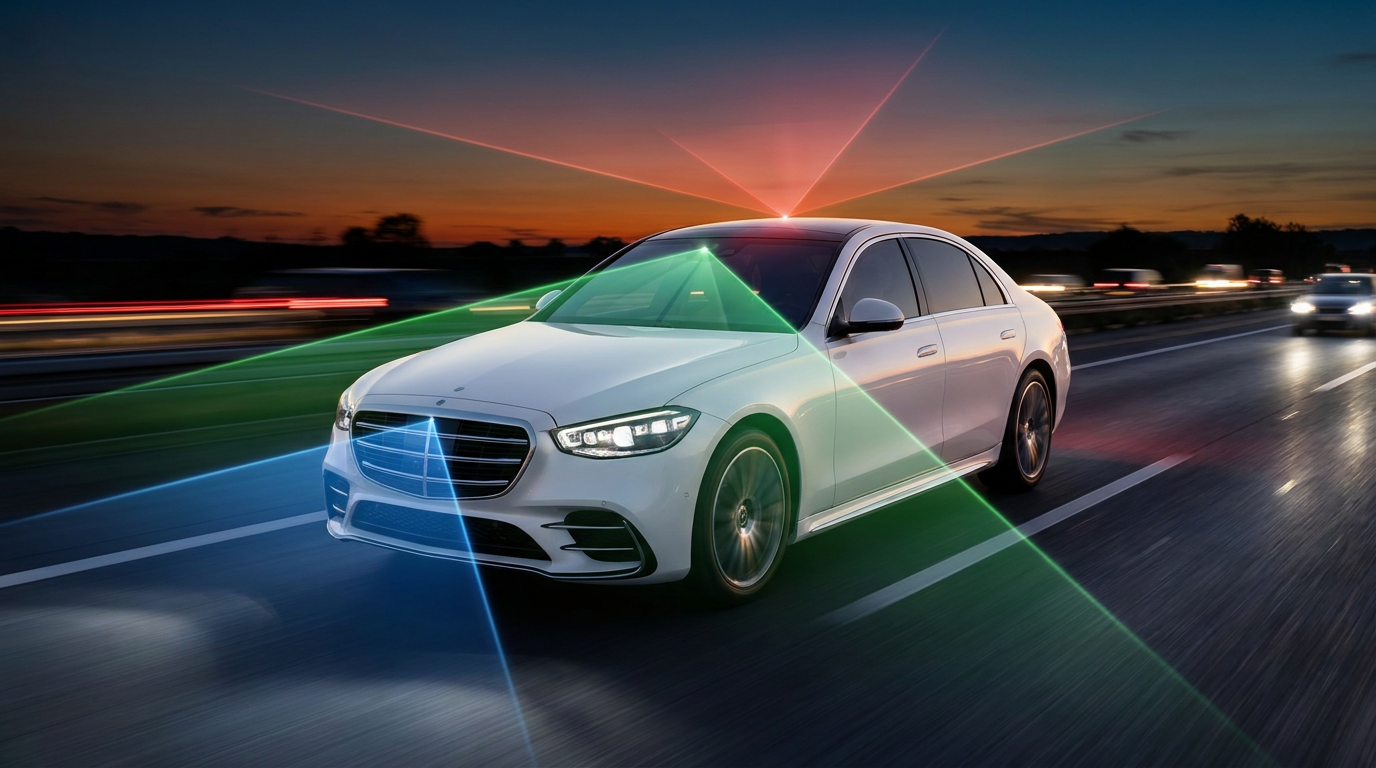
Sensor fusion is the automotive equivalent of a highly redundant nervous system. It combines data from three distinct types of hardware: optical cameras, millimeter-wave radar, and LiDAR. Each sensor has distinct strengths and critical blind spots, making their combination essential for safety.[5]
Cameras act as the eyes of the vehicle. They provide high-resolution, full-color imagery necessary for reading speed limit signs, identifying lane markings, and classifying objects like pedestrians or traffic lights. However, just like human eyes, cameras struggle in direct blinding sunlight, heavy rain, or complete darkness.[5]
To compensate for visual limitations, vehicles use millimeter-wave radar. Radar emits radio waves that bounce off surrounding objects, making it exceptional at determining the exact velocity and distance of other cars. Crucially, radar easily penetrates fog, rain, and snow, providing a reliable safety net when cameras are blinded.[5]
But the true linchpin of Level 3 autonomy is LiDAR (Light Detection and Ranging). LiDAR sensors emit millions of invisible laser pulses per second, measuring the exact time it takes for the light to bounce back. This creates a highly accurate, real-time 3D point cloud of the vehicle's surroundings.[5][6]
Unlike cameras, LiDAR does not rely on ambient light, meaning it performs flawlessly in pitch-black conditions. It provides the exact depth perception and high-resolution spatial awareness that radar lacks, allowing the vehicle's computers to distinguish between a plastic bag floating in the wind and a concrete block on the highway from hundreds of meters away.[6]

Unlike cameras, LiDAR does not rely on ambient light, meaning it performs flawlessly in pitch-black conditions.
Gathering this data is only half the battle. The vehicle must process it instantly. This is handled by a centralized domain controller—a powerful onboard AI supercomputer. The controller compares the inputs from the cameras, radar, and LiDAR, reconciling any discrepancies to make split-second driving decisions.[5]
Because the driver is not paying attention in a Level 3 system, the vehicle must also feature absolute hardware redundancy. If the primary steering motor fails, a backup must instantly take over. The same applies to the braking system and the power supply. This redundancy is what makes Level 3 engineering so incredibly complex and expensive.[3][5]
However, the biggest hurdle for Level 3 isn't technological; it's legal. When a Level 3 system is engaged, the liability for the vehicle's actions shifts entirely from the human driver to the automaker. If the car crashes while driving itself, the manufacturer is legally responsible.[2][4]
Because of this immense liability, automakers and regulators have restricted Level 3 systems to very narrow Operational Design Domains (ODDs). Currently, systems like Mercedes' Drive Pilot are only permitted to operate on pre-mapped highways, in clear weather, and typically at speeds under 95 km/h.[4][7]
Geographically, the rollout has been equally fragmented. While Germany has established a clear legal framework for Level 3 under UNECE Regulation R157, the United States remains a patchwork. Currently, only California and Nevada have explicitly approved these systems for consumer use.[1][2]

This combination of high costs—often adding €6,000 to €7,000 to the vehicle's price—and narrow usability has led to a surprising industry pivot in 2026. Consumers are finding that they rarely encounter the exact conditions required to activate their expensive Level 3 features.[4][7]
Consequently, major automakers are quietly pausing their aggressive Level 3 rollouts. In early 2026, both BMW and Mercedes-Benz opted to remove their flagship Level 3 systems from the latest facelifts of the 7 Series and S-Class, citing weak demand and regulatory friction.[4][7]
Instead, the industry is doubling down on "Level 2+" (or L2++). Governed by new regulations like the UN's Driver Control Assistance Systems (DCAS), Level 2+ allows for extensive hands-free driving on highways and automatic lane changes, but crucially requires the driver to keep their eyes on the road.[3][4]
By keeping the driver in the loop, the liability remains with the human. This frees automakers from the strict ODD limitations of Level 3, allowing them to offer hands-free driving across a much wider variety of roads and speeds, providing greater everyday utility to the consumer at a lower cost.[3][4]

This pivot does not mean the dream of true autonomy is dead. The sensor fusion technology developed for Level 3 is trickling down, making Level 2+ systems incredibly robust and safe. Companies continue to refine LiDAR and domain controllers, preparing for a future where the legal and technological frameworks finally align.[3][8]
For now, the automotive industry has learned a valuable lesson: the most advanced technology is only successful if it offers practical, everyday value. As sensor fusion becomes standard, the foundation for a fully autonomous future is being laid, one redundant system at a time.[8]
How we got here
2021
Honda introduces the Legend in Japan, the world's first certified Level 3 vehicle in limited production.
2022
Mercedes-Benz receives the first international certification for its Drive Pilot Level 3 system in Germany.
2023
Nevada and California become the first U.S. states to approve Mercedes' Drive Pilot for public roads.
2024
BMW introduces its Personal Pilot L3 system in the 7 Series for the German market.
Early 2026
BMW and Mercedes-Benz announce they are pausing Level 3 features in upcoming facelifts to focus on Level 2+ systems.
Viewpoints in depth
Automotive Strategy
Focuses on balancing cutting-edge innovation with consumer utility, cost control, and legal liability.
For automakers, the transition to Level 3 autonomy has proven to be a double-edged sword. While it represents a massive marketing victory and a showcase of engineering prowess, the practical reality is fraught with financial and legal risk. Because Level 3 shifts the liability of a crash from the driver to the manufacturer, automakers are forced to implement incredibly expensive redundant hardware—such as backup steering motors and power supplies—and restrict the system's use to very narrow conditions. As consumer demand wanes due to these strict limitations, strategic planners are realizing that Level 2+ systems offer a much better return on investment, providing the hands-free experience buyers want without the crushing liability.
Regulatory & Safety Frameworks
Prioritizes public safety, demanding strict operational limits and clear liability rules before allowing hands-free driving.
Regulators view autonomous driving through the lens of public safety and legal accountability. Organizations like the UNECE have established strict frameworks, such as Regulation R157, which initially capped Level 3 speeds at 60 km/h before slowly expanding them to 95 km/h. Regulators insist that if a human is allowed to disengage from the driving task, the vehicle must be mathematically proven to handle emergency situations flawlessly. This cautious approach has led to the fragmented global rollout of Level 3, as different jurisdictions grapple with how to handle the "liability shift" and ensure that automated systems do not introduce new hazards to public roads.
Sensor & Hardware Engineering
Advocates for the necessity of advanced LiDAR and redundant sensor fusion to achieve true, safe autonomy.
From an engineering perspective, achieving true autonomy is an exercise in eliminating blind spots. Hardware suppliers and sensor engineers argue that relying solely on cameras—which can be blinded by sun glare or heavy rain—is fundamentally unsafe for "eyes-off" driving. They champion the necessity of sensor fusion, particularly the inclusion of LiDAR, which provides an infallible 3D map of the environment regardless of lighting conditions. For these engineers, the current industry pivot to Level 2+ is merely a temporary economic pause; they believe that as the cost of LiDAR and domain controllers continues to fall, the robust sensor architectures they are building today will inevitably become the standard for the fully autonomous vehicles of tomorrow.
What we don't know
- When a unified federal regulatory framework for Level 3 autonomy will be established in the United States.
- How quickly the cost of LiDAR and redundant hardware will fall to make Level 3 systems mass-market viable.
- Whether insurance premiums will ultimately rise or fall for consumers utilizing Level 3 systems.
Key terms
- SAE Level 3
- Conditional driving automation where the vehicle handles all driving tasks under specific conditions, allowing the driver to look away from the road.
- Sensor Fusion
- The process of combining data from multiple different sensors (like cameras, radar, and LiDAR) to create a single, highly accurate model of the vehicle's surroundings.
- LiDAR
- Light Detection and Ranging; a sensor that uses rapid laser pulses to map the exact distance and shape of surrounding objects in 3D.
- Operational Design Domain (ODD)
- The specific operating conditions—such as speed limits, weather, and road types—under which an autonomous system is designed to function safely.
- Level 2+ (L2++)
- An unofficial but widely used industry term for advanced driver assistance systems that allow hands-free driving but still require the driver to keep their eyes on the road.
- Liability Shift
- The legal transition of responsibility for a vehicle's actions from the human driver to the automaker when a Level 3 autonomous system is engaged.
Frequently asked
Can I sleep in a Level 3 autonomous car?
No. While Level 3 allows you to take your eyes off the road to read or watch a screen, you must remain awake and ready to take over control when the system requests it.
Where is Level 3 driving currently legal?
Regulations vary globally, but currently, Level 3 systems are permitted on specific highways in Germany, as well as in the U.S. states of California and Nevada.
Why are cameras alone not enough for Level 3?
Cameras provide excellent resolution and color, but they struggle in direct sunlight, heavy rain, and darkness. They also cannot measure exact distance and velocity as accurately as radar and LiDAR.
Why are automakers shifting focus to Level 2+?
Level 2+ systems keep the legal liability with the driver, which allows automakers to offer hands-free driving across a much wider variety of roads and speeds, providing better everyday utility for the consumer.
Sources
Source coverage
8 outlets
4 viewpoints surfaced








[1]Kelley Blue BookAutomotive Strategy
Level 3 Autonomy: What Car Buyers Should Know
Read on Kelley Blue Book →[2]JATO DynamicsRegulatory & Safety Frameworks
Level 3 autonomous driving system authorised in Europe
Read on JATO Dynamics →[3]Counterpoint ResearchIndustry Analysis
OEMs are pausing their Level 3 autonomous driving ambitions
Read on Counterpoint Research →[4]S&P GlobalRegulatory & Safety Frameworks
OEMs are pausing their Level 3 autonomous driving ambitions
Read on S&P Global →[5]Tech BriefsSensor & Hardware Engineering
Advanced LiDAR — On the Road to SAE Level 3 Partially Automated Driving
Read on Tech Briefs →[6]ValeoSensor & Hardware Engineering
How does automotive LiDAR technology work?
Read on Valeo →[7]SpeedMeAutomotive Strategy
BMW and Mercedes-Benz shift focus from Level 3 to Level 2 autonomy
Read on SpeedMe →[8]Factlen Editorial TeamIndustry Analysis
Synthesis by Factlen editorial team
Read on Factlen Editorial Team →
Every angle. Every day.
Get automotive stories with full source coverage and perspective breakdowns delivered to your inbox.