
Why AI Companies Are Cleaning New York City Apartments for Free
Startups are offering free professional home cleaning services in exchange for the right to record the chores on head-mounted cameras, harvesting crucial real-world data to train the next generation of household robots.
By Factlen Editorial Team
- AI Data Brokers
- Focus on the urgent need to harvest massive amounts of real-world human demonstration data to train embodied AI.
- Robotics Developers
- View this data as the critical missing link to deploy safe, autonomous humanoid robots in unstructured home environments.
- Privacy Advocates
- Warn that trading intimate home footage for free services normalizes surveillance and risks exposing sensitive data.
What's not represented
- · Traditional Cleaning Services
- · Labor Rights Advocates
Why this matters
As artificial intelligence moves from digital chatbots to physical robots, the race to gather real-world training data is entering our living rooms. Understanding how this data is collected and valued helps consumers navigate the emerging trade-offs between domestic privacy and the convenience of automated household help.
Key points
- The startup Shift is offering free professional home cleaning in New York City in exchange for recording the process on head-mounted cameras.
- The first-person video data is licensed to robotics labs to train embodied AI systems on how to navigate the unstructured, chaotic environments of real homes.
- Physical robots require synchronized streams of visual and physical data to learn, making human demonstration footage incredibly valuable.
- Shift plans to expand the free service model to other major cities and include more complex domestic tasks like cooking and plumbing.
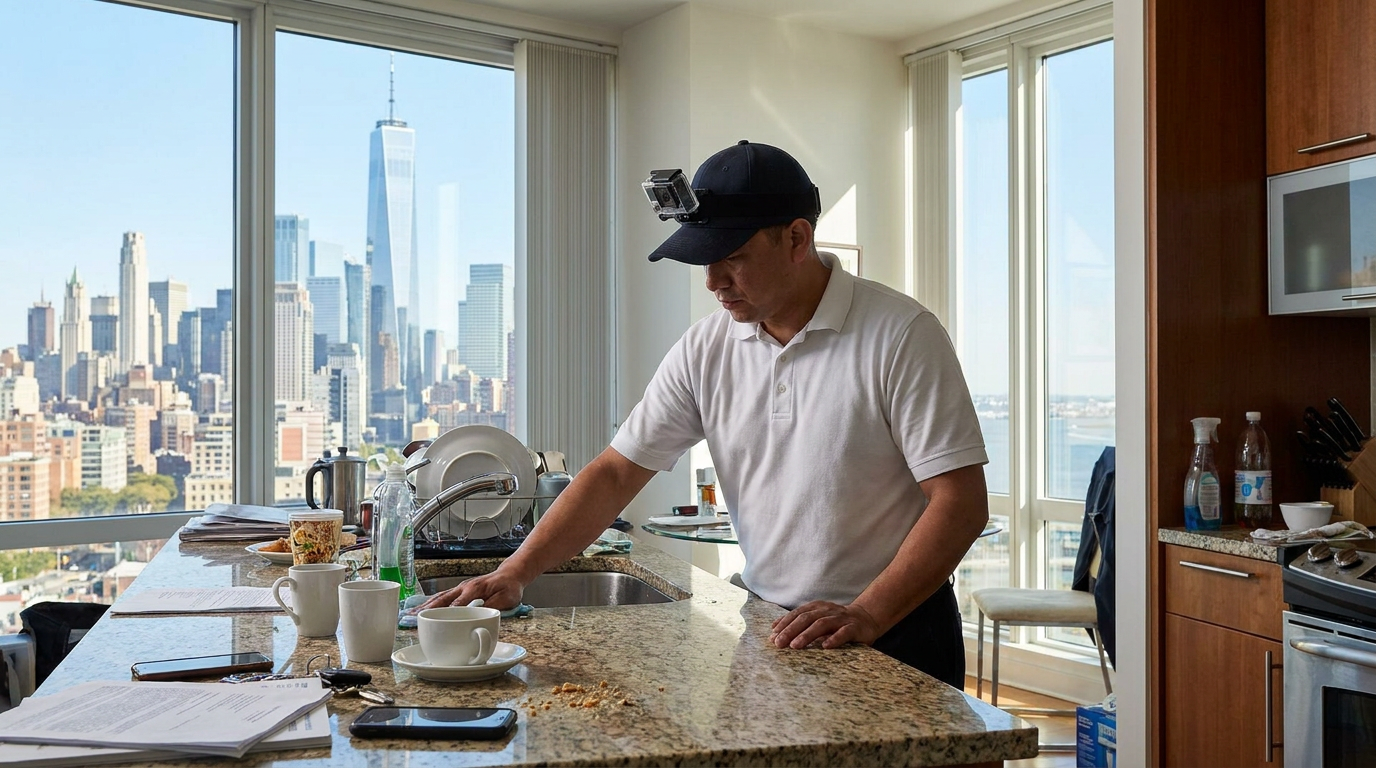
New Yorkers are currently jumping at an unusual and highly modern proposition: a spotless apartment, completely free of charge, courtesy of a professional cleaning crew. There is no hidden subscription fee, no bait-and-switch pricing, and no tipping required at the end of the session. The only catch is that the cleaner arrives wearing a specialized baseball cap equipped with a high-definition camera, recording their every move as they scrub floors, fold laundry, and wipe down countertops. For residents willing to open their doors, it is a chance to outsource their most tedious chores. For the company providing the service, it is a highly orchestrated data-gathering mission designed to map the chaotic reality of human living spaces.[1][2]
The service is provided by Shift, a newly launched startup that is turning domestic chores into a lucrative data-mining operation. Shift operates as an offshoot of the German data-collection firm MicroAGI, and its business model relies on a simple, transparent barter system. Residents trade the privacy of their messy living rooms for a free deep clean, while Shift harvests the resulting first-person video footage. When a resident books a slot, a vetted professional arrives with their own supplies and the mandatory "magic hat" camera rig. They spend up to two hours performing the exact tasks a traditional maid service would handle, all while the camera captures the precise hand movements and spatial reasoning required to execute the job.[3][4]
That first-person video footage is the real product, and it is far more valuable than the cost of the cleaning labor. Shift does not make its money from homeowners; instead, it processes and licenses the anonymized video datasets to the world’s leading artificial intelligence and robotics laboratories. In the accelerating race to build autonomous humanoid robots capable of operating safely in human spaces, high-quality video of mundane physical tasks has become one of the most sought-after commodities in the technology industry. The companies building the hardware have realized that the physical chassis is only half the battle; the true challenge is teaching the machine how to interact with a world built for humans.[2][4]
To understand why a video of someone loading a dishwasher or wiping a table is so incredibly valuable, one must look at the current bottleneck in artificial intelligence development. Large language models like ChatGPT achieved their remarkable fluency by ingesting trillions of text tokens scraped from the public internet over several years. But physical robots cannot learn how to fold a towel, grip a slippery plate, or navigate around a sleeping dog just by reading text. They require "embodied" data—synchronized, high-fidelity streams of visual observations paired with the corresponding physical actions required to complete a task.[5][6]
This strict requirement creates a massive hurdle known within the industry as the embodiment gap. While industrial robots have thrived for decades in highly structured environments like automotive assembly lines and Amazon fulfillment centers, the average home is an absolute nightmare of chaos for a machine. Homes feature varied and unpredictable lighting, constantly shifting clutter, different brands and shapes of appliances, and delicate objects that require precise force feedback to handle safely. A robot trained to pick up a standardized cardboard box in a warehouse will fail completely when asked to pick up a dropped sock from a plush carpet.[2][5]

Robotics developers frequently refer to the home as the "last mile" of autonomous deployment, representing the ultimate test of a machine's adaptability. To bridge this embodiment gap, AI models need to see exactly how humans navigate these unstructured environments. They need to observe how a human hand adjusts its grip when a wet glass slips, how a person maneuvers a vacuum around a fragile floor lamp, and how humans recover from minor mistakes in real time. Without thousands of hours of this contact-rich manipulation data, a household robot remains a rigid, easily confused piece of hardware.[2][6]
Traditionally, robotics companies attempted to collect this crucial data through a process known as "teleoperation." In a controlled laboratory setting, a human operator uses a virtual reality headset or a set of complex leader-follower mechanical arms to manually puppet a robot through a specific task. As the human moves, the robot mimics the motion, recording the joint angles, force feedback, and camera feeds. This creates a perfect, one-to-one training episode that directly maps human intent to the robot's specific physical dimensions. While highly accurate, this method requires the physical robot to be present for every single demonstration, severely limiting where and how the data can be gathered.[5][6]
The primary flaw with teleoperation is that it is agonizingly slow, expensive, and difficult to scale. Skilled operators might only produce 5 to 50 successful episodes of a complex task per hour, and operator fatigue quickly degrades the quality of the data. Furthermore, bringing a $20,000 teleoperation rig and a prototype humanoid robot into thousands of diverse, real-world homes to capture authentic clutter is logistically impossible. The industry desperately needed a way to capture human physical intuition at scale without requiring the robot to be in the room. This is exactly where Shift’s "egocentric" video approach changes the mathematical equation.[5]
The primary flaw with teleoperation is that it is agonizingly slow, expensive, and difficult to scale.
By outfitting human cleaners with head-mounted cameras, Shift entirely bypasses the need for a physical robot during the data collection phase. The cleaner simply performs the household task naturally, relying on their own human intuition to navigate the mess. The resulting first-person video is then processed using advanced computer vision algorithms that extract the human's hand trajectories, object interactions, and spatial reasoning. This raw video is translated into a structured format that a neural network can digest, allowing the AI to learn the fundamental physics and geometry of the chore before ever attempting it with a mechanical arm.[4][6]
The economics of this egocentric data model are highly favorable for the data brokers orchestrating the exchange. A standard, comprehensive apartment cleaning in New York City can easily cost a resident anywhere between $50 and $250, depending on the size of the unit and the scope of the work. Shift absorbs this entire cost, paying the cleaners a competitive hourly wage for their labor. In return, the company captures hours of premium, contact-rich manipulation data that robotics firms are desperate to buy, often licensing the same dataset to multiple developers to maximize their return on investment.[2]

MicroAGI, Shift’s parent company, is already operating this data-gathering model at a massive, global scale. The company claims to have built a network of tens of thousands of operators across more than 15 countries, effectively turning daily chores into a new form of gig work. In the first quarter of 2026 alone, the company collectively paid out more than $5 million to its global workforce of camera-clad operators. The New York City free cleaning service is simply their most visible, consumer-facing initiative to date, designed to rapidly accelerate data collection in dense, varied urban environments.[3]
Naturally, inviting a camera-clad stranger into a private residence raises immediate and profound privacy concerns. Shift explicitly addresses this tension in its service agreement, promising that all footage is strictly anonymized before it is processed, stored, or licensed to third parties. The company utilizes automated blurring software designed to obscure faces, names, ID cards, cell phone screens, and any other personally identifiable information that might inadvertently be caught on tape while the cleaner moves through the home. Despite these technological safeguards, privacy advocates warn that the layout of a home, the objects within it, and the general context of the footage still represent a significant surrender of personal privacy.[3][4]
Even with robust anonymization protocols in place, the inherent intimacy of the home means that some level of exposure is unavoidable. A reporter for Business Insider who tested the Shift service noted the surreal and slightly uncomfortable experience of having a cleaner and a private chef—both wired with visible cameras—navigating her small apartment. She admitted to deliberately hiding personal items and sensitive documents before the crew arrived, highlighting the mental friction and preparation required to participate in this modern data transaction. The presence of the cameras transforms a normally relaxing domestic service into an active surveillance event, requiring the homeowner to remain vigilant about what the lens might capture.[3]
Yet, early consumer demand suggests that a massive segment of the population is perfectly willing to make the trade. Since officially launching the service in late May 2026, Shift has been inundated with thousands of booking requests, filling its available cleaning slots almost instantly. For many busy professionals and budget-conscious residents, the allure of free, high-quality domestic labor appears to easily outweigh the abstract privacy concerns of feeding background video to a machine learning model. The sheer volume of sign-ups proves that data brokers have found a highly effective currency to exchange for access to private spaces.[2][3]
The ultimate beneficiaries of this massive data harvesting operation are companies like 1X, Figure, and Agibot, which are actively building the physical hardware for the home. 1X, for example, is currently rolling out its NEO humanoid, a soft-bodied robot designed specifically to safely perform domestic chores alongside humans. These hardware developers envision a near future where a robot can be scheduled to tidy the house, do the laundry, and empty the dishwasher while the owner is at work, fundamentally altering the economics of household management. To make that vision a reality, the robots must be pre-trained on the exact kinds of messy, unpredictable scenarios that Shift's cleaners are currently documenting.[2][7]

To achieve that ambitious vision, these robots need what is known as a "foundation model" for physical tasks—a generalized, underlying understanding of physics, geometry, and human intent. Every hour of footage captured by a Shift cleaner in a messy New York apartment adds another crucial layer of real-world experience to that model. By watching a human hand scrub a stubborn stain, untangle a vacuum cord, or gently place a fragile glass in a dishwasher, the AI learns to handle the infinite edge cases of domestic life. This diverse dataset slowly builds the physical intuition required for a machine to operate autonomously without constant human supervision or the risk of causing property damage.[6][7]
Shift has no intention of stopping at basic vacuuming and dusting. Buoyed by the overwhelming response in New York, the company has already announced aggressive plans to expand the free service model to other major technology hubs, including San Francisco, London, Zurich, and Munich. Furthermore, they are actively exploring data collection for much more complex household tasks. Future iterations of the service are expected to include free cooking, plumbing, and general handyman repairs, all recorded from the first-person perspective to teach robots how to wield tools, diagnose leaks, and prepare meals. This expansion will provide robotics labs with the diverse skill sets needed to market their humanoids as comprehensive home assistants.[3][4]
As the robotics industry races toward a projected multi-trillion-dollar market, the hunger for authentic human demonstration data will only intensify. The companies that successfully map the chaos of the human home will hold the keys to the next massive technological leap, transforming how society handles domestic labor. For now, the path to the autonomous robotic butler is not being paved solely by engineers writing code in pristine laboratories; it is being paved by human gig workers, wearing baseball caps and scrubbing floors, willingly trading their physical labor and privacy to teach their eventual mechanical replacements.[2][5]
How we got here
2023–2024
Large language models prove that scaling data leads to massive capability leaps, prompting robotics firms to seek similar data scale.
Early 2026
MicroAGI expands its global network of gig workers capturing first-person video of daily tasks, paying out over $5 million in Q1.
May 28, 2026
Shift officially launches its free, camera-recorded home cleaning service in New York City.
June 2026
Shift experiences overwhelming demand, filling booking slots instantly and announcing plans to expand to cooking and plumbing.
Viewpoints in depth
AI Data Brokers
Focus on the urgent need to harvest massive amounts of real-world human demonstration data to train embodied AI.
Companies like Shift and MicroAGI argue that the current bottleneck in robotics is not compute power or hardware, but a severe lack of contact-rich manipulation data. They view egocentric video capture as the only scalable, cost-effective way to bridge the embodiment gap. By turning daily chores into a global gig economy, they believe they are accelerating the timeline for useful, autonomous robots to reach the consumer market.
Robotics Developers
View this data as the critical missing link to deploy safe, autonomous humanoid robots in unstructured home environments.
Hardware developers like 1X and Figure emphasize that while robots excel in structured warehouses, the average home is chaotic and unpredictable. They rely on massive datasets of human demonstration footage to build foundation models that understand physics, geometry, and human intent. For these engineers, every hour of recorded cleaning provides the essential edge cases needed to ensure their robots can operate safely without constant human supervision.
Privacy Advocates
Warn that trading intimate home footage for free services normalizes surveillance and risks exposing sensitive data.
Consumer watchdogs and privacy advocates express deep concern over the normalization of recording inside private residences. While companies promise robust anonymization protocols to blur faces and screens, critics argue that the layout of a home, the objects within it, and the general context of the footage still represent a significant surrender of personal privacy. They caution that trading this intimate access for the convenience of a free cleaning sets a dangerous precedent for data harvesting.
What we don't know
- How reliably anonymization software can scrub highly personal or contextual details from hours of continuous home video.
- Whether the economics of providing free professional labor in exchange for data will remain sustainable as the novelty wears off.
- Exactly when the humanoid robots trained on this data will be commercially available and affordable for the average consumer.
Key terms
- Embodied AI
- Artificial intelligence that interacts with the physical world through a robotic body, requiring spatial awareness and physical coordination.
- Egocentric Video
- First-person video footage captured from the perspective of the person performing a task, usually via a head-mounted camera.
- Teleoperation
- The process of a human remotely controlling a robot to perform a task, generating a perfect, one-to-one training episode for the machine.
- Foundation Model
- A large, generalized AI model trained on a vast quantity of data that can be adapted to perform a wide variety of specific tasks.
- Action-State Stream
- The synchronized recording of what a system sees (the state) and the physical movements it makes (the action) used to train robots.
Frequently asked
Why do AI companies need video of people cleaning?
Robots struggle with the chaotic, unstructured nature of homes. First-person video of humans cleaning provides the exact physical data and spatial reasoning AI needs to learn how to navigate clutter and friction.
Is the video of my home kept private?
Shift claims that all footage is strictly anonymized before processing, using automated software to blur faces, names, cell phone screens, and other personally identifiable information.
Do I have to pay anything for the cleaning?
No. The service is entirely free. The resident trades access to their home and the resulting video data in exchange for the professional cleaning labor.
Will this service expand to other cities?
Yes. Shift plans to expand the free cleaning model to San Francisco, London, Zurich, and Munich, and eventually include other tasks like cooking and plumbing.
Sources
Source coverage
7 outlets
3 viewpoints surfaced





[1]BBCPrivacy Advocates
Why an AI company cleaned my New York City apartment for free
Read on BBC →[2]ForbesAI Data Brokers
Physical AI Data Is So Valuable This Startup Cleans Your Home For Free (To Train Robots)
Read on Forbes →[3]Business InsiderPrivacy Advocates
I invited cleaners and a chef from the startup Shift into my New York apartment. They worked for free — but recorded the process to train AI robots.
Read on Business Insider →[4]Android AuthorityAI Data Brokers
If it's free, you're the product — but at least Shift tells you that
Read on Android Authority →[5]evsint.comRobotics Developers
Why Data Is the Embodied AI Bottleneck
Read on evsint.com →[6]ShaipRobotics Developers
How Robot Training Data and Manipulation Datasets Power Real-World Robotics in 2026
Read on Shaip →[7]1X TechnologiesRobotics Developers
NEO: Automate Your Chores
Read on 1X Technologies →

Every angle. Every day.
Get technology stories with full source coverage and perspective breakdowns delivered to your inbox.