
The 2026 Reality of Solid-State EV Batteries: From Lab Breakthroughs to Pilot Production
Solid-state batteries promise to double EV range and eliminate fire risks. In 2026, the technology is finally moving from laboratory testing to automotive pilot lines, though mass-market adoption remains years away.
By Factlen Editorial Team
- Automotive Pragmatists
- Emphasizes that while the technology is promising, manufacturing yields, cost control, and supply chains dictate a slower rollout.
- Solid-State Developers
- Argues that the fundamental chemistry is proven and the focus is now on securing OEM partnerships and scaling pilot lines.
- Industry Analysts
- Believes the market will bifurcate, with solid-state serving premium EVs while sodium-ion and advanced LFP dominate the mass market.
What's not represented
- · Raw material suppliers (mining companies)
- · Battery recycling facilities
Why this matters
Solid-state batteries are the key to making electric vehicles lighter, safer, and capable of charging as fast as a gas car refuels. Understanding the realistic timeline for this technology helps consumers decide whether to buy an EV today or wait for the next generation of battery architecture.
Key points
- Solid-state batteries replace flammable liquid electrolytes with solid materials, drastically improving EV safety.
- The technology enables pure lithium-metal anodes, potentially doubling the energy density of current batteries.
- QuantumScape recently signed a major joint research agreement with Honda to advance solid-state production.
- Chinese developers like GBT are rolling out 'A-sample' cells, targeting early mass production by late 2026.
- Manufacturing bottlenecks, such as solid-solid interface stability, will delay widespread adoption until 2027-2030.
- Early solid-state batteries will be reserved for premium EVs, while sodium-ion batteries will serve the budget market.
For over a decade, the electric vehicle industry has chased a singular holy grail: the solid-state battery. The promises have long sounded like science fiction—vehicles capable of traveling 600 miles on a single charge, replenishing their power in under ten minutes, and operating with near-zero risk of catastrophic battery fires.[8]
In 2026, the narrative surrounding this technology is fundamentally shifting. The industry is no longer debating whether solid-state chemistry works in a laboratory. Instead, the conversation has moved to the factory floor. Automakers and battery startups are navigating the complex transition from isolated "A-sample" prototypes to pilot manufacturing lines, marking the critical bridge between theoretical breakthroughs and commercial reality.[8]
To understand the magnitude of this shift, one must look at the architecture of modern energy storage. Traditional lithium-ion batteries rely on a liquid organic electrolyte to shuttle ions back and forth between the cathode and the anode. While effective, this liquid is inherently volatile and flammable. Under extreme stress—such as a severe crash, overcharging, or intense heat—the liquid can ignite, triggering a dangerous chain reaction known as thermal runaway.[5]
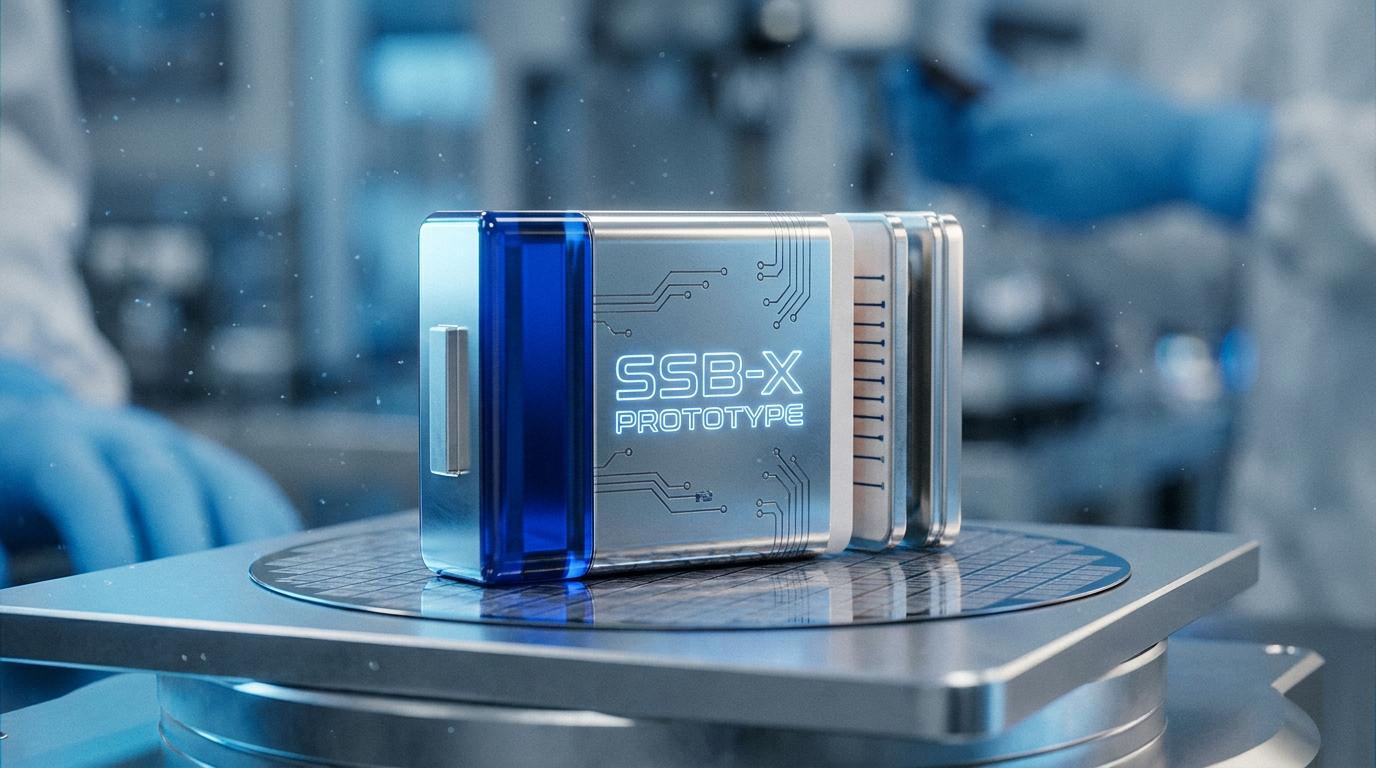
Solid-state batteries eliminate this vulnerability by replacing the liquid solvent with a solid material, typically a specialized ceramic, polymer, or sulfide glass. Because these solid electrolytes are non-flammable, the battery's thermal stability increases dramatically. Recent testing of solid-state prototypes has demonstrated that they can withstand extreme physical trauma, including needle penetration and severe crushing, without catching fire or exploding.[3][5]

Beyond safety, the solid electrolyte unlocks a massive leap in energy density. Traditional batteries use graphite anodes to safely absorb lithium ions. A solid electrolyte is physically robust enough to suppress the growth of "dendrites"—microscopic metallic whiskers that can pierce battery separators and cause short circuits. This suppression allows engineers to use pure lithium-metal anodes, pushing energy densities from today's ceiling of roughly 260 Wh/kg up to 400 or even 500 Wh/kg.[5]
The commercial momentum for this architecture accelerated sharply in June 2026. QuantumScape, a prominent solid-state battery developer previously anchored by its deep ties to Volkswagen, announced a major joint research agreement with Honda Motor. The multi-year pact focuses on advancing QuantumScape’s solid-state platform toward automotive production processes.[1][2]
The Honda agreement is viewed as a significant validation signal for the broader sector. According to industry reports, the Japanese automaker only signed the pact after conducting rigorous, hands-on benchmarking and stress testing of QuantumScape's proprietary cells. The deal also highlights a growing "fabless" business model in the battery world, where technology firms license their solid-state intellectual property to established automotive manufacturers rather than attempting to build massive gigafactories themselves.[2]
The Honda agreement is viewed as a significant validation signal for the broader sector.
Simultaneously, aggressive timelines are emerging from China's battery sector. Greater Bay Technology (GBT), a startup backed by the GAC Group, recently announced that its first "A-sample" all-solid-state cells had successfully rolled off the production line. GBT's cells reportedly utilize a novel organic-inorganic composite electrolyte system designed to overcome traditional manufacturing hurdles.[3]
GBT has publicly stated its ambition to achieve gigawatt-hour-level mass production and in-vehicle deployment by late 2026. If realized, this would represent one of the fastest transitions from prototype to commercial scale in the industry's history, offering cells capable of stable ultra-fast charging and deep cold-weather resilience.[3]

However, veteran automotive engineers urge caution regarding these hyper-accelerated timelines. At a recent automotive policy seminar, BYD's chief scientist Lian Yubo acknowledged that solid-state technology has entered a "critical breakthrough stage," but he emphasized that the transition to large-scale vehicle deployment remains constrained by profound engineering complexities.[4]
The primary bottleneck is no longer discovering the right materials, but rather manufacturing them consistently. Maintaining a stable interface between two solid materials as the battery swells and contracts during charging is notoriously difficult. Furthermore, producing these highly sensitive solid electrolytes requires entirely new manufacturing equipment, pristine cleanroom environments, and unprecedented precision to ensure high yields and low defect rates.[4][5]
Because of these manufacturing hurdles, the immediate future belongs to transitional technologies. Throughout 2026, several automakers are deploying "semi-solid" or hybrid batteries. These designs use a small amount of liquid or gel electrolyte to bridge the gap between the solid components, offering a compromise that improves safety and energy density while remaining compatible with existing lithium-ion manufacturing equipment.[5]
The timeline of Toyota, long considered a pioneer in solid-state research, offers a sobering reality check. Despite viral rumors suggesting an imminent mass-market release, Toyota's official roadmap clarifies that 2026 will see the rollout of advanced next-generation lithium-ion cells and pilot solid-state production. The company's first true commercial solid-state electric vehicles are not slated to launch until the 2027–2028 timeframe.[6]

When solid-state vehicles do finally arrive on showroom floors, they will not immediately democratize long-range electric driving. Due to the immense capital required to build new supply chains and manufacturing lines, early solid-state batteries will carry a significant price premium. Automakers are expected to debut the technology exclusively in flagship luxury sedans and high-performance sports cars, where buyers can absorb the added cost.[6]
For the mass market, the industry is pivoting in an entirely different direction. As solid-state technology chases maximum performance, sodium-ion batteries are rapidly scaling to conquer the budget sector. By replacing expensive lithium with cheap, abundant sodium, manufacturers are driving battery costs down to unprecedented levels, ensuring that affordable urban EVs can thrive even as premium models push the boundaries of range.[7]
Ultimately, 2026 will be remembered as the year the solid-state battery stepped out of the laboratory and onto the pilot line. While the dream of a ubiquitous, affordable 600-mile EV remains a few years away, the fundamental science has been proven, the automotive giants have placed their bets, and the roadmap to the next era of electric mobility is finally set in stone.[8]
How we got here
2020
Toyota demonstrates an early solid-state prototype vehicle, though manufacturing challenges prevent commercialization.
2023
Major automakers publish roadmaps targeting the late-2020s for solid-state commercialization.
Early 2026
Semi-solid and hybrid battery designs begin entering limited production as a transitional step.
June 2026
QuantumScape and Honda sign a joint research agreement after rigorous benchmarking of the technology.
Late 2026
Target for initial pilot-line production of true solid-state cells by multiple developers.
2027-2028
Expected commercial launch window for flagship solid-state EVs from companies like Toyota and BYD.
Viewpoints in depth
Solid-State Developers
Startups and technology firms argue that the fundamental chemistry is proven and ready for pilot scaling.
Companies like QuantumScape and Greater Bay Technology (GBT) maintain that the core scientific hurdles of solid-state batteries have been cleared. Their focus has shifted entirely to execution: securing OEM partnerships, proving out their intellectual property, and establishing pilot production lines. They point to successful 'A-sample' tests—which demonstrate extreme safety under physical duress and energy densities exceeding 400 Wh/kg—as proof that the technology is ready to leave the laboratory. For these developers, the fabless licensing model is becoming a preferred route to market.
Automotive Pragmatists
Established automakers emphasize that manufacturing yields and cost control will dictate a slower, more deliberate rollout.
Giants like Toyota and BYD acknowledge the transformative potential of solid-state chemistry but remain hyper-focused on the realities of mass manufacturing. Engineers point out that maintaining a stable solid-solid interface during the expansion and contraction of charging cycles is incredibly difficult to replicate across millions of cells. Because producing these batteries requires entirely new cleanroom environments and precision equipment, these automakers project that true commercial scale will not be achieved until the 2027–2030 window, and even then, it will likely debut in low-volume luxury models.
Battery Analysts
Industry observers believe the EV market will bifurcate based on battery chemistry and price points.
Market analysts argue that the obsession with solid-state batteries obscures a broader diversification in the EV sector. While solid-state technology will eventually dominate the premium segment by offering 600-mile ranges and 10-minute charge times, it will remain too expensive for entry-level vehicles for the foreseeable future. Instead, analysts point to the rapid rise of sodium-ion batteries and advanced Lithium Iron Phosphate (LFP) cells as the true drivers of mass-market EV adoption, creating a bifurcated industry where chemistry is dictated strictly by the vehicle's price tier.
What we don't know
- Exactly how much a solid-state battery pack will cost per kilowatt-hour when it first hits the commercial market.
- Which manufacturing approach (polymer, ceramic, or sulfide-based electrolytes) will ultimately become the industry standard.
- How well these solid-state cells will maintain their capacity after a decade of real-world driving and fast-charging.
Key terms
- Solid Electrolyte
- A solid material (like ceramic, polymer, or sulfide) that conducts ions between a battery's anode and cathode, replacing flammable liquids.
- Lithium Dendrites
- Microscopic, needle-like metallic structures that can grow inside liquid batteries, potentially causing short circuits and fires.
- Energy Density (Wh/kg)
- A measure of how much energy a battery can store relative to its weight, directly determining an EV's driving range.
- Semi-Solid Battery
- A transitional battery design that uses a hybrid of solid and liquid electrolytes to improve safety while utilizing existing manufacturing equipment.
Frequently asked
Will solid-state batteries make EVs cheaper?
Initially, no. Early solid-state batteries will be expensive to manufacture and will likely debut in luxury vehicles. Budget EVs are shifting toward sodium-ion batteries instead.
When can I buy a car with a solid-state battery?
While some pilot vehicles and semi-solid hybrids are testing in 2026, true mass-market solid-state EVs from major automakers like Toyota and BYD are slated for 2027 to 2030.
Why are solid-state batteries safer?
They replace the flammable organic liquid electrolytes found in traditional lithium-ion batteries with stable solid materials, drastically reducing the risk of fire or thermal runaway.
Sources
Source coverage
8 outlets
3 viewpoints surfaced








[1]QuantumScapeSolid-State Developers
QuantumScape Announces Agreement with Honda on Solid-State Battery Technology
Read on QuantumScape →[2]24/7 Wall StSolid-State Developers
QuantumScape Stock Surges on Honda Solid-State Battery Pact
Read on 24/7 Wall St →[3]ElectrekSolid-State Developers
China ramps up solid-state EV battery production with new breakthrough
Read on Electrek →[4]CarNewsChinaAutomotive Pragmatists
BYD scientist says solid-state batteries in 'critical breakthrough stage'
Read on CarNewsChina →[5]Battery TechnologyIndustry Analysts
Lithium Solid-State Batteries: The Divide Between Promise and Reality
Read on Battery Technology →[6]EV WorldAutomotive Pragmatists
Toyota's Solid-State Battery Roadmap: Reality vs. Fiction
Read on EV World →[7]EVTech NewsIndustry Analysts
Sodium-Ion vs Solid-State: The Next EV Battery Leap
Read on EVTech News →[8]Factlen Editorial TeamIndustry Analysts
Synthesis by Factlen editorial team
Read on Factlen Editorial Team →
Every angle. Every day.
Get transportation stories with full source coverage and perspective breakdowns delivered to your inbox.