
The Evidence Behind the Password's Decline: How Passkeys Reached 5 Billion Active Users
Global passkey adoption has crossed 5 billion active credentials, fundamentally shifting how the internet defends against phishing. This evidence pack examines the data behind the transition, the cryptographic mechanism protecting users, and the vulnerabilities that remain.
By Factlen Editorial Team
- Consumer Tech Ecosystem
- Prioritizes seamless user experience, fast logins, and reducing cart abandonment through synced passkeys.
- Enterprise Security
- Focuses on mitigating phishing risks, securing workforce access, and lowering helpdesk overhead.
- High-Assurance Identity
- Advocates for strict hardware-bound credentials and closing vulnerabilities in account recovery flows.
What's not represented
- · Small business owners struggling with implementation costs
- · Users without access to modern biometric smartphones
Why this matters
Passwords are the root cause of most data breaches and online fraud. The mass adoption of passkeys means the internet is finally moving to a security model where users cannot be tricked into giving away their credentials, fundamentally protecting your digital identity and finances.
Key points
- Global passkey usage has reached an estimated 5 billion active credentials.
- Passkeys use public-key cryptography to mathematically prevent traditional phishing attacks.
- 68% of organizations with over 500 employees are now deploying or piloting passkeys.
- Early enterprise adopters report a 45% reduction in login times and 35% fewer password resets.
- 75% of consumers have enabled a passkey on at least one account to reduce login friction.
- Account recovery flows, such as SMS and email fallbacks, remain the primary vulnerability.
The password turned sixty recently, and 2026 is shaping up to be the year its decline became mathematically visible. In early May, the FIDO Alliance—the consortium managing the open standards for passwordless authentication—announced that an estimated 5 billion passkeys are now in active use worldwide. For a technology that most internet users could not have named just three years ago, this represents a remarkably rapid transition from experimental novelty to foundational internet infrastructure. The shift reflects a coordinated push by the world's largest technology platforms to replace shared secrets with cryptographic certainty.[1][7]
The urgency behind this migration stems from a structural flaw in how the internet was built: passwords are the root cause of most digital compromises. Despite decades of security awareness training, human beings remain vulnerable to deception. According to recent survey data, one in three consumers experienced an account compromise or received a breach notification in the past year alone. Passwords are fundamentally fragile because they require a user to memorize a secret and hand it over to a server, creating a constant risk of interception.[1][3]
The primary mechanism driving passkey adoption is its ability to render traditional phishing attacks mathematically inert. Instead of relying on a shared secret, passkeys utilize asymmetric public-key cryptography. When a user registers for a service, their device generates a unique pair of cryptographic keys. The public key is sent to the website's server, while the private key remains locked securely inside the user's device, protected by a hardware enclave.[6]
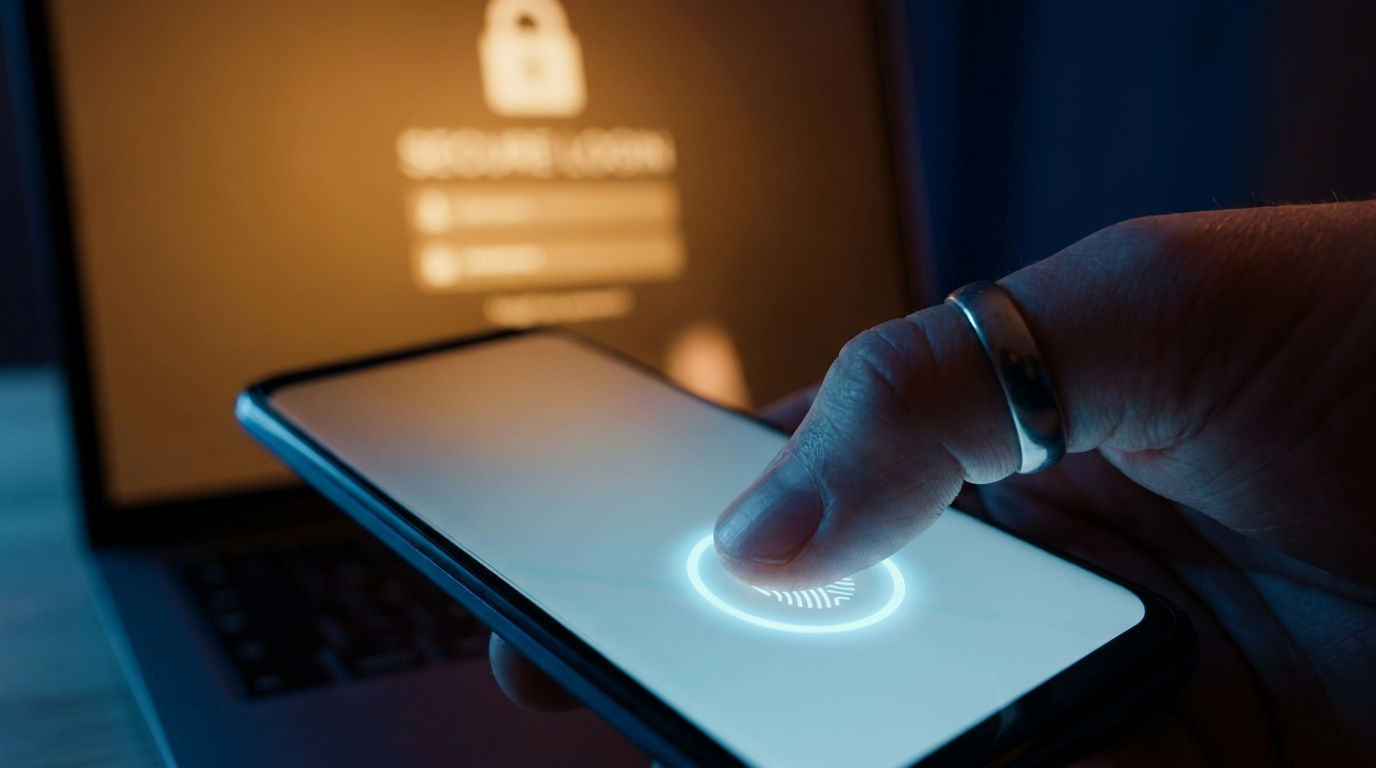
During a login attempt, the server sends a cryptographic challenge to the device. The device uses its stored private key to solve the challenge and sends the solution back. Crucially, the private key never leaves the user's smartphone or laptop. The user authorizes this transaction locally using a biometric marker—such as Face ID, Touch ID, or Windows Hello—or a local device PIN. Because the server only holds the public key, a database breach yields nothing of value to an attacker; there are no passwords to steal, hash, or crack.[6][7]
Furthermore, this cryptographic exchange is strictly bound to the specific domain where the passkey was created. If a user is tricked into visiting a visually identical phishing site—for example, a malicious domain using a Cyrillic character to mimic a legitimate bank—the device's operating system will recognize the domain mismatch and refuse to provide the passkey. The human user does not need to spot the fake URL; the cryptography simply fails to execute, neutralizing the attack before it begins.[2][6]

The evidence supporting this phishing resistance is exceptionally strong. Security analysts note that AI-powered phishing campaigns are currently driving click-through rates as high as 54 percent against traditional passwords and standard multi-factor authentication. However, organizations deploying passkey-only authentication report zero successful phishing-based account takeovers. By removing the human element from the credential exchange, passkeys close the vulnerability gap that social engineering relies upon.[2][6]
Historically, businesses have hesitated to overhaul their authentication infrastructure due to legacy system compatibility and integration costs. That resistance appears to be breaking. Current data indicates that 68 percent of organizations with over 500 employees are now actively deploying, piloting, or rolling out passkeys for their workforce. This marks a massive acceleration from previous years, driven by both security mandates and operational economics.[1][4]
The return on investment for early enterprise movers is highly measurable. Organizations that have transitioned to passkeys report a 45 percent reduction in employee login times, significantly boosting daily productivity. More importantly for IT budgets, companies report a 35 percent reduction in helpdesk tickets related to password resets. Given that password recovery is traditionally one of the most expensive and time-consuming burdens for enterprise IT departments, the financial incentive to adopt passkeys is clear.[1][4]

The return on investment for early enterprise movers is highly measurable.
The shift is also being accelerated by external financial pressures from the cyber insurance industry. Major insurance carriers are increasingly offering premium credits and policy incentives for organizations that implement phishing-resistant authentication. This creates a direct financial reward for modernization, pushing passkeys from an optional security upgrade to a baseline requirement for corporate risk management.[6]
While enterprise adoption is driven by security and cost savings, consumer adoption is driven by convenience and revenue retention. Passwords do not just cause data breaches; they actively kill e-commerce sales. The friction of remembering, typing, and resetting passwords creates a massive barrier to user engagement across the digital economy.[7]
Nearly half of all consumers—47 percent—report that they are likely to abandon a purchase or a sign-in process entirely when they cannot remember their password. By replacing the frustrating password recovery loop with a simple biometric tap, businesses are seeing immediate improvements in their conversion metrics. Removing login friction is one of the most effective ways to plug revenue leaks in any online business model.[1][4]
Consumers are responding enthusiastically to this reduction in friction. Global awareness of passkeys has reached 90 percent, and 75 percent of internet users have now enabled a passkey on at least one account. Furthermore, nearly half of the global population reports using passkeys whenever possible or most of the time. The data suggests that when platforms offer a secure, passwordless option, users adopt it rapidly.[1][3]

Despite the cryptographic strength of the primary passkey login, the surrounding authentication ecosystem remains vulnerable. The most significant uncertainty in the passwordless transition revolves around account recovery. If a user loses their smartphone or laptop, how do they regain access to their digital life without a password?[7]
Currently, many organizations that offer passkeys still maintain legacy fallback methods for account recovery, such as sending a one-time code via SMS or emailing a reset link. These fallback methods are highly susceptible to interception, SIM-swapping, and social engineering. Security experts warn that rolling out passkeys while leaving SMS recovery intact does not eliminate phishing risk; it merely shifts the attacker's focus from the front door to the back window.[6][7]
Threat actors are already adapting to this new reality. As primary authentication becomes hardened by passkeys, attackers are increasingly targeting IT helpdesks and automated recovery flows. If an attacker can convince a customer service representative to issue a temporary access token or reset a device binding, the cryptographic strength of the passkey is entirely bypassed. Securing these human-centric recovery processes is the next major hurdle for the industry.[2][6]
Major platform providers are beginning to address this vulnerability by actively deprecating weak recovery paths. Microsoft, for example, has announced plans to completely remove security questions as a password reset option in its enterprise environments by early 2027. The rationale is straightforward: security questions are easily guessed or bypassed using AI-driven social engineering, and maintaining them undermines the integrity of a passwordless architecture.[2]
Another area of ongoing debate involves the distinction between synced passkeys and device-bound passkeys. Synced passkeys, which are backed up to cloud ecosystems like Apple iCloud or Google Password Manager, offer immense consumer convenience by automatically restoring access on new devices. However, high-assurance environments—such as banking and defense—often prefer device-bound hardware keys, arguing that synced credentials introduce cloud-provider dependency and potential export risks.[5]
Despite these challenges, the momentum behind the passwordless transition is overwhelming. The password is not dead yet—57 percent of organizations still rely on phishable methods for their primary day-to-day sign-ins, and legacy system compatibility remains a hurdle for many IT departments. The gap between deploying passkeys and completely eliminating passwords is still being bridged.[1]
However, the trajectory is irreversible. With 5 billion credentials actively deployed and major tech platforms enforcing phishing-resistant defaults, the internet is undergoing a profound architectural shift. By replacing easily stolen secrets with mathematical certainty, the technology industry is finally addressing its most persistent vulnerability, offering a safer and more seamless digital future.[1][7]
How we got here
2013
The FIDO Alliance is founded to develop open standards for passwordless authentication.
2022
Apple, Google, and Microsoft announce expanded support for the FIDO standard, bringing passkeys to mainstream operating systems.
2024
Major consumer platforms, including Amazon, WhatsApp, and X, begin rolling out passkey support to billions of users.
May 2026
The FIDO Alliance reports that global passkey adoption has crossed the 5 billion mark.
Viewpoints in depth
Identity Security Practitioners
Focus on the cryptographic elimination of shared secrets and the reduction of phishing attack surfaces.
Security engineers view passkeys as the most significant architectural upgrade to internet security since the adoption of HTTPS. By replacing shared secrets (passwords) with asymmetric cryptography, passkeys remove the human element from authentication security. Practitioners emphasize that even the most sophisticated AI-generated phishing sites cannot steal a credential that the user themselves does not know and cannot manually provide.
Enterprise IT & Helpdesk
Value the operational efficiency and cost reduction associated with passwordless authentication.
For IT departments, the primary appeal of passkeys is economic. Password resets historically account for a massive percentage of helpdesk tickets, costing organizations significant time and resources. IT leaders argue that passkeys not only accelerate employee onboarding and daily logins but also drastically reduce the overhead associated with managing credential expiration policies and multi-factor authentication (MFA) fatigue.
High-Assurance Environments
Express caution regarding synced passkeys, preferring hardware-bound solutions for critical infrastructure.
Experts in banking, defense, and critical infrastructure point out a crucial distinction between synced passkeys (which are backed up to cloud ecosystems like Apple or Google) and device-bound passkeys (like physical security keys). They argue that while synced passkeys are excellent for consumer adoption, they introduce cloud-provider dependency and potential export risks. For maximum security, this camp advocates for hardware-bound keys where the private key physically cannot leave the device.
What we don't know
- How quickly legacy systems and older websites will update their infrastructure to support passkeys.
- Whether attackers will find new ways to exploit cloud-synced passkey ecosystems as they become more lucrative targets.
Key terms
- Public-Key Cryptography
- A security system that uses two mathematically linked keys: a public key shared with the website, and a private key kept secretly on your device.
- Phishing-Resistant Authentication
- Login methods that cannot be intercepted or stolen by fake websites or social engineering, because they do not rely on a user typing a secret.
- Synced Passkey
- A passkey that is securely backed up to a cloud ecosystem (like Apple, Google, or a password manager) so it can be used across multiple devices.
- Device-Bound Passkey
- A passkey locked to a specific piece of hardware, such as a physical security key, which cannot be copied or transferred.
Frequently asked
What exactly is a passkey?
A passkey is a digital credential tied to your device (like a phone or laptop) that uses cryptography instead of a password. You unlock it using your device's biometric scanner (face or fingerprint) or PIN.
Why are passkeys safer than passwords?
Unlike passwords, passkeys are never sent to the website's server. They are also bound to the specific website you created them for, meaning they cannot be tricked by fake phishing websites.
What happens if I lose my phone?
Most consumer passkeys are synced to your cloud account (like Apple iCloud or Google Password Manager), so they automatically restore when you sign into your new device. Organizations also provide secure account recovery processes.
Are passwords completely gone?
Not yet. While 5 billion passkeys are in use, 57% of organizations still rely on passwords for primary day-to-day sign-ins. The transition is ongoing.
Sources
Source coverage
7 outlets
3 viewpoints surfaced







[1]FIDO AllianceEnterprise Security
The State of Passkeys 2026: Global Consumer and Workforce Report
Read on FIDO Alliance →[2]MicrosoftEnterprise Security
World Passkey Day is a chance to reflect on progress toward a shared goal
Read on Microsoft →[3]PCMagConsumer Tech Ecosystem
FIDO Survey Shows Passkey Adoption, Especially as a Primary Login Method, Still Trails Awareness
Read on PCMag →[4]DescopeConsumer Tech Ecosystem
2026 FIDO Report: Passkeys at Global Scale
Read on Descope →[5]Biometric UpdateHigh-Assurance Identity
Passkeys are here; now about those passwords
Read on Biometric Update →[6]AgamiSoft SecurityHigh-Assurance Identity
The Security and Adoption Numbers Behind the Passkeys vs Passwords Shift
Read on AgamiSoft Security →[7]Factlen Editorial TeamEnterprise Security
Synthesis by Factlen editorial team
Read on Factlen Editorial Team →
Every angle. Every day.
Get technology stories with full source coverage and perspective breakdowns delivered to your inbox.