
JWST Detects an Unidentified Chemical Substance on the Surfaces of Titan and Pluto
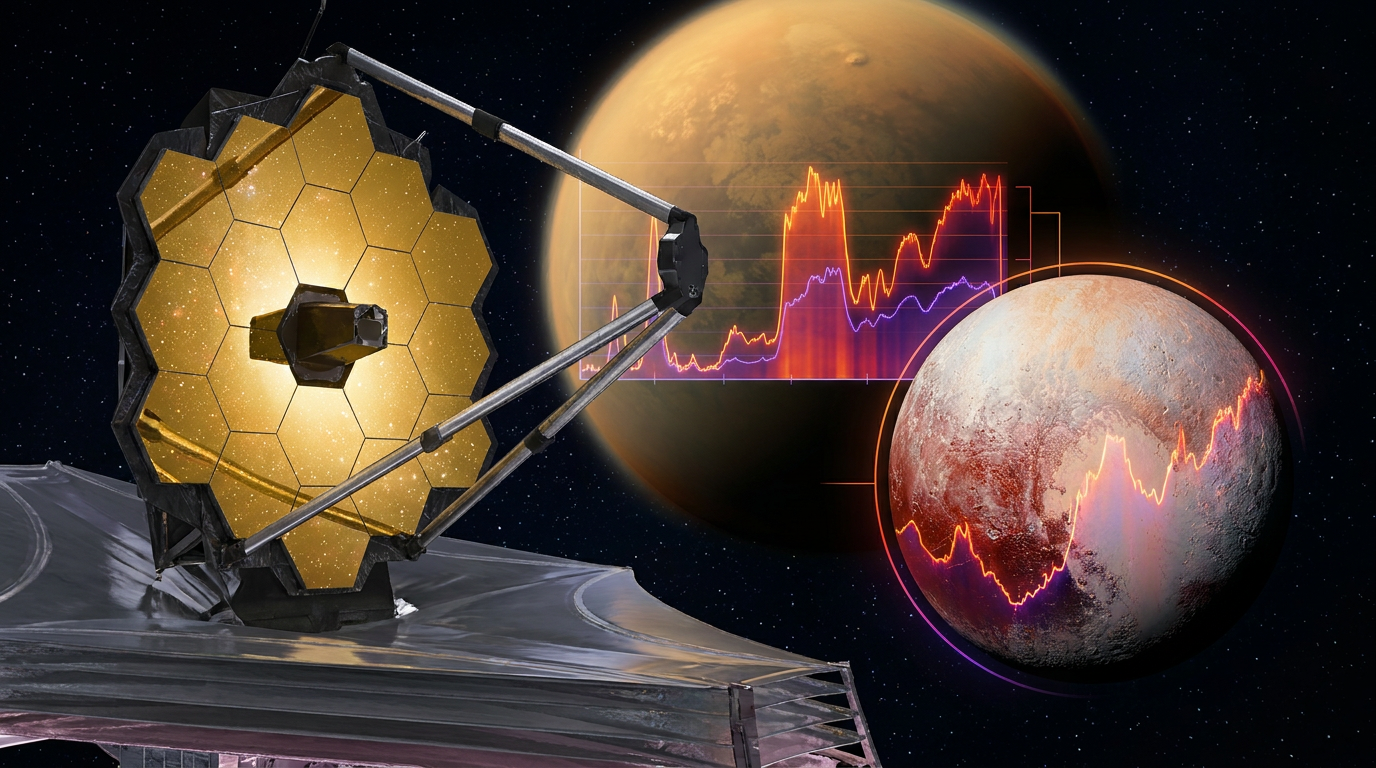
Astronomers using the James Webb Space Telescope have discovered a mysterious compound absorbing infrared light at exactly 5.11 micrometers on both Titan and Pluto. The substance does not match any known laboratory spectra of ices, pointing to undiscovered complex chemistry in the outer solar system.
By Factlen Editorial Team
- Planetary Spectroscopists
- Focus on the raw JWST data, the precise 5.11 μm absorption feature, and the rigorous elimination of known atmospheric gases.
- Prebiotic Chemists
- Interpret the anomaly as a potential complex organic polymer or tholin, emphasizing its implications for the building blocks of life.
- Science Communicators
- Highlight the shared mystery between two vastly different outer solar system bodies and the unprecedented capabilities of JWST.
What's not represented
- · Laboratory chemists who must now synthesize new compounds at ultra-low temperatures to match the spectra.
Why this matters
Identifying this unknown compound could unlock the chemical pathways that create complex organics in deep space. Because Titan is considered a frozen analog to early Earth, understanding its surface chemistry provides direct clues about how the prebiotic building blocks of life form.
Key points
- The James Webb Space Telescope detected an unknown substance on the surfaces of Titan and Pluto.
- The material absorbs infrared light at exactly 5.11 micrometers, a signature that does not match any known ice.
- Radiative transfer models confirm the substance is located on the solid ground, not in the atmosphere.
- Scientists hypothesize the material may be a complex organic polymer formed by radiation hitting nitrogen and methane.
- The discovery highlights a shared chemical pathway between a Saturnian moon and a Kuiper Belt dwarf planet.
The James Webb Space Telescope (JWST) has detected an unidentified chemical substance resting on the surfaces of two of the solar system's most enigmatic bodies: Saturn's largest moon, Titan, and the dwarf planet Pluto. The discovery highlights the telescope's unprecedented ability to probe the chemical makeup of distant worlds.[1][2]
According to a June 2026 analysis of JWST spectroscopic data, an unknown material is absorbing infrared light at a highly specific wavelength of 5.11 micrometers (μm). The absorption feature was found independently on both celestial bodies, linking them through a shared chemical mystery.[2][3]
The discovery presents a profound puzzle for astrochemists. Despite extensive databases detailing how different ices and minerals interact with light, the 5.11 μm signature does not match any known compound expected to exist in these frozen environments. The evidence points to a complex, undiscovered molecule.[2][8]
To understand the significance of this finding, it is necessary to examine how astronomers identify distant chemicals. Using a technique called spectroscopy, instruments measure the light reflecting off a planet. Because different molecules absorb specific wavelengths of light, the resulting spectrum acts as a highly precise chemical fingerprint.[4][8]

Titan has historically frustrated such spectroscopic efforts. The moon is enveloped in a thick, opaque atmosphere of nitrogen and methane that scatters visible light, hiding the surface beneath a dense, impenetrable orange smog.[6][8]
However, JWST's Near-Infrared Spectrograph (NIRSpec) and Mid-Infrared Instrument (MIRI) are specifically designed to peer through narrow "windows" in this haze. By observing Titan in the 5-μm infrared range, researchers were able to capture clear, uncontaminated data from the solid ground below.[2][4]
The data revealed a distinct anomaly. At exactly 5.113 μm, the amount of light reflecting back to the telescope dropped by 6 to 7 percent, indicating that something on the surface was actively absorbing that specific energy.[2][3]
To ensure this absorption was not simply a quirk of Titan's thick atmosphere, the research team ran rigorous radiative transfer models. These mathematical simulations accounted for all known gases and hazes floating above the moon. The models confirmed that the atmosphere could not be responsible for the missing light; the absorption had to originate from a solid material resting on the surface.[2][8]
To ensure this absorption was not simply a quirk of Titan's thick atmosphere, the research team ran rigorous radiative transfer models.
The mystery deepened when astronomers turned JWST toward Pluto. Despite being located billions of miles further away in the Kuiper Belt, Pluto possesses a thin, Titan-like atmosphere that is also dominated by nitrogen and methane.[2][7]

JWST's MIRI instrument detected the exact same absorption feature on Pluto's surface. While slightly shallower at 4 to 5 percent deep, and roughly three times broader than the signature found on Titan, the central wavelength of the missing light was identical.[2][3]
Finding the identical unidentified substance on two vastly different worlds suggests a shared chemical pathway. Both bodies, despite their different origins and temperatures, are subjected to solar radiation and cosmic rays that constantly bombard their nitrogen-methane atmospheres.[6][7]
The primary challenge for researchers is the "laboratory mismatch." Spectroscopists compared the 5.11 μm feature against published laboratory spectra of pure ices—including methane, nitrogen, carbon monoxide, water, and carbon dioxide. None of these fundamental building blocks produced the observed absorption.[2][5]
This lack of a match strongly implies that the substance is not a simple, primary ice, but rather a complex secondary product. Prebiotic chemists suspect the culprit belongs to a class of compounds known as tholins.[6][7]
Tholins are complex, tar-like organic polymers. They form when high-energy ultraviolet radiation breaks the molecular bonds of simple atmospheric gases, allowing the fragments to recombine into long, chaotic chains of carbon and nitrogen.[7][8]

These polymers are responsible for the deep reddish hues observed on Pluto's surface by the New Horizons probe in 2015, and they make up the dense haze particles that slowly rain down onto Titan's surface to form organic dunes.[6][7]
Theoretical models have previously suggested that specific polymers, such as polyimine, could form in these ultra-cold conditions. Polyimine is highly conjugated, meaning its electrons are arranged in a way that allows it to efficiently absorb lower-energy light—a property that aligns perfectly with the JWST observations.[6][8]
If the mysterious substance is indeed a complex polymer, it carries profound implications for astrobiology. Titan is widely considered a deep-freeze analog to the early Earth, preserving the prebiotic chemistry that eventually led to the building blocks of life.[6][8]
How we got here
2005
The Cassini-Huygens mission reveals Titan's surface is rich in complex carbon compounds, but lacks the infrared resolution to identify specific surface molecules.
2015
The New Horizons probe flies past Pluto, discovering vast regions stained red by complex organic polymers known as tholins.
2025
JWST begins deep-space spectroscopic observations, mapping volatile compounds across the outer solar system.
June 2026
Researchers publish JWST data revealing the identical, unidentified 5.11 μm absorption feature on both Titan and Pluto.
Viewpoints in depth
The Spectroscopic Evidence
The data clearly points to a solid surface material, not an atmospheric gas.
Researchers utilizing JWST's Near-Infrared Spectrograph (NIRSpec) and Mid-Infrared Instrument (MIRI) have established a high-confidence detection of the 5.11 μm feature. By running radiative transfer models that account for all known gas and haze opacities in Titan's atmosphere, they demonstrated that the missing light cannot be explained by atmospheric absorption. The feature's presence in the spectra of both Titan's trailing side and Pluto's surface strongly indicates a solid-state material. The primary challenge now is the 'laboratory mismatch': the signature does not align with any published spectra of ices relevant to these environments, forcing spectroscopists to look beyond standard planetary building blocks.
The Prebiotic Chemistry Angle
The anomaly likely represents a complex organic polymer formed by radiation.
For prebiotic chemists, this unidentified substance is a tantalizing clue. Both Titan and Pluto are known factories for 'tholins'—complex carbon-nitrogen chains formed when ultraviolet light breaks apart simple molecules. Researchers hypothesize that the 5.11 μm absorption could belong to a highly conjugated polymer, perhaps similar to polyimine, which theoretical models suggest can absorb wide spectrums of light and catalyze further chemical reactions. If the substance is indeed a complex organic polymer, it proves that the outer solar system is capable of synthesizing highly advanced prebiotic molecules, preserving a chemical record of the processes that may have occurred on the early Earth.
What we don't know
- The exact molecular structure of the substance absorbing the 5.11 μm light.
- Whether the compound is a single complex polymer or a mixture of interacting ices.
- How the same chemical signature evolved on both a Saturnian moon and a Kuiper Belt dwarf planet despite vastly different environments.
Key terms
- Spectroscopy
- The study of how matter interacts with electromagnetic radiation, allowing scientists to identify chemicals by the specific wavelengths of light they absorb.
- Tholins
- Complex, tar-like organic polymers formed when ultraviolet light or cosmic rays irradiate simple compounds like methane and nitrogen.
- Radiative Transfer Model
- A mathematical simulation used to calculate how light travels through a planetary atmosphere, helping to separate atmospheric signals from surface signals.
- Micrometer (μm)
- One millionth of a meter; infrared light wavelengths are typically measured in micrometers.
Frequently asked
Why is it so hard to see Titan's surface?
Titan is shrouded in a thick, opaque atmosphere of nitrogen and methane haze that scatters most visible light, requiring infrared instruments to peer through specific 'windows'.
Could this substance be a sign of life?
No, it is highly unlikely to be biological. However, it is likely a complex organic molecule, which scientists study to understand the prebiotic chemistry that precedes life.
Why do Titan and Pluto have the same substance?
Despite their different locations, both bodies have atmospheres rich in nitrogen and methane, suggesting they undergo similar radiation-driven chemical processes.
Sources
Source coverage
8 outlets
3 viewpoints surfaced








[1]New ScientistPrebiotic Chemists
We've found a mysterious substance on Titan and Pluto
Read on New Scientist →[2]arXivPlanetary Spectroscopists
An Unidentified Absorption Feature At 5.11 μm On The Surface Of Titan And Pluto From JWST Spectroscopy
Read on arXiv →[3]Astrobiology.comPlanetary Spectroscopists
An Unidentified Absorption Feature At 5.11 μm On The Surface Of Titan And Pluto From JWST Spectroscopy
Read on Astrobiology.com →[4]NASAPlanetary Spectroscopists
Webb Maps Volatile Compounds Across the Solar System
Read on NASA →[5]ScienceXScience Communicators
Something is absorbing light on the surfaces of Pluto and Saturn's moon Titan
Read on ScienceX →[6]Space.comPrebiotic Chemists
Building Blocks of Life Could Form on Saturn's Moon Titan
Read on Space.com →[7]Discover MagazinePrebiotic Chemists
What Are Tholins? The Mysterious Substance That Turned Ultima Thule Red
Read on Discover Magazine →[8]Factlen Editorial TeamScience Communicators
Synthesis by Factlen editorial team
Read on Factlen Editorial Team →

More in science
See all 5 stories →Microbiome Science
Young Gut Microbiomes Reopen the Brain's 'Critical Period' of Neuroplasticity in Adult Mice
7 sources

Gut-Brain Axis
Gut Microbes From Young Mice Restore Brain Plasticity in Older Adults
5 sources

Planetary Science
Deep Carbon Monoxide Detection Confirms Uranus is a True Ice Giant
8 sources

Every angle. Every day.
Get science stories with full source coverage and perspective breakdowns delivered to your inbox.