
Fact Check: Does Ranked-Choice Voting Actually Reduce Political Polarization?
Advocates claim ranked-choice voting curbs negative campaigning and penalizes extreme candidates. We break down the data from recent municipal and state elections to see which claims hold up to empirical scrutiny.
By Factlen Editorial Team
- Empirical Election Researchers
- Focus on measurable data regarding campaign tone, candidate ideology, and the mathematical outcomes of voting systems.
- Democratic Reform Advocates
- Argue that structural changes to the ballot are essential to breaking the two-party duopoly and ensuring majority rule.
- Public Opinion Analysts
- Examine how voters actually experience and understand new electoral systems in the voting booth.
What's not represented
- · Local Election Clerks
- · Third-Party Candidates
Why this matters
As more states and municipalities adopt alternative voting systems, understanding the actual data behind these reforms helps voters separate genuine democratic improvements from political wishful thinking.
Key points
- Data shows ranked-choice voting significantly reduces negative campaigning by forcing candidates to seek second-choice votes.
- The system successfully penalizes highly polarizing candidates and rewards those who can build broad consensus.
- Claims that the system dramatically increases voter turnout are not supported by current empirical evidence.
- Despite concerns about complexity, over 60% of voters report finding the ranking process intuitive and easy to use.
In an era defined by intense political polarization and voter dissatisfaction with binary choices, ranked-choice voting has emerged as the most widely discussed democratic reform in the United States. Proponents argue it is a structural antidote to vitriol, capable of transforming how campaigns are run and who ultimately wins. Critics often dismiss these promises as utopian, warning that the system is overly complex and fails to deliver on its grandest claims. To separate the rhetoric from reality, we examined the empirical data from dozens of municipalities and states that have already made the switch.[6]
The mechanics of ranked-choice voting are straightforward in theory: instead of selecting a single candidate, voters rank their preferences. If no candidate secures an outright majority of first-choice votes, an instant runoff is triggered. The candidate with the fewest votes is eliminated, and their supporters' votes are redistributed to their second choices. This process repeats until one candidate crosses the fifty-percent threshold. The central premise is that this mechanism fundamentally alters the incentives for politicians seeking office.[1][3]
The first major claim evaluated by election researchers is that ranked-choice voting reduces negative campaigning. The logic suggests that because candidates need to appeal to their rivals' supporters for second-choice votes, they will avoid launching vicious attack ads that might alienate those voters. According to comprehensive data from the Bipartisan Policy Center, this claim is supported by strong evidence. In mayoral races utilizing the system, researchers documented a measurable decrease in negative messaging compared to traditional plurality elections.[2]

Candidates in these races frequently engage in cross-endorsements, publicly asking voters to rank them first and a specific rival second. This structural need to build coalitions rather than simply energize a base fundamentally changes the tone of the final weeks of a campaign. The National Bureau of Economic Research found that this shift is not just anecdotal; the reduction in hostility is statistically significant across multiple election cycles in diverse geographic regions.[2][4]
The second major claim is that the system penalizes extreme candidates and rewards consensus builders. Under traditional plurality rules, a highly polarizing figure with a dedicated base of thirty percent can win a crowded primary if the moderate vote is fractured among several candidates. Ranked-choice voting is designed to prevent this exact scenario by ensuring the winner has broad, if not always enthusiastic, support across the electorate.[1][6]
The evidence for this claim is robust. Data compiled by the MIT Election Data and Science Lab shows that candidates who are broadly acceptable to a majority of voters consistently defeat polarizing candidates who have high first-choice support but deep unfavorability ratings. The system effectively approximates the election of a Condorcet winner—a candidate who would defeat every other candidate in a series of head-to-head matchups.[1][4]
The system effectively approximates the election of a Condorcet winner—a candidate who would defeat every other candidate in a series of head-to-head matchups.
However, not all claims made by advocates hold up to empirical scrutiny. The third major assertion—that ranked-choice voting significantly increases voter turnout—is supported by only weak and mixed evidence. While advocacy groups like FairVote often point to high-turnout elections in areas that recently adopted the system, academic researchers caution against confusing correlation with causation.[1][3]

The MIT Election Lab notes that voter turnout is driven far more by the competitiveness of the specific race, the amount of money spent, and the broader political climate than by the format of the ballot itself. While the system does not appear to depress turnout, the data does not support the idea that changing the ballot structure alone will suddenly draw large numbers of disengaged citizens to the polls.[1]
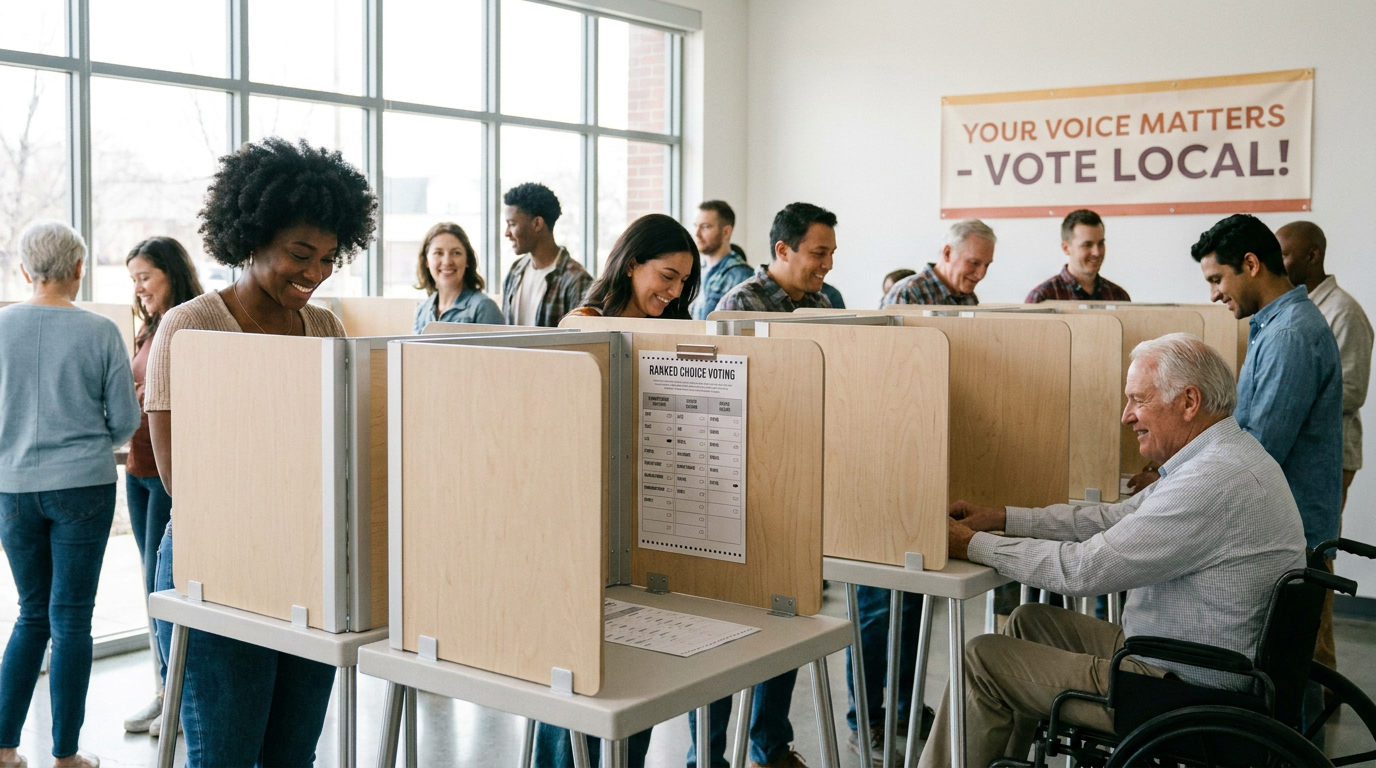
Another critical area of study is voter comprehension. Opponents frequently argue that ranking candidates is too confusing for the average voter, potentially leading to spoiled ballots and disenfranchisement. To test this, the Pew Research Center conducted extensive post-election polling in jurisdictions that recently transitioned to the new system.[5]
The polling data reveals a highly encouraging picture: despite initial apprehension, the vast majority of voters find the system intuitive once they are actually in the voting booth. Over sixty percent of voters reported that the ranking process was easy to understand, and ballot spoilage rates were statistically indistinguishable from traditional elections after the first implementation cycle.[5]
A genuine vulnerability in the system, however, is the phenomenon of ballot exhaustion. This occurs when a voter chooses to rank only one or two candidates, and those candidates are eliminated in early rounds. If the voter has not ranked any of the finalists, their ballot becomes inactive and does not factor into the final round of tabulation.[2][6]
The Bipartisan Policy Center found that ballot exhaustion rates can range from five to fifteen percent in highly fractured races. While this means some voters do not weigh in on the final pairing, researchers note that this is conceptually similar to a voter choosing to stay home during a traditional runoff election because their preferred candidate was eliminated in the primary.[2]

Ultimately, the empirical evidence paints a nuanced but highly positive picture of ranked-choice voting. It is not a magic bullet capable of curing all democratic apathy, nor does it guarantee high turnout. It does, however, deliver on its most important structural promises: it demonstrably curbs the vitriol of modern campaigns and ensures that elected officials represent a genuine consensus of their constituents.[4][6]
As more municipalities consider adopting the reform, the data suggests that the transition requires robust voter education campaigns to minimize early confusion. But once established, the system provides a proven mechanism for cooling the political temperature and rewarding candidates who seek to unite rather than divide.[1][6]
How we got here
2004
San Francisco becomes the first major modern U.S. city to implement ranked-choice voting for municipal elections.
2018
Maine becomes the first state to use the system for federal congressional elections.
2022
Alaska implements a top-four open primary system followed by a ranked-choice general election.
2026
Over 50 municipalities across the United States now utilize the system for local elections.
Viewpoints in depth
Democratic Reform Advocates
Advocates view the system as a necessary structural fix to a broken political culture.
Organizations like FairVote argue that the two-party plurality system inherently breeds toxicity by forcing a zero-sum game where candidates win by tearing down their single opponent. They view ranked-choice voting as a structural mechanism to incentivize positive campaigning, arguing that when politicians are forced to ask for second-choice votes, they can no longer afford to alienate large swaths of the electorate. They point to the success of consensus candidates in recent elections as proof that the system works exactly as intended.
Empirical Election Researchers
Researchers focus on the mathematical realities and limitations of the system.
Academic institutions and think tanks take a more measured view, validating some claims while debunking others. They confirm that the system reduces vitriol and helps elect Condorcet winners, but they push back against the narrative that it is a cure-all for democratic disengagement. Researchers emphasize that voter turnout is driven by race competitiveness, not ballot design, and they closely monitor ballot exhaustion rates to ensure that voters are not inadvertently disenfranchising themselves by failing to rank multiple candidates.
Public Opinion Analysts
Analysts track how the electorate adapts to the new rules in the voting booth.
Polling organizations focus on the human element of the reform: voter comprehension. Their data consistently shows a gap between the theoretical fear of the system and the practical reality of using it. While political traditionalists often argue the ballot is too confusing, post-election surveys reveal that voters quickly adapt to the ranking process. Analysts note that voter education campaigns in the months leading up to an election are the single biggest factor in reducing ballot spoilage and ensuring a smooth transition.
What we don't know
- Whether the reduction in negative campaigning will persist as political operatives develop new strategies to game the ranking system.
- How the system will perform if implemented on a massive scale in a highly contested presidential general election.
Key terms
- Ranked-Choice Voting (RCV)
- An electoral system where voters rank candidates by preference on their ballots, rather than selecting just one.
- Instant Runoff
- The mathematical process of eliminating the lowest-performing candidates and redistributing their votes until someone reaches a majority.
- Condorcet Winner
- A candidate who would win a one-on-one election against every other candidate in the race, representing the broadest consensus.
- Plurality Election
- The traditional voting system where the candidate with the most votes wins, even if they receive less than 50% of the total vote.
Frequently asked
What happens if my first choice is eliminated?
If your first-choice candidate is eliminated because they have the fewest votes, your ballot is not discarded. Instead, your vote is automatically transferred to the candidate you ranked second.
Does this system benefit one political party over another?
Empirical data shows no inherent partisan advantage. It tends to benefit consensus-building candidates of any affiliation and penalizes highly polarizing candidates, regardless of whether they are on the left or the right.
Do I have to rank every single candidate?
No. You can rank as many or as few candidates as you wish. If you only want to vote for one person, you can simply mark them as your first choice and leave the rest blank.
What is ballot exhaustion?
Ballot exhaustion occurs when a voter does not rank all the candidates, and all the candidates they did rank are eliminated. At that point, the ballot becomes inactive and does not count in the final round.
Sources
Source coverage
6 outlets
3 viewpoints surfaced






[1]MIT Election Data and Science LabEmpirical Election Researchers
Ranked Choice Voting: Research and Data
Read on MIT Election Data and Science Lab →[2]Bipartisan Policy CenterEmpirical Election Researchers
The Effects of Ranked Choice Voting on Campaigns and Voters
Read on Bipartisan Policy Center →[3]FairVoteDemocratic Reform Advocates
Data on Ranked Choice Voting in Practice
Read on FairVote →[4]National Bureau of Economic ResearchEmpirical Election Researchers
Electoral Systems and Political Polarization
Read on National Bureau of Economic Research →[5]Pew Research CenterPublic Opinion Analysts
Public Views of Ranked Choice Voting and Election Reforms
Read on Pew Research Center →[6]Factlen Editorial TeamPublic Opinion Analysts
Synthesis by Factlen editorial team
Read on Factlen Editorial Team →
More in news politics
See all 5 stories →Election Integrity
The Evidence Pack: How Accurate Are Open-Source Deepfake Detectors in 2026?
7 sources

Strait of Hormuz
Iran Threatens Strait of Hormuz Closure as US and Iranian Delegations Arrive in Switzerland for Emergency Talks
7 sources
Geneva Summit
U.S. and Iranian Delegations Open High-Stakes Peace Talks in Switzerland
6 sources
Every angle. Every day.
Get news politics stories with full source coverage and perspective breakdowns delivered to your inbox.