
How mass timber is transforming the future of urban architecture
Engineered wood products like cross-laminated timber are replacing steel and concrete in high-rise construction, offering a faster, lighter, and vastly more sustainable way to build our cities.
By Factlen Editorial Team
- Sustainable Architecture Advocates
- Focus on the urgent need to decarbonize construction, championing mass timber as a carbon sink that enables faster, cleaner urban development.
- Fire Safety & Engineering Researchers
- Emphasize rigorous, data-driven validation of structural integrity and char rates to ensure building codes are updated safely.
- Environmental & Forestry Scientists
- Warn that mass timber is only a climate solution if paired with strict, sustainable forestry practices to prevent deforestation.
What's not represented
- · Traditional concrete and steel manufacturers
- · Local zoning board officials
Why this matters
The built environment is responsible for nearly 40 percent of global carbon emissions. Shifting from concrete and steel to engineered wood offers one of the most viable, scalable solutions to decarbonize our cities while building faster and more resilient structures.
Key points
- Mass timber refers to engineered wood products, like CLT and glulam, that offer the structural strength of steel and concrete.
- Because trees absorb CO2 as they grow, mass timber buildings act as massive carbon sinks, locking away greenhouse gases.
- Prefabricated timber panels allow for significantly faster construction times, smaller labor forces, and lighter building foundations.
- Despite common misconceptions, mass timber performs exceptionally well in fires due to a natural charring process that protects the structural core.
- Widespread adoption of mass timber could reduce global greenhouse gas emissions by up to 39 gigatons by the end of the century.
- The environmental benefits rely entirely on sustainable forestry practices to ensure harvested trees are continuously replaced.
For over a century, the silhouette of the modern city has been defined by two materials: steel and concrete. They are the undisputed champions of verticality, allowing humanity to build higher and denser than ever before. But as the environmental toll of traditional construction becomes impossible to ignore, a quiet revolution is taking root in the architecture world. A new generation of skyscrapers, office buildings, and residential complexes is rising, built not from forged metal or poured cement, but from wood.[4][8]
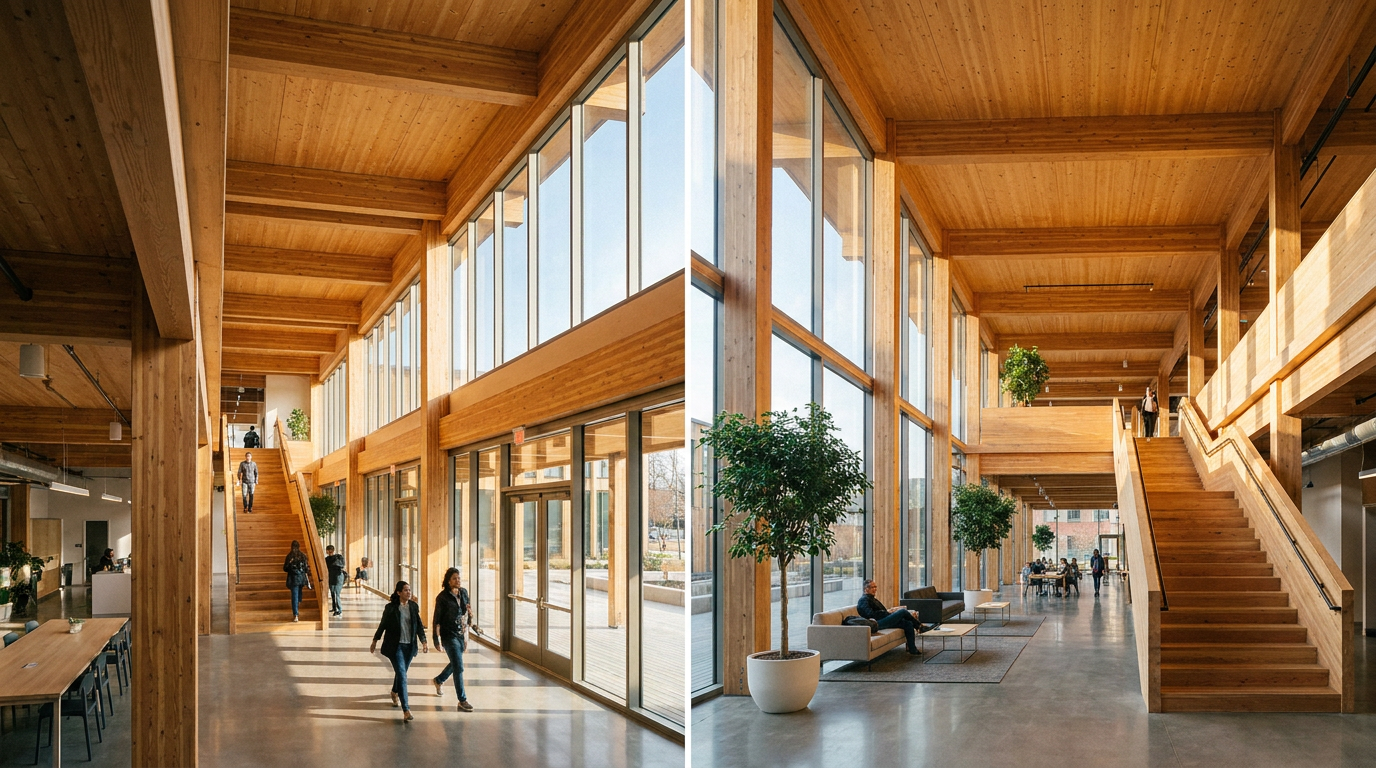
This is not the light-frame timber used to build suburban homes. It is a category of engineered materials known collectively as "mass timber." By taking smaller pieces of wood and bonding them together under immense pressure, manufacturers are creating massive structural components that rival the strength and durability of traditional building materials. The result is a highly versatile building system that is fundamentally changing how architects think about structural engineering, aesthetics, and the carbon footprint of the built environment.[3][4][6]
The most prominent member of the mass timber family is Cross-Laminated Timber, or CLT. To create a CLT panel, layers of solid wood boards are stacked on top of one another, with each layer oriented at a 90-degree angle to the one below it. This cross-grain configuration neutralizes the natural tendency of wood to warp or shrink, resulting in a rigid, dimensionally stable panel that can span long distances and bear tremendous weight. These panels are typically used for floors, walls, and elevator shafts, effectively replacing reinforced concrete slabs.[3][4][6]

Alongside CLT is Glued Laminated Timber, commonly known as glulam. Unlike CLT, the wood grain in glulam runs parallel throughout the entire piece. This makes it exceptionally strong in one direction, making it the material of choice for load-bearing columns, long-span beams, and even sweeping architectural arches. Together, CLT and glulam form the backbone of the mass timber movement, allowing structural engineers to design buildings that are lighter, warmer, and vastly more sustainable.[3][4][6]
The environmental argument for mass timber is rooted in the urgent need to decarbonize the construction industry. The built environment is responsible for nearly 40 percent of global carbon dioxide emissions, with the manufacturing of cement and steel acting as massive contributors. Concrete production requires heating limestone to extreme temperatures, releasing vast amounts of CO2 in the process. Mass timber, by contrast, offers a way to drastically reduce a building's "embodied carbon"—the emissions generated before the building is even occupied.[5][7]
The climate benefit of wood lies in biogenic carbon sequestration. As trees grow, they absorb carbon dioxide from the atmosphere through photosynthesis, using the carbon to build their cellular structure while releasing oxygen. When a tree is harvested and manufactured into a mass timber panel, that carbon remains locked inside the wood for the lifetime of the building. For every cubic meter of wood used in construction, approximately 0.9 tons of carbon dioxide is safely stored away from the atmosphere.[5][6][8]
The potential global impact of this material shift is staggering. A recent comprehensive study by the Yale School of the Environment modeled the effects of widespread mass timber adoption. The researchers found that if 30 to 60 percent of new urban buildings were constructed with CLT between now and the end of the century, it could reduce global greenhouse gas emissions by up to 39 gigatons. To put that in perspective, that figure is roughly equivalent to the entire world's energy-related CO2 emissions for a single year.[1]

The potential global impact of this material shift is staggering.
Beyond its carbon-storing capabilities, mass timber fundamentally changes the logistics of a construction site. Because mass timber components are prefabricated in a factory using highly precise computer-numerical-control (CNC) machines, they arrive at the job site ready to be assembled. There is no waiting for concrete to cure or welding steel beams high in the air. The panels and columns snap together almost like a massive furniture kit, allowing entire floors to be installed in a matter of hours.[6][7]
This prefabrication drastically reduces construction timelines, minimizes on-site waste, and requires a smaller labor force. Furthermore, because a mass timber structure weighs roughly one-fifth as much as a comparable concrete building, it requires a significantly smaller and less expensive foundation. This lightweight nature makes mass timber particularly attractive for urban infill projects or for adding new stories on top of existing buildings that cannot support the weight of additional concrete.[6][7][8]
Despite these advantages, the most persistent psychological hurdle facing mass timber is the fear of fire. The idea of living or working in a wooden high-rise instinctively triggers concerns about catastrophic blazes. However, fire protection engineers point out that mass timber behaves very differently in a fire than the small 2x4 framing of a residential house. When exposed to intense heat, the outer layer of a massive timber beam predictably chars.[3][7]
This charring effect is actually a powerful defense mechanism. The burnt outer layer turns into an insulating blanket of carbon, which starves the fire of oxygen and protects the unburned structural wood deep inside the beam. While steel can rapidly lose its structural integrity and buckle when exposed to the extreme temperatures of a building fire, a mass timber column will maintain its load-bearing capacity for a significantly longer period.[3][7][8]

To prove this to skeptical regulators, researchers at Oregon State University and the Bureau of Alcohol, Tobacco, Firearms and Explosives (ATF) Fire Research Laboratory have conducted exhaustive, large-scale fire tests. In one series of experiments, fully furnished multi-story mass timber structures were subjected to worst-case scenario fires. The exposed glulam columns and CLT ceilings withstood the infernos, achieving fire-resistance ratings of up to three hours without losing structural integrity.[2][3]
These rigorous tests have paved the way for sweeping changes to international building codes. Recent updates to the International Building Code (IBC) now prescriptively allow for mass timber buildings to reach up to 18 stories, provided they incorporate specific safety measures like automated sprinkler systems and, in some cases, protective layers of gypsum wallboard over the wood. As the data continues to validate the safety of the material, cities around the world are eagerly updating their zoning laws to welcome taller timber structures.[3][6]
However, environmental scientists caution that mass timber is not a silver bullet, and its sustainability is entirely dependent on the supply chain. If the surge in demand for CLT leads to the clear-cutting of old-growth forests or the destruction of natural habitats, the carbon math quickly falls apart. The climate benefits only materialize if the wood is sourced from strictly managed, sustainable forests where mature trees are harvested and immediately replaced with new saplings, ensuring a continuous cycle of carbon absorption.[1][5][7]

There are also questions about the end-of-life treatment of these buildings. While the carbon is sequestered for the life of the structure, what happens when the building is eventually demolished? To maintain the climate benefit, the timber must be salvaged, repurposed, or recycled, rather than sent to a landfill where it would decompose and release its stored carbon back into the atmosphere. Designing buildings for "deconstruction" is becoming a critical focus for mass timber architects.[5][8]
Ultimately, the future of urban construction is likely to be hybrid. Engineers are increasingly combining mass timber with strategic amounts of steel and concrete, using each material where it performs best. A building might feature a concrete foundation and elevator core for lateral stiffness, steel cross-bracing for seismic resilience, and mass timber floors and columns for warmth, lightness, and carbon sequestration. As this technology matures, mass timber is poised to transform our skylines, proving that the most advanced building material of the 21st century might just be the one we have been using since the dawn of civilization.[4][6][8]
How we got here
Late 1980s
Cross-Laminated Timber (CLT) is first developed and introduced for commercial structural use in Europe.
2015
The Framework building in Portland, Oregon, becomes one of the first high-profile tests for tall wood structures in the U.S.
2019
Mjøstårnet in Norway is completed, reaching 18 stories and proving the viability of high-rise mass timber architecture.
2021
The International Building Code (IBC) is officially updated to prescriptively allow mass timber buildings up to 18 stories tall.
2025
Yale researchers publish a landmark study quantifying the gigatons of carbon that could be saved by shifting urban construction to timber.
Viewpoints in depth
Sustainable Architecture Advocates
Focus on the urgent need to decarbonize the construction industry through renewable materials.
This camp views mass timber as one of the few scalable climate solutions available to the building sector today. They argue that because concrete and steel are inherently carbon-intensive to produce, the only way to meet global emission targets is to fundamentally change the materials we build with. By utilizing a material that actively sequesters carbon, they believe cities can transform from massive sources of pollution into sprawling carbon sinks, all while benefiting from faster construction times and the psychological benefits of biophilic design.
Fire Safety & Engineering Researchers
Focus on rigorous, data-driven validation of structural integrity to ensure public safety.
While supportive of the technology, fire protection engineers and structural researchers emphasize that building codes must be updated based on empirical data, not environmental optimism. They focus their efforts on conducting large-scale burn tests to measure exact char rates, structural deflection under heat, and the performance of glulam connections. Their goal is to ensure that as timber buildings grow taller, they meet or exceed the life-safety standards currently provided by non-combustible materials like steel and concrete.
Environmental & Forestry Scientists
Focus on the entire lifecycle of the wood, warning against the dangers of unregulated harvesting.
Forestry experts caution that mass timber is only a "green" solution if the supply chain is meticulously managed. They point out that a sudden, massive spike in global demand for engineered wood could incentivize clear-cutting, biodiversity loss, and the destruction of old-growth forests in poorly regulated regions. For this camp, the climate math only works if the timber is sourced from certified sustainable forests where the rate of replanting outpaces the rate of harvesting, ensuring the forest ecosystem remains intact.
What we don't know
- How the global timber supply chain will scale to meet surging demand without inadvertently incentivizing deforestation in poorly regulated regions.
- The long-term viability of recycling or repurposing mass timber panels once a building reaches the end of its multi-decade lifespan.
- How quickly local municipalities and conservative zoning boards will adopt the updated international building codes that permit taller timber structures.
Key terms
- Cross-Laminated Timber (CLT)
- Large wooden panels made by gluing layers of solid sawn lumber at right angles to one another, providing immense structural strength in two directions.
- Glulam (Glued Laminated Timber)
- Structural beams and columns made by bonding layers of timber with the grain all running parallel, often used for long spans or curved arches.
- Biogenic Carbon Sequestration
- The process by which trees absorb carbon dioxide from the atmosphere during photosynthesis and store it in their wood fibers.
- Embodied Carbon
- The total greenhouse gas emissions generated by the extraction, manufacturing, transportation, and assembly of building materials.
- Char Rate
- The predictable speed at which the outer layer of a massive piece of wood burns and turns to charcoal, which then insulates the unburned wood inside.
Frequently asked
Is mass timber the same as the wood framing in a standard house?
No. Traditional light-frame construction uses small dimensional lumber like 2x4s. Mass timber uses massive, engineered panels and beams made by pressing layers of wood together, giving it the strength of steel.
Won't a wooden skyscraper just burn down?
Surprisingly, no. In a fire, the outside of a mass timber beam chars, creating an insulating layer that protects the structural core. Large-scale tests show it can withstand severe fires for over three hours without collapsing.
Doesn't cutting down trees for buildings hurt the environment?
It depends entirely on the forestry. If sourced from sustainably managed forests, harvesting mature trees (which have slowed their carbon absorption) and planting new ones actually optimizes the forest's ability to pull carbon from the atmosphere.
Sources
Source coverage
8 outlets
3 viewpoints surfaced








[1]Yale School of the EnvironmentEnvironmental & Forestry Scientists
Replacing concrete and steel with mass timber could significantly reduce global carbon emissions
Read on Yale School of the Environment →[2]Oregon State UniversityFire Safety & Engineering Researchers
Researchers conduct large-scale tests to understand fire behavior in mass timber structures
Read on Oregon State University →[3]WoodWorksFire Safety & Engineering Researchers
Mass Timber Explained: Structural and Fire Safety Benefits
Read on WoodWorks →[4]DezeenSustainable Architecture Advocates
The Dezeen guide to engineered wood and mass timber
Read on Dezeen →[5]Lever ArchitectureSustainable Architecture Advocates
Biogenic Carbon Sequestration in Mass Timber Construction
Read on Lever Architecture →[6]Naturally:WoodSustainable Architecture Advocates
Mass timber describes a family of engineered wood products
Read on Naturally:Wood →[7]American UniversityEnvironmental & Forestry Scientists
What is Mass Timber Construction?
Read on American University →[8]Factlen Editorial Team
Synthesis by Factlen editorial team
Read on Factlen Editorial Team →

Every angle. Every day.
Get home stories with full source coverage and perspective breakdowns delivered to your inbox.