
Why 2026 is the year AI moved from the cloud to your laptop
Small Language Models (SLMs) are revolutionizing artificial intelligence by running entirely on local devices, offering zero-latency performance, absolute data privacy, and massive cost savings.
By Factlen Editorial Team

- Privacy & Security Advocates
- Argue that local AI is essential for protecting sensitive data and maintaining user sovereignty over personal information.
- Enterprise IT Leaders
- Focus on the dramatic cost reductions, predictable latency, and compliance benefits of moving AI workloads to edge devices.
- Open-Source Developers
- Value the democratization of AI, emphasizing the ability to customize, tinker, and deploy models without relying on corporate gatekeepers.
- Cloud AI Providers
- Maintain that while local models are useful for narrow tasks, massive centralized models remain necessary for complex, generalized reasoning.
What's not represented
- · Hardware manufacturers balancing memory costs
- · Cloud providers facing revenue shifts
Why this matters
By running AI directly on your laptop or phone rather than in the cloud, Small Language Models guarantee absolute data privacy, eliminate subscription fees, and work entirely offline. This shift democratizes artificial intelligence, turning it from a costly corporate service into a secure, everyday utility you control.
Key points
- Small Language Models (SLMs) typically feature 1 to 14 billion parameters, allowing them to run locally on consumer hardware.
- Local execution ensures data never leaves the device, providing absolute privacy for sensitive medical, financial, or personal information.
- By eliminating cloud API fees, businesses can reduce their AI operational costs by up to 95%.
- Quantization techniques compress model weights, enabling massive neural networks to fit within standard 8GB RAM configurations.
- While highly efficient for specific tasks, SLMs lack the broad general knowledge and complex reasoning of massive cloud models.
In the relentless race toward artificial general intelligence, the technology industry spent the last few years fixated on scale. The prevailing narrative suggested that the future belonged exclusively to massive, trillion-parameter models housed in multi-billion-dollar data centers. Yet, as 2026 unfolds, a quiet but profound revolution is moving in the exact opposite direction. The most disruptive trend in artificial intelligence is not happening in the cloud, but directly on the devices sitting on our desks and in our pockets. Small Language Models (SLMs) have matured from experimental curiosities into production-grade engines, fundamentally altering how individuals and enterprises interact with machine learning. By prioritizing efficiency over sheer scale, these compact models are democratizing access to advanced AI, proving that bigger is not always better when it comes to practical, everyday utility.[1][8]
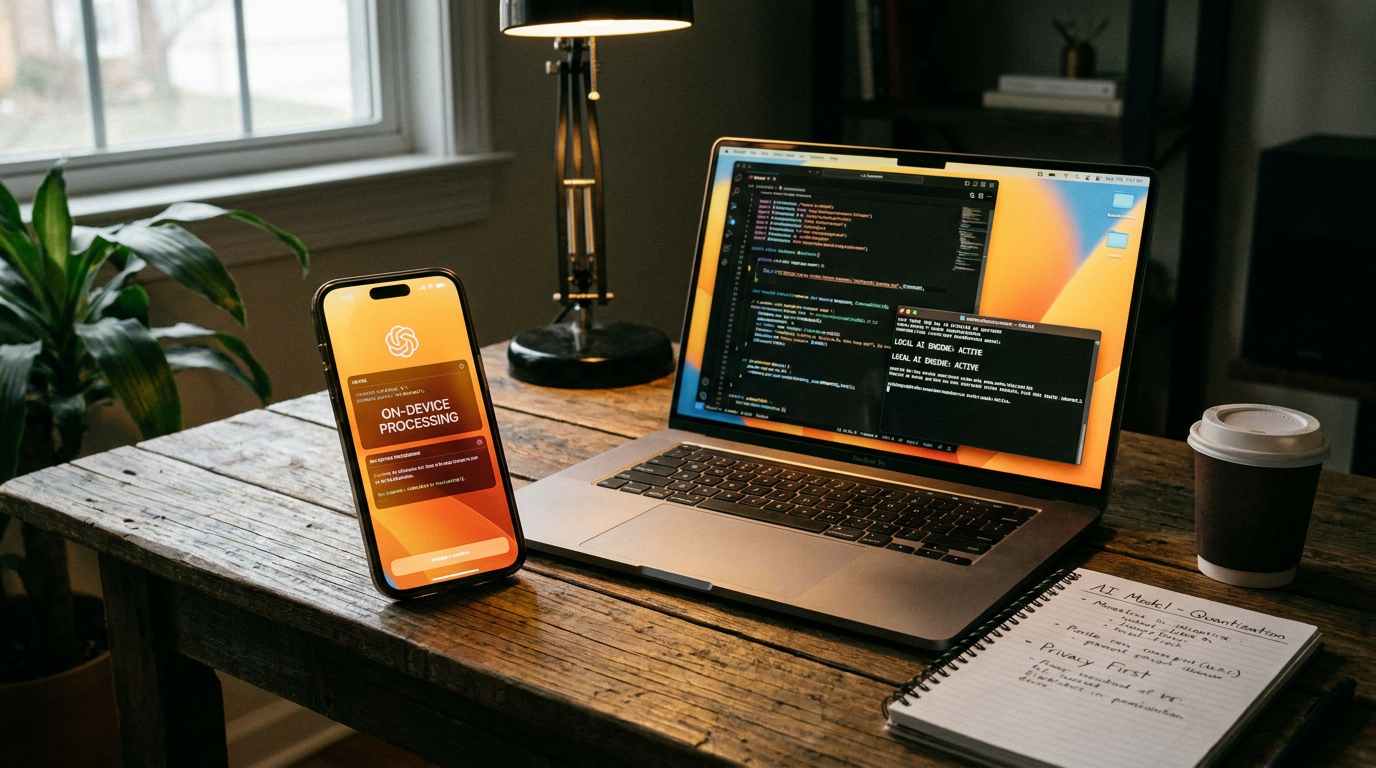
To understand this shift, one must define what makes a model "small." While frontier cloud models boast hundreds of billions or even trillions of parameters—the internal variables that dictate how a neural network processes language—Small Language Models typically range from 1 billion to 14 billion parameters. This drastically reduced footprint allows them to operate entirely locally on consumer hardware, such as standard laptops, smartphones, and even embedded microcomputers. They do not require a continuous internet connection, nor do they rely on expensive API calls to remote servers. Instead, they leverage the existing computational power of the user's device, bringing the intelligence directly to where the data originates.[2][7]
The implications for data privacy are absolute and immediate. When utilizing a cloud-based AI service, users implicitly agree to transmit their prompts, documents, and sensitive information to a third-party server for processing. For heavily regulated industries like healthcare, finance, and legal services—or simply for individuals protective of their personal data—this external transmission is often a non-starter. Local SLMs solve this inherently by ensuring that data never leaves the premises. A physician can summarize patient notes, or a financial analyst can parse confidential earnings reports, with the cryptographic certainty that their inputs remain entirely on their local machine. Privacy is no longer a promise buried in a terms-of-service agreement; it is a physical guarantee dictated by the architecture of the system.[3][8]

Beyond security, local execution introduces the distinct advantage of zero-latency, offline accessibility. Cloud models are perpetually bottlenecked by network speeds and server loads, resulting in variable response times and complete failure during internet outages. A locally hosted SLM operates independently of the web. Whether deployed on a laptop in a remote off-grid cabin, integrated into a factory floor's internal network, or utilized during a natural disaster where connectivity is severed, the model remains fully functional. This resilience is transforming edge computing, allowing autonomous systems and field workers to rely on advanced natural language processing in environments where a stable internet connection is impossible.[3][5]
The economic argument for SLMs is equally compelling, particularly for small and medium-sized enterprises. Operating massive cloud models incurs significant, recurring operational expenses. Every query, summarization, and generation carries a micro-transaction fee that scales linearly with usage. By transitioning to local inference, organizations can eliminate these "cloud taxes" entirely. Recent industry analyses indicate that deploying SLMs can result in an 85% to 95% reduction in total AI operational costs. The only required investment is the initial hardware, which is rapidly becoming commoditized. For a mid-sized company processing thousands of customer service queries daily, the transition from a metered cloud API to a locally hosted SLM represents a massive shift in unit economics.[2][7]
This localized revolution is heavily dependent on recent breakthroughs in consumer hardware. Historically, running a capable neural network required specialized, enterprise-grade graphics processing units (GPUs) that cost tens of thousands of dollars. Today, the landscape has shifted dramatically. Apple's M-series silicon, with its unified memory architecture, and consumer-grade Nvidia RTX graphics cards have inadvertently become powerhouse AI engines. Because large language models are fundamentally constrained by memory bandwidth—the speed at which data can be shuttled from RAM to the processor—architectures that tightly integrate memory and compute excel at local inference. A standard 2026 laptop can now generate text at speeds ranging from 40 to 80 tokens per second, easily outpacing human reading comprehension.[4][6]

This localized revolution is heavily dependent on recent breakthroughs in consumer hardware.
Software innovation has kept pace with hardware, drastically lowering the barrier to entry. Just a few years ago, deploying a local model required deep technical expertise, complex Python environments, and hours of troubleshooting. Today, open-source inference engines like Ollama, Llama.cpp, and vLLM have reduced the process to a single command-line prompt or a simple graphical interface. These tools abstract away the underlying complexity, allowing users to download and run sophisticated models as easily as installing a standard desktop application. This frictionless deployment model has sparked a vibrant ecosystem of developers building customized, local-first AI applications that run seamlessly in the background of everyday operating systems.[4][6]
The technical magic that makes this possible is a process known as quantization. In their raw state, neural network weights are typically stored in 16-bit floating-point precision, meaning a 7-billion parameter model would require roughly 14 gigabytes of memory just to load. Quantization compresses these weights down to 8-bit or even 4-bit precision, drastically shrinking the model's physical footprint with only a negligible loss in output quality. Through advanced quantization techniques, a highly capable 8-billion parameter model can now fit comfortably within 4 to 6 gigabytes of RAM. This mathematical compression is the key that unlocked local AI, allowing models to run on standard hardware without triggering catastrophic memory bottlenecks.[5][7]
The 2026 model landscape is dominated by highly optimized architectures from both tech giants and open-source communities. Microsoft's Phi-4 series has been particularly influential, proving that the quality of training data is far more important than the sheer volume of parameters. By training on carefully curated, "textbook quality" synthetic data, the 14-billion parameter Phi-4 frequently outperforms older 70-billion parameter models in complex reasoning and coding benchmarks. Similarly, Meta's Llama 3.2 and Google's Gemma 3 families offer lightweight, instruction-tuned variants that punch far above their weight class. These models are not just smaller versions of their cloud counterparts; they are entirely new architectures engineered specifically for edge efficiency.[1][7]

The push for efficiency has extended even further down the hardware stack, reaching embedded devices and microcomputers. Enthusiasts and engineers are now successfully deploying ultra-small models, such as the 1-billion parameter Llama 3.2 or TinyLlama, on devices as modest as a Raspberry Pi. While these micro-deployments generate text at a slower rate—often hovering around 5 tokens per second—they are entirely sufficient for background tasks like smart home automation, localized sensor parsing, or simple robotic commands. This capability pushes AI out of the data center and directly into the physical environment, enabling a new class of intelligent, autonomous hardware that operates without ever pinging an external server.[5]
Despite their impressive capabilities, it is crucial to understand the inherent trade-offs of Small Language Models. They are not artificial general intelligence, and they do not possess the vast, encyclopedic world knowledge of a trillion-parameter cloud model. When an SLM is pushed outside of its specific training domain or asked to recall obscure trivia, it is significantly more prone to hallucination—confidently generating plausible but entirely incorrect information. Their smaller parameter count means they simply lack the capacity to store the entirety of the internet within their weights. Users must approach them as highly capable reasoning engines rather than infallible knowledge retrieval systems.[1][8]
Furthermore, SLMs often struggle with highly complex, multi-step reasoning tasks. While they excel at summarization, translation, and structured data extraction, they can lose the thread when asked to navigate deeply layered logical puzzles or maintain context over exceptionally long conversations. Their smaller "context windows" and reduced internal complexity mean they are best utilized for discrete, well-defined tasks rather than open-ended, sprawling analysis. For enterprise deployment, the most successful implementations involve chaining multiple SLMs together, where each model acts as a narrow specialist handling a specific step in a broader workflow, rather than relying on a single model to do everything.[7][8]
This shift toward specialization is the defining characteristic of the local AI movement. Instead of paying for a massive "generalist" model to perform a simple task, organizations are fine-tuning SLMs to become hyper-focused experts. A 3-billion parameter model trained exclusively on medical coding or legal contract parsing will routinely outperform a massive general-purpose model on those specific tasks, while consuming a fraction of the energy. This targeted approach allows businesses to deploy highly accurate, domain-specific AI tools directly to the edge, integrating them into factory production lines, retail point-of-sale systems, and hospital diagnostic equipment where low latency and high reliability are paramount.[2][7]

Ultimately, the rise of Small Language Models represents a fundamental democratization of artificial intelligence. By breaking the monopoly of the cloud, SLMs return control, privacy, and computational sovereignty to the end user. As hardware continues to improve and quantization techniques become even more sophisticated, the gap between local and cloud capabilities will continue to narrow. The future of AI is not a monolithic, centralized brain, but a distributed network of highly efficient, specialized models running quietly and securely on the devices we use every day.[3][8]
How we got here
Early 2023
The release of LLaMA sparks the open-source AI movement, proving capable models can run outside corporate data centers.
Late 2023
Quantization techniques like GGUF become standardized, allowing massive models to fit into standard consumer RAM.
Mid 2024
Microsoft releases the Phi-3 family, demonstrating that high-quality training data can allow small models to beat much larger competitors.
Early 2026
Edge-optimized models like Gemma 3 and Llama 3.2 become standard tools for enterprise deployment, shifting focus from cloud to local.
Viewpoints in depth
Privacy & Security Advocates
Local execution is the only true guarantee of data privacy.
For privacy advocates, the shift to local SLMs is a necessary correction to the cloud-first era. They argue that relying on third-party APIs for processing sensitive medical, legal, or personal data introduces unacceptable risks of data breaches or unauthorized training usage. By executing models entirely on-device, organizations can achieve compliance with strict data sovereignty laws while individuals regain control over their digital footprint.
Enterprise IT Leaders
Edge AI drastically reduces operational costs and eliminates latency bottlenecks.
Corporate IT departments view SLMs primarily through the lens of unit economics and reliability. Paying a per-token fee for millions of daily cloud API calls quickly becomes a massive operational expense. By deploying highly specialized SLMs on local hardware or edge servers, enterprises can slash their AI budgets by up to 95%. Furthermore, local execution guarantees predictable, low-latency performance that isn't derailed by internet outages or cloud provider downtime.
Open-Source Developers
Democratized access to AI accelerates innovation and hardware hacking.
The open-source community sees local SLMs as a triumph of democratization. Developers are actively pushing the boundaries of what consumer hardware can achieve, building tools like Ollama and Llama.cpp that make deployment frictionless. This camp is less concerned with enterprise compliance and more focused on the freedom to customize models, integrate them into smart home systems like Home Assistant, and run AI on unconventional hardware like Raspberry Pis.
What we don't know
- How cloud providers will adjust their pricing models as more enterprises shift workloads to local edge devices.
- Whether future hardware advancements will completely erase the performance gap between local SLMs and cloud-based frontier models.
Key terms
- Small Language Model (SLM)
- A compact AI model, typically under 14 billion parameters, designed to run efficiently on personal devices rather than massive cloud servers.
- Quantization
- A mathematical compression technique that reduces the precision of an AI model's weights, allowing it to use significantly less memory.
- Inference
- The process where a trained AI model processes a prompt and generates a response or prediction.
- Memory Bandwidth
- The speed at which data can be read from or stored into a computer's RAM, a critical bottleneck for running AI locally.
- Edge Computing
- Processing data locally on the device where it is generated (like a phone or laptop) rather than sending it to a centralized cloud server.
Frequently asked
Can I run a local AI model on my current laptop?
Yes, most modern laptops with at least 8GB of RAM can run smaller quantized models. Apple's M-series Macs and PCs with dedicated gaming GPUs perform best.
Do local language models need the internet to work?
No. Once the model file is downloaded to your device, it operates entirely offline, making it ideal for remote work or secure environments.
Are small language models as smart as ChatGPT?
Not across the board. While they excel at specific tasks like summarization or coding, they lack the vast general trivia knowledge and complex reasoning capabilities of massive cloud models.
Is my data safe when using a local SLM?
Yes. Because the processing happens entirely on your device's hardware, your prompts and documents are never transmitted to external servers.
Sources
Source coverage
8 outlets
4 viewpoints surfaced








[1]Cogitx AI ResearchEnterprise IT Leaders
Small Language Models: Comprehensive Guide 2026
Read on Cogitx AI Research →[2]Ruh AIPrivacy & Security Advocates
Small Language Models (SLMs): The Efficient Future of AI in 2026
Read on Ruh AI →[3]DataNorthPrivacy & Security Advocates
Why businesses are using Local LLMs for privacy
Read on DataNorth →[4]Dev.toOpen-Source Developers
Benchmarking Llama 3.2, Phi-3, and Mistral locally
Read on Dev.to →[5]Home Assistant CommunityOpen-Source Developers
Deploying LLMs to a Raspberry Pi Compute Module
Read on Home Assistant Community →[6]Nithin BekalOpen-Source Developers
Comparing Local LLM Performance on Macbooks and PCs
Read on Nithin Bekal →[7]Meta-IntelligenceEnterprise IT Leaders
Deploy SLMs at the edge with enterprise-grade performance
Read on Meta-Intelligence →[8]Factlen Editorial TeamCloud AI Providers
Synthesis by Factlen editorial team
Read on Factlen Editorial Team →

Every angle. Every day.
Get ai stories with full source coverage and perspective breakdowns delivered to your inbox.