
How Fungi and Algae Are Rewriting the Economics of Sustainable Fashion
Lab-grown mycelium leather and algae-based dyes are rapidly approaching price parity with conventional textiles, signaling a massive shift toward a circular material economy.
By Factlen Editorial Team
- Biotech Innovators
- Focused on scaling production, achieving price parity, and replacing fossil-based inputs with lab-grown alternatives.
- Fashion Brands & Retailers
- Focused on meeting sustainability goals and regulatory compliance without sacrificing aesthetic quality or margins.
- Environmental Researchers
- Focused on lifecycle assessments, circular economy metrics, and the urgent need to divest from toxic textile chemistry.
- Traditional Leather Industry
- Argues that traditional leather is a durable byproduct of the food industry, viewing next-gen materials as complementary rather than a total replacement.
What's not represented
- · Garment workers in traditional textile dyeing hubs
- · Conventional cotton and livestock farmers
Why this matters
The fashion industry is one of the world's heaviest polluters, but the commercial scaling of lab-grown leathers and algae dyes proves that sustainability no longer requires sacrificing quality or profit. As these materials reach price parity with plastics and animal products, they offer a blueprint for decarbonizing global manufacturing.
Key points
- Next-generation biomaterials could capture 8% of the global fiber market by 2030.
- Mycelium leather production costs have dropped from $127/sqm to nearly $15/sqm.
- Algae-based textile dyes offer a carbon-negative alternative to toxic fossil-based chemistry.
- Biotech startups are securing nine-figure funding to build industrial-scale manufacturing facilities.
- Adopting lab-grown materials could reduce a brand's cost of goods sold by 4% over five years.
The fashion industry has long operated on a linear, extractive model, relying heavily on fossil fuels, water-intensive agriculture, and toxic chemistry. But step into a material lab in 2026, and the landscape looks radically different.[5]
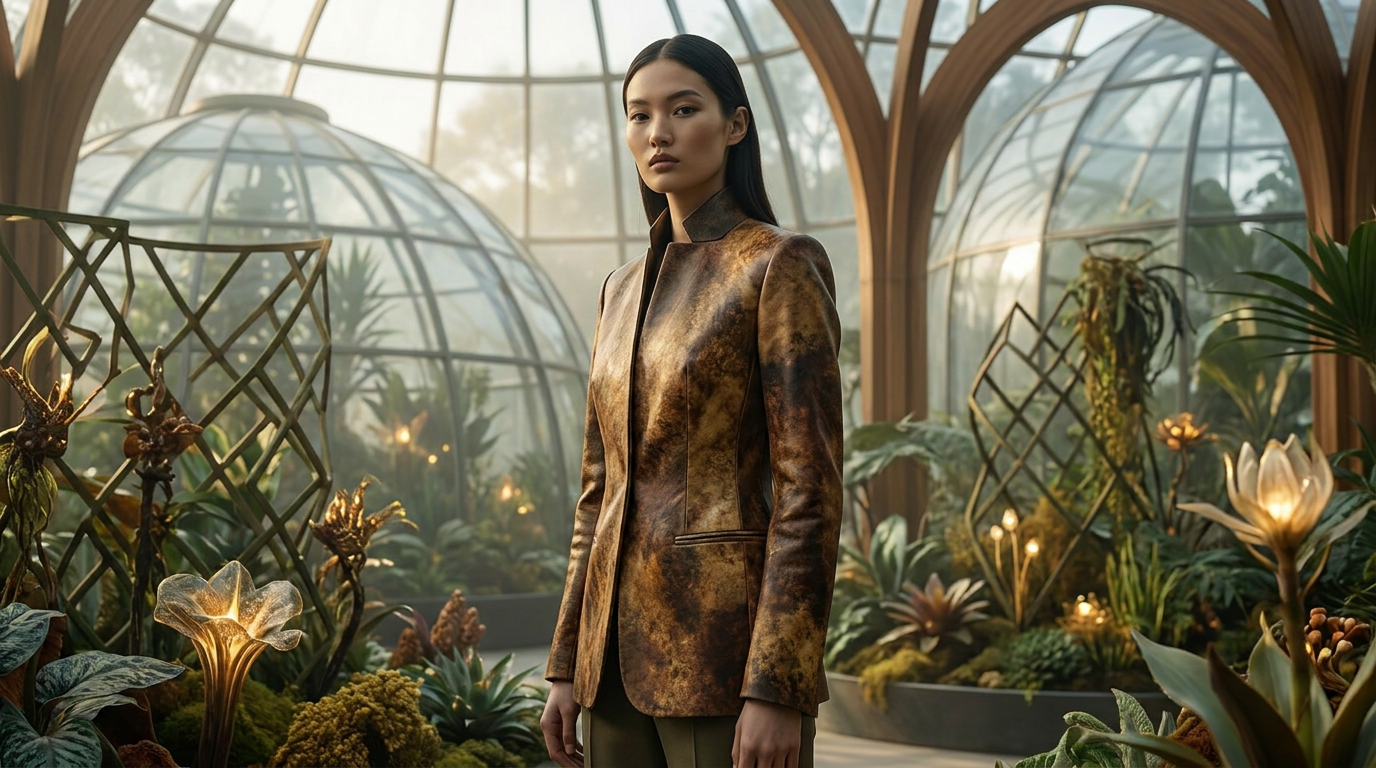
Jackets are being grown from the root structures of mushrooms, sneakers are spun from pineapple leaves, and fabrics are dyed using carbon-absorbing algae. What was once confined to experimental runway statements has officially entered the commercial mainstream.[5]
The shift is being driven by a convergence of environmental urgency, regulatory pressure, and massive technological leaps in biofabrication. According to a recent Boston Consulting Group report, next-generation materials could capture 8% of the global fiber market by 2030—representing roughly 13 million tons of material.[1]
For years, the primary barrier to sustainable fashion was the "green premium"—the prohibitive cost of producing eco-friendly alternatives. However, the economics of biomaterials are rapidly approaching a tipping point.[3]

Take mycelium leather, a material cultivated from the vegetative part of fungi. In 2015, producing a square meter of mycelium leather cost approximately $127, restricting its use to exclusive luxury partnerships. By 2020, optimizations in substrate formulations and growth conditions drove that cost down to $23.[3]
Today, production costs are hovering around $15 per square meter, placing it in direct price parity with conventional bovine leather, which typically costs between $18 and $22 per square meter.[3]
This economic viability has unlocked unprecedented scale. Biotech startups like MycoWorks, Ecovative, and Hydefy have each secured nine-figure funding rounds to build industrial-scale facilities, moving beyond pilot programs to fulfill massive commercial contracts.[4]
In a major milestone for widespread access, MycoWorks recently launched a direct-to-consumer e-commerce platform for its "Reishi" mycelium material. This allows independent designers and small brands to purchase sheets directly, bypassing the massive minimum order quantities that historically locked out smaller players.[2]

In a major milestone for widespread access, MycoWorks recently launched a direct-to-consumer e-commerce platform for its "Reishi" mycelium material.
The environmental math behind these fungal textiles is compelling. Lifecycle assessments demonstrate that cultivating mycelium requires 97% less water than conventional leather tanning and generates 89% fewer greenhouse gas emissions.[3]
Beyond structural materials like leather, innovators are tackling the fashion industry's most toxic secret: color. Traditional textile dyeing relies on fossil-based chemistry, releasing an estimated 200,000 tons of toxic chemicals into global waterways annually.[7]
Algae is emerging as a powerful, regenerative alternative. Startups like Israel-based Algaeing and the EU-funded LOCALITY project in Sweden and Norway are harnessing microalgae to create biodegradable, non-toxic dyes.[6][7]
Because algae photosynthesizes, it naturally absorbs carbon dioxide as it grows, rendering the resulting dyes carbon-negative. Furthermore, applying these biological pigments to textiles reduces water consumption by up to 80% compared to synthetic dyeing processes.[7]

The transition is not without friction. Natural dyes can behave unpredictably regarding colorfastness and UV resistance, requiring researchers to develop new fixation methods that do not rely on the heavy metals used in conventional textile manufacturing.[6]
Additionally, the traditional leather industry argues that biomaterials should be viewed as complementary rather than a total replacement. Proponents note that bovine leather is a byproduct of the food industry, boasting a proven "healthspan" of decades, which inherently distributes its environmental impact over a long lifecycle.[8]
Yet, the momentum behind biofabrication is undeniable. For forward-looking brands, the strategic adoption of next-gen materials is no longer just a sustainability play; it is a financial imperative.[1]

Transitioning to these resilient, lab-grown supply chains could reduce a brand's cost of goods sold by an estimated 4% over the next five years compared to inaction, insulating them from climate-related agricultural shocks and tightening environmental regulations.[1][5]
We are witnessing the dawn of a circular material economy. By replacing petroleum and animal agriculture with fungi and algae, the fashion industry is finally learning to collaborate with nature rather than merely extracting from it.[9]
How we got here
2015
Early mycelium leather production costs hover around $127 per square meter, limiting it to high-end concept pieces.
2021
Major fashion houses begin debuting exclusive capsule collections featuring mushroom-based leather.
2023
Biotech startups secure nine-figure funding rounds to build commercial-scale production facilities.
2025
MycoWorks launches a direct-to-consumer platform for its Reishi material, making biomaterials accessible to independent designers.
2026
Next-generation materials approach price parity with conventional textiles, driven by regulatory pressures and optimized bio-manufacturing.
Viewpoints in depth
Biotech Innovators
Focused on scaling production, achieving price parity, and replacing fossil-based inputs with lab-grown alternatives.
For biotechnology startups, the primary objective is moving from pilot-scale novelty to industrial ubiquity. Companies like MycoWorks and Algaeing argue that the fashion industry's reliance on petroleum and animal agriculture is fundamentally unsustainable. By engineering biological processes—such as cultivating mycelium on agricultural waste or harvesting pigments from fast-growing microalgae—they aim to decouple textile production from environmental degradation. Their current focus is on driving down costs through economies of scale and proving that biomaterials can meet or exceed the technical performance of legacy fabrics.
Fashion Brands & Retailers
Focused on meeting sustainability goals and regulatory compliance without sacrificing aesthetic quality or margins.
Apparel companies are caught between mounting regulatory pressures, shifting consumer expectations, and the rigid economics of retail. For these brands, next-generation materials offer a vital pathway to decarbonize their supply chains and insulate themselves from climate-related agricultural shocks. However, they remain cautious about supply consistency, minimum order quantities, and the "green premium." Their adoption strategy hinges on biomaterials achieving strict price parity and seamless integration into existing manufacturing infrastructure, ensuring that sustainability does not compromise their bottom line.
Traditional Leather Industry
Argues that traditional leather is a durable byproduct of the food industry, viewing next-gen materials as complementary rather than a total replacement.
Representatives of the conventional leather industry push back against the narrative that biomaterials will entirely replace animal hides. They emphasize that bovine leather is inherently a byproduct of global meat production, arguing that utilizing these hides prevents massive biological waste. Furthermore, they highlight the proven longevity and "healthspan" of high-quality leather goods, which can last for decades, thereby distributing their environmental footprint over a much longer lifecycle than many synthetic or early-stage alternative materials.
Environmental Researchers
Focused on lifecycle assessments, circular economy metrics, and the urgent need to divest from toxic textile chemistry.
Academic researchers and environmental organizations evaluate biomaterials strictly through the lens of lifecycle assessments (LCAs). They champion the staggering reductions in water usage and greenhouse gas emissions offered by mycelium and algae, particularly praising the carbon-negative potential of photosynthetic dyes. However, they also caution against "greenwashing," urging the industry to ensure that the binders, coatings, and fixation methods used in biofabrication do not inadvertently reintroduce toxic chemicals or microplastics into the environment.
What we don't know
- Whether biomaterials can maintain consistent quality and structural integrity when scaled to millions of tons annually.
- How quickly small and medium-sized enterprises (SMEs) will be able to afford and access these materials without facing prohibitive minimum order quantities.
- The long-term durability and aging characteristics of mycelium leather compared to decades-old conventional leather.
Key terms
- Mycelium
- The vegetative, thread-like root structure of fungi, which can be cultivated and compressed into a durable, leather-like material.
- Biofabrication
- The production of complex biological products from raw materials such as living cells, molecules, and extracellular matrices.
- Circular Economy
- An economic system aimed at eliminating waste and the continual use of resources, contrasting with the traditional linear "take, make, dispose" model.
- Green Premium
- The additional cost historically associated with choosing a clean, sustainable technology or material over a conventional, higher-emission alternative.
- Colorfastness
- The resistance of a material's color to fading or running when exposed to environmental factors like washing, light, or friction.
Frequently asked
What is mycelium leather?
It is a sustainable material grown from the vegetative root structure of mushrooms, engineered to mimic the texture, flexibility, and durability of animal leather.
Are algae dyes better for the environment?
Yes. They are biodegradable, reduce water usage by up to 80%, and naturally absorb carbon dioxide during the algae's growth phase, making them carbon-negative.
Is mushroom leather as cheap as real leather?
It is rapidly approaching price parity. Production costs have dropped from $127 per square meter in 2015 to around $15 today, making it competitive with conventional bovine leather.
Why hasn't every brand switched to biomaterials?
Challenges remain regarding supply consistency, high minimum order quantities that lock out small brands, and the time required to build industrial-scale bio-manufacturing facilities.
Sources
Source coverage
9 outlets
4 viewpoints surfaced









[1]BCGFashion Brands & Retailers
Scaling Next-Gen Materials in Fashion: An Executive Guide
Read on BCG →[2]Fashion DiveBiotech Innovators
Biomaterials firm launches DTC mycelium leather
Read on Fashion Dive →[3]Biology JournalEnvironmental Researchers
Commercial Viability and Environmental Impact of Mycelium-Based Leather Alternatives
Read on Biology Journal →[4]TrellisBiotech Innovators
Hèrmes and Stella McCartney embrace a leather alternative: fungus
Read on Trellis →[5]CFDAFashion Brands & Retailers
A New Materials World – and Its Setbacks
Read on CFDA →[6]EU LOCALITY ProjectEnvironmental Researchers
Developing algae-based dyes for fabrics
Read on EU LOCALITY Project →[7]Green ProphetEnvironmental Researchers
Natural, sustainable textile dyes using algae
Read on Green Prophet →[8]APLFTraditional Leather Industry
How Next-Gen Fashion Materials Rise to Power
Read on APLF →[9]Factlen Editorial TeamEnvironmental Researchers
Synthesis by Factlen editorial team
Read on Factlen Editorial Team →

Every angle. Every day.
Get lifestyle stories with full source coverage and perspective breakdowns delivered to your inbox.