
How Enhanced Geothermal Systems Are Unlocking 24/7 Clean Energy Anywhere
By borrowing advanced drilling techniques from the oil and gas industry, next-generation geothermal technology is tapping into the Earth's heat to provide continuous, carbon-free power.
By Factlen Editorial Team
- Clean Energy Advocates
- Focus on EGS as the ultimate baseload complement to wind and solar.
- Tech & Industry Investors
- Value EGS for its ability to provide 24/7 firm power for AI data centers.
- Scientific & Regulatory Monitors
- Focus on advancing the technology safely while monitoring seismic and environmental risks.
What's not represented
- · Local communities near EGS drilling sites
- · Traditional fossil fuel workers transitioning to geothermal
Why this matters
Wind and solar power are intermittent, leaving grids vulnerable when the sun sets. Enhanced Geothermal Systems (EGS) solve this by providing round-the-clock clean baseload power, potentially unlocking enough energy to power the entire U.S. grid multiple times over.
Key points
- Enhanced Geothermal Systems (EGS) use advanced drilling to extract heat from deep, dry rock, bypassing the need for natural hot springs.
- The technology borrows horizontal drilling and hydro-shearing techniques from the shale oil and gas industry.
- EGS provides 24/7 baseload clean power, making it a highly sought-after energy source for AI data centers.
- Drilling speeds have improved by 500% in recent years, dramatically lowering the cost of geothermal development.
- The U.S. Department of Energy projects EGS could expand domestic geothermal capacity to 90 gigawatts by 2050.
The global transition to renewable energy has long wrestled with a fundamental math problem: the wind does not always blow, and the sun does not always shine. While wind and solar power have become remarkably cheap, their intermittency leaves electrical grids vulnerable, requiring expensive battery arrays or fossil-fuel backups to maintain stability. To fully decarbonize, the grid requires "baseload" power—energy that flows continuously, 24 hours a day, regardless of the weather. Next-generation geothermal energy is rapidly emerging as the solution to this exact bottleneck.[1][7]
Geothermal power is not a new concept; humans have harnessed the Earth's subterranean heat for over a century. However, conventional geothermal plants have historically been confined to a geographic lottery. They require a rare combination of natural underground water, highly permeable rock, and intense heat close to the surface—conditions typically found only near volcanic fault lines, such as in Iceland or California's Geysers. Because of these strict geological prerequisites, traditional geothermal supplies less than 1% of the world's electricity.[1][6]
Enhanced Geothermal Systems (EGS) are designed to rewrite those geological rules. Instead of hunting for rare natural underground aquifers, EGS technology engineers its own. The foundational premise is simple: if you drill deep enough anywhere on the planet, the Earth's crust is blistering hot. By artificially creating permeability and introducing water into these deep, hot dry rocks, EGS transforms geothermal energy from a location-bound niche into a universally scalable power source.[1][4]
The mechanism begins with advanced drilling. Engineers drill vertical wells anywhere from three to ten kilometers deep into crystalline rock formations where temperatures exceed 150°C (300°F). At these depths, the rock is incredibly dense and lacks the natural fractures necessary for water to flow. To overcome this, EGS borrows horizontal drilling techniques pioneered by the shale oil and gas industry, turning the drill bit 90 degrees to expose thousands of feet of hot rock.[4]

Once the well is drilled, operators use a process called "hydro-shearing." Fluid is injected into the well at high pressure to pry open existing, microscopic fractures in the deep rock. Unlike traditional fossil fuel fracking, which blasts new cracks into shale using chemical proppants, hydro-shearing gently dilates natural fault lines to create a vast, permeable underground radiator. Cold water is then pumped down an injection well, forced through this hot fractured rock network, and drawn back up through a separate production well.[4]
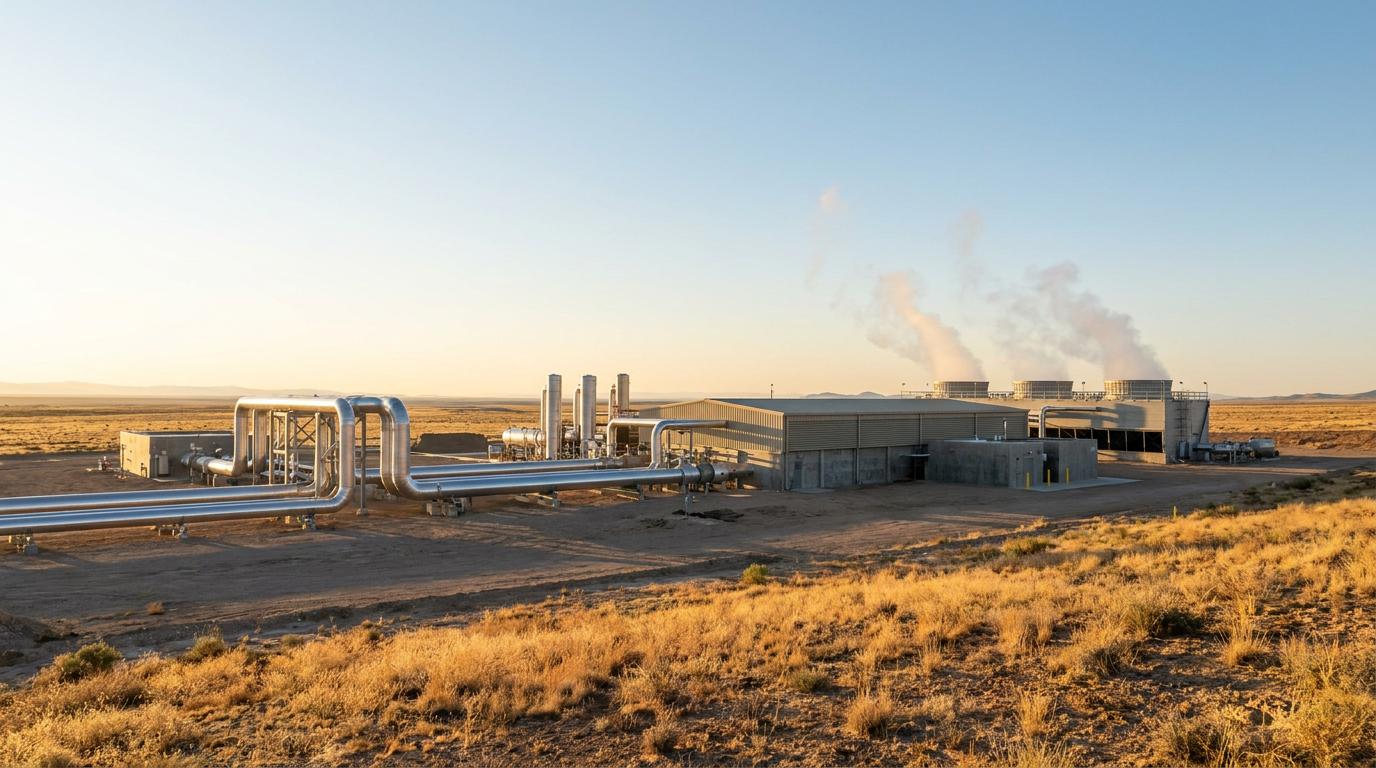
At the surface, the superheated water enters a binary cycle power plant. Because the geothermal fluid is kept under immense pressure, it does not boil. Instead, it is passed through a heat exchanger, transferring its thermal energy to a secondary "binary" fluid that has a much lower boiling point than water. This secondary fluid flashes into vapor, spinning a massive turbine to generate electricity. The original geothermal water, now cooled, is pumped back underground in a closed loop to be heated again.[2]
The rapid maturation of EGS is largely a story of technology transfer. For decades, the concept of hot dry rock geothermal was economically unviable because drilling through miles of hard granite destroyed drill bits and bankrupted projects. However, the shale boom of the 2010s drove massive innovations in polycrystalline diamond compact (PDC) drill bits, fiber-optic subsurface sensors, and high-pressure fluid management. EGS startups are now repurposing this exact hardware to harvest heat instead of hydrocarbons.[1][4]
The rapid maturation of EGS is largely a story of technology transfer.
The economic impact of this technology transfer has been staggering. At the U.S. Department of Energy's Utah FORGE laboratory—a dedicated testing ground for next-generation geothermal—researchers have demonstrated a 500% improvement in drilling speeds over the past three years. Across the broader EGS industry, the time required to drill a deep geothermal well has plummeted by 70% in just 24 months, drastically lowering the capital expenditures that previously held the sector back.[4]

This drop in costs has pushed EGS across the commercial threshold. Fervo Energy, the industry's leading developer, is currently constructing Cape Station in Beaver County, Utah. Designed to be the world's largest next-generation geothermal facility, Cape Station is scaling up to 400 megawatts of capacity—enough to power hundreds of thousands of homes. The project has already secured power purchase agreements with major utilities, proving that EGS can move from government-funded pilot programs to grid-scale commercial deployment.[3]
The financial markets are signaling that the EGS era has arrived. In 2026, Fervo Energy is preparing for an initial public offering (IPO) aimed at raising up to $1.33 billion, targeting a valuation of roughly $6.5 billion. This influx of capital represents one of the largest clean energy public offerings of the decade, reflecting immense Wall Street confidence in the viability of engineered geothermal reservoirs.[3]
The sudden gold rush into EGS is being heavily accelerated by the tech industry. The explosion of artificial intelligence has triggered a massive surge in electricity demand, with new AI data centers requiring hundreds of megawatts of continuous power. Tech giants like Google and Microsoft, bound by strict corporate decarbonization pledges, cannot rely on natural gas to run their server farms. They are aggressively backing EGS because it is one of the only technologies capable of providing 24/7, carbon-free electricity at scale.[3][6]
Despite the momentum, EGS faces environmental and regulatory scrutiny, particularly regarding induced seismicity. Because the process involves injecting high-pressure fluids underground, it can trigger micro-earthquakes. To manage this risk, scientists from the Lawrence Berkeley National Laboratory recently deployed custom high-temperature seismometers nearly 7,000 feet underground at Fervo's Utah site. Operating in 338°F conditions, these sensors provide real-time, continuous monitoring of fracture formations, ensuring that the hydro-shearing process remains safe and contained.[5]

Water consumption is another hurdle. The initial stimulation of an EGS reservoir requires millions of gallons of water, a sensitive issue in the drought-prone American West where many early projects are located. However, the industry is mitigating this by utilizing non-freshwater sources, such as treated municipal wastewater or agricultural runoff. Furthermore, because EGS operates as a closed loop, water usage drops to near zero once the plant is operational, and its overall surface land footprint is significantly smaller than that of equivalent solar or wind farms.[1][6]
Beyond the grid, EGS offers a unique geopolitical and economic advantage: a seamless transition for the fossil fuel workforce. The roughnecks, petroleum engineers, and drilling contractors who built the oil and gas industry possess the exact skills required to scale EGS. Geothermal development provides a direct, high-paying off-ramp for these workers into the clean energy economy, sidestepping the economic displacement often associated with the transition away from fossil fuels.[4][7]
The long-term potential of engineered geothermal is vast. The U.S. Department of Energy estimates that with continued technological refinement, EGS could expand domestic geothermal capacity from just 4 gigawatts today to 90 gigawatts by 2050. By unlocking the limitless heat beneath our feet, next-generation geothermal is poised to transform from a geological novelty into the reliable, carbon-free backbone of the 21st-century grid.[1][3]
How we got here
1970s
Early experiments with Hot Dry Rock (HDR) geothermal face severe technical and financial hurdles.
2018
The U.S. Department of Energy launches the Utah FORGE project to research and develop EGS technologies.
2023
Fervo Energy successfully completes a 30-day commercial pilot, proving the viability of engineered geothermal reservoirs.
2025
Researchers at Utah FORGE demonstrate a 500% improvement in drilling speeds, drastically lowering EGS capital costs.
2026
Fervo Energy prepares for a $1.33 billion IPO as its 400 MW Cape Station project scales up for commercial delivery.
Viewpoints in depth
Clean Energy Advocates
View EGS as the critical missing piece for a 100% renewable grid.
For grid operators and environmental advocates, the holy grail of renewable energy is 'firm' or baseload power—electricity that flows 24/7 regardless of the weather. Wind and solar are cheap but intermittent, requiring expensive battery storage to cover gaps. Clean energy advocates argue that EGS provides the perfect complement, offering the reliability of a coal or nuclear plant but with zero carbon emissions and a fraction of the land footprint.
The Tech Industry
Sees geothermal as the ideal power source for energy-hungry AI data centers.
The explosion of artificial intelligence has triggered a massive surge in electricity demand. Tech companies like Google and Microsoft have strict carbon-neutral pledges, meaning they cannot rely on natural gas to power their new data centers. They are aggressively funding EGS startups like Fervo Energy because geothermal provides the continuous, uninterrupted clean power required to run server farms around the clock.
Environmental Skeptics
Raise concerns about induced seismicity and water consumption.
While supportive of clean energy, some environmental groups and local communities are cautious about the mechanics of EGS. Because the process involves injecting fluid at high pressure to fracture rock—similar to oil and gas fracking—it can cause micro-earthquakes (induced seismicity). Additionally, the initial stimulation of the rock requires millions of gallons of water, prompting concerns in drought-prone western states where many EGS projects are located.
What we don't know
- Whether the rapid cost reductions seen in pilot projects will scale linearly as EGS expands to more challenging geological regions.
- The long-term impact of continuous hydro-shearing on deep subsurface fault lines over decades of operation.
- How quickly regulatory bodies will streamline the permitting process for EGS wells on federal lands.
Key terms
- Enhanced Geothermal Systems (EGS)
- A technology that creates artificial underground reservoirs by injecting fluid into hot, dry rock to extract heat for electricity.
- Hydro-shearing
- The process of injecting fluid at high pressure to gently open existing microscopic fractures in deep underground rock.
- Baseload Power
- The minimum amount of electric power needed to be supplied to the electrical grid at any given time, requiring 24/7 reliability.
- Binary Cycle Power Plant
- A facility where hot geothermal water heats a secondary fluid with a lower boiling point, which flashes to vapor to spin a turbine.
- Induced Seismicity
- Minor earthquakes or tremors caused by human activity, such as injecting fluids deep underground.
Frequently asked
Is EGS the same as oil and gas fracking?
It uses similar equipment, but instead of extracting fossil fuels, EGS injects water to extract heat. It also uses 'hydro-shearing' to open existing fractures rather than blasting new ones, and uses no hydrocarbon chemicals.
Can EGS be built anywhere?
Theoretically, yes, because the Earth's crust is hot everywhere if you drill deep enough. However, current projects target areas where hot rock is relatively close to the surface (3 to 10 kilometers down) to keep drilling costs manageable.
Does geothermal energy produce greenhouse gases?
Next-generation closed-loop EGS systems produce virtually zero greenhouse gas emissions, as the water is continuously recirculated and no fossil fuels are burned.
Sources
Source coverage
7 outlets
3 viewpoints surfaced






[1]World Resources InstituteClean Energy Advocates
Next-Generation Geothermal Can Help Unlock 100% Clean Power
Read on World Resources Institute →[2]U.S. Department of EnergyScientific & Regulatory Monitors
Geothermal Power Plants
Read on U.S. Department of Energy →[3]CarbonCredits.comTech & Industry Investors
Fervo Energy Prepares for $1.33B IPO as Geothermal Demand Surges
Read on CarbonCredits.com →[4]Information Technology and Innovation FoundationClean Energy Advocates
Accelerating Advanced Geothermal Technologies
Read on Information Technology and Innovation Foundation →[5]Lawrence Berkeley National LaboratoryScientific & Regulatory Monitors
Custom sensor monitors seismicity for months straight more than a mile below ground
Read on Lawrence Berkeley National Laboratory →[6]BloombergNEFTech & Industry Investors
Next-Generation Geothermal Technologies
Read on BloombergNEF →[7]Factlen Editorial TeamScientific & Regulatory Monitors
Synthesis by Factlen editorial team
Read on Factlen Editorial Team →


Every angle. Every day.
Get guides stories with full source coverage and perspective breakdowns delivered to your inbox.