
The Hidden Inefficiency of Portable Air Conditioners and the Dual-Hose Fix
A growing consensus of HVAC experts and climate researchers warns that popular single-hose portable air conditioners are fundamentally inefficient due to a flaw that creates negative air pressure. Upgrading to dual-hose models and understanding new Department of Energy testing standards can dramatically improve cooling performance and reduce grid strain.
By Factlen Editorial Team
- Consumer Advocates
- Focuses on practical cooling performance, misleading marketing metrics, and the cost-saving benefits of dual-hose systems.
- Energy & Climate Researchers
- Emphasizes the macroeconomic and environmental threat of inefficient cooling on global power grids.
- Regulatory Agencies & Analysts
- Prioritizes the establishment of accurate, real-world testing standards to correct market failures.
What's not represented
- · Portable AC Manufacturers
- · Low-Income Consumers Relying on Cheap Units
Why this matters
Millions of consumers are unknowingly purchasing portable air conditioners that actively pull hot outdoor air into their homes, driving up electricity bills and straining global power grids. Understanding the physics of dual-hose systems and the new SACC efficiency ratings can save buyers hundreds of dollars while reducing climate impact.
Key points
- Single-hose portable air conditioners create negative pressure, actively sucking hot outdoor air into the home.
- Dual-hose units solve this inefficiency by using a dedicated intake hose to cool the machine's internal condenser.
- The older ASHRAE testing standard misled consumers by measuring cooling capacity in a perfectly sealed lab.
- The DOE's new SACC rating accounts for real-world heat infiltration, often dropping advertised BTUs by nearly half.
- Space cooling is the fastest-growing source of energy demand in the buildings sector globally.
- Transitioning to highly efficient air conditioners could reduce peak electrical grid load by up to 20%.
As global temperatures reach 1.5°C above pre-industrial levels, the demand for space cooling is surging. The International Energy Agency (IEA) reports that cooling now represents roughly 10% of global electricity demand, a figure that spikes dramatically during summer heatwaves.[3]
For millions of renters and homeowners without central air, portable air conditioners are the immediate lifeline. During sustained heat events, a mere 1°C increase in average daily temperatures above 24°C can drive a 16% spike in weekly air conditioner sales.[3]
However, a growing consensus among climate researchers and HVAC engineers warns that the most popular cooling solution on the market is fundamentally flawed. According to a recent analysis in New Scientist, the standard single-hose portable air conditioner is so inefficient that experts argue the design should be phased out entirely.[1]
The core issue lies in the physics of thermodynamics and air pressure. To cool a room, an air conditioner must absorb indoor heat and exhaust it outside. In a standard window unit, the hot components sit outside the glass. But in a portable unit, the entire machine sits inside the room, meaning it must use a plastic duct to vent the waste heat out a window.[5]
In a single-hose design, the unit pulls already-cooled air from the room, uses it to cool its internal condenser, and then blasts that hot air out the window. This creates a critical mechanical flaw: negative pressure.[1][5]

By continuously pumping indoor air outside, a single-hose unit lowers the air pressure inside the room. Physics dictates that this pressure must be equalized. As a result, the vacuum effect actively sucks hot, unconditioned outdoor air into the home through cracks under doors, gaps in window frames, and vents.[2][6]
Industry reviewers note that this "infiltration air" forces the machine into a perpetual battle against itself. The unit is actively pulling the summer heat indoors at the exact same time it is trying to cool the room down. In practical testing, this limits the unit's ability to cool larger spaces and forces the compressor to run continuously, driving up electricity bills.[2][5]
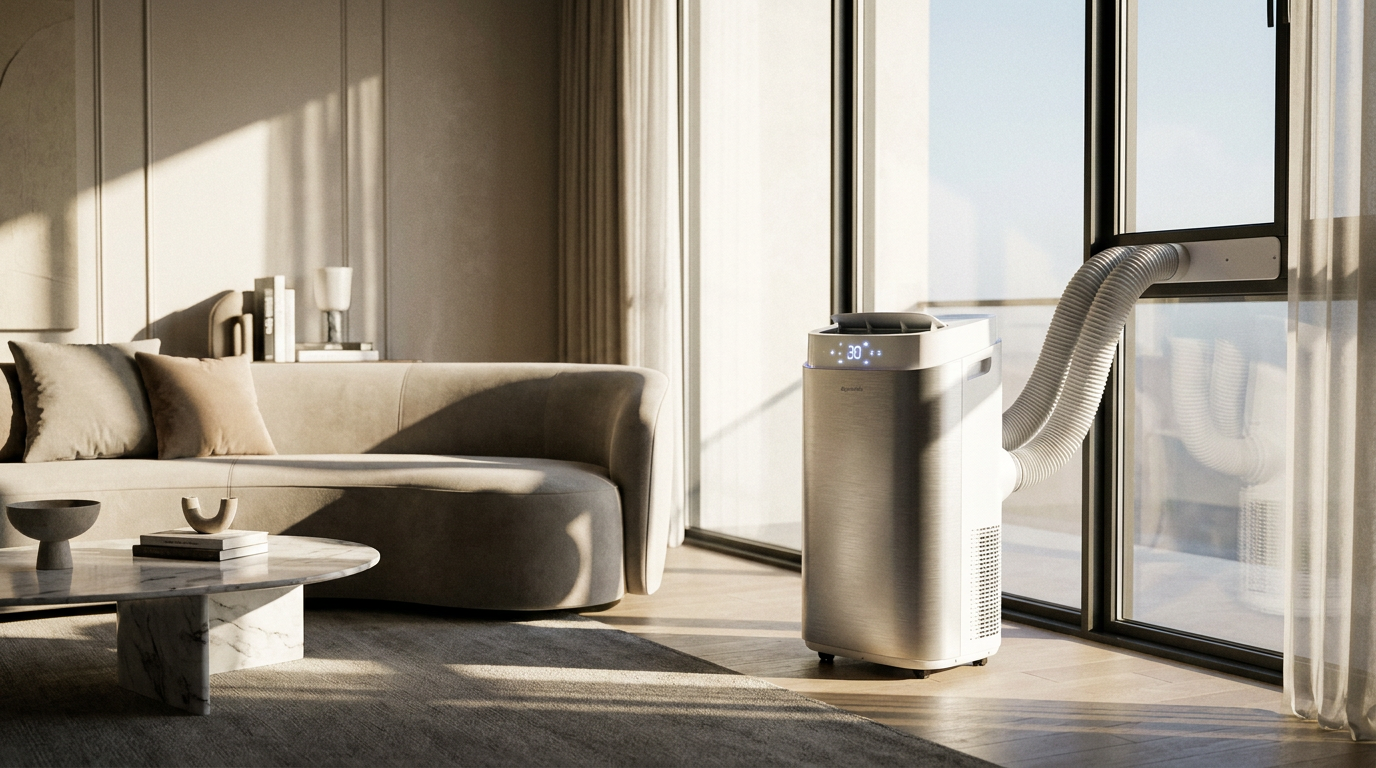
The "easy fix" to this thermodynamic trap is the dual-hose portable air conditioner. While slightly more expensive and requiring a wider window bracket, dual-hose models fundamentally alter the airflow mechanics to eliminate negative pressure.[1][2]
The "easy fix" to this thermodynamic trap is the dual-hose portable air conditioner.
A dual-hose unit features two separate ducts connected to the window. One hose actively draws in warm outdoor air specifically to cool the internal condenser, while the second hose immediately exhausts that heated air back outside.[2][5]
Because the air used to cool the machine is entirely isolated from the air inside the room, the unit never exhausts the room's conditioned air. The indoor air pressure remains neutral, and the vacuum effect is eliminated.[5][6]
For years, consumers were unaware of this massive efficiency gap due to a misleading regulatory testing standard known as ASHRAE. Developed by the American Society of Heating, Refrigerating, and Air-Conditioning Engineers, the older ASHRAE test measured cooling capacity in a perfectly sealed laboratory environment.[4]
Because the ASHRAE lab was sealed, it never accounted for the hot infiltration air that a single-hose unit pulls into a real-world living room. This allowed manufacturers to advertise single-hose units with artificially inflated cooling capacities, often claiming 14,000 BTUs (British Thermal Units) of power.[4][6]
To correct this, the U.S. Department of Energy (DOE) introduced the Seasonally Adjusted Cooling Capacity (SACC) standard. The SACC metric mandates that manufacturers account for the heat gained from the exhaust duct and the hot air infiltrating the room due to negative pressure.[4]

Under the rigorous SACC standard, the true performance gap becomes undeniable. A single-hose unit that previously boasted a 14,000 BTU ASHRAE rating often drops to a mere 7,700 BTU SACC rating once the negative pressure penalty is applied.[4][6]
While dual-hose units do have minor inefficiencies—such as the radiant heat emitted by having two warm plastic ducts in the room instead of one—testing confirms that eliminating the infiltration air results in vastly superior real-world cooling.[2][5]
The stakes of this consumer shift extend far beyond individual electricity bills. The IEA warns that extreme heat and inefficient cooling are locked in a vicious cycle: hotter temperatures drive the use of inefficient ACs, which strain power grids and require more fossil fuels to operate, thereby accelerating the warming that caused the heatwave in the first place.[1][3]
Space cooling is currently the fastest-growing source of energy demand in the buildings sector. In regions like Texas and India, cooling-driven peaks are pushing electrical grids to the brink of failure, raising the risk of rolling blackouts during lethal heat events.[3]

Transitioning the consumer market away from single-hose units is a critical step in mitigating this grid strain. The IEA estimates that if all new air conditioners sold globally were highly efficient, the increase in peak electrical load could be reduced by 20%.[3]
Ultimately, the evidence suggests that the convenience of a single-hose portable AC comes at a steep cost to both the consumer and the climate. By understanding the physics of negative pressure and the reality of SACC ratings, buyers can opt for dual-hose systems—a simple hardware choice that breaks the cycle of inefficient cooling.[1][6]
How we got here
2016
The U.S. Department of Energy begins evaluating energy efficiency standards specifically for portable air conditioners.
October 2017
The DOE introduces the Seasonally Adjusted Cooling Capacity (SACC) metric to account for real-world heat infiltration.
2020
Updated energy efficiency standards for portable cooling units are officially finalized by regulators.
2025
The SACC efficiency standards become fully binding, forcing manufacturers to display more accurate cooling capacities.
Viewpoints in depth
The Climate & Grid Perspective
Viewing inefficient ACs as a systemic threat to infrastructure and emissions targets.
For energy researchers and grid operators, the proliferation of single-hose air conditioners is a compounding crisis. As global temperatures rise, the immediate consumer reaction is to purchase the cheapest available cooling unit. However, because these units operate inefficiently, they draw excessive power during peak heat hours. The International Energy Agency notes that this forces utility companies to fire up heavily polluting 'peaker' plants to prevent blackouts, thereby releasing more greenhouse gases and accelerating the warming cycle.
The Consumer Advocate Perspective
Focusing on the financial deception of outdated BTU ratings and real-world performance.
Consumer protection analysts argue that buyers have been systematically misled by the ASHRAE testing standards. Because single-hose units are cheaper to manufacture, they dominate retail shelves. Shoppers purchase what they believe is a powerful 14,000 BTU machine, only to find it cannot cool a medium-sized living room because it is actively pulling hot air through the floorboards. Advocates stress that educating the public on SACC ratings and the dual-hose mechanism is essential for saving consumers money on both the upfront purchase and their monthly utility bills.
What we don't know
- Whether manufacturers will voluntarily phase out single-hose units before outright bans are considered.
- How quickly the global power grid can adapt to the projected tripling of cooling demand by 2050.
- If future portable AC designs can eliminate the radiant heat loss from the exhaust ducts entirely.
Key terms
- Negative Pressure
- A state where the air pressure inside a room is lower than outside, causing unconditioned outdoor air to be sucked in through gaps.
- SACC (Seasonally Adjusted Cooling Capacity)
- A Department of Energy rating that measures an air conditioner's true cooling power by accounting for real-world inefficiencies.
- ASHRAE Rating
- An older, lab-based cooling measurement that often overstates a portable AC's effectiveness by ignoring infiltration air.
- Infiltration Air
- Unconditioned, warm outdoor air that is pulled into a building through cracks and gaps to replace exhausted air.
- Condenser
- The internal component in an air conditioner that releases collected heat, which must be cooled by either indoor or outdoor air.
Frequently asked
Why does my single-hose AC pull in warm air?
It creates negative pressure by exhausting indoor air outside, forcing warm outdoor air to seep in through cracks to replace the missing air.
What is the difference between ASHRAE and SACC ratings?
ASHRAE measures cooling in a perfect lab, while SACC accounts for real-world inefficiencies like the heat pulled in from outside.
Are dual-hose air conditioners harder to install?
They require a slightly wider window bracket to accommodate two hoses, but the installation process is fundamentally the same as a single-hose unit.
Can I convert a single-hose AC to a dual-hose?
Generally no, as the internal intake and exhaust chambers are specifically designed and sealed for either one or two hoses.
Sources
Source coverage
6 outlets
3 viewpoints surfaced






[1]New ScientistEnergy & Climate Researchers
Most portable air conditioners suck – but there's an easy fix
Read on New Scientist →[2]ForbesConsumer Advocates
Dual-Hose Vs. Single-Hose Portable ACs: Which Is Better?
Read on Forbes →[3]International Energy AgencyEnergy & Climate Researchers
Cooling demand is increasing quickly as temperatures rise
Read on International Energy Agency →[4]Department of EnergyRegulatory Agencies & Analysts
Energy Conservation Standards for Portable Air Conditioners
Read on Department of Energy →[5]Consumer AnalysisConsumer Advocates
A deeper analysis of dual hose vs single hose units
Read on Consumer Analysis →[6]Factlen Editorial TeamRegulatory Agencies & Analysts
Synthesis by Factlen editorial team
Read on Factlen Editorial Team →

More in science
See all 5 stories →Microbiome Science
Young Gut Microbiomes Reopen the Brain's 'Critical Period' of Neuroplasticity in Adult Mice
7 sources

Gut-Brain Axis
Gut Microbes From Young Mice Restore Brain Plasticity in Older Adults
5 sources

Planetary Science
Deep Carbon Monoxide Detection Confirms Uranus is a True Ice Giant
8 sources

Every angle. Every day.
Get science stories with full source coverage and perspective breakdowns delivered to your inbox.