
Smart Rings vs. Smartwatches: The 2026 Clinical Evidence on Wearable Accuracy
Peer-reviewed studies and lab tests reveal that while smart rings capture more accurate sleep and recovery data, smartwatches remain superior for active workout tracking.
By Factlen Editorial Team
- Passive Tracking Advocates
- Prioritize continuous, frictionless data collection via screenless rings.
- Active Performance Camp
- Rely on real-time feedback, GPS, and active workout tracking via smartwatches.
- Clinical Skeptics
- Urge caution regarding the diagnostic accuracy of consumer health data.
What's not represented
- · Traditional watch enthusiasts who wear smart rings to keep their wrists free for mechanical timepieces.
Why this matters
Consumers are spending hundreds of dollars on health wearables. Understanding the physiological strengths and limitations of each form factor ensures you buy the right device for your specific health goals, rather than paying for inaccurate data.
Key points
- Smart rings capture cleaner resting heart rate and HRV signals due to finger physiology.
- Smartwatches remain significantly more accurate for tracking active heart rate during exercise.
- No consumer wearable perfectly matches clinical polysomnography for sleep stage tracking.
- Rings boast higher nighttime wear compliance due to comfort and multi-day battery life.
- Wearables show high predictive value for detecting population-level arrhythmias like AFib.
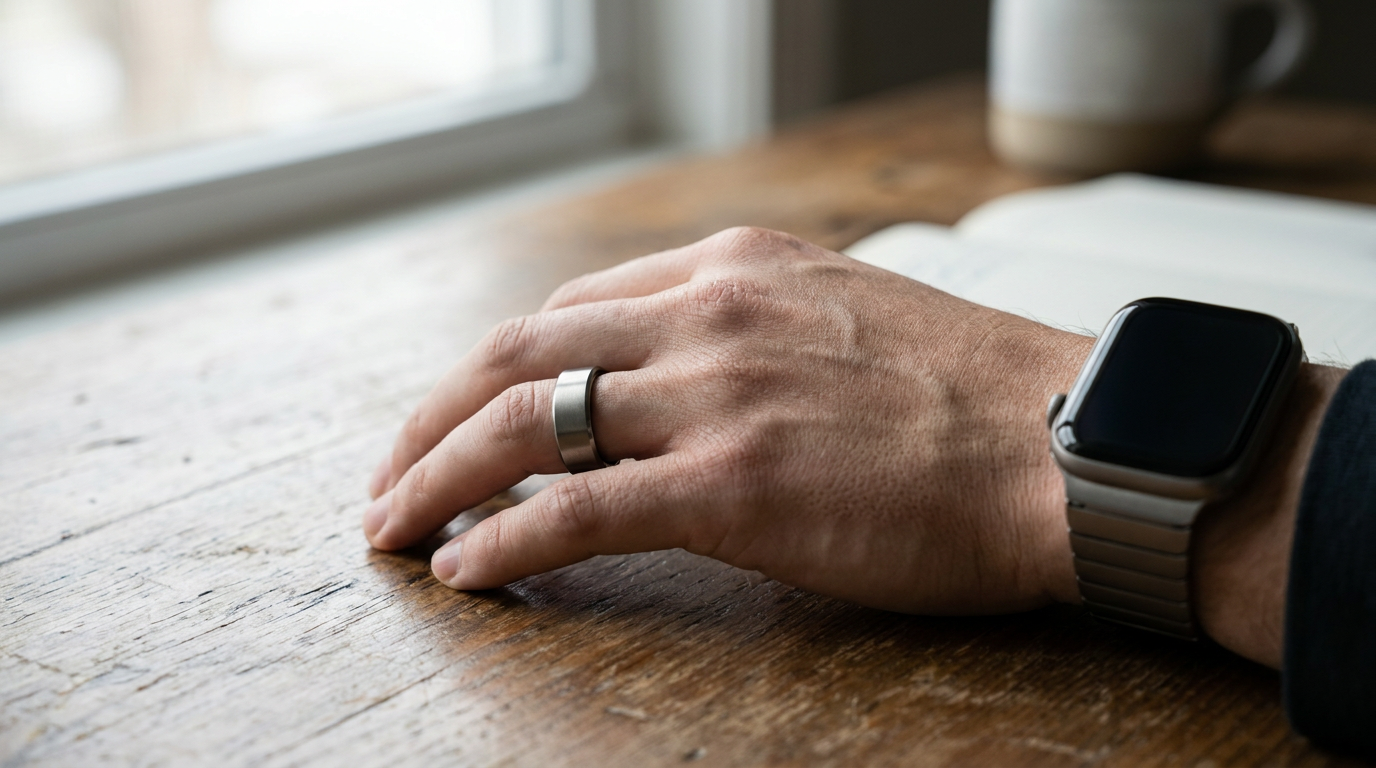
The wearable health market in 2026 has officially bifurcated into two distinct philosophies. For years, the smartwatch was the undisputed king of consumer biometrics, dominating wrists with glowing screens and constant notifications. But with the maturation of the Oura Ring 4, the highly anticipated launch of the Samsung Galaxy Ring, and a flood of subscription-free competitors like RingConn, the smart ring has moved from a niche biohacking accessory to a mainstream staple. Consumers are no longer defaulting to a watch; they are actively choosing between active engagement and passive observation.
This shift has forced consumers into a difficult purchasing decision: wrist or finger? The choice is no longer just about aesthetics, brand loyalty, or avoiding screen fatigue; it is fundamentally about physiological accuracy. As the technology has miniaturized, the physical placement of the sensor on the human body has become the primary variable in data quality. Understanding which form factor provides better data requires looking past the marketing brochures and diving into the clinical evidence.
To understand the true capabilities of these devices, we must look at the rigorous evidence compiled over the last two years. Independent laboratories and peer-reviewed medical journals have spent significant resources testing these commercial devices against clinical gold standards like electrocardiograms and polysomnography. The consensus among researchers is surprisingly clear: the most accurate wearable depends entirely on whether the user is moving or resting. There is no single device that perfectly captures every metric.
When it comes to nocturnal measurements—specifically resting heart rate and Heart Rate Variability (HRV)—smart rings hold a distinct physiological advantage over their wrist-worn counterparts. The digital arteries located in the human finger are situated much closer to the skin's surface and feature a significantly denser capillary network than the blood vessels found in the wrist. This anatomical reality fundamentally changes how optical sensors interact with the body.[6][7]

This physiological advantage gives the photoplethysmography (PPG) sensors inside a smart ring a much cleaner, stronger signal to read. According to clinical reviews, wrist-mounted sensors are highly susceptible to motion artifacts and loose contact during sleep. As a user tosses and turns, a watch can easily slip, letting in ambient light that corrupts the data. Conversely, a properly sized ring maintains consistent, 360-degree optical contact with the blood vessels throughout the night.[7]
As a result of this secure placement, premium devices like the Oura Ring Gen 4 have demonstrated near-chest-strap accuracy for overnight HRV measurements. For users whose primary goal is tracking nervous system recovery, baseline stress levels, and readiness to train, the finger simply provides a higher-fidelity data stream than the wrist. The data is less noisy, requiring fewer algorithmic corrections to produce a reliable morning readiness score.[6]
However, the moment the user gets out of bed and begins to exercise, the smartwatch decisively reclaims the accuracy crown. For active heart rate monitoring during physical exertion, wrist-worn devices like the Apple Watch Series 11 and high-end Garmin Forerunner models remain the consumer gold standard. The wrist provides a stable platform for larger sensors and higher sampling rates that rings simply cannot accommodate.[1]
Smart rings notoriously struggle during high-intensity exercise, particularly during activities that involve gripping. Lifting heavy weights, tightly holding bicycle handlebars, or swinging a tennis racket physically forces blood out of the finger's capillaries. This temporary restriction effectively blinds the ring's optical sensors, leading to dropped heart rate readings and inaccurate calorie burn estimations during the most critical moments of a workout.[1]
Smart rings notoriously struggle during high-intensity exercise, particularly during activities that involve gripping.
In stark contrast, independent laboratory testing in 2026 found that the Apple Watch Series 11 averaged an incredibly low 0.98% error rate when compared directly to a medical-grade Polar H10 chest strap during active treadmill protocols. If real-time workout pacing, cardiovascular zone training, and precise exertion tracking are the priority, the smartwatch remains an absolutely non-negotiable tool for athletes.[2]

Beyond heart rate, the most fiercely contested battleground in the wearable technology space is sleep staging—the algorithmic attempt to categorize a night's rest into light, deep, and REM sleep cycles. Here, the clinical evidence reveals significant limitations and transparent uncertainty across all consumer devices, regardless of where they are worn on the body.
A landmark 2024 study published in the journal Sensors compared commercial wearables against polysomnography (PSG), the clinical gold standard that utilizes direct brainwave monitoring. The research found that the Oura Ring achieved an impressive 76 to 79.5% sensitivity for sleep stage classification, excelling particularly at matching the clinical data for REM and light sleep phases.[5][9]
The Apple Watch, meanwhile, proved statistically superior at detecting "awake" time during the night but struggled more with accurate deep sleep estimation. Yet, researchers emphasize a crucial caveat that consumers often overlook: no consumer wearable on the market perfectly tracks sleep architecture. They are all making highly educated guesses based on secondary physiological markers.[5]
Because these commercial devices rely entirely on pulse rate, skin temperature, and physical movement rather than actual brainwave activity, their sleep staging will always remain an algorithmic approximation. Reviewers frequently note that wearing four different high-end trackers to bed simultaneously will yield four entirely different sleep scores, highlighting the inherent uncertainty in treating wearable sleep data as absolute medical truth.[1]

Moving beyond basic fitness and sleep tracking, wearables are increasingly stepping into the highly regulated realm of clinical disease detection. A comprehensive meta-analysis published in the Journal of Medical Internet Research evaluated the ability of commercial activity trackers to detect severe medical events in free-living populations.[8]
The findings are incredibly promising but introduce complex clinical challenges. Wearables demonstrated an 87.4% positive predictive value for detecting atrial fibrillation (AFib), a leading cause of stroke. However, physicians warn that deploying these sensitive algorithms across millions of healthy, asymptomatic users generates a high volume of false positives, creating operational bottlenecks and unnecessary anxiety within the healthcare system.[3][8]
Ultimately, the most accurate wearable is the one a user will actually wear consistently day after day. This is where the smart ring's unobtrusive form factor delivers its final, and perhaps most important, advantage: long-term user compliance.
Smart rings are incredibly lightweight, entirely screenless, and boast impressive battery lives ranging from five to nine days on a single charge. Users are significantly more likely to wear them 24/7, capturing the continuous, unbroken baseline data required for accurate long-term health trending. Smartwatches, burdened by daily charging requirements and nighttime bulk, often end up abandoned on the nightstand.[4][7]
The 2026 clinical evidence pack provides a clear framework for consumers. Smart rings are passive observers, unmatched for frictionless recovery tracking, sleep compliance, and overnight HRV accuracy. Smartwatches are active companions, essential for real-time performance metrics, GPS routing, and workout precision. Consumers must align their purchase not with the smartest marketing campaign, but with their specific, personal health goals.
How we got here
2015
The first generation of the Oura Ring launches, pioneering the smart ring category.
2022
Apple Watch adds advanced sleep stage tracking in watchOS 9, directly challenging dedicated sleep trackers.
2024
Independent studies confirm smart rings match clinical ECGs for nocturnal HRV tracking.
2026
Samsung enters the market with the Galaxy Ring, solidifying the ring form factor as a mainstream alternative to the smartwatch.
Viewpoints in depth
The Passive Tracking Advocates
Users and researchers who prioritize continuous, frictionless data collection.
This camp argues that the best wearable is the one you forget you're wearing. Because smart rings lack screens and notifications, they reduce digital fatigue while boasting multi-day battery life. Proponents emphasize that accurate baseline metrics—like resting heart rate and overnight temperature—require 24/7 compliance, which is much higher for unobtrusive rings than for bulky watches.
The Active Performance Camp
Athletes and trainers who rely on real-time feedback and workout pacing.
For this group, a wearable is a real-time coaching tool. They argue that smart rings are fundamentally flawed for serious athletes because they cannot display live heart rate zones, GPS pacing, or interval timers during a run. Furthermore, rings are prone to motion artifacts during weightlifting or cycling due to grip pressure, making smartwatches or chest straps non-negotiable for active training.
The Clinical Skeptics
Medical professionals urging caution regarding consumer health data.
Physicians and researchers warn that consumer wearables, regardless of form factor, are not medical devices. They point out that proprietary algorithms for metrics like 'Readiness' or 'Sleep Scores' lack clinical validation. While acknowledging the devices' utility for tracking general trends, this camp cautions against using consumer wearables to diagnose conditions, noting that false positives for arrhythmias can lead to unnecessary medical anxiety and testing.
What we don't know
- How proprietary algorithms from Apple, Oura, and Samsung weight different biometric inputs to generate their daily 'readiness' scores.
- Whether the long-term use of consumer wearables genuinely improves clinical health outcomes or simply increases health anxiety.
Key terms
- Photoplethysmography (PPG)
- An optical measurement technique that uses light to detect changes in blood volume in the microvascular bed of tissue, commonly used to calculate heart rate.
- Heart Rate Variability (HRV)
- The fluctuation in the time intervals between adjacent heartbeats, used as a key indicator of physiological stress and recovery.
- Polysomnography (PSG)
- A comprehensive clinical sleep study that records brain waves, blood oxygen, heart rate, and breathing, serving as the gold standard for sleep tracking.
Frequently asked
Are smart rings more accurate than smartwatches?
It depends on the metric. Smart rings are generally more accurate for resting heart rate and sleep tracking, while smartwatches are significantly more accurate for active workouts.
Can a smart ring track my runs or weightlifting?
While they can track basic movement, smart rings lack GPS for running and often struggle with heart rate accuracy during weightlifting due to grip pressure restricting blood flow in the finger.
Do I need a subscription to use a smart ring?
It varies by brand. The Oura Ring requires a monthly subscription for full data access, while the Samsung Galaxy Ring and RingConn do not charge ongoing fees.
Sources
Source coverage
9 outlets
3 viewpoints surfaced








[1]Runner's WorldActive Performance Camp
I trained for an ultra with the Samsung Galaxy Ring — here's why I'm still reaching for my Garmin
Read on Runner's World →[2]The Next WebActive Performance Camp
Apple's AirPods Pro 3 heart rate sensor rivals Apple Watch accuracy in new lab test
Read on The Next Web →[3]UndarkClinical Skeptics
Consumer devices that monitor heart rate, glucose, and sleep cycles need better validation
Read on Undark →[4]Smart Ring HQPassive Tracking Advocates
Samsung Galaxy Ring review: The strongest no-subscription smart ring
Read on Smart Ring HQ →[5]Live Work SleepActive Performance Camp
Oura Ring vs Apple Watch: Sleep Tracking Accuracy
Read on Live Work Sleep →[6]Wearable Wellness GuidePassive Tracking Advocates
Smart Ring vs Smartwatch: HRV and Stress Tracker Comparison
Read on Wearable Wellness Guide →[7]AskVoraPassive Tracking Advocates
Smart Rings vs. Smartwatches: Which Form Factor Wins in 2026?
Read on AskVora →[8]Journal of Medical Internet ResearchClinical Skeptics
Wearable Activity Trackers for Disease Detection: Systematic Review and Meta-Analysis
Read on Journal of Medical Internet Research →[9]SensorsClinical Skeptics
Accuracy of Three Commercial Wearable Devices for Sleep Tracking in Healthy Adults
Read on Sensors →
Every angle. Every day.
Get shopping stories with full source coverage and perspective breakdowns delivered to your inbox.