
The Solid-State Audio Revolution: How Silicon Chips Are Replacing the 100-Year-Old Speaker
Microscopic solid-state silicon chips are replacing traditional magnetic voice coils in headphones, promising a massive leap in audio clarity, battery life, and durability.
By Factlen Editorial Team
- Solid-State Audio Pioneers
- Argue that silicon-based MEMS will entirely replace legacy coil speakers due to their superior speed, microscopic size, and automated manufacturing scale.
- Audiophile Reviewers
- Praise the technology's unprecedented treble clarity and transient response, while closely monitoring how next-generation chips handle deep bass.
- Consumer Electronics Manufacturers
- Value the space-saving and heat-resistant properties of MEMS, which allow for automated robotic assembly and larger internal batteries.
What's not represented
- · Traditional driver manufacturers whose legacy coil businesses may be disrupted by the shift to silicon foundries.
- · Hearing aid designers, who stand to benefit massively from the miniaturization of full-range audio drivers.
Why this matters
The fundamental technology inside headphones is undergoing its first major redesign in a century. This shift to solid-state silicon will make wireless earbuds significantly smaller, more durable, and capable of delivering audiophile-grade sound previously impossible in portable devices.
Key points
- Solid-state MEMS speakers are replacing 100-year-old dynamic driver technology in wireless earbuds.
- Built on silicon wafers, MEMS chips are up to 98% smaller than traditional magnetic coils.
- The stiff silicon diaphragm reacts instantly to audio signals, eliminating distortion and phase shifts.
- New 'ultrasonic' modulation techniques allow tiny chips to generate massive bass pressure.
- The space saved allows manufacturers to include larger batteries or advanced biometric sensors.
- MEMS chips can survive automated soldering ovens, drastically reducing manufacturing costs.
The speakers inside the world's most advanced wireless earbuds rely on a mechanical concept invented more than a century ago. Despite massive leaps in Bluetooth transmission, active noise cancellation, and battery chemistry, the actual component producing the sound you hear has remained stubbornly analog.[1][2][9]
This legacy technology is known as a dynamic driver. It consists of a copper voice coil, a heavy magnet, and a suspended plastic or paper diaphragm. When an electrical current passes through the coil, it interacts with the magnet, pushing and pulling the diaphragm to move air and create sound waves. While reliable, dynamic drivers are bulky, heavy, and physically limited by how fast a plastic cone can start and stop moving without distorting.[1][4]
Now, the audio industry is undergoing a paradigm shift akin to the transition from spinning hard drives to solid-state drives (SSDs). A new generation of micro-speakers is replacing century-old magnets and coils with solid-state silicon chips.[1][9]
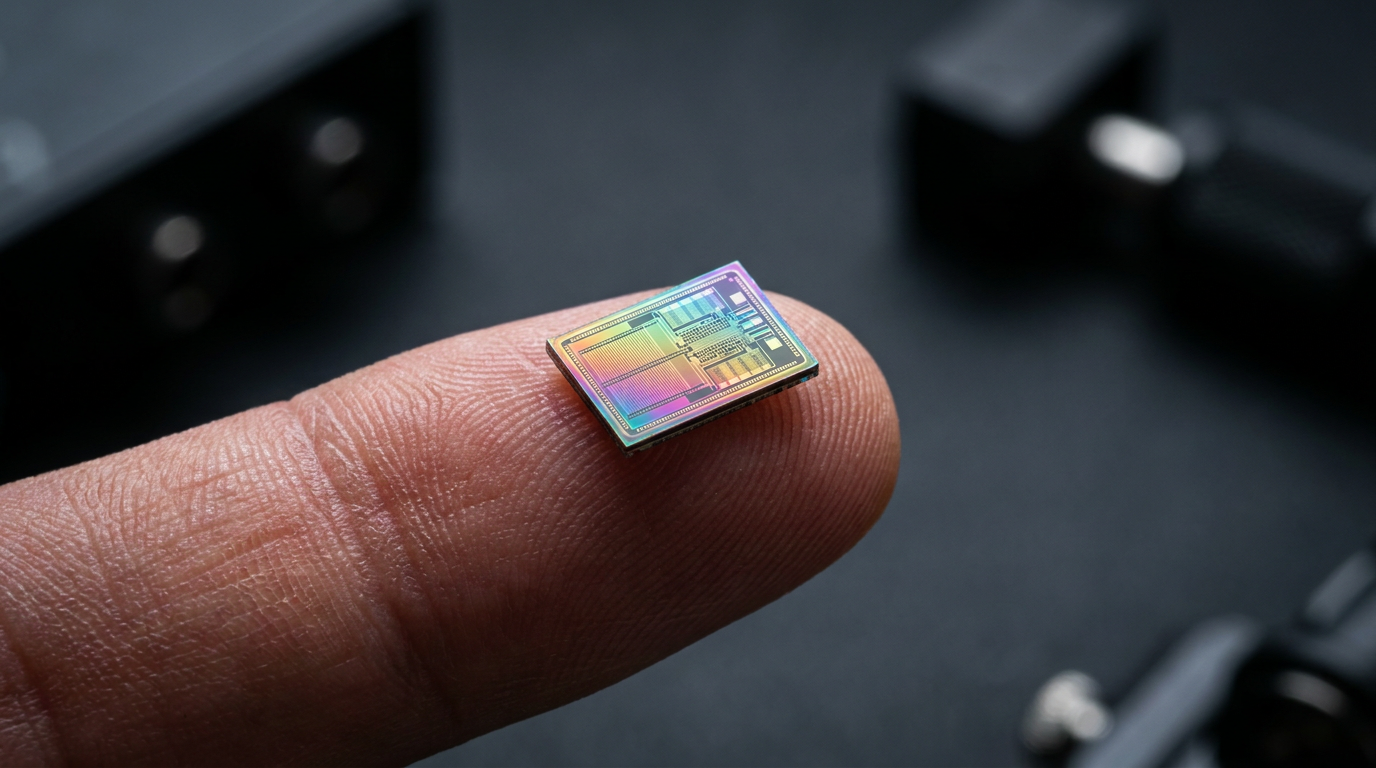
These new components are built using MEMS (Micro-Electro-Mechanical Systems) technology. MEMS involves etching microscopic mechanical structures directly onto semiconductor wafers, using the exact same fabrication plants that manufacture computer processors. While MEMS microphones have been standard in smartphones for over a decade, engineering a silicon chip to physically push enough air to act as a speaker was a monumental physics challenge.[1][6]

Instead of electromagnetism, solid-state speakers rely on the piezoelectric effect. A microscopic layer of crystalline material is bonded to a silicon membrane. When a voltage is applied, the crystal instantly changes shape, causing the attached silicon membrane to bend and flex. This microscopic flexing is what generates the sound.[1][4]
The immediate benefit of this architecture is unprecedented speed and precision, known in audio engineering as transient response. Because the silicon diaphragm is incredibly stiff and weighs a fraction of a milligram, it can react to an audio signal almost instantly. It starts and stops with zero mechanical overhang, eliminating the muddy phase shifts and distortion common in traditional plastic cones.[4][5]
Audiophiles testing early MEMS-equipped earbuds have reported a staggering leap in clarity. Instruments are sharply separated, and high-frequency details—like the decay of a cymbal crash or the breath of a vocalist—are rendered with a lifelike precision that previously required expensive, over-ear studio monitors.[4][5]
Beyond sound quality, MEMS drivers offer a massive spatial advantage. They are up to 98 percent smaller by volume than traditional dynamic coils. Some solid-state tweeters measure just one millimeter thick and weigh less than 150 milligrams. For industrial designers building true wireless earbuds, this is a goldmine.[2][8]
Beyond sound quality, MEMS drivers offer a massive spatial advantage.
By shrinking the speaker assembly to the size of a grain of rice, manufacturers can reclaim precious internal volume. That space can be reallocated to house significantly larger batteries, advanced biometric health sensors, or more complex computational audio processors—or it can be used to simply shrink the earbud into a far more comfortable, low-profile form factor.[3][8]

The shift to silicon also revolutionizes how headphones are manufactured. Traditional dynamic drivers require delicate manual assembly and gluing, which inevitably leads to part-to-part variance. If the left driver sounds slightly different from the right, the stereo image collapses. MEMS speakers, etched by lasers in automated foundries, boast near-perfect uniformity across millions of units.[3][4]
Furthermore, because they contain no plastic or magnets, MEMS chips can survive the extreme heat of Surface Mount Technology (SMT) reflow soldering. This means earbuds can be assembled entirely by automated pick-and-place robots and baked in soldering ovens alongside the Bluetooth chips, drastically cutting production costs and assembly time.[3]
Despite these advantages, the solid-state revolution faced an early hurdle: bass. Because MEMS diaphragms are microscopic, they struggled to physically displace enough air to create deep, thumping low frequencies. As a result, the first wave of consumer products utilized a "hybrid" approach, pairing a silicon MEMS tweeter for the highs with a traditional dynamic coil for the lows.[4][7]
To solve the bass problem and achieve a fully solid-state earbud, engineers developed a radical new transduction principle dubbed "Sound from Ultrasound." Instead of trying to push air directly at audible frequencies, next-generation chips generate rapid ultrasonic pulses at around 400,000 Hz—far beyond human hearing.[2][6]
A companion controller chip then modulates these ultrasonic waves, essentially using them as an acoustic carrier signal. As the ultrasonic pulses interact within the sealed chamber of the ear canal, they create variable air pressure that our ears perceive as rich, audible sound. This "ultrasonic pump" acts as a pressure multiplier, allowing a tiny silicon chip to generate massive bass pressure—up to 140 decibels at 20Hz.[2][6]

The technology is now scaling beyond in-ear monitors. In late 2025, the industry saw the debut of full-range MEMS architectures designed specifically for over-ear headphones. These solid-state plates slash the weight of the driver assembly by nearly 60 percent, dramatically reducing neck fatigue during long listening sessions.[8]
This over-ear architecture also introduces a novel comfort feature: active micro-cooling. By leveraging the same MEMS fabrication techniques, engineers have developed a silent, vibration-free "air pump on a chip." Integrated into the earcup alongside the speaker, it actively vents humidity and heat, solving the longstanding problem of sweaty ears during extended wear.[8]

As manufacturing scales, the cost of solid-state audio is plummeting. New amplifier-less MEMS designs are reducing component costs and power consumption, paving the way for the technology to trickle down from premium $300 flagships to affordable everyday earbuds.[7]
The transition will take a few years to fully saturate the market, as legacy audio giants retool their supply chains to accommodate silicon speakers. But the trajectory is clear: the century-old magnetic voice coil has finally met its match, and the future of portable audio is entirely solid-state.[1][9]
How we got here
1920s
The moving-coil dynamic driver is invented, becoming the standard for loudspeakers and headphones for the next century.
2010s
MEMS technology becomes the standard for microphones in smartphones, but creating a MEMS speaker remains a physics challenge.
2023
The first consumer earbuds featuring solid-state MEMS tweeters hit the market, paired with traditional drivers for bass.
Late 2024
Engineers unveil 'Sound from Ultrasound' technology, allowing MEMS chips to generate massive bass pressure without a secondary coil.
2025
Amplifier-less MEMS tweeters and full-range over-ear solid-state architectures are announced, lowering costs and expanding the technology's reach.
Viewpoints in depth
Solid-State Audio Pioneers
Silicon manufacturers believe the century-old voice coil is fundamentally obsolete.
Companies driving this technology, such as xMEMS and USound, argue that the audio industry has been artificially constrained by the physical limits of magnets and plastic. They point to the semiconductor industry's proven ability to scale production, lower costs, and achieve perfect part-to-part consistency. In their view, the transition to solid-state audio is as inevitable as the shift from cathode-ray tube televisions to flat-panel LCDs, promising a future where audio fidelity is dictated by silicon precision rather than mechanical assembly.
Audiophile Reviewers
Audio critics are stunned by the clarity but are closely watching the evolution of bass response.
Reviewers who have tested early MEMS implementations universally praise the technology's transient response. The speed of the silicon diaphragm eliminates the 'muddy' overlap found in traditional drivers, resulting in a soundstage where every instrument is distinctly separated. However, purists note that the first generation of MEMS required hybrid setups to deliver satisfying low-end punch. The critical test for this camp is whether the new 'ultrasonic' modulation techniques can deliver the warm, physical bass rumble of a large dynamic driver without introducing artificial digital artifacts.
Consumer Electronics Manufacturers
Hardware designers view MEMS primarily as a spatial and manufacturing revolution.
For the engineers building the next generation of wearables, the acoustic benefits of MEMS are almost secondary to the spatial advantages. True wireless earbuds are incredibly space-constrained, and shrinking the speaker by 98 percent frees up vital real estate. Manufacturers are eager to use this space for larger batteries to extend playtime or to integrate advanced health-tracking sensors. Furthermore, the ability to run MEMS chips through automated soldering ovens promises to eliminate the costly, error-prone manual labor currently required to glue and wire traditional speakers.
What we don't know
- It remains to be seen how quickly legacy audio giants like Apple, Sony, and Bose will transition their flagship products to solid-state drivers.
- The exact impact of the required ultrasonic modulation chips on the overall battery life of ultra-compact earbuds is still being optimized at scale.
Key terms
- Dynamic Driver
- The traditional speaker technology that uses a magnetic voice coil attached to a suspended cone to push air and create sound.
- Piezoelectric Effect
- A property of certain materials that causes them to physically bend or change shape when an electrical voltage is applied.
- Transient Response
- How quickly a speaker can start and stop moving in reaction to an audio signal, which is crucial for clarity and crispness.
- SMT Reflow Soldering
- An automated manufacturing process where electronic components are temporarily attached to a circuit board and then baked in an oven to melt the solder.
Frequently asked
What does MEMS stand for?
MEMS stands for Micro-Electro-Mechanical Systems. It refers to microscopic mechanical devices, like tiny flexing membranes, that are etched directly onto semiconductor silicon chips.
Do solid-state speakers sound better?
Yes. Because the silicon diaphragm is incredibly stiff and light, it reacts to audio signals almost instantly. This eliminates the distortion common in traditional plastic cones, resulting in pristine clarity and instrument separation.
Are ultrasonic speakers safe for my ears?
Yes. The ultrasonic pulses are contained within the acoustic chamber and modulated into standard audible frequencies before reaching the eardrum. Standard acoustic meshes also block raw ultrasonic frequencies from escaping.
Why haven't major brands adopted this yet?
The technology is brand new and requires a shift in how audio circuits are designed. While early adopters have launched hybrid models, major brands are expected to adopt full-range MEMS chips as mass production scales up in 2026.
Sources
Source coverage
9 outlets
3 viewpoints surfaced









[1]SoundGuysAudiophile Reviewers
What are MEMS speakers and how do they work?
Read on SoundGuys →[2]xMEMS LabsSolid-State Audio Pioneers
Sound from Ultrasound: The Future of TWS Earbuds
Read on xMEMS Labs →[3]USoundSolid-State Audio Pioneers
Advantages of USound MEMS speakers in TWS applications
Read on USound →[4]TechRadarAudiophile Reviewers
What Is xMEMS Technology?
Read on TechRadar →[5]ZDNETAudiophile Reviewers
I listened to wireless earbuds with xMEMs drivers, and they've set a new bar for me
Read on ZDNET →[6]eCousticsConsumer Electronics Manufacturers
xMEMS Cypress Solid-State MEMS Speaker
Read on eCoustics →[7]How-To GeekConsumer Electronics Manufacturers
Solid-state speaker technology is growing less expensive with the introduction of xMEMS' Lassen tweeter
Read on How-To Geek →[8]TechPowerUpConsumer Electronics Manufacturers
xMEMS Debuts Breakthrough Headphone Architecture
Read on TechPowerUp →[9]Factlen Editorial Team
Synthesis by Factlen editorial team
Read on Factlen Editorial Team →

Every angle. Every day.
Get shopping stories with full source coverage and perspective breakdowns delivered to your inbox.