
Neuroaesthetics: The Emerging Science of How Interior Design Shapes the Brain
Advancements in neuroscience are proving that interior design is not just about aesthetics, but a biological imperative. By utilizing brain-imaging data, architects are engineering spaces that measurably lower stress, boost productivity, and serve as preventive mental healthcare.
By Factlen Editorial Team
- Architectural Designers
- Focus on translating scientific data into practical spatial strategies that improve client well-being and productivity.
- Neuroscientists and Researchers
- Focus on the measurable biological outcomes of design, using brain imaging to prove that aesthetics are an evolutionary imperative.
- Public Health Advocates
- View the built environment as a critical tool for preventive mental healthcare and neuro-inclusive accessibility.
What's not represented
- · Low-income housing developers
- · Traditional decorators focused purely on visual trends
Why this matters
Because Americans spend the vast majority of their lives indoors, the built environment acts as a constant, invisible influence on our nervous systems. Understanding neuroaesthetics empowers individuals and companies to design spaces that actively reduce anxiety and support cognitive health, rather than inadvertently causing stress.
Key points
- Neuroaesthetics combines neuroscience and architecture to measure how the built environment affects human biology.
- The unconscious brain processes a room in seconds, and spaces lacking natural patterns can trigger a measurable spike in stress hormones.
- Biophilic design, which incorporates nature-inspired fractal patterns, has been shown to lower cortisol levels by up to 20 percent.
- Curvilinear spaces and dynamic lighting actively stimulate the brain's reward centers and support healthy circadian rhythms.
- The design industry is shifting to view interior architecture as a form of preventive mental healthcare rather than mere decoration.
Have you ever walked into a room and felt your shoulders instantly drop, or conversely, entered a space that left you inexplicably tense? For decades, interior design treated these reactions as matters of personal taste—a subjective preference for linen over velvet, or blue over gray. But a rapidly growing body of scientific research is proving that our response to the built environment is not just cultural; it is a biological imperative. Welcome to the era of neuroaesthetics, a discipline that is fundamentally reshaping how architects and designers approach the spaces where we live, work, and heal.[1][2]
Neuroaesthetics sits at the intersection of neuroscience, psychology, and architecture. It is the scientific study of how aesthetic experiences—such as light, sound, texture, and spatial geometry—affect the human brain and nervous system. While designers have long relied on intuition to craft beautiful rooms, advanced brain-scanning technologies like fMRI and EEG now allow researchers to measure exactly what happens physiologically when we encounter specific design elements. The data reveals that our surroundings trigger measurable biological responses, shifting design from a luxury to a form of preventive mental healthcare.[2][5][6][7]
To understand why design impacts us so profoundly, we have to look at the subliminal brain. Nobel laureate Eric Kandel famously noted that roughly 95 percent of brain activity occurs beyond our conscious awareness. When a person walks into a new room, their unconscious brain processes the environment in just three to four seconds, instinctively scanning for cues of safety, refuge, or threat. If the space feels unnatural or chaotic, the brain works overtime to process the visual noise, leading to a subtle but persistent spike in stress hormones.[6][9]
This unconscious scanning is rooted in human evolution. For 99.99 percent of our species' history, humans evolved in natural, outdoor environments. Our neural networks are literally hardwired to process the specific visual and sensory inputs found in nature. When we spend our days in gray, enclosed, right-angled boxes under static fluorescent lighting, our nervous systems experience a low-level cognitive dissonance. Neuroaesthetics seeks to bridge this gap, using evidence-based strategies to create indoor environments that speak the brain's native language.[4][6][9]

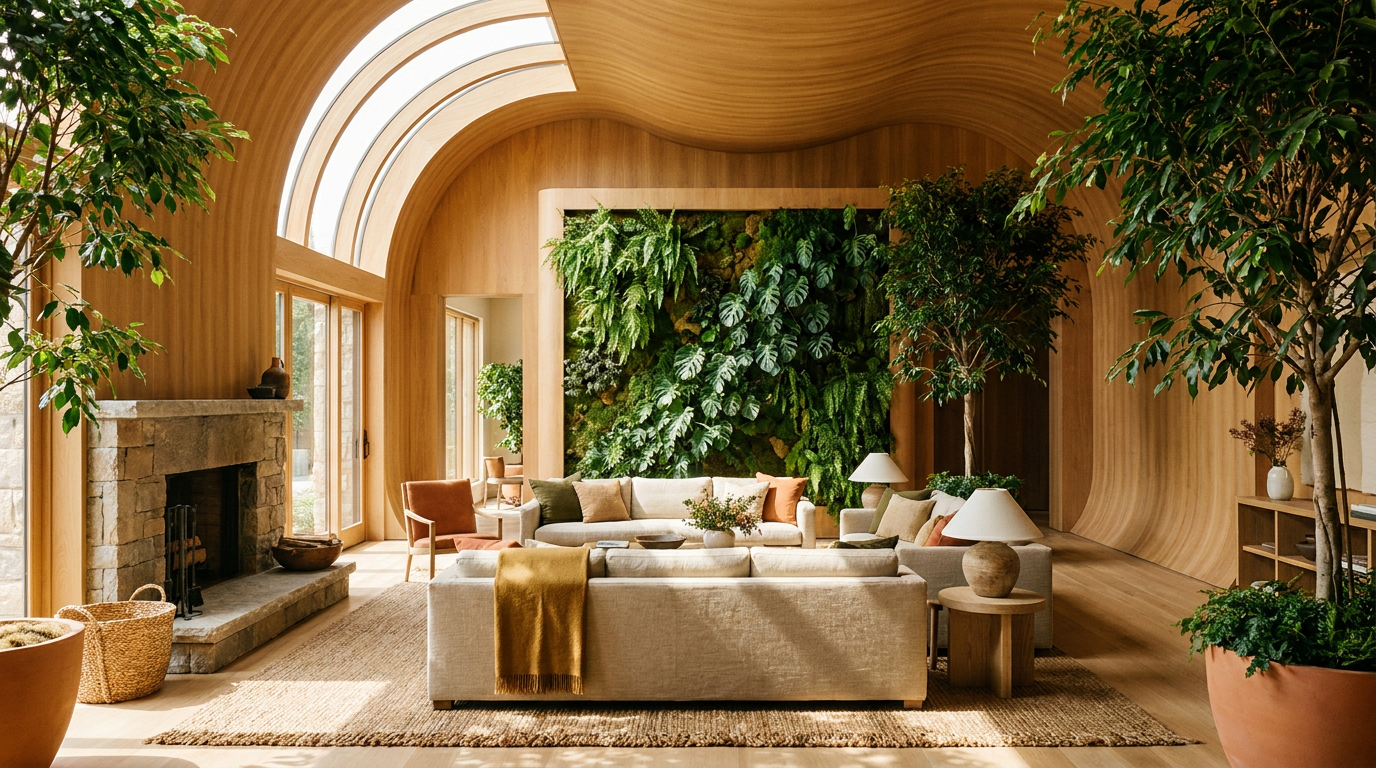
One of the most powerful tools in the neuroaesthetic arsenal is biophilic design—the integration of nature-inspired elements into the built environment. But this goes far beyond simply placing a potted plant in a corner. True biophilic design incorporates "fractals," which are the repeating, self-similar patterns found in leaves, snowflakes, and ocean waves. The human visual system is incredibly proficient at processing fractals fluently and automatically.[4][5][6][7]
When people are exposed to fractal patterns in architecture—whether through the grain of exposed wood, the veining of stone, or specifically designed wallpapers and carpets—their bodies react measurably. Research demonstrates that environments rich in these natural patterns can lower heart rates, reduce blood pressure, and decrease cortisol levels by 15 to 20 percent. As researchers note, navigating an artificial environment without fractals is akin to traveling in a country where you do not speak the language; the brain simply has to work harder.[6][7]
Research demonstrates that environments rich in these natural patterns can lower heart rates, reduce blood pressure, and decrease cortisol levels by 15 to 20 percent.
Geometry also plays a crucial role in how a space feels. Functional imaging studies have shown that curvilinear spaces—rooms and furniture featuring soft, rounded edges rather than sharp right angles—actively stimulate the orbitofrontal cortex, a region of the brain linked to emotional regulation and the processing of reward and pleasure. The presence of organic, curved forms subconsciously reminds the brain of evolutionary safe havens, generating an immediate sense of comfort and calm.[4][7]

Beyond shape and pattern, light is perhaps the most critical driver of our biological response to a room. Humans operate on a circadian rhythm synchronized by the sun. Static, artificial lighting disrupts this internal clock, leading to fatigue and poor sleep. Neuroaesthetic design employs dynamic lighting systems that mimic the natural progression of daylight—bright, cool, and blue-toned in the morning to stimulate focus, transitioning to warm, dim, and amber-toned in the evening to promote the release of melatonin.[5][9]
The tactile and acoustic layers of a room are equally vital. Nature is a multisensory experience, and our indoor spaces must reflect that complexity to be truly restorative. Textures like natural wood or woven fabrics stimulate the somatosensory cortex, producing feelings of warmth and belonging. Meanwhile, poor acoustics can trigger a constant state of hyper-arousal. By using sound-absorbing materials and layered textures, designers can quiet the environment, allowing the nervous system to downregulate.[1][5][7][9]
The clinical and commercial applications of this research are staggering. In healthcare settings, studies have consistently shown that patients whose rooms feature natural light and views of nature require less pain medication and heal significantly faster than those in standard clinical rooms. The built environment actively optimizes the healing process, reducing fatigue not just for patients, but for the clinical staff working long shifts.[2][5][7]
In the workplace, the integration of neuroaesthetic principles translates directly to the bottom line. Employees working in offices that utilize biophilic design, natural light, and sensory balance report a 15 percent increase in productivity and significantly lower rates of fatigue. By reducing the cognitive load required to simply exist in a space, workers have more mental bandwidth available for creativity, problem-solving, and collaboration.[2][7][8]

Crucially, neuroaesthetics is also driving a push toward neuro-inclusive design. Because human brains process sensory input differently, a space that feels stimulating to one person might feel overwhelmingly chaotic to someone who is neurodivergent. For example, individuals with ADHD may benefit from a certain level of ambient sound to maintain focus, while others require absolute quiet. By providing flexible environments where individuals can control their lighting, acoustic privacy, and visual stimulation, designers can create spaces that support a wider spectrum of human needs.[3][8][9]
As we look to the future, the integration of biometric data and design will only deepen. Tools like Visual Attention Software are already helping architects predict exactly where a person's eyes will land when they enter a room, allowing them to strategically place calming elements where they will have the most impact. At recent industry summits, leaders unveiled frameworks like the "Intentional Spaces Roadmap," which positions evidence-based design as a critical lever for public health.[1][8][9]

Ultimately, the rise of neuroaesthetics validates what many have intuitively known all along: beauty is not frivolous. The aesthetic quality of our surroundings is deeply intertwined with our physical and emotional health. By translating the language of the brain into the materials, light, and geometry of our homes and cities, we are no longer just decorating spaces. We are engineering environments that actively help us thrive.[1][2][8][9]
How we got here
1990s
Advancements in brain scanning technology like fMRI allow researchers to observe real-time physiological responses to beauty and spatial design.
2000s
Early studies on biophilic design begin to quantify the productivity and health benefits of incorporating nature into office and hospital environments.
2013
Neurologist Anjan Chatterjee publishes 'The Aesthetic Brain', bringing the concepts of neuroaesthetics to a broader audience.
2020-2022
The global shift to remote work during the pandemic accelerates interest in how home environments impact cognitive load and mental health.
2025-2026
Neuroaesthetics becomes a foundational pillar in commercial architecture, with frameworks like the Intentional Spaces Roadmap treating design as preventive healthcare.
Viewpoints in depth
Neuroscientists and Researchers
Focus on the evolutionary mismatch between human biology and modern architecture.
This camp emphasizes that the human brain spent millions of years adapting to natural environments. Modern, angular, fluorescent-lit spaces force the brain to work harder to process visual information, leading to chronic low-level stress. They rely on fMRI and EEG data to prove that beauty and natural patterns are biological necessities, not cultural constructs.
Architectural Designers
Focus on the practical application and client outcomes of evidence-based design.
Designers are moving away from purely trend-based decorating toward evidence-based architecture. By using tools like Visual Attention Software and biometric feedback, they can prove the ROI of their designs to corporate clients—showing that an investment in biophilic design pays off through higher employee retention, faster healing times, and increased productivity.
Public Health Advocates
Focus on equity, accessibility, and neuro-inclusive environments.
If the built environment can act as preventive mental healthcare, this camp argues that access to well-designed, neuro-inclusive spaces should not be a luxury reserved for high-end corporate offices or wealthy homeowners. They advocate for integrating neuroaesthetic principles into public schools, affordable housing, and community hospitals to improve baseline population health.
What we don't know
- How the long-term, compounding effects of neuroaesthetic design compare to traditional medical interventions for chronic stress.
- The exact threshold of biophilic elements required to trigger a positive biological response—whether a few plants suffice, or if structural architectural changes are necessary.
- How to standardize and scale neuro-inclusive design principles across diverse public spaces without creating conflicting sensory environments.
Key terms
- Neuroaesthetics
- The scientific study of how aesthetic experiences, such as art and architectural design, affect the human brain and nervous system.
- Biophilic Design
- An architectural approach that seeks to connect building occupants more closely to nature through the use of natural light, plants, and organic materials.
- Fractals
- Repeating, self-similar patterns found abundantly in nature (like leaves or snowflakes) that the human brain processes with extreme ease.
- Circadian Rhythm
- The natural, internal 24-hour clock that regulates the sleep-wake cycle, heavily influenced by exposure to light.
- Orbitofrontal Cortex
- A region of the brain involved in the cognitive process of decision-making and the processing of reward and pleasure, stimulated by curvilinear design.
- Somatosensory Cortex
- The part of the brain that receives and processes sensory information from the body, such as touch and texture.
Frequently asked
What is the difference between neuroaesthetics and regular interior design?
Traditional design often focuses on subjective visual taste and trends. Neuroaesthetics uses scientific data and brain imaging to create spaces that measurably improve biological health, lower stress, and enhance cognitive function.
How does biophilic design affect the brain?
Biophilic design incorporates natural elements like sunlight, greenery, and fractal patterns. The human brain is evolutionarily hardwired to process these natural cues fluently, which lowers cortisol levels and reduces the cognitive load of a space.
Can neuroaesthetics be applied to a home on a budget?
Yes. Many neuroaesthetic principles are accessible, such as maximizing natural light, using warm-toned bulbs in the evening, decluttering to reduce visual noise, and incorporating natural textures like wood or woven fabrics.
What is neuro-inclusive design?
It is an approach that recognizes that different brains process sensory input differently. Neuro-inclusive spaces offer adjustable lighting, acoustic control, and varied levels of visual stimulation to accommodate conditions like ADHD or autism.
Sources
Source coverage
9 outlets
3 viewpoints surfaced









[1]ArchiExpo e-MagazinePublic Health Advocates
Neuroaesthetics Is Reshaping Wellness and the Built Environment
Read on ArchiExpo e-Magazine →[2]ArchDailyArchitectural Designers
Neuroesthetics: The Influence of Design on Human Experience
Read on ArchDaily →[3]CorganPublic Health Advocates
Behavior by Design: Insights from SXSW 2025
Read on Corgan →[4]Cognitive ProcessingNeuroscientists and Researchers
The neuroaesthetics of architectural spaces
Read on Cognitive Processing →[5]PMCNeuroscientists and Researchers
Biophilic design, neuroarchitecture and therapeutic home environments
Read on PMC →[6]Science in DesignNeuroscientists and Researchers
Neuroaesthetics for Interior Designers
Read on Science in Design →[7]Pearl AcademyArchitectural Designers
Neuroaesthetics in Interior Spaces: Designing for Mental Well-Being
Read on Pearl Academy →[8]Studio 10Architectural Designers
The Relationship Between Neuroaesthetics and Experience Design in Commercial Interiors
Read on Studio 10 →[9]Factlen Editorial TeamPublic Health Advocates
Synthesis by Factlen editorial team
Read on Factlen Editorial Team →

More in lifestyle
See all 5 stories →

Every angle. Every day.
Get lifestyle stories with full source coverage and perspective breakdowns delivered to your inbox.