
Rotating vs. Raking: Which Automatic Litter Box Mechanism Wins?
As self-cleaning litter boxes become household staples, choosing between a rotating globe and a raking tray comes down to cat count, floor space, and long-term costs.
By Factlen Editorial Team
- Rotating Mechanism Advocates
- Prioritize multi-cat capacity, odor sealing, and long-term reliability.
- Raking Mechanism Advocates
- Value low upfront costs, space-saving designs, and feline accessibility.
- Veterinary Experts
- Focus on consistent cleanliness to prevent feline stress and urinary issues.
What's not represented
- · Traditional manual-scoop purists who argue automation removes a critical daily health-check touchpoint.
Why this matters
Automatic litter boxes save time and reduce household odors, but picking the wrong mechanism can lead to jammed machines, wasted money, and a cat that refuses to use it. Understanding the mechanical trade-offs ensures a stress-free upgrade for both pet and owner.
Key points
- Rotating models cost $500–$700 upfront but use affordable clumping clay litter.
- Raking models cost $130–$200 upfront but often require expensive monthly crystal trays.
- Rotating globes are ideal for multi-cat homes due to large, sealed waste drawers.
- Raking trays offer a low profile, making them better for small spaces and senior cats.
- Smart features like weight tracking and app connectivity are mostly exclusive to premium rotating models.
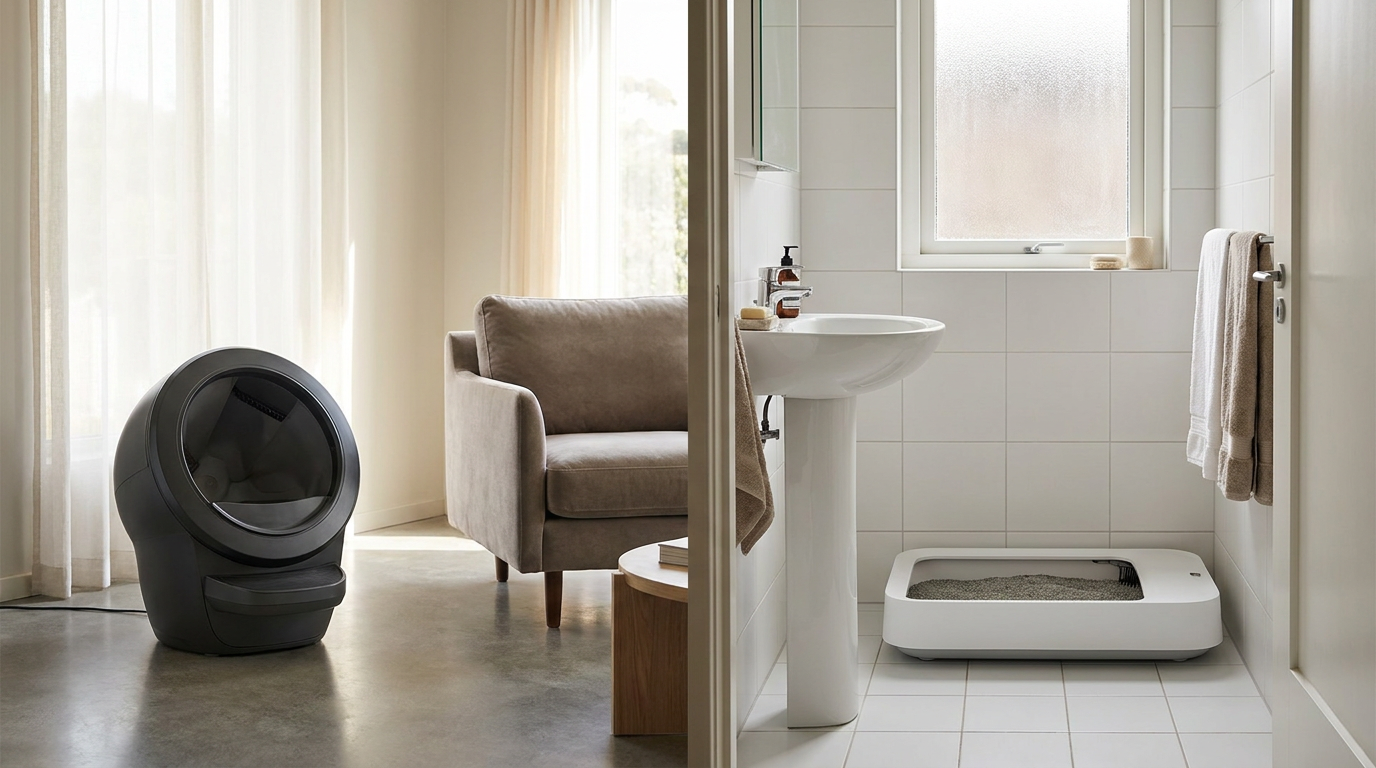
The automatic litter box market has evolved from a niche luxury into a booming household staple, driven by pet owners seeking hands-free hygiene and better odor control. But as the technology matures in 2026, buyers are faced with a fundamental hardware divide: should you invest in a rotating globe mechanism or a raking tray system? Both eliminate the daily chore of manual scooping, but they operate on entirely different mechanical principles that dictate their ideal use cases.[1][2]
The rotating mechanism, popularized by flagship devices like the Whisker Litter-Robot 4, relies on a tumbling motion. After a cat exits the globe, a weight sensor triggers a countdown. The entire inner chamber then slowly rotates on its axis, passing the litter bed through a sifting screen. Clean litter falls into a holding reservoir, while solid clumps are guided down a chute into a sealed, carbon-filtered waste drawer below. Once the waste is deposited, the globe rotates back, returning the clean litter to a flat bed.[1][2][4]
Conversely, the raking mechanism, exemplified by models like the PetSafe ScoopFree Crystal Pro, mimics the traditional open-tray design but adds a motorized comb. After the cat leaves, a horizontal rake slowly travels from one end of the flat litter bed to the other. It physically pushes solid waste and clumps into a covered receptacle at the end of the tray, leaving the remaining litter smoothed out behind it.[1][4][5]
The most immediate trade-off between the two systems is upfront cost versus long-term maintenance. Rotating models are complex machines that command premium prices, typically ranging from $500 to $700. However, they are designed to work with standard, inexpensive clumping clay litter. Raking models offer a much lower barrier to entry, often priced between $130 and $200. The catch is that many raking systems require proprietary disposable trays or expensive silica crystal litter, which can add $15 to $25 in recurring monthly costs.[1][3][5]

Litter compatibility is a critical factor that dictates how well each machine performs. Rotating systems demand fast, hard-clumping clay litter; if the clumps are soft, they will smear against the walls of the globe during the tumbling cycle, creating a stubborn residue. Raking systems, on the other hand, struggle with heavy clay that can stick to the tines of the comb. They perform best with crystal litter that absorbs urine instantly and dries out solid waste, allowing the rake to glide through without jamming.[4]
Litter compatibility is a critical factor that dictates how well each machine performs.
When it comes to multi-cat households, the rotating mechanism holds a distinct advantage. Raking systems are prone to jamming under high traffic because a single day's output from three cats can overwhelm the shallow waste receptacle before the cycle completes. Rotating designs handle higher volumes effortlessly, utilizing gravity to drop waste into deep, sealed drawers. A premium rotating model can hold up to 14 days of waste for a single cat, or easily manage a few days for a multi-cat family before requiring a bag swap.[3][5]

Odor control also heavily favors the rotating design. Because the waste is dropped into a fully enclosed, often carbon-filtered drawer beneath the unit, it is completely isolated from the open air. Raking systems push waste into a covered compartment at the end of the tray, but the seal is rarely airtight, and the crystal litter relies on desiccation rather than physical isolation to manage smells. For urban apartments where the litter box sits near living spaces, the rotating globe's odor sealing is a measurable upgrade.[1][5]
However, raking systems win decisively on spatial footprint and feline accessibility. Rotating globes are massive appliances that dominate a room and require the cat to step up into an enclosed cavern. This can be intimidating for skittish cats and physically difficult for senior felines with arthritis. Raking boxes maintain a low profile, fit easily under counters or in tight bathroom corners, and offer the open-air environment that many cats naturally prefer.[3][5]
Health monitoring capabilities further divide the two tiers. High-end rotating models have embraced smart technology, utilizing multi-modal OmniSense systems to track a cat's weight and bathroom frequency via smartphone apps. This allows owners to catch early signs of feline lower urinary tract disease (FLUTD) or kidney issues. Raking models are generally analog, plug-and-play devices that prioritize simplicity over data collection.[3][6]

Veterinarians broadly support the shift toward automated systems, noting that consistent cleanliness is the primary factor in preventing feline behavioral issues and inappropriate elimination. A machine that scoops itself ensures the cat always steps into a pristine bed, reducing stress. However, experts caution that owners must still actively monitor the waste drawer, as the hands-off nature of these devices makes it easier to miss visual cues like blood in the stool.[6]
Ultimately, the rotating mechanism fits well when a household has multiple cats, prioritizes absolute odor control, and values smart-health tracking—provided the owner has the floor space and the budget for a premium appliance. It is the definitive choice for tech-forward pet parents seeking maximum automation.[1][3][5]
Conversely, the raking mechanism fits well when an owner is outfitting a small apartment, caring for a senior cat with mobility limitations, or seeking a sub-$200 entry point into automated pet care. It offers a reliable, low-profile solution for single-cat homes willing to trade smart features for simplicity and space savings.[1][5]
Viewpoints in depth
Rotating Mechanism Advocates
Prioritize multi-cat capacity, odor sealing, and long-term reliability.
Proponents of the rotating globe design argue that it is the only viable solution for households with more than one cat. By utilizing gravity and a tumbling motion, these machines avoid the mechanical jams that plague raking combs when faced with heavy waste volumes. Furthermore, advocates highlight the superior odor control achieved by dropping waste into a fully sealed, carbon-filtered drawer, and praise the long-term cost savings of being able to use standard, inexpensive clumping clay litter.
Raking Mechanism Advocates
Value low upfront costs, space-saving designs, and feline accessibility.
Supporters of the raking tray system emphasize its approachability and compact footprint. They argue that spending $700 on a litter box is unfeasible for many pet owners, making the $150 raking models a crucial entry point into automated hygiene. Additionally, they point out that the open-top, low-to-the-ground design is far more accommodating for senior cats with arthritis, kittens, and felines that are claustrophobic or intimidated by the enclosed cavern of a rotating globe.
Veterinary Perspective
Focus on consistent cleanliness to prevent feline stress and urinary issues.
Veterinary behaviorists maintain that the specific mechanism matters less than the resulting cleanliness. Cats have a strong natural preference for pristine elimination areas; a box that is soiled can lead to stress, avoidance behaviors, and feline lower urinary tract disease (FLUTD). Vets support both automated systems for their ability to provide a clean bed every time, though they caution owners to regularly check the waste receptacles to monitor for signs of illness that would normally be caught during manual scooping.
What we don't know
- Whether upcoming AI-powered health monitoring features will become standard across lower-priced raking models.
- How long the motorized components in budget raking systems will last compared to premium rotating models under heavy daily use.
Key terms
- Rotating Mechanism
- A self-cleaning system where a globe tumbles the litter, passing it through a screen to separate clean granules from solid waste.
- Raking Mechanism
- A self-cleaning system that uses a motorized comb to physically push solid waste across a flat litter bed into a receptacle.
- Silica Crystal Litter
- A highly absorbent, non-clumping litter often required by raking systems to dry out solid waste and prevent it from sticking to the rake.
- FLUTD
- Feline Lower Urinary Tract Disease, a common health issue in cats that can be exacerbated by stress or dirty litter boxes.
Frequently asked
Can I use regular clay litter in a raking automatic box?
Generally, no. Heavy clumping clay often sticks to the tines of the rake, causing jams. Most raking systems require silica crystals or specialized hard-clumping formulas.
Are automatic litter boxes safe for kittens?
Most manufacturers recommend waiting until a kitten weighs at least 3 to 5 pounds (usually around 6 months old) before using the automatic mode, ensuring the weight sensors can accurately detect them.
How often do I need to empty the waste drawer?
For a single cat, raking trays typically need emptying every 3 to 7 days, while premium rotating models can hold waste for 10 to 14 days.
Do automatic litter boxes eliminate all odors?
While they significantly reduce ambient smells by promptly removing waste, rotating models with sealed, carbon-filtered drawers generally offer better odor isolation than covered raking trays.
Sources
Source coverage
6 outlets
3 viewpoints surfaced





[1]ForbesRotating Mechanism Advocates
The Best Automatic Litter Boxes Of 2026, Tested And Reviewed
Read on Forbes →[2]Business InsiderRotating Mechanism Advocates
The best automatic litter boxes in 2026, tested and reviewed
Read on Business Insider →[3]The Consumers GuideRotating Mechanism Advocates
Expert-tested reviews of the best automatic self-cleaning cat litter boxes of 2026
Read on The Consumers Guide →[4]BoxiecatRaking Mechanism Advocates
Understanding the Difference Between Raking and Rotating Automatic Litter Boxes
Read on Boxiecat →[5]CatlinkRaking Mechanism Advocates
Raking vs Rotating: Which Automatic Litter Box is Right for You?
Read on Catlink →[6]NeakasaVeterinary Experts
What Do Veterinarians Say About Automatic Litter Boxes?
Read on Neakasa →
More in shopping
See all 6 stories →Luggage Tech
Hardside vs. Softside Luggage: The Complete Trade-Off Analysis
6 sources
Home Tech
How Ventless Heat Pump Combos Are Rewriting the Rules of Laundry
6 sources
Audio Tech
The Solid-State Audio Revolution: How Silicon Chips Are Replacing the 100-Year-Old Speaker
9 sources

Smart Home Tech
Matter over Thread vs. Wi-Fi: Choosing the Right Smart Home Protocol
7 sources
Every angle. Every day.
Get shopping stories with full source coverage and perspective breakdowns delivered to your inbox.