
The Science of Beanless Coffee: How Precision Fermentation is Brewing a Climate Solution
Food technology startups are using upcycled ingredients and microbial fermentation to recreate the exact molecular profile of coffee, offering a sustainable alternative as climate change threatens traditional crops.
By Factlen Editorial Team
- Alternative Coffee Developers
- Focus on the technological replication of coffee to solve supply chain vulnerabilities.
- Climate & Sustainability Analysts
- Emphasize the urgent need to decouple coffee consumption from tropical deforestation.
- Market & Consumer Analysts
- Focus on adoption hurdles, price parity, and taste acceptance in the mass market.
What's not represented
- · Traditional coffee farmers in Latin America and Africa whose livelihoods depend on conventional crop yields.
- · Specialty coffee roasters focused on single-origin terroir.
Why this matters
With climate change threatening to wipe out half of the world's coffee-growing land by 2050, your morning cup is becoming an environmental liability. Beanless coffee offers a sustainable, climate-resilient alternative that could stabilize prices and drastically reduce the beverage's massive water and carbon footprint.
Key points
- Climate change is projected to eliminate 50% of suitable coffee-growing land by 2050.
- Startups are using precision fermentation and upcycled seeds to recreate coffee's 800+ flavor compounds.
- Beanless alternatives use up to 95% less water and 92% less land than traditional coffee farming.
- The technology is already achieving price parity and winning blind taste tests against premium arabica brands.
The morning cup of coffee is a non-negotiable ritual for billions, but the agricultural math underpinning that daily habit is quietly breaking down. Global coffee consumption continues to rise year over year, yet the narrow tropical belt that sustains the world's arabica and robusta plants is under severe threat. By 2050, rising temperatures and intensifying droughts are projected to eliminate roughly half of all suitable coffee-producing land worldwide. In highly productive regions like Latin America, which currently dominate the global supply chain, up to 90% of traditional growing areas could become entirely unproductive within a few decades.[1][4]
This climate vulnerability has triggered a vicious cycle. Coffee is not just a victim of a warming planet; it is a significant contributor to the problem. The traditional supply chain—from clearing rainforests for new plantations to water-intensive processing and global shipping—carries a heavy environmental toll. A single cup of conventional coffee requires roughly 140 times its volume in water to produce, and the crop accounts for 17 times its own weight in carbon emissions. As yields drop due to heat stress, farmers are often forced to clear more virgin land just to maintain baseline production levels, exacerbating the very climate shifts threatening their livelihoods.[4]
Enter the "beanless" coffee movement. Rather than trying to engineer a more heat-resistant coffee plant, a new wave of food-technology startups is asking a more radical question: What if we could brew coffee without the coffee bean? By leveraging precision fermentation and upcycled agricultural byproducts, these companies are recreating the exact molecular profile of coffee from the ground up, entirely bypassing the fragile tropical supply chain.[3][4]
The process begins with exhaustive molecular mapping. Coffee is one of the most chemically complex beverages on earth, deriving its signature taste, mouthfeel, and aroma from a delicate interplay of over 800 distinct volatile and non-volatile compounds. Food scientists at companies like Compound Foods have spent years isolating these specific molecules, identifying exactly which combinations of acids, sugars, and oils trigger the sensory experience of a morning roast.[2][3]

Once the target profile is mapped, the challenge becomes sourcing those compounds without using a coffee plant. The solution lies in upcycling. Startups are turning to abundant, underutilized agricultural materials—such as date seeds, sunflower seeds, chickpeas, and rice. These base ingredients provide the necessary proteins, fibers, and carbohydrates, but they do not inherently taste like coffee on their own.[1][3]
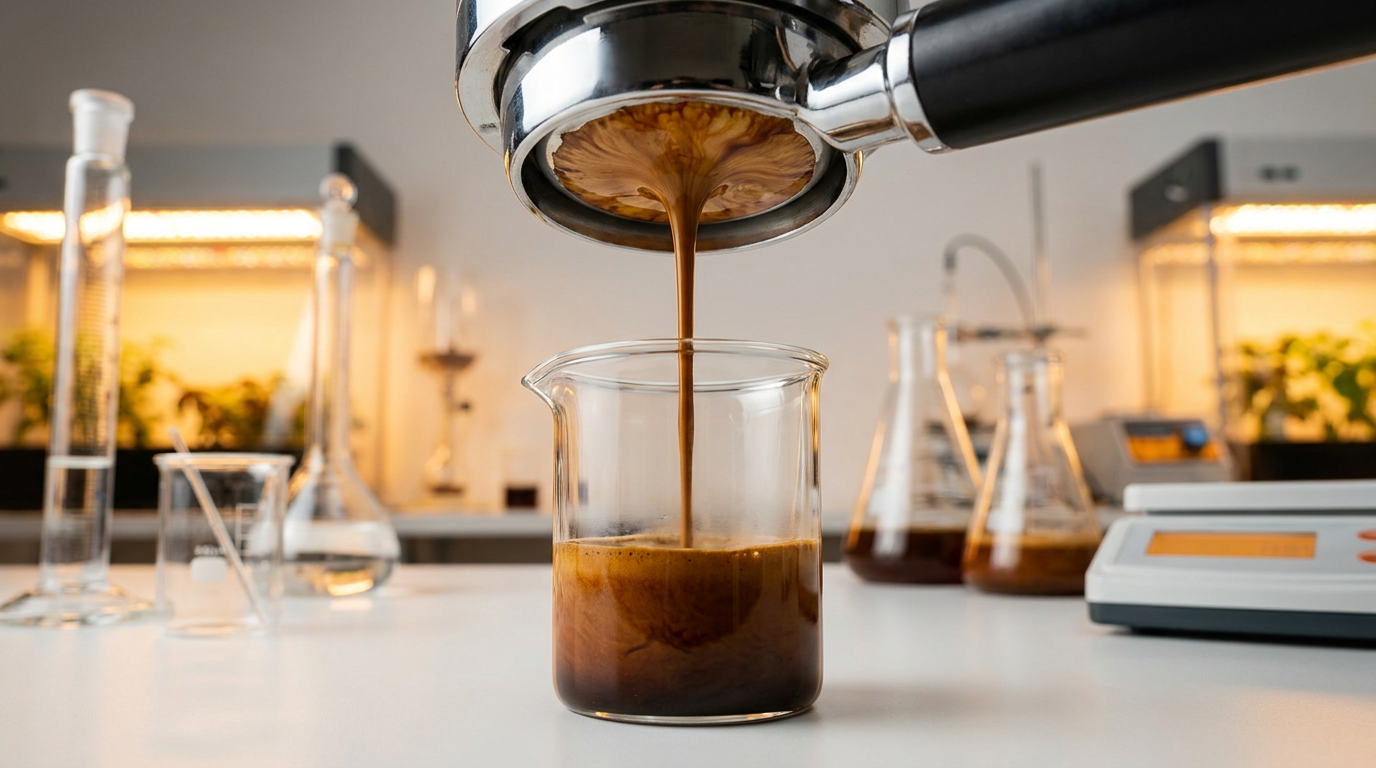
This is where precision fermentation acts as the transformative engine. By introducing specific, often engineered, strains of yeast and food-grade microbes to the upcycled biomass, scientists can trigger targeted chemical reactions. The microbes consume the base sugars and excrete the exact flavor compounds found in traditional coffee. It is the same fundamental technology used to brew beer or culture yogurt, but fine-tuned to an unprecedented molecular degree.[4][6]
The final, crucial step is roasting. The fermented biomass is dried, roasted, and ground using traditional coffee-roasting equipment. This subjects the newly formed compounds to the Maillard reaction—the browning process that unlocks the deep, complex aromas of a dark or medium roast. The result is a powder that looks, smells, and brews exactly like conventional ground coffee, complete with a customizable dose of natural caffeine added during the process.[1][5]
The fermented biomass is dried, roasted, and ground using traditional coffee-roasting equipment.
The environmental math of this beanless approach is staggering. Because the ingredients are grown in standard agricultural settings or sourced as byproducts, the process entirely decouples coffee production from vulnerable tropical ecosystems. Companies utilizing this fermentation method report using up to 95% less water and 92% less land than traditional coffee farming. Furthermore, the carbon footprint of the final product is reduced by roughly 85%, offering a genuinely sustainable alternative to one of the world's most resource-intensive crops.[1][5][6]
Commercial viability is already being proven in the market. In blind taste tests conducted by academic institutions like Purdue University, a majority of participants actually preferred the taste of beanless formulations over premium, single-origin arabica brands. The technology allows for precise control over bitterness and acidity, virtually eliminating the sour or burnt notes that often plague over-extracted conventional coffee.[2][3]

Different startups are targeting different segments of the coffee market. In the United States, companies like Minus Coffee and Atomo are focusing heavily on the booming cold brew and ready-to-drink (RTD) sectors. Cold brew is an ideal entry point for beanless tech, as the lower brewing temperatures and longer steeping times naturally mask some of the missing terroir complexities while highlighting the smooth, chocolatey notes that fermentation excels at producing.[4][5][6]
Meanwhile, in Asia, Singapore-based Prefer is scaling its beanless technology to tackle the mass market. Utilizing fermented rice and chickpeas, Prefer has developed a highly cost-effective alternative that is already being deployed in RTD lattes across the city's transit networks. By partnering with major food manufacturers and dairy-alternative companies, they are proving that beanless coffee can integrate seamlessly into existing supply chains without requiring expensive retooling.[1]
The economic argument for beanless coffee is becoming just as compelling as the environmental one. Over the past five years, traditional coffee prices have surged by nearly 50%, driven by poor harvests and supply chain instability. Beanless alternatives, insulated from tropical weather shocks, offer remarkable price stability. In some markets, fermented coffee alternatives are already 50% cheaper to produce than conventional arabica, making them highly attractive to large-scale consumer packaged goods companies.[1]

Despite these breakthroughs, the technology still faces hurdles. Replicating the hyper-specific terroir of a single-origin Ethiopian Yirgacheffe or a Panamanian Geisha—where soil composition and altitude impart delicate floral and fruity notes—remains incredibly difficult. For the true coffee purist who drinks their pour-over black, beanless coffee may not yet pass the ultimate sensory test.[5]
However, the immediate goal of the beanless coffee movement is not to replace the artisanal pour-over. The vast majority of global coffee consumption occurs in the form of heavily milked lattes, iced mochas, and mass-market instant blends. If precision fermentation can replace the commodity-grade beans used in these everyday drinks, it could drastically reduce global deforestation and water use, saving the remaining viable coffee land for true specialty cultivation.[1][5]
As climate change continues to squeeze the global coffee belt, the definition of what constitutes a "real" cup of coffee is inevitably going to shift. By combining agricultural upcycling with cutting-edge microbial science, the food tech industry is ensuring that even if the coffee bean becomes a luxury of the past, the morning ritual will survive.[5]
How we got here
2020
Startups like Compound Foods are founded to address vulnerabilities in the global coffee supply chain.
2022
Minus Coffee launches its first consumer product, a beanless cold brew, demonstrating the viability of fermentation-based coffee.
2024
A global cocoa supply crisis prompts beanless coffee startups to rapidly adapt their fermentation platforms to create cocoa-free chocolate.
Early 2026
Singapore-based Prefer expands its ready-to-drink beanless coffee across mass-market transit networks.
Mid 2026
Beanless coffee alternatives begin reaching price parity with traditional arabica, driven by surging conventional coffee prices.
Viewpoints in depth
Alternative Coffee Developers
Focus on the technological replication of coffee to solve supply chain vulnerabilities.
Startups in this space argue that the traditional coffee supply chain is fundamentally broken by climate change. By mapping the 800+ volatile compounds in coffee and using precision fermentation, they believe they can perfectly recreate the sensory experience of coffee without the environmental devastation. Their goal is price parity and seamless integration into existing mass-market products, insulating the beverage industry from tropical weather shocks.
Climate & Sustainability Analysts
Emphasize the urgent need to decouple coffee consumption from tropical deforestation.
Environmental analysts point out that coffee is both a victim and a driver of climate change, requiring massive amounts of water and contributing significantly to carbon emissions. They view beanless coffee not just as a novelty, but as a critical adaptation strategy to save the remaining 50% of viable coffee-growing land for specialty cultivation, while shifting mass-market consumption to sustainable, upcycled alternatives.
Traditional Coffee Purists
Skeptical that lab-grown alternatives can replicate the complex terroir of real coffee.
While acknowledging the environmental benefits, specialty coffee roasters and purists maintain that coffee's magic lies in its terroir—the unique combination of soil, altitude, and microclimate that gives single-origin beans their distinct floral or fruity notes. They argue that while fermentation might successfully mimic the chocolatey, roasted notes of a dark blend or cold brew, it cannot yet replicate the delicate complexity of a high-end arabica pour-over.
What we don't know
- Whether beanless coffee can ever fully replicate the complex, delicate terroir of a light-roast, single-origin arabica bean.
- How quickly major multinational coffee chains will adopt beanless alternatives for their mass-market blended drinks.
- Whether traditional coffee farmers will receive financial support to transition to other crops as beanless alternatives drive down commodity prices.
Key terms
- Precision Fermentation
- A technology that uses engineered microorganisms, like yeast or bacteria, to produce specific complex organic molecules, such as flavor compounds.
- Upcycling
- The process of transforming byproducts, waste materials, or underutilized ingredients into new materials or products of better quality or environmental value.
- Terroir
- The characteristic taste and flavor imparted to a crop by the environment in which it is produced, including soil, topography, and climate.
- Volatile Compounds
- Chemicals that easily evaporate at room temperature, responsible for the complex aromas and scents in foods and beverages like coffee.
- Maillard Reaction
- A chemical reaction between amino acids and reducing sugars that gives browned food its distinctive flavor, crucial in the coffee roasting process.
Frequently asked
Does beanless coffee have caffeine?
Yes. Most beanless coffee companies add natural caffeine extracted from other sources, such as green tea, allowing them to match or even customize the caffeine content of a traditional cup.
What is beanless coffee actually made of?
It is typically made from upcycled agricultural byproducts like date seeds, sunflower seeds, chickpeas, and rice, which are fermented with microbes and then roasted.
Does it taste like real coffee?
In blind taste tests, many consumers cannot tell the difference, especially in milk-based drinks and cold brews, though replicating the exact terroir of a black, single-origin pour-over remains a challenge.
Is beanless coffee cheaper than regular coffee?
It is rapidly reaching price parity and, in some cases, is already up to 50% cheaper to produce than premium arabica beans, offering stability against volatile climate-driven coffee prices.
Sources
Source coverage
6 outlets
3 viewpoints surfaced






[1]Green QueenClimate & Sustainability Analysts
As Surging Coffee Prices Change Consumer Habits, One Singaporean Startup Has An RTD Solution
Read on Green Queen →[2]World Bio Market InsightsAlternative Coffee Developers
Compound Foods launches proprietary platform for beanless coffee
Read on World Bio Market Insights →[3]Climate Tech DistilleryClimate & Sustainability Analysts
Compound Foods: Recreating Coffee Without the Bean
Read on Climate Tech Distillery →[4]Lowercarbon CapitalAlternative Coffee Developers
Minus Coffee: Beanless Coffee for a Warming Planet
Read on Lowercarbon Capital →[5]SigepAlternative Coffee Developers
Alternative protein ecosystem: Startups developing alternatives to coffee and chocolate
Read on Sigep →[6]Factlen Editorial TeamMarket & Consumer Analysts
Synthesis by Factlen editorial team
Read on Factlen Editorial Team →


Every angle. Every day.
Get lifestyle stories with full source coverage and perspective breakdowns delivered to your inbox.