
How AI Tutors Are Reshaping Online Learning and the Push for Universal Personalized Education
Generative AI is finally offering a scalable solution to a 40-year-old educational challenge, providing students with personalized, one-on-one tutoring at a fraction of the historical cost.
By Factlen Editorial Team
- EdTech Optimists
- Believe AI is the first scalable solution to the Two Sigma problem, democratizing access to personalized tutoring.
- Pedagogical Skeptics
- Warn that without strict guardrails, AI encourages cognitive offloading and superficial task completion rather than durable learning.
- Public School Administrators
- View AI as a necessary tool to combat teacher burnout and provide cost-effective support across large districts.
- Classroom Educators
- Emphasize that AI should handle drills and grading, freeing human teachers to focus on mentorship and emotional support.
What's not represented
- · Data privacy advocates concerned about student data collection
- · Low-income families lacking home internet access for AI tools
Why this matters
For decades, one-on-one tutoring was a luxury reserved for affluent families, leaving most students to navigate crowded classrooms alone. The deployment of AI tutors is democratizing access to personalized education, potentially raising baseline academic performance across entire public school systems.
Key points
- Benjamin Bloom's 1984 research showed 1-on-1 tutoring improves student performance by two standard deviations.
- AI tutors are now providing a scalable, low-cost way to deliver personalized instruction to millions of students.
- States like Arizona and Iowa are rolling out AI tutoring platforms to hundreds of thousands of public school students.
- Effective AI tutors use Socratic dialogue to guide students rather than simply giving them the answers.
- Experts warn that without pedagogical guardrails, AI can lead to superficial task completion rather than durable learning.
- Teachers using AI tools report saving nearly six hours per week on administrative and planning tasks.
In 1984, educational psychologist Benjamin Bloom published a finding that would haunt educators for decades. He discovered that students who received one-on-one tutoring performed two full standard deviations better than those taught in a conventional classroom. In practical terms, this meant the average tutored student outperformed 98 percent of their classroom peers.[6]
Bloom called this the "Two Sigma Problem." The problem was not figuring out how to teach students effectively, but rather how to afford it. Providing a dedicated human tutor for every single child would require expanding the teaching workforce by tens of millions, an economic impossibility for any public school system. For forty years, the Two Sigma standard remained an unattainable holy grail.[6]
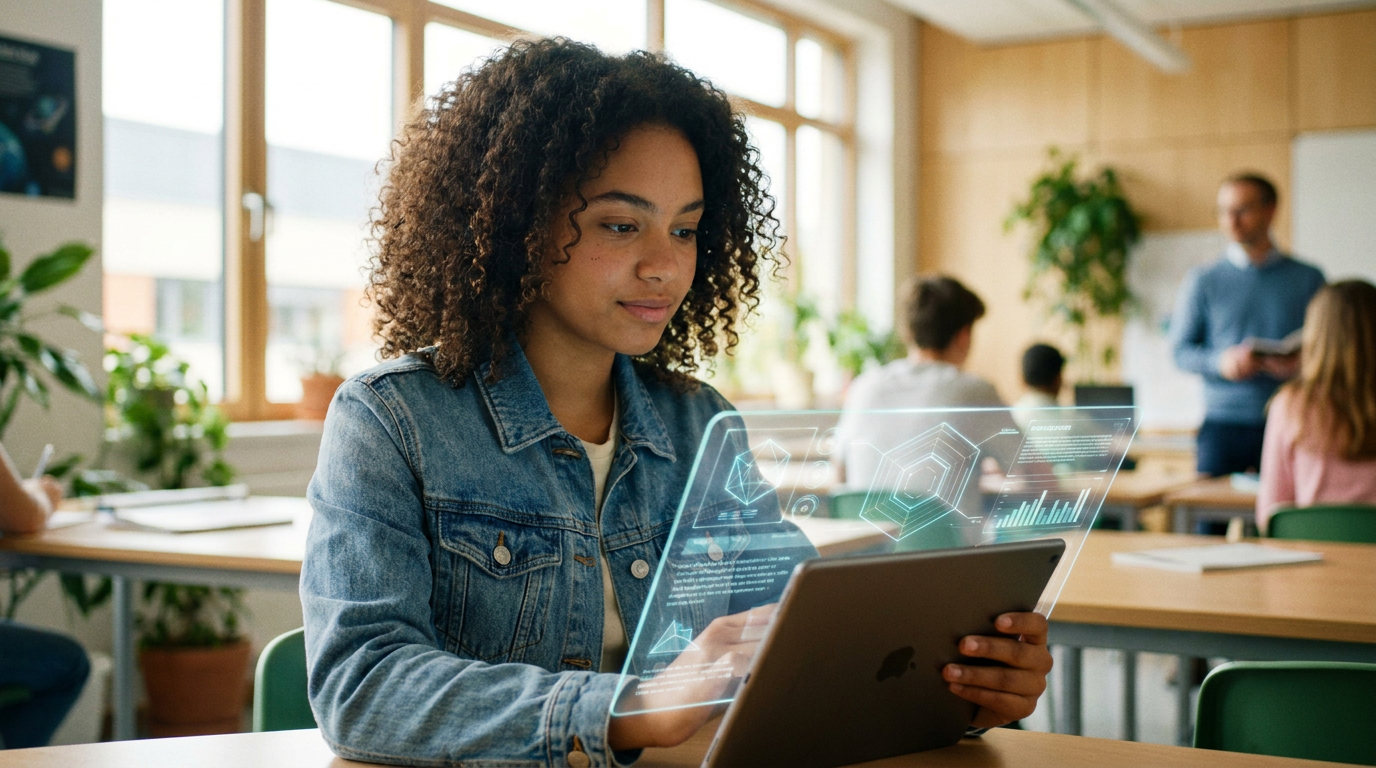
Today, the rapid maturation of generative artificial intelligence is finally offering a scalable solution. AI-powered tutoring systems are moving out of the experimental phase and into mainstream public education, promising to deliver personalized, one-on-one instruction at a fraction of the cost of human tutors.[6]

The rollout is happening at a staggering scale. In Arizona, the Department of Education recently announced that 170,000 public school students—roughly 16 percent of the state's total—are now using Khanmigo, an AI tutor developed by Khan Academy. Iowa has launched a $3 million initiative deploying an AI reading tutor called Amira for elementary students, while Maryland, Indiana, and Virginia are actively expanding their own state-funded pilot programs.[4]
Unlike early educational software that simply presented multiple-choice questions, modern AI tutors are designed around pedagogical best practices. The most effective platforms utilize Socratic dialogue. When a student is stuck on a math problem, the AI does not simply provide the correct answer. Instead, it asks probing questions, identifies the specific step where the student's logic failed, and guides them to discover the solution themselves.[1][6]
To prevent the "hallucinations" that plague general-purpose chatbots, educational AI relies on a technique called Retrieval-Augmented Generation. This restricts the AI's knowledge base to curated, grade-level-appropriate curriculum materials. Furthermore, tools like Khanmigo are now integrated directly into a student's learning record, allowing the AI to see the student's past performance and tailor its pacing and vocabulary to their specific skill gaps.[1][3]
The empirical evidence supporting these systems is becoming increasingly robust. A recent randomized controlled trial published in Scientific Reports found that students using a meticulously designed AI tutor learned substantially more than those in traditional active-learning classrooms, achieving an effect size between 0.73 and 1.3 standard deviations.[3]
The empirical evidence supporting these systems is becoming increasingly robust.
While not quite reaching Bloom's two-sigma benchmark, the gains are highly significant. A joint study by Stanford University and the National Bureau of Economic Research tracked students using Khanmigo for mathematics and documented a 0.2 standard deviation improvement over control groups. More recently, Khan Academy reported a 6.1 percent increase in "next-item correctness"—meaning students were measurably more likely to solve a new problem correctly immediately after interacting with the AI tutor.[1][5]

However, the transition to AI-assisted learning is not without friction. The Organization for Economic Cooperation and Development (OECD) issued a stark warning in its 2026 Digital Education Outlook: simply giving students access to generative AI does not automatically result in learning.[2]
The OECD researchers found that when students use general-purpose AI without pedagogical guardrails, their immediate task performance improves, but their actual comprehension stalls. This phenomenon, often called "outsourcing the reps," occurs when the AI does the heavy cognitive lifting—writing the essay or solving the equation—leaving the student as a passive observer. When access to the AI is removed during exams, these students often perform worse than their peers.[2][6]
To combat this, purpose-built educational AI is designed to enforce "productive struggle." The system is programmed to refuse requests to write essays or complete homework, instead acting as a coach that critiques drafts and suggests structural improvements. The goal is to ensure the student retains ownership of the intellectual effort.[6]

For teachers, the integration of AI is proving to be a massive time-saver rather than a threat to their employment. Surveys indicate that educators who utilize AI tools save an average of nearly six hours per week on administrative tasks, lesson planning, and grading.[3]
This reduction in administrative burden is facilitating a fundamental shift in the role of the educator. Rather than spending their time delivering standardized lectures to a room of thirty students, teachers are increasingly acting as mentors and facilitators. While the AI handles the routine drills and immediate feedback, the human teacher focuses on complex problem-solving, emotional support, and motivating students who are falling behind.[2][6]
The most profound impact of AI tutoring may ultimately be its democratizing effect. Historically, high-quality, one-on-one tutoring has been a luxury reserved for affluent families who could afford hourly rates of $50 or more. By reducing the marginal cost of a tutoring session to near zero, AI is making personalized educational support available to students regardless of their socioeconomic status.[6]
As the technology continues to evolve, the focus is shifting from whether AI should be used in classrooms to how it can be integrated most effectively. While AI may never fully replace the empathy and social dynamics provided by a great human teacher, it is proving to be the most powerful tool yet developed for closing the gap between the education we can afford and the education every student deserves.[6]
How we got here
1984
Benjamin Bloom publishes his research on the 'Two Sigma Problem,' proving the massive efficacy of 1-on-1 tutoring.
2023
Khan Academy introduces Khanmigo, one of the first generative AI tutors designed specifically for K-12 education.
2025
Stanford and NBER publish early efficacy studies showing measurable math improvements for students using AI tutors.
2026
Major state education departments, including Arizona and Iowa, roll out AI tutoring platforms to hundreds of thousands of public school students.
Viewpoints in depth
EdTech Optimists
Believe AI is the first scalable solution to the Two Sigma problem.
Proponents of educational AI argue that the technology represents a historic inflection point. For decades, the massive benefits of personalized tutoring were restricted by the hard economic limits of human labor. By driving the marginal cost of a tutoring session to near zero, optimists believe AI can democratize access to elite-level educational support, raising the baseline academic performance of entire generations regardless of their socioeconomic background.
Pedagogical Skeptics
Warn that AI encourages cognitive offloading if not strictly managed.
Educational researchers and organizations like the OECD caution that the mere presence of AI does not guarantee learning. They point to data showing that when students use general-purpose AI to complete assignments, they often bypass the 'productive struggle' necessary to build neural pathways. Skeptics argue that unless AI tools are strictly constrained to act as coaches rather than answer-generators, they risk creating a generation of students who can produce high-quality outputs but possess little actual comprehension.
Classroom Educators
Emphasize that AI should handle drills while humans handle mentorship.
Many teachers view AI not as a replacement, but as a highly capable assistant that can take over the most exhausting parts of the job—grading, lesson planning, and repetitive drills. By offloading these tasks, educators argue they are finally free to focus on the deeply human aspects of teaching: identifying emotional distress, motivating disengaged students, and facilitating complex, collaborative classroom discussions that an algorithm cannot replicate.
What we don't know
- Whether the academic gains seen in early math and reading trials will translate to more subjective subjects like history and creative writing.
- How long-term reliance on AI tutors will affect students' independent problem-solving skills over a multi-year period.
- The full extent of the data privacy implications as millions of students feed their learning patterns into commercial AI models.
Key terms
- Two Sigma Problem
- The educational challenge of scaling the massive performance benefits of one-on-one tutoring to entire populations of students.
- Socratic Dialogue
- A teaching method where the instructor asks probing questions to lead the student to discover the answer, rather than simply providing it.
- Retrieval-Augmented Generation (RAG)
- An AI technique that restricts a model's answers to a specific, curated database of information to prevent it from making up false facts.
- Cognitive Offloading
- The act of relying on an external tool, like an AI chatbot, to do the thinking for you, which can prevent actual learning.
- Productive Struggle
- The necessary mental effort a student must exert to master a new concept, which good AI tutors are programmed to encourage.
Frequently asked
Can an AI tutor replace a human teacher?
No. AI excels at structured drills and providing immediate feedback, but human teachers are still required for motivation, emotional support, and complex mentorship.
Does AI just give students the answers?
Purpose-built educational AI, unlike general chatbots, uses Socratic dialogue to ask probing questions and guide students to find the answer themselves.
Is AI tutoring effective for all subjects?
Currently, AI excels in structured subjects like mathematics and language practice, though it is rapidly improving in open-ended writing critique and reading comprehension.
Sources
Source coverage
6 outlets
4 viewpoints surfaced






[1]Khan AcademyEdTech Optimists
Khanmigo efficacy study 2026
Read on Khan Academy →[2]OECDPedagogical Skeptics
Digital Education Outlook 2026
Read on OECD →[3]Scientific ReportsClassroom Educators
AI tutoring outperforms in-class active learning
Read on Scientific Reports →[4]K-12 DivePublic School Administrators
State education departments expand AI tutoring pilots
Read on K-12 Dive →[5]National Bureau of Economic ResearchClassroom Educators
Early Evidence on AI Tutoring in Mathematics
Read on National Bureau of Economic Research →[6]Factlen Editorial TeamEdTech Optimists
Synthesis by Factlen editorial team
Read on Factlen Editorial Team →

Every angle. Every day.
Get education stories with full source coverage and perspective breakdowns delivered to your inbox.