
How Augmented Reality and AI Are Forging the 'Digital Tradesperson'
Vocational schools and industrial employers are using virtual reality and artificial intelligence to compress training timelines, safely teach high-risk skills, and solve a critical labor shortage.
By Factlen Editorial Team
- Industry Employers
- Focus on compressing training timelines, capturing retiring veterans' knowledge, and deploying job-ready technicians faster to solve labor shortages.
- Vocational Educators
- Value immersive technology for safely scaling hands-on practice and engaging digital-native students without risking injury or wasting physical materials.
- Traditional Tradespeople
- Emphasize that while digital tools are useful accelerators, tactile fidelity is imperfect and real-world bench time remains essential for mastering the physical craft.
What's not represented
- · Labor Unions
- · Older workers adapting to new tech
Why this matters
As a generation of veteran tradespeople retires, the global economy faces a severe shortage of the skilled labor needed to build and maintain critical infrastructure. By integrating spatial computing and AI into vocational education, industries are making these essential careers safer, more accessible, and highly lucrative for a new generation.
Key points
- A wave of retirements is causing a severe shortage of skilled tradespeople and a loss of critical 'tribal knowledge.'
- Virtual reality allows apprentices to practice high-risk tasks like high-voltage wiring in a zero-consequence environment.
- VR training can compress the time it takes a technician to reach independent service from 12 months down to 90 days.
- Augmented reality and AI act as 'digital mentors,' overlaying schematics and predictive diagnostics onto physical equipment.
- While technology accelerates learning, experts note it cannot fully replace the tactile feel of real-world, hands-on practice.
The global economy runs on skilled trades, but the workforce is facing a demographic cliff. As veteran electricians, pipefitters, and HVAC technicians retire, they take decades of "tribal knowledge"—the hands-on, experience-driven instincts required to troubleshoot complex machinery—with them out the door.[1][7]
Traditional apprenticeships, which rely heavily on shadowing these veterans for years, are struggling to keep pace with the sheer volume of open roles. The U.S. Bureau of Labor Statistics projects roughly 80,000 job openings for electricians alone each year over the next decade, driven by retirements and rising infrastructure demands.[7]
To bridge this widening gap, vocational schools and industrial employers are turning to a radical overhaul of trade education. By integrating Virtual Reality (VR), Augmented Reality (AR), and Artificial Intelligence (AI), the industry is compressing training timelines and forging a new class of worker: the "digital tradesperson."[1][4]
The most immediate shift is happening in the classroom through immersive VR simulations. In trades where a single mistake can result in severe injury or destroyed equipment, VR provides a zero-risk environment for apprentices to build essential muscle memory before they ever step onto a job site.[2][5]
Trainees can wire a virtual high-voltage panel, troubleshoot a commercial rooftop chiller, or practice arc flash response protocols without touching a live current. Because the environment is entirely digital, instructors can instantly reset the simulation, allowing students to repeat complex, rare failure scenarios dozens of times in a single afternoon.[2][3][5][7]
This repetition yields measurable results. Data from industry pilot programs indicates that technicians trained in VR can reach the milestone of independent service calls in under 90 days, a stark contrast to the 12 or more months typically required in a traditional apprenticeship. Furthermore, a PwC study found that VR-trained employees were 40% more confident in applying their skills than their classroom-trained peers.[2][5]

Government agencies are also recognizing the power of this technology to attract younger, digital-native demographics. The Saskatchewan Apprenticeship and Trade Certification Commission, for example, has deployed VR kits to high schools, allowing students to step into the virtual work boots of welders and sheet metal workers to spark early interest in vocational careers.[6]
Government agencies are also recognizing the power of this technology to attract younger, digital-native demographics.
But the technological intervention does not stop at graduation. As apprentices transition to the field, Augmented Reality (AR) is replacing the bulky paper manuals and trial-and-error diagnostics of the past.[1][4]
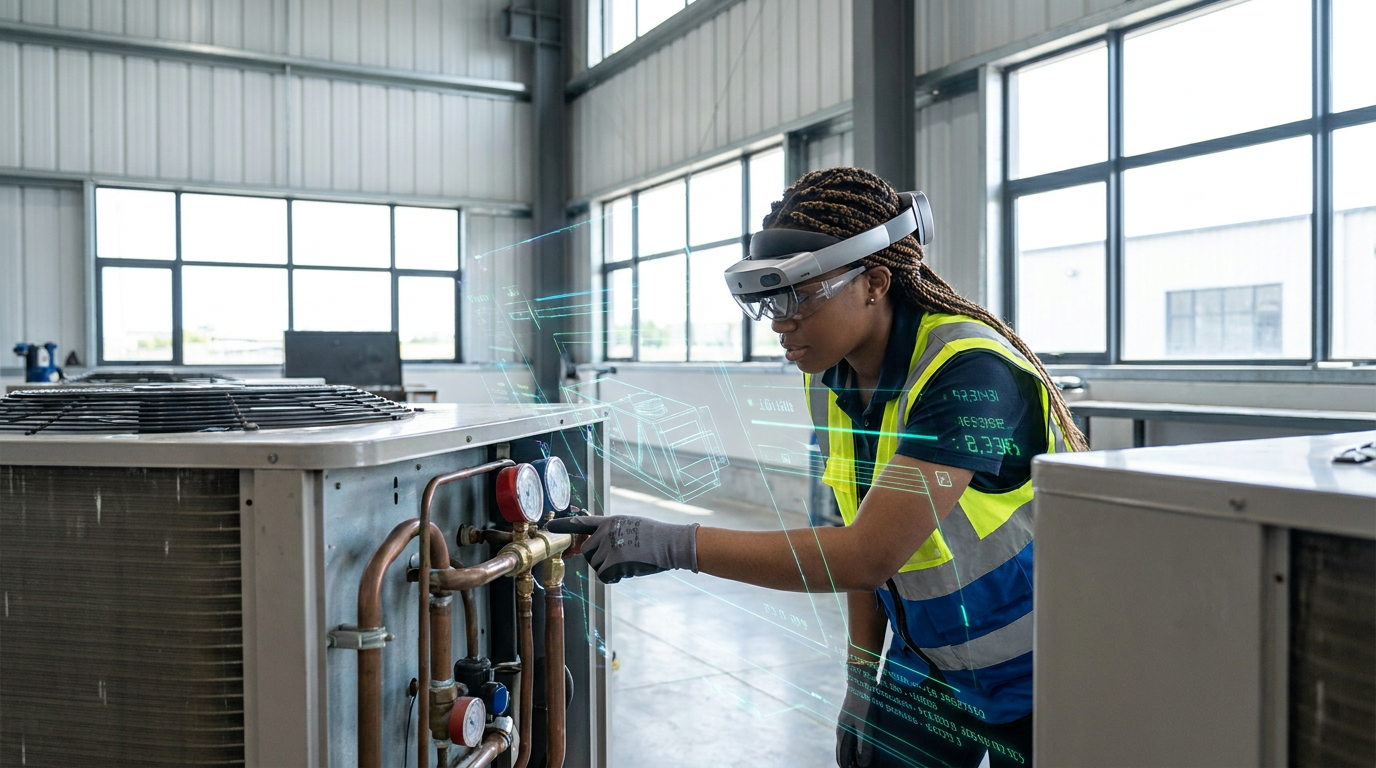
AR glasses and mobile interfaces overlay digital instructions, wiring diagrams, and lockout-tagout safety steps directly onto the physical equipment a technician is servicing. If a junior mechanic encounters an unfamiliar fault code on a modern, IoT-connected HVAC system, AR allows them to pull up the machine's repair history and common failure patterns in real time.[1][5][7]
Behind these AR overlays sits the analytical power of Artificial Intelligence, acting as a "digital mentor." AI systems ingest vast amounts of maintenance logs and sensor data to guide technicians through the most probable troubleshooting steps, effectively preserving the tribal knowledge of retired veterans.[1][3]

This AI integration is fundamentally shifting the nature of maintenance from reactive to predictive. Instead of rushing to fix a broken pump after it halts production, AI-enabled sensors monitor vibration and temperature data to detect early signs of failure.[1]
The technician's role evolves accordingly. The predictive maintenance technician spends as much time interpreting sensor data and diagnosing digital patterns as they do turning a wrench. This blend of mechanical aptitude and digital literacy is what defines the modern digital tradesperson, offering a highly stable and lucrative career path.[1][4]

Despite the rapid adoption, educators and industry leaders acknowledge the current limitations of the technology. The most significant hurdle is tactile fidelity—the physical sensation of the work.[4][7]
While VR can teach the exact sequence of steps to assemble a manifold, it cannot perfectly replicate the resistance of a stripped bolt or the precise torque required to seal a pipe. Consequently, experts emphasize that VR and AR are not full replacements for the workbench; they are accelerators that must be paired with real-world, hands-on practice.[3][4]
Additionally, scaling these programs requires significant upfront investment in headset fleets and the ongoing software development needed to keep virtual models updated as manufacturers release new generations of equipment.[4][7]

Nevertheless, the consensus among workforce developers is that the integration of spatial computing and AI is no longer optional. By making vocational training safer, faster, and more appealing to a new generation, these technologies are ensuring that the critical infrastructure of the future remains in highly capable hands.[1][7]
Viewpoints in depth
Vocational Educators
Educators view immersive technology as a vital tool to safely scale hands-on practice and engage a new generation of students.
For trade schools and high school vocational programs, the primary barrier to entry has always been the cost and risk of physical materials. VR eliminates the need to purchase expensive consumables for practice and removes the liability of having novices handle live currents or heavy machinery. Educators also note that digital-native students respond highly to gamified, immersive environments, making trades more appealing to demographics that might have otherwise defaulted to a four-year university track.
Industry Employers
Companies are focused on using AI and AR to capture retiring veterans' knowledge and deploy job-ready technicians faster.
Industrial employers are facing a demographic crisis as their most experienced technicians age out of the workforce. Their priority is speed to competency. By using AI to ingest decades of maintenance logs and AR to project that knowledge directly into the field of vision of a junior mechanic, companies can maintain operational efficiency even with a less experienced workforce. For employers, the 'digital tradesperson' is a necessary evolution to keep production lines and infrastructure running.
Traditional Tradespeople
Veteran workers emphasize that while digital tools are useful accelerators, they cannot replace the physical mastery of the craft.
While acknowledging the benefits of safer classroom training, experienced tradespeople caution against over-relying on digital simulations. They point out that tactile fidelity—the physical sensation of cross-threading a pipe, the exact torque required for a seal, or the subtle sounds of a failing motor—cannot be perfectly replicated in a headset. From this perspective, VR and AR are excellent supplements for learning procedures, but true mastery still requires thousands of hours of real-world bench time.
What we don't know
- How quickly smaller, independent contracting businesses will be able to afford the upfront hardware costs of AR/VR training fleets.
- Whether the integration of AI diagnostics will eventually depress wages for entry-level technicians by simplifying the troubleshooting process.
- How rapidly hardware manufacturers can improve haptic feedback to better simulate the physical resistance of real-world tools.
Key terms
- Digital Tradesperson
- A modern technician who blends traditional mechanical skills with digital literacy, using AI and AR tools to diagnose and repair systems.
- Tribal Knowledge
- The hands-on, experience-driven insight and troubleshooting instincts that veteran workers accumulate over years on the job.
- Predictive Maintenance
- Using AI-enabled sensors to monitor equipment data, such as temperature or vibration, to fix problems before a breakdown occurs.
- Haptic Feedback
- Technology that simulates the sense of touch, allowing VR users to feel resistance or vibration when interacting with virtual tools.
- Augmented Reality (AR)
- Technology that overlays digital information, such as wiring diagrams or repair instructions, onto the physical world through glasses or a screen.
Frequently asked
Can VR completely replace hands-on trades training?
No. While VR accelerates learning and allows for safe practice of dangerous tasks, experts agree it cannot fully replicate the tactile feedback and physical resistance of real-world tools.
What is a 'digital tradesperson'?
A modern technician who combines traditional mechanical skills with digital literacy, using AI diagnostics and augmented reality to maintain and repair complex systems.
How does VR improve safety for apprentices?
VR allows trainees to practice high-risk procedures—such as arc flash response or handling high-voltage equipment—in a zero-consequence digital environment before attempting them in reality.
Sources
Source coverage
7 outlets
3 viewpoints surfaced







[1]Randstad USAIndustry Employers
Beyond the hype: 3 AI trends redefining the skilled trades
Read on Randstad USA →[2]VR OwlIndustry Employers
VR HVAC Training: From Classroom to Job-Ready Technicians
Read on VR Owl →[3]ImmerseLearnIndustry Employers
Is Online VR Training Effective? Proven Benefits for Skilled Trades
Read on ImmerseLearn →[4]EdquipVocational Educators
VR in Vocational Training: The Future of Hands-On Education
Read on Edquip →[5]AutoVRseIndustry Employers
How VR Training Enhances Learning for HVAC Technicians
Read on AutoVRse →[6]Saskatchewan Apprenticeship and Trade Certification CommissionVocational Educators
Students try skilled trades in the classroom using virtual reality
Read on Saskatchewan Apprenticeship and Trade Certification Commission →[7]Factlen Editorial TeamTraditional Tradespeople
Synthesis by Factlen editorial team
Read on Factlen Editorial Team →

Every angle. Every day.
Get education stories with full source coverage and perspective breakdowns delivered to your inbox.