
How Solid-State Batteries Work and Why They Are the Future of EVs
After decades of laboratory research, solid-state batteries are finally crossing the threshold into commercial production in 2026. By replacing flammable liquid electrolytes with solid materials, this breakthrough technology promises to double EV range, enable five-minute charging, and eliminate fire risks.
By Factlen Editorial Team
- Battery Innovators & Startups
- Argue that solid-state technology is ready to transition from the lab to mass production, unlocking unprecedented EV performance.
- Legacy Automakers
- View the technology as a critical long-term investment, focusing on rigorous testing, safety validation, and gradual integration.
- Industry Analysts
- Emphasize the massive manufacturing hurdles, material trade-offs, and cost barriers that must be solved before widespread adoption.
What's not represented
- · Raw material mining communities
- · Battery recycling facilities
- · Independent auto repair shops
Why this matters
Solid-state batteries promise to eliminate electric vehicle range anxiety, slash charging times to under ten minutes, and drastically reduce the risk of battery fires. Understanding how this technology works is crucial as it prepares to fundamentally reshape the automotive industry and the devices we rely on daily.
Key points
- Solid-state batteries replace flammable liquid electrolytes with solid materials like ceramics, glass, or polymers.
- The solid barrier prevents dendrite growth, allowing the use of highly energy-dense lithium-metal anodes.
- This architecture can potentially double the range of electric vehicles while drastically reducing fire risks.
- Major players like Honda, Toyota, and QuantumScape are aggressively pushing the technology toward mass production in 2026.
- Significant manufacturing hurdles, including material brittleness and moisture sensitivity, still delay mass-market adoption.
For the last thirty years, the lithium-ion battery has been the undisputed champion of portable power. It is the invisible heartbeat of modern life, tucked inside everything from the smartphone in your pocket to the electric vehicle in your driveway. But as the world demands more range, faster charging, and absolute safety from its EVs, the traditional lithium-ion cell is hitting a chemical and physical wall.[6]
The solution to this bottleneck is not a software update or a minor tweak, but a fundamental reimagining of the battery's architecture. Enter the solid-state battery, a technology that has spent decades confined to laboratory benches and investor pitch decks. In 2026, however, the narrative is shifting from theoretical promises to tangible production, with major automakers and battery startups crossing critical milestones.[4][7]
To understand why solid-state batteries are considered the holy grail of energy storage, one must first look under the hood of a conventional battery. Every battery consists of three primary components: the anode (the negative electrode), the cathode (the positive electrode), and the electrolyte (the medium that sits between them).[6]
When a battery powers a device, lithium ions travel from the anode, through the electrolyte, to the cathode. The electrons, which cannot pass through the electrolyte, are forced to take an external route through your device's circuit, creating the electrical current that powers the motor or lights the screen. When the battery is plugged in to charge, this entire journey runs in reverse.[1][6]

In almost every battery on the market today, that crucial electrolyte is a liquid—specifically, a lithium salt dissolved in an organic solvent. While effective at shuttling ions, this liquid comes with severe compromises. It is highly flammable, sensitive to extreme temperatures, and requires heavy, bulky protective casing to prevent punctures and thermal runaway.[6]
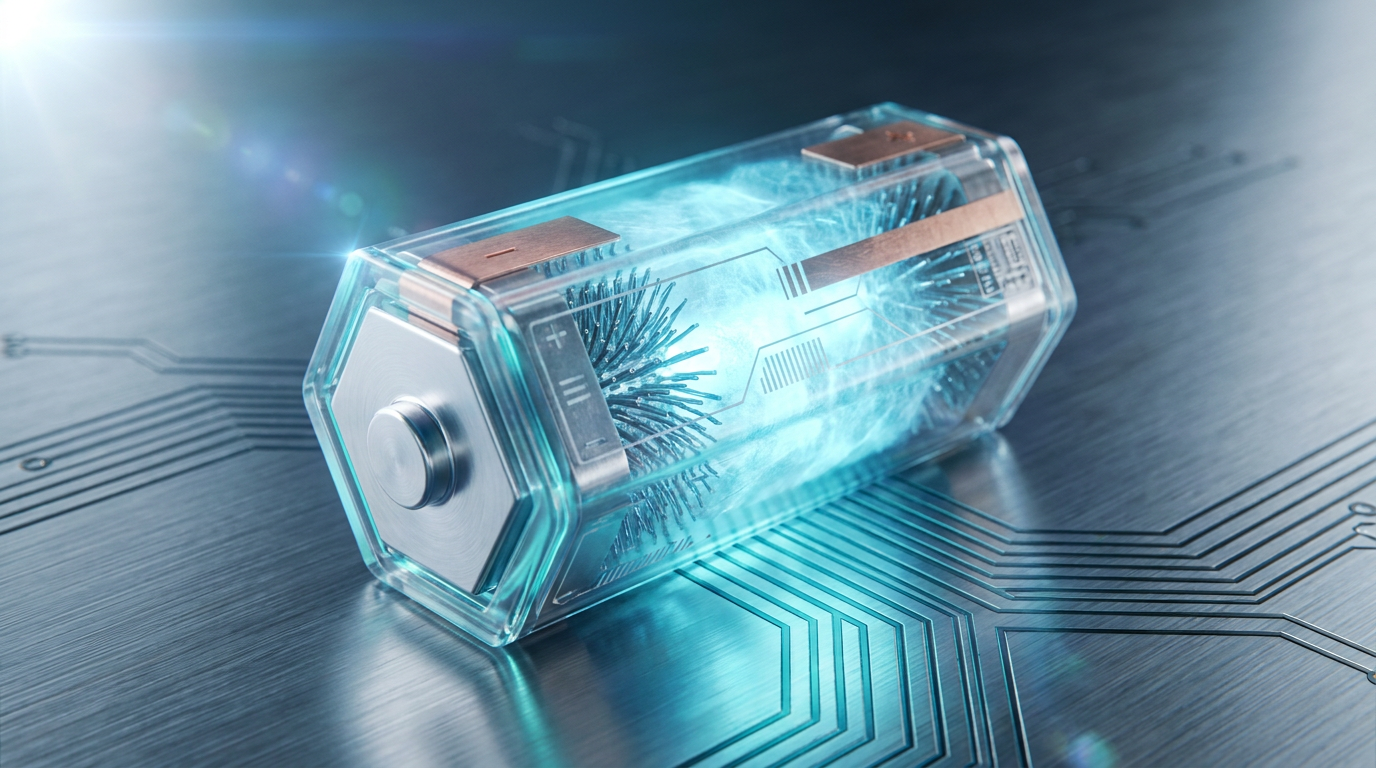
A solid-state battery changes the equation with a single, profound swap: it replaces the flammable liquid electrolyte with a solid material. Depending on the manufacturer, this solid separator might be a specialized ceramic, a glass compound, a sulfide, or a polymer.[1][6]
This solid barrier still allows lithium ions to pass through during the charging and discharging cycles, but it fundamentally alters the battery's physical limits. Because the solid electrolyte is inherently non-flammable, the risk of a catastrophic battery fire is virtually eliminated. Thermal events in solid-state systems require vastly higher temperatures to trigger, making them exponentially safer for passenger vehicles.[2][4]
But safety is only the beginning. The true prize of the solid-state architecture is a massive leap in energy density—the amount of power a battery can hold relative to its weight. Today's best liquid lithium-ion batteries max out around 250 to 300 watt-hours per kilogram (Wh/kg). Solid-state cells are targeting 400 to 500 Wh/kg, effectively doubling the energy capacity in the same physical footprint.[2][4]

This leap is made possible by the solid electrolyte's ability to unlock a new kind of anode. In conventional batteries, the anode is typically made of graphite, a bulky material needed to safely absorb lithium ions. If manufacturers try to use pure lithium metal as an anode in a liquid battery, it forms dendrites—microscopic, needle-like metallic whiskers that grow through the liquid, pierce the separator, and cause a short circuit.[1][6]
This leap is made possible by the solid electrolyte's ability to unlock a new kind of anode.
A solid electrolyte acts as a physical wall, suppressing dendrite growth and allowing engineers to use a pure lithium-metal anode. By stripping away the heavy graphite, the battery becomes significantly lighter and more compact, allowing automakers to either double an EV's range without adding weight, or drastically reduce the vehicle's weight while maintaining current ranges.[1][3]
Charging speeds also see a dramatic transformation. Because solid electrolytes are vastly more stable under high voltage and heat, they can accept a massive influx of current without degrading. Startups and automakers are currently testing cells that can charge from zero to 80 percent in under ten minutes, mirroring the time it takes to fill a traditional car with gasoline.[3][4]
The momentum in 2026 is palpable. In June, Japanese automotive giant Honda signed a major joint research agreement with California-based QuantumScape, a leader in solid-state lithium-metal technology. After rigorous competitive benchmarking, Honda committed to a multi-year plan to integrate QuantumScape's proprietary ceramic separators into its future vehicle platforms.[3][5]
Meanwhile, in China, Greater Bay Technology—backed by the GAC Group—announced that its A-sample solid-state cells had successfully rolled off the production line. These cells passed extreme needle penetration and thermal shock tests without igniting, and the company is aggressively targeting mass production by the end of 2026.[4]
European automakers are equally invested. Mercedes-Benz recently completed a 1,200-kilometer real-world highway test using a vehicle equipped with solid-state cells from US-based Factorial, proving that the technology can endure the rigors of cross-country travel outside of a controlled laboratory environment.[7]

Despite these breakthroughs, the road to mass commercialization remains steep. The science is largely settled, but the manufacturing is not. Building solid-state batteries requires entirely new factory lines, ultra-precise manufacturing tolerances, and novel supply chains.[6][8]
Furthermore, each solid material comes with its own engineering trade-offs. Sulfide-based electrolytes offer excellent ion conductivity but are highly sensitive to moisture, requiring expensive dry-room manufacturing. Oxide-based ceramics are incredibly stable but can be brittle, risking microscopic cracks under the physical swelling and shrinking that occurs during charge cycles.[1]
Because of these manufacturing hurdles, the first wave of solid-state batteries will not appear in budget-friendly commuter cars. Analysts project that the initial rollout will target premium electric vehicles, high-performance motorcycles, and emerging sectors like electric vertical takeoff and landing aircraft, where the premium for lightweight energy is justified.[2][4]

Yet, the long-term economic outlook is highly optimistic. Market intelligence firm IDTechEx forecasts that the global market for solid-state batteries will reach $10 billion by 2036, driven by localized manufacturing and relentless material science improvements.[2]
As production scales and defect rates drop, the cost per kilowatt-hour is expected to plummet. Because solid-state packs require far less heavy cooling infrastructure and protective armor than their liquid predecessors, the overall cost of the vehicle could eventually drop below that of today's EVs.[6][8]
The transition from liquid to solid represents the most significant paradigm shift in energy storage since the commercialization of the lithium-ion battery in the 1990s. While it will take years for the technology to fully saturate the market, the milestones achieved in 2026 confirm that the solid-state future is no longer a distant mirage—it is actively being built.[8]
How we got here
1991
Sony commercializes the first rechargeable lithium-ion battery, revolutionizing portable electronics.
2010s
Automakers and startups begin heavily investing in solid-state research, though early prototypes struggle with stability.
2020–2025
Billions are poured into R&D, but companies repeatedly miss ambitious mass-production deadlines due to manufacturing complexities.
June 2026
Honda signs a major joint research agreement with QuantumScape, signaling renewed OEM confidence in the technology.
Late 2026
Companies like Greater Bay Technology target the first mass-production runs of A-sample solid-state cells for vehicles.
Viewpoints in depth
Battery Innovators' View
Startups and tech firms believe the fundamental science is solved and rapid commercialization is imminent.
Companies like QuantumScape and Greater Bay Technology argue that the chemical hurdles of solid-state batteries have largely been cleared. Their focus has shifted entirely to scaling manufacturing. By demonstrating successful A-sample cells that survive extreme thermal and puncture tests, these innovators believe the industry is on the cusp of a massive disruption that will render traditional liquid lithium-ion batteries obsolete within a decade.
Legacy Automakers' View
Established car manufacturers are taking a cautious, highly validated approach to integration.
Giants like Honda, Toyota, and Mercedes-Benz recognize the existential importance of solid-state technology but are wary of overpromising. Having been burned by missed deadlines in the past, they are subjecting new cells to rigorous competitive benchmarking. Their strategy involves gradual integration, likely starting with premium, low-volume models to validate the technology in the real world before committing to mass-market fleet overhauls.
Material Scientists' View
Researchers emphasize that scaling production requires overcoming severe physical and chemical trade-offs.
Chemists and manufacturing analysts point out that moving from a pristine lab environment to a gigafactory is notoriously difficult. They highlight the inherent trade-offs in solid materials: sulfides are highly conductive but react violently with moisture, while oxides are stable but brittle. Until a manufacturer can produce millions of flawless cells with high yields and low costs, scientists warn that the solid-state revolution remains a work in progress.
What we don't know
- Exactly when solid-state batteries will reach price parity with traditional lithium-ion cells.
- Which solid electrolyte material (sulfide, oxide, or polymer) will ultimately dominate the mass market.
- How well these next-generation cells will hold up after ten to fifteen years of real-world driving and weather exposure.
Key terms
- Electrolyte
- The medium inside a battery that allows charged ions to travel back and forth between the positive and negative sides.
- Anode
- The negative electrode of a battery, where lithium ions are stored when the battery is fully charged.
- Dendrites
- Microscopic, needle-like metallic structures that can grow inside a liquid battery, potentially piercing the separator and causing a short circuit.
- Energy Density
- A measure of how much electrical energy a battery can store relative to its physical weight or size, typically measured in Wh/kg.
- Thermal Runaway
- A dangerous chain reaction where a battery overheats uncontrollably, often leading to a fire or explosion.
Frequently asked
Will solid-state batteries make electric vehicles cheaper?
Eventually, yes. While initial production costs are high, solid-state batteries require less heavy cooling infrastructure and protective casing, which should lower the overall cost of the vehicle at scale.
Can I upgrade my current EV with a solid-state battery?
No. Solid-state batteries require entirely different battery pack architectures, thermal management systems, and software, meaning they cannot be retrofitted into older vehicles.
Are solid-state batteries completely fireproof?
While no energy storage device is entirely without risk, solid-state batteries eliminate the highly flammable liquid electrolyte, making them exponentially safer and highly resistant to thermal runaway.
Sources
Source coverage
8 outlets
3 viewpoints surfaced








[1]American Chemical SocietyIndustry Analysts
Working Principle and Potential Advantages of Solid-State Batteries
Read on American Chemical Society →[2]IDTechExIndustry Analysts
Solid-State Batteries 2026-2036: Technology, Forecasts, Players
Read on IDTechEx →[3]QuantumScapeBattery Innovators & Startups
QuantumScape Announces Agreement with Honda on Solid-State Battery Technology
Read on QuantumScape →[4]ElectrekBattery Innovators & Startups
China ramps up solid-state EV battery production
Read on Electrek →[5]InsideEVsLegacy Automakers
Honda Is Teaming Up With QuantumScape For Solid-State EV Batteries
Read on InsideEVs →[6]Pudgycat.ioIndustry Analysts
What Is a Solid-State Battery? The Plain-English Explainer
Read on Pudgycat.io →[7]EleportBattery Innovators & Startups
New Battery Technologies 2026: What Actually Matters
Read on Eleport →[8]Factlen Editorial TeamLegacy Automakers
Synthesis by Factlen editorial team
Read on Factlen Editorial Team →

Every angle. Every day.
Get guides stories with full source coverage and perspective breakdowns delivered to your inbox.