
How Tool Libraries and Repair Cafés Are Rebuilding Neighborhood Infrastructure
As communities seek antidotes to social isolation and disposable consumer culture, grassroots tool-sharing networks and collaborative repair spaces are rapidly expanding across the globe.
By Factlen Editorial Team
- Community Organizers
- Focus on the social cohesion and skill-sharing benefits of accessible third places.
- Circular Economy Advocates
- Prioritize waste diversion, lifecycle extension, and the legislative fight against planned obsolescence.
- Municipal Planners
- View shared resource hubs as vital civic infrastructure that requires sustainable public funding.
What's not represented
- · Traditional hardware retailers
- · Consumer electronics manufacturers
Why this matters
These collaborative spaces offer a highly practical way to save money, learn tactile skills, and reduce household waste, all while fostering genuine, face-to-face connections with neighbors in an increasingly digital world.
Key points
- Tool libraries and repair cafés are rapidly expanding globally as communities seek to combat social isolation and reduce waste.
- These spaces function as modern 'third places,' offering neutral ground for intergenerational connection and skill-sharing.
- By pooling resources, neighborhoods democratize access to expensive tools and divert thousands of tons of goods from landfills.
- Recent 'Right to Repair' legislative victories are empowering volunteers by legally mandating access to diagnostic tools and parts.
- Despite their success, these volunteer-run hubs face ongoing challenges securing affordable physical space and sustainable funding.
Modern urban life is increasingly defined by two distinct but intersecting crises: an epidemic of social isolation and a mounting ecological toll driven by disposable consumer culture. As neighborhoods become more atomized and the lifespan of household goods shrinks, communities are left searching for solutions that address both the fraying social fabric and the overflow of local landfills. In response, a grassroots movement has steadily gained momentum through 2025 and 2026, offering a dual remedy. Across the globe, neighborhoods are reclaiming physical spaces to establish tool libraries and repair cafés—collaborative hubs that prioritize shared resources over individual ownership.[6]
These initiatives represent a modern evolution of the "third place," a concept coined by urban sociologist Ray Oldenburg in 1989. Oldenburg defined third places as informal, neutral public spaces distinct from the home (the first place) and the workplace (the second place). Historically, these were pubs, coffee shops, and local post offices—venues where neighbors gathered, conversed, and built civic trust. As commercial pressures and digital migration have eroded many traditional third places, tool libraries and repair spaces are stepping into the void, offering a highly practical, hands-on environment where community members can connect across generational and socioeconomic divides.[3][6]
The mechanics of a tool library are elegantly simple, mirroring the familiar operations of a traditional public library. Instead of every household on a suburban block purchasing a power drill or a pressure washer that might be used for only fifteen minutes a year, a centralized neighborhood hub acquires and maintains a comprehensive inventory of equipment. Residents can check out everything from weed whackers and fence post drivers to sewing machines and specialized bicycle wrenches. By pooling resources, these libraries drastically reduce the financial barrier to home maintenance and creative projects, while simultaneously cutting down on the manufacturing demand for rarely used consumer goods.[2][4]

Real-world implementations of this model are proving highly successful in diverse urban environments. In New York, the Brooklyn Public Library system has integrated a free tool library into its Greenpoint branch, allowing patrons to check out power tools for a week at a time using their standard library cards. On the West Coast, organizations like Green Lents in Portland, Oregon, serve eleven historically marginalized neighborhoods, providing not just tools but a vital community knowledge space. These hubs democratize access to expensive equipment, ensuring that lower-income residents are not priced out of essential repairs or neighborhood improvement projects.[1][2]
Operating alongside—and often in tandem with—tool libraries are repair cafés. The repair café model originated in Amsterdam in 2009, spearheaded by environmentalist Martine Postma, who envisioned a welcoming venue where people could bring broken household items to be fixed by knowledgeable volunteers. The concept struck a chord, and by 2026, the network has expanded to nearly 3,000 locations worldwide. These events transform the solitary frustration of a broken appliance into a collaborative, educational experience, fundamentally shifting how communities interact with the objects they own.[1][5]
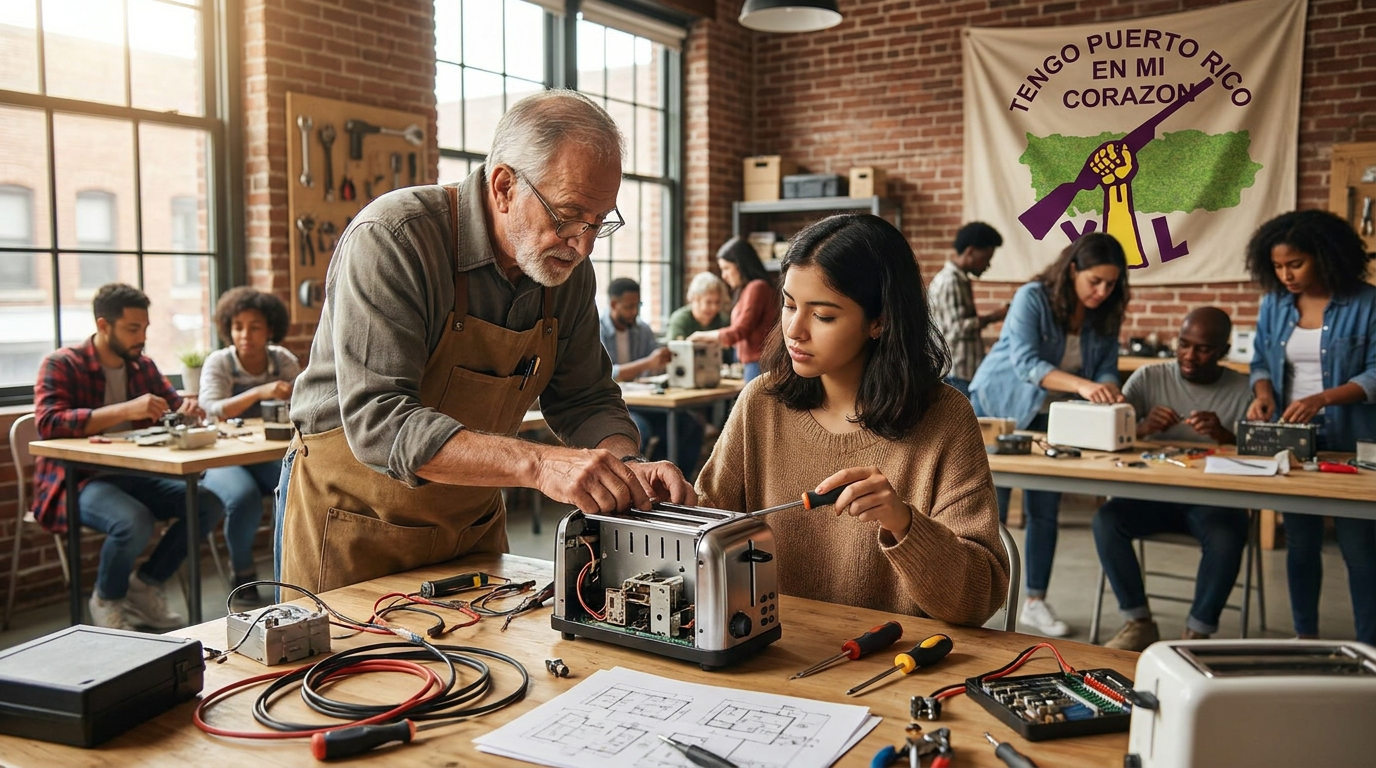
A typical afternoon at a repair café is a bustling scene of cross-pollination. Volunteers with backgrounds in electrical engineering, carpentry, or tailoring set up workstations, while attendees arrive carrying malfunctioning toasters, torn winter coats, or sluggish laptops. The ethos is not simply a drop-off repair service; it is an active transfer of knowledge. Volunteers guide the owners through the troubleshooting and repair process, teaching them how to solder a wire, patch a seam, or replace a blown fuse. This hands-on instruction demystifies technology and empowers residents to tackle future repairs independently.[1][3]
The social impact of these interactions is profound. In Harlem, New York, Repair Cafe El Barrio stands as the city's first dedicated repair café, where founder Rocio Salceda teaches attendees how to sew using machines she brings to the space. In Washington State, the Waste Loop organization combines a tool library with on-site repair stations, stitching together a community of sustainability-minded individuals. These spaces naturally foster intergenerational mingling, as retired tradespeople pass down intuitive, tactile skills to younger generations who have grown up in an era of sealed, disposable electronics.[1]

Beyond the social benefits, the economic and environmental stakes of the repair movement are massive. The prevailing linear economy—based on a "take, make, and dispose" model—encourages planned obsolescence, where products are designed with artificially limited lifespans. The financial burden on consumers is staggering; researchers estimate that Australians alone spend roughly $28.3 billion annually replacing items that could have been repaired. By diverting countless tons of e-waste and textiles from landfills, repair cafés serve as a practical, localized engine for the circular economy, which emphasizes material recovery and lifecycle extension.[4][5]
Beyond the social benefits, the economic and environmental stakes of the repair movement are massive.
The grassroots energy of community repair spaces is increasingly intersecting with formal legislative efforts, most notably the "Right to Repair" movement. For years, manufacturers have restricted access to proprietary parts, diagnostic software, and repair manuals, forcing consumers to either rely on expensive official service centers or discard functional devices over minor faults. However, recent legislative victories are shifting the landscape. In 2024 and 2025, states like California and Washington passed landmark Right to Repair bills covering personal electronics and wheelchairs, legally mandating that manufacturers provide independent shops and consumers with the necessary resources to fix their own equipment.[1][5]
This legislative backing amplifies the effectiveness of community repair hubs. When volunteers at a repair café can legally access a smartphone's diagnostic codes or purchase an official replacement battery, their success rate skyrockets. The synergy between top-down policy changes and bottom-up community action is creating a robust ecosystem where repairing an item is no longer an act of defiance against a manufacturer, but a standard, supported consumer choice. Advocacy groups operating out of these third places frequently organize letter-writing campaigns to push for further legislative expansion.[1][6]

Academics studying this cultural shift note a distinct evolution from the traditional "Do-It-Yourself" (DIY) mindset to a "Do-It-Together" (DIT) framework. While the DIY movement has sometimes been co-opted by corporate marketing to sell more individual tools and materials, the DIT model actively resists commodification. By centering the sharing of physical space and collective knowledge, DIT initiatives like tool libraries ensure that the impulse to repair does not simply generate a new avenue for consumption. Instead, it reclaims repair as a communal practice that strengthens local resilience.[3]
The global footprint of the DIT movement highlights its universal appeal. In Tartu, Estonia, the Paranduskelder community makerspace hosts workshops that repurpose industrial leather leftovers into sustainable accessories, blending repair with creative upcycling. Similarly, Repair Cafe Budapest has gained recognition for its radically inclusive environment, welcoming everyone from hobbyists to individuals experiencing housing difficulties. These international examples demonstrate that the desire for agency over our material environment, coupled with the need for authentic social connection, transcends cultural and geographic boundaries.[3]
Despite their rapid growth and undeniable benefits, tool libraries and repair cafés face significant operational hurdles. Because they are overwhelmingly run by non-profit organizations and rely heavily on volunteer labor, burnout is a persistent threat. Securing affordable, accessible physical space in increasingly expensive urban real estate markets is another major challenge. Many initiatives operate out of church basements, community centers, or public libraries, constantly juggling storage constraints and limited operating hours while trying to meet surging public demand.[1][6]

Recognizing the civic value of these spaces, forward-thinking municipalities are beginning to step in with structural support. In early 2026, the regional government of Oregon Metro distributed "Reuse Impact Fund" grants to several local repair organizations. This targeted funding allowed groups like Repair PDX and the William Temple House to expand their operating hours, transition to more stable e-commerce platforms for salvaged goods, and offer vital translation services. By treating repair hubs as essential civic infrastructure rather than niche hobbyist projects, local governments can ensure their long-term viability.[2]
Ultimately, the resurgence of tool libraries and repair cafés signals a profound shift in how communities envision their future. They offer a tangible, localized antidote to the abstract anxieties of climate change and social fragmentation. When neighbors gather to troubleshoot a broken vacuum cleaner or share a table saw, they are not just fixing appliances or building garden beds; they are actively repairing the social infrastructure of their neighborhoods. In an era defined by digital isolation and disposable goods, these collaborative spaces prove that the most sustainable resources a community possesses are the skills and time of its own residents.[3][6]
How we got here
1989
Sociologist Ray Oldenburg coins the term 'Third Place' to describe vital community gathering spots.
2009
Martine Postma establishes the world's first Repair Cafe in Amsterdam.
2024–2025
California and Washington pass landmark Right to Repair legislation for electronics and wheelchairs.
Early 2026
Municipalities like Oregon Metro begin issuing dedicated grants to fund local repair and reuse hubs.
Viewpoints in depth
Community Organizers' view
Argue that the primary value of these spaces is social, not just environmental.
Community organizers emphasize that in an era of profound loneliness and digital isolation, having a physical 'third place' where people can gather without the expectation of spending money is vital. They focus on the skill-sharing and intergenerational bonding that occurs naturally when neighbors collaborate on a shared task, viewing the repaired item as a secondary benefit to the repaired social fabric.
Circular Economy Advocates' view
Focus on the hard metrics of waste diversion and lifecycle extension.
Environmental advocates view repair cafés and tool libraries as essential infrastructure for combating planned obsolescence and reducing the carbon footprint of manufacturing. They heavily champion Right to Repair legislation, arguing that empowering consumers to fix their own goods is a necessary step in transitioning away from a destructive 'take-make-dispose' linear economy.
Municipal Planners' view
View these hubs through the lens of neighborhood resilience and resource management.
Urban planners and local governments are increasingly concerned with how to sustainably fund and scale these spaces. They advocate for integrating tool libraries into existing public infrastructure—such as municipal library systems—or offering targeted grants to offset the high costs of commercial real estate, ensuring these hubs remain accessible to marginalized communities.
What we don't know
- Whether local governments will provide sustained, long-term funding for these spaces or rely on short-term grants.
- How the expansion of Right to Repair laws will impact the availability of proprietary parts for community repair hubs.
- If the volunteer-driven model can scale to meet surging public demand without causing widespread organizer burnout.
Key terms
- Third Place
- An informal public gathering space outside of home and work that fosters community connection.
- Circular Economy
- An economic model aimed at eliminating waste by continually reusing and repairing resources.
- Planned Obsolescence
- The manufacturing practice of designing products with an artificially limited useful life so they require frequent replacement.
- Do-It-Together (DIT)
- A collaborative evolution of the DIY movement that emphasizes sharing tools, knowledge, and physical space.
Frequently asked
Do I need repair skills to attend a repair cafe?
No. Volunteers with technical expertise are there to help you fix your items and teach you the process step-by-step.
Are tool libraries free to use?
Many are completely free, often integrated into public library systems, while others operate on a low-cost, sliding-scale annual membership.
What kinds of items can be fixed at these events?
Common items include small household appliances, clothing, bicycles, and electronics, though capabilities depend on the specific volunteers present.
Sources
Source coverage
6 outlets
3 viewpoints surfaced





[1]ForbesCommunity Organizers
How Repair Cafes And Tool Libraries Are Building Community
Read on Forbes →[2]Oregon MetroMunicipal Planners
Reuse Impact Funding supports community repair and tool libraries
Read on Oregon Metro →[3]Cooperative CityCircular Economy Advocates
Repair culture as a catalyst for socio-ecological change
Read on Cooperative City →[4]ACE HubCircular Economy Advocates
Repairing your relationship with repair in 2025
Read on ACE Hub →[5]Brampton Environmental AllianceCircular Economy Advocates
The Rise of Repair Cafés and the Circular Economy
Read on Brampton Environmental Alliance →[6]Factlen Editorial TeamCommunity Organizers
Synthesis by Factlen editorial team
Read on Factlen Editorial Team →
Every angle. Every day.
Get community stories with full source coverage and perspective breakdowns delivered to your inbox.