
How to Navigate Paris as a '15-Minute City': A 2026 Local Guide
Following a massive post-Olympic green transformation, Paris has pedestrianized hundreds of streets and expanded its cycling network, fundamentally changing how visitors experience the French capital.
By Factlen Editorial Team
- Urban Planners & Ecologists
- Advocates focused on the environmental and health benefits of removing cars.
- Slow Travel Advocates
- Tourism experts who believe the changes create a more authentic visitor experience.
- Policy Analysts
- Observers analyzing the political friction and logistical challenges of the transition.
What's not represented
- · Suburban Commuters
- · Local Delivery & Logistics Workers
- · Accessibility Advocates for the Disabled
Why this matters
The era of frantic, taxi-hopping Parisian sightseeing is over. By embracing the city's new pedestrian-first infrastructure, travelers can save money, avoid crowds, and experience a more authentic, village-like side of the French capital.
Key points
- Paris has transformed into a '15-minute city,' prioritizing pedestrians and cyclists over cars.
- Over 100 streets are now fully pedestrianized, with more closed to traffic on weekends.
- The city's cycling network has expanded to 1,678 kilometers as of early 2026.
- Major attractions like the Louvre now enforce strict daily visitor caps to manage crowds.
- A new €2.50 flat-rate transit fare makes exploring outer neighborhoods highly affordable.
The 2024 Olympics served as a global showcase, but by the summer of 2026, Paris has fundamentally rewritten its urban DNA. The city is no longer built for the automobile. Instead, it has fully embraced the "15-minute city" model—an urban planning philosophy pioneered by researcher Carlos Moreno where residents and visitors alike can reach essential services, cultural sites, and green spaces within a short walk or bike ride.[1][2][5]
For tourists, this transformation requires a complete shift in mindset. The traditional Parisian vacation often involved frantic taxi rides between distant monuments, battling gridlock around the Arc de Triomphe, and rushing through crowded museum halls. Today, the city's infrastructure actively discourages that approach, rewarding "slow travel" and neighborhood immersion instead.[1][6]
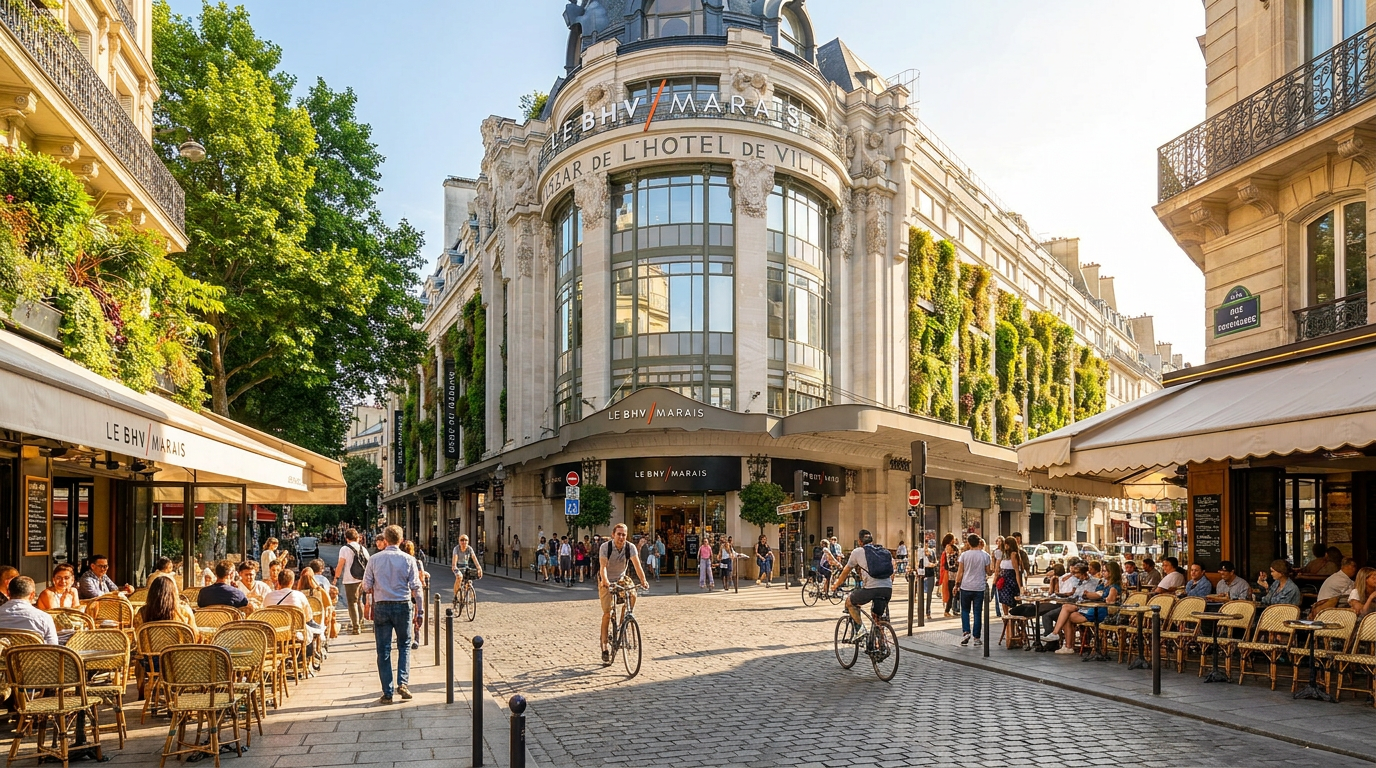
The most visible change is the sheer volume of space returned to pedestrians. Over one hundred streets across the capital are now entirely car-free year-round. Historic thoroughfares like Rue de la Huchette, Rue Mouffetard, and Rue Cler have been transformed into quiet havens where café terraces spill onto the cobblestones and local food markets thrive without the noise of combustion engines.[3]
This pedestrianization expands dramatically on weekends through the "Paris Respire" (Paris Breathes) initiative. On Sundays and public holidays, entire districts—including Montmartre, Le Marais, and the Canal Saint-Martin—are closed to motorized traffic. For a visitor, these are the ideal days to explore the city's creative heart, wandering between vintage boutiques and independent bookshops without ever stepping off the pavement.[3][6]

Beneath the surface of these quiet streets lies a massive reallocation of urban real estate. During her tenure, former Mayor Anne Hidalgo spearheaded the removal of 60,000 parking spaces, replacing them with 130,000 bicycle parking spots and expanded sidewalks. The city also tripled parking fees for heavy SUVs, sending a clear message that large private vehicles are no longer welcome in the historic center.[2]
In place of cars, bicycles have become the undisputed kings of the Parisian commute. As of March 2026, the city boasts 1,678 kilometers of dedicated cycle routes, up from just 700 kilometers a few years prior. The Vélib' bike-sharing program has expanded to meet this demand, making it incredibly easy for tourists to rent a bike and safely navigate from the Eiffel Tower to the Latin Quarter entirely on protected lanes.[2][4]
In place of cars, bicycles have become the undisputed kings of the Parisian commute.
The concrete itself is also turning green. Paris is currently hitting its ambitious 2026 target to cover 100 hectares of building space with vertical gardens and green rooftops. At street level, former traffic circles like the Place de Catalogne have been converted into "urban forests," featuring dense plantings of trees and shrubs that provide shade, lower summer temperatures, and improve air quality.[4]

Even the iconic Place de la Concorde has seen a post-Olympic transformation, with a significant portion of the square permanently closed to cars to create more space for pedestrians and greenery. These micro-parks offer perfect resting spots for travelers, allowing them to recharge with a fresh baguette and a book rather than retreating to a hotel room.[4][6]
Sustainability in 2026 also means managing the sheer volume of human footfall. Major cultural institutions have realized that unlimited access degrades both the visitor experience and the surrounding neighborhoods. The Louvre Museum, for instance, now strictly caps daily entries at approximately 30,000 visitors and mandates timed-entry tickets.[1]
This crowd-control philosophy encourages tourists to look beyond the "Golden Triangle" and explore the city's lesser-known, yet equally fascinating, museums. Instead of fighting for a glimpse of the Mona Lisa, visitors are increasingly drawn to the intimate Musée de Montmartre, the architectural marvel of the Philharmonie de Paris, or the quiet sculpture gardens of the Musée Rodin.[6]
Getting to these outer-arrondissement gems has never been easier or more affordable. A sweeping 2026 public transportation reform introduced a flat rate of €2.50 per trip across the entire Île-de-France region. Whether you are taking the Metro two stops down the street or riding the RER train all the way to the Palace of Versailles or Disneyland Paris, the cost remains a predictable, budget-friendly flat fare.[6]

Economically, the 15-minute city model is a boon for independent Parisian businesses. When tourists walk rather than drive, their spending naturally disperses into the local economy. A morning stroll through the 11th arrondissement might lead to an impromptu stop at a neighborhood boulangerie, a purchase from a local ceramicist, and a coffee at an independent roaster—money that previously might have been concentrated at mega-attractions.[6]
The transition has not been entirely frictionless. The aggressive reduction in car infrastructure sparked fierce pushback from suburban commuters, logistics companies, and motoring lobby groups, who argued that the changes alienated those who rely on vehicles for their livelihoods. Yet, the dramatic 40% drop in nitrogen dioxide pollution on car-free days provided a compelling counter-argument that ultimately won out.[2]

For the 2026 traveler, the message is clear: pack comfortable walking shoes and leave the rigid itinerary at home. Paris is no longer a checklist of monuments to be conquered from the back seat of a taxi. It is a collection of vibrant, interconnected villages, best experienced at a walking pace, one fifteen-minute neighborhood at a time.[1][6]
How we got here
2024
Paris hosts the Summer Olympics, using the event as a catalyst to accelerate its green infrastructure and clean the Seine.
2025
The city expands the 'Paris Respire' program, permanently closing major squares like Place de la Concorde to through-traffic.
March 2026
Official city data confirms the cycling network has reached 1,678 kilometers, more than double its pre-pandemic length.
May 2026
Mayor Anne Hidalgo, the primary architect of the 15-minute city transition, steps down after completing her major urban overhauls.
Viewpoints in depth
Urban Planners & Ecologists
Advocates focused on the environmental and health benefits of removing cars.
For environmental researchers and city planners, pedestrianizing Paris is not about aesthetics—it is a matter of public health and climate resilience. They point to the 40% reduction in nitrogen dioxide levels on car-free days and the cooling effect of new 'urban forests' as proof that aggressive anti-car policies work. This camp argues that returning 60,000 parking spaces to the public domain is a crucial step in future-proofing the city against extreme summer heatwaves.
Slow Travel Advocates
Tourism experts who believe the changes create a more authentic visitor experience.
Travel industry analysts and local guides argue that the 15-minute city model rescues Paris from the pitfalls of mass tourism. By capping entries at mega-sites like the Louvre and making neighborhoods highly walkable, the city forces visitors to disperse. This camp highlights the economic benefits of 'slow travel,' noting that pedestrian tourists are far more likely to spend money at independent neighborhood bistros, bakeries, and boutiques rather than funneling their budgets exclusively into central tourist traps.
Policy Analysts
Observers analyzing the political friction and logistical challenges of the transition.
Not everyone celebrates the car-free transition. Motoring lobby groups, delivery drivers, and residents of the outer suburbs have consistently argued that the 15-minute city model caters to wealthy, able-bodied central Parisians while punishing those who must commute from afar. They point out that tripling SUV parking fees and removing tens of thousands of parking spots has severely complicated urban logistics, tradeswork, and accessibility for those who cannot rely on bicycles or walking.
What we don't know
- How suburban commuters and logistics companies will adapt to the permanent loss of 60,000 parking spaces.
- Whether the €2.50 flat-rate transit fare will generate enough revenue to maintain the expanded network long-term.
- If other major European capitals will successfully replicate the aggressive Parisian pedestrianization timeline.
Key terms
- 15-Minute City
- An urban planning concept where residents can access most of their daily needs—work, shopping, education, and leisure—within a 15-minute walk or bike ride.
- Paris Respire
- A citywide initiative that translates to 'Paris Breathes,' which closes designated neighborhoods to motorized traffic on Sundays and public holidays.
- Vélib'
- The large-scale public bicycle-sharing system in Paris, which has been massively expanded to support the city's transition away from cars.
- Urban Forest
- Dense, micro-plantings of trees and shrubs in former concrete spaces, designed to lower city temperatures and improve air quality.
Frequently asked
Do I need to rent a car to visit Paris in 2026?
Absolutely not. With expanded pedestrian zones, 1,678 kilometers of bike lanes, and a €2.50 flat-rate transit fare, driving is actively discouraged and entirely unnecessary.
Are major attractions affected by the new sustainability rules?
Yes. Sites like the Louvre now enforce strict daily visitor caps (around 30,000) and require timed-entry tickets to reduce neighborhood crowding.
What are the best neighborhoods for a walking-focused trip?
Le Marais, the Latin Quarter, and Canal Saint-Martin offer extensive pedestrianized streets, local markets, and easy access to major sights without relying on transit.
Sources
Source coverage
6 outlets
3 viewpoints surfaced






[1]ForbesUrban Planners & Ecologists
Paris is turning even greener after the Olympics
Read on Forbes →[2]MediumPolicy Analysts
How Paris transformed into a 15-minute city
Read on Medium →[3]Paris Je T'aimeSlow Travel Advocates
Paris pedestrianized zones tourist guide 2026
Read on Paris Je T'aime →[4]FUSACUrban Planners & Ecologists
Examples of eco initiatives for green revolution in Paris
Read on FUSAC →[5]OECD Cogito BlogUrban Planners & Ecologists
From the 15-minute city to the 30-minute region: Rethinking how we live and connect
Read on OECD Cogito Blog →[6]Factlen Editorial TeamSlow Travel Advocates
Synthesis by Factlen editorial team
Read on Factlen Editorial Team →

Every angle. Every day.
Get travel stories with full source coverage and perspective breakdowns delivered to your inbox.