
The Iron Path: How Via Ferratas Are Democratizing Big-Wall Adventure
Originally built for WWI soldiers, via ferratas use fixed steel cables and specialized shock absorbers to allow hikers to safely scale vertical cliffs. The hybrid sport is now experiencing an explosive global boom.
By Factlen Editorial Team
- Adventure Tourism Advocates
- Focus on accessibility, economic growth, and democratizing the alpine experience for non-climbers.
- Safety & Gear Researchers
- Focus on the unique physics of via ferrata falls, equipment standards, and the critical need for user education.
- Alpine Traditionalists
- Value untouched wilderness and express caution over the permanent installation of iron cables in natural landscapes.
What's not represented
- · Local wildlife conservationists
- · Public land managers
Why this matters
Via ferratas are making extreme alpine environments accessible to everyday hikers, creating new avenues for outdoor recreation and transforming mountain tourism economies.
Key points
- Via ferratas use fixed steel cables and iron rungs to allow non-climbers to scale vertical mountain faces.
- The sport originated in the 19th century and was heavily expanded by soldiers during World War I.
- A specialized Y-shaped lanyard with a shock absorber is required to safely arrest high-impact falls.
- The activity is experiencing a massive boom in North America, expanding from alpine peaks to urban quarries.
- Statistical data shows the sport is highly safe when climbers use the proper gear and remain clipped in.
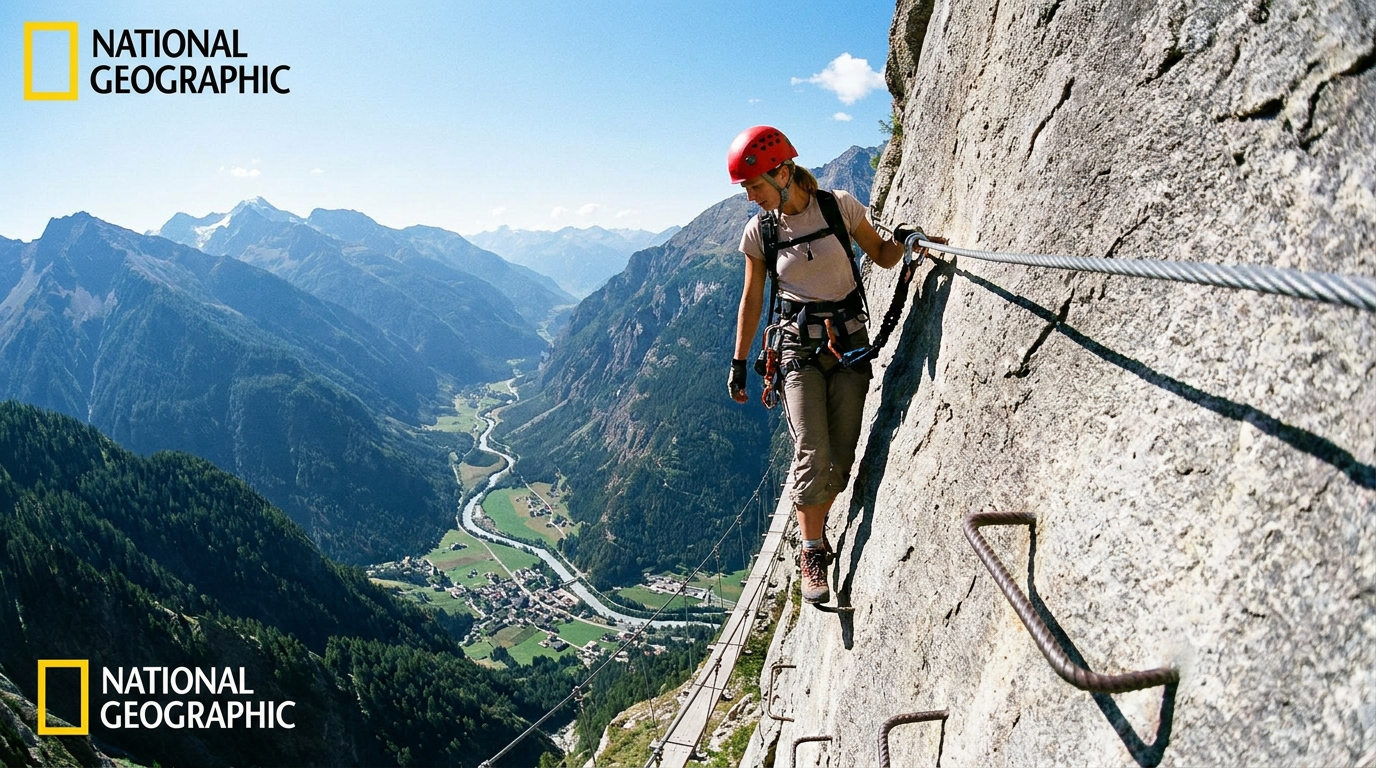
Imagine hanging hundreds of feet above a sweeping alpine valley, your boots resting on a narrow iron rung bolted directly into a vertical cliff face. To your left, a sheer drop; to your right, a smooth wall of limestone. In traditional rock climbing, this position would require years of technical training, specialized footwear, and an intricate understanding of rope systems. But here, you simply slide a metal carabiner along a thick steel cable, take a breath, and step up to the next rung.
This is the world of the via ferrata—Italian for "iron path." It is a hybrid outdoor sport that bridges the gap between high-altitude hiking and technical mountaineering. By outfitting exposed mountain routes with permanent steel cables, ladders, suspension bridges, and carved steps, via ferratas democratize access to some of the world's most dramatic vertical environments.[5]
For decades, the sport was largely confined to the European Alps, where it is deeply woven into the local mountain culture. But in recent years, via ferratas have experienced an explosive surge in popularity across North America and beyond. Driven by a post-pandemic hunger for structured, accessible outdoor adventure, new routes are cropping up everywhere from the red rocks of Utah to the hardwood forests of upstate New York.[2]
The rapid expansion has caught the attention of the academic world. In March 2026, a comprehensive study led by the University of Eastern Finland and Lakehead University formally classified via ferrata as a distinct hybrid activity. Researchers noted that it has its own unique risk profiles, participation pathways, and destination impacts, arguing it can no longer be treated merely as a sub-category of traditional climbing.[1]

To understand the modern via ferrata boom, one must look back to its utilitarian origins. The concept predates modern recreational climbing by over a century. The very first via ferrata was constructed in 1843 on the Dachstein mountain in Austria, where pioneers installed iron pins and ropes to help locals navigate a treacherous summit ridge.[3]
However, the true catalyst for the "iron paths" was the grim necessity of war. During World War I, the jagged peaks of the Dolomite mountains became a brutal, high-altitude frontline between Italian and Austro-Hungarian forces. To move troops, artillery, and supplies through the hostile, vertical terrain, soldiers engineered extensive networks of iron rungs and ladders directly into the rock.[2][5]
Following the war, these military installations were largely abandoned to the elements. It wasn't until the 1930s and 1950s that alpine clubs began restoring the rusted wartime networks, transforming them from theaters of combat into recreational attractions. Today, the European Alps boast over 1,000 established via ferrata routes, ranging from gentle scenic traverses to extreme, overhanging athletic challenges.[5]

The magic of the via ferrata lies in its illusion of extreme danger paired with highly engineered safety. Climbers wear a standard climbing harness and a helmet, but the critical piece of equipment is the via ferrata lanyard. This specialized device is Y-shaped, featuring two arms, each terminating in an auto-locking carabiner.[3]
The magic of the via ferrata lies in its illusion of extreme danger paired with highly engineered safety.
The golden rule of via ferrata is simple: at least one carabiner must be clipped to the steel safety cable at all times. When a climber reaches an anchor point where the cable is bolted to the rock, they unclip one carabiner, move it past the bolt, and then repeat the process with the second. This ensures continuous protection against a catastrophic fall.[3]
But the most important component of the lanyard is the one you hope never to use: the shock absorber. In traditional rock climbing, the dynamic elasticity of a long climbing rope absorbs the energy of a fall. On a via ferrata, the climber is attached to a rigid steel cable by only a few feet of static material.[3][5]
If a climber slips, they will slide down the steel cable until their carabiner smashes into the nearest metal rock anchor. Because the lanyard is so short, this generates a massive spike of kinetic energy—what climbers call a high "fall factor." If a climber were using standard, non-elastic climbing slings, the force of this sudden stop could easily snap the gear or cause severe spinal injury.[5]
To solve this physics problem, modern via ferrata lanyards feature a compact pouch containing tightly folded webbing stitched together with specialized thread. In the event of a severe fall, these stitches are designed to violently rip apart. This controlled tearing mechanism absorbs the shock, decelerating the climber safely and preventing the hardware from failing.[3]

Despite the intimidating heights, statistical data shows that the system works remarkably well when used correctly. A comprehensive retrospective analysis by the Austrian Alpine Safety Board reviewed over a decade of via ferrata emergencies. They found that while rescues are increasing due to the sport's growing popularity, fatal accidents are exceedingly rare, accounting for just 3.7% of emergencies.[4]
Crucially, the study revealed that the vast majority of severe injuries occurred when individuals chose to climb unsecured, bypassing the safety equipment entirely. The data also highlighted that most rescues are not the result of falls, but rather climbers becoming stranded due to exhaustion or misjudging the physical difficulty of a route.[4]
Beyond the mechanics and the safety data, the true appeal of the via ferrata is deeply psychological. Unlike traditional rock climbing, which often isolates a climber and their belayer in intense, quiet focus, a via ferrata is a highly social experience. Groups move together along the cable, navigating wobbly suspension bridges and exposed ledges as a team.[2]

Guides and operators note that the shared adrenaline creates a unique bonding environment. Strangers encourage each other over difficult sections, and the constant, rhythmic clicking of carabiners becomes a shared soundtrack to the ascent. It provides the visceral thrill of big-wall mountaineering without the exclusionary barrier to entry.[2]
As the sport continues to evolve, its footprint is expanding in surprising ways. While traditional routes require massive alpine peaks, developers are now building via ferratas in abandoned rock quarries and urban river gorges. This localized approach is bringing the "iron path" to people who may never set foot in the Alps or the Rockies.[2]
For mountain towns and tourism boards, via ferratas represent a sustainable, four-season economic engine. They allow destinations to safely guide visitors through spectacular terrain while strictly managing environmental impact, keeping foot traffic confined to a single, reinforced path rather than eroding fragile alpine ecosystems.[1][6]
Ultimately, the rise of the via ferrata represents a shift in how we interact with the vertical world. It proves that with a bit of clever engineering and a healthy respect for gravity, the profound awe of the high mountains doesn't have to be reserved for elite alpinists. The iron path is open, waiting for anyone willing to clip in and climb.[6]
How we got here
1843
The first via ferrata is constructed on the Dachstein mountain in Austria.
1914–1918
Soldiers build extensive iron paths in the Dolomites to move troops during World War I.
1930s
Alpine clubs begin restoring the abandoned military routes for recreational tourism.
2001
The first modern via ferrata in the United States opens in Kentucky's Red River Gorge.
March 2026
A major academic study formally classifies via ferrata as a distinct hybrid sport requiring dedicated research.
Viewpoints in depth
Adventure Tourism Advocates
Focus on accessibility, economic growth, and democratizing the alpine experience.
Proponents of via ferrata expansion view the sport as a powerful tool for democratizing the outdoors. By installing permanent safety infrastructure, destinations can allow everyday hikers to experience the profound awe of big-wall mountaineering without requiring years of technical training. Furthermore, tourism boards argue that via ferratas create sustainable, four-season economic engines for mountain towns while keeping foot traffic confined to a single, reinforced path, thereby minimizing widespread erosion.
Safety & Gear Researchers
Focus on the unique physics of via ferrata falls and the critical need for user education.
Safety experts emphasize that the illusion of security on a via ferrata can lead to dangerous complacency. Because climbers are attached to a rigid steel cable by a short static lanyard, a fall generates extreme kinetic energy that standard climbing gear cannot withstand. Researchers stress the absolute necessity of specialized shock absorbers and continuous clipping, pointing to data showing that the vast majority of severe accidents occur when individuals bypass the safety equipment entirely.
Alpine Traditionalists
Value untouched wilderness and express caution over the permanent installation of iron cables.
Traditional mountaineers and conservationists often express concern over the "over-engineering" of natural landscapes. From this perspective, bolting miles of steel cable and iron ladders into pristine rock faces detracts from the wilderness experience and lowers the barrier to entry so much that it invites overcrowding. They advocate for strict regulations on where new routes can be developed, ensuring that true alpine environments remain wild and challenging.
What we don't know
- How the rapid expansion of via ferratas in North America will impact local wildlife and fragile cliff-side ecosystems.
- Whether public land managers will relax current bans on permanent climbing anchors to allow more routes on federal land.
Key terms
- Via Ferrata
- Italian for "iron path," a mountain route equipped with fixed cables, ladders, and bridges to aid climbers.
- Klettersteig
- The German term for via ferrata, commonly used in Austria, Germany, and Switzerland.
- Fall Factor
- A climbing physics ratio used to evaluate the severity of a fall; via ferrata falls can generate uniquely high and dangerous fall factors.
- Shock Absorber
- A specialized component of a via ferrata lanyard designed to tear open and absorb kinetic energy during a fall.
- Carabiner
- A metal loop with a sprung gate used to connect the climber's lanyard to the steel safety cable.
Frequently asked
Do I need rock climbing experience to do a via ferrata?
No. While some routes are physically demanding, via ferratas are designed to allow hikers and non-climbers to safely navigate vertical terrain using fixed iron rungs and cables.
What happens if I fall on a via ferrata?
If you fall, your via ferrata lanyard's shock absorber will deploy. The internal webbing tears apart to absorb the extreme kinetic energy, preventing severe injury or equipment failure.
Can I use standard rock climbing gear instead?
No. Using standard static climbing slings on a via ferrata is highly dangerous. The unique physics of a via ferrata fall require a specialized shock absorber to prevent the gear from snapping.
Are via ferratas safe for children?
Standard via ferrata shock absorbers are calibrated for users weighing between 40 and 120 kg (88 to 265 lbs). Children under this weight require additional belaying with a traditional climbing rope.
Sources
Source coverage
6 outlets
3 viewpoints surfaced






[1]University of Eastern FinlandSafety & Gear Researchers
Via Ferrata's global rise prompts call for industry collaboration
Read on University of Eastern Finland →[2]Adventure.comAdventure Tourism Advocates
Why are via ferratas the new 'it' outdoor adventure in North America?
Read on Adventure.com →[3]EdelridSafety & Gear Researchers
Via Ferrata Guide: Equipment and History
Read on Edelrid →[4]National Institutes of HealthSafety & Gear Researchers
Via Ferrata Emergencies in Austria: A Retrospective Analysis
Read on National Institutes of Health →[5]WikipediaAlpine Traditionalists
Via ferrata
Read on Wikipedia →[6]Factlen Editorial TeamAdventure Tourism Advocates
Synthesis by Factlen editorial team
Read on Factlen Editorial Team →
Every angle. Every day.
Get travel stories with full source coverage and perspective breakdowns delivered to your inbox.