
How AI and Bioacoustics Are Decoding the Natural World
Artificial intelligence is transforming wildlife conservation by analyzing millions of hours of ecosystem audio, allowing scientists to track endangered species and decode animal communication at an unprecedented scale.
By Factlen Editorial Team
- Conservation Biologists
- Focused on rapid species tracking and replacing invasive monitoring methods.
- AI & Linguistics Researchers
- Focused on foundation models and the theoretical frontier of decoding non-human communication.
- Agricultural Stewards
- Focused on practical biodiversity metrics for land management and regenerative farming.
- Bioethics Advocates
- Focused on data access, noise pollution, and the ethical risks of democratizing location data.
What's not represented
- · Indigenous communities whose traditional ecological knowledge often predates and parallels the findings of modern bioacoustic AI.
- · Policy makers who must figure out how to integrate AI-generated biodiversity metrics into actual environmental law and carbon credit markets.
Why this matters
By automating the analysis of ecosystem sounds, AI is giving humanity a real-time dashboard of planetary health, allowing conservationists to track endangered species and measure the success of climate interventions before it's too late.
Key points
- Passive Acoustic Monitoring (PAM) uses remote microphones to capture continuous ecosystem soundscapes.
- AI foundation models can now process millions of hours of audio to identify thousands of species.
- Google DeepMind's Perch model helped locate endangered Hawaiian honeycreepers 50 times faster than manual methods.
- Project CETI and the Earth Species Project are using AI to decode the complex communication structures of whales and birds.
- Bioacoustic data is being used to verify the success of regenerative agriculture by tracking farm biodiversity.
- Ethical concerns remain regarding data access and the risk of poachers weaponizing open-source location tracking.
For centuries, humanity’s understanding of the natural world has been fundamentally visual. Biologists tracked footprints, tagged ears, and peered through binoculars to count populations. But the wild is often hidden beneath dense forest canopies or submerged in the lightless depths of the ocean. As the planet faces a rapid decline in biodiversity, traditional visual surveys and catch-and-release methods have proven too slow, too invasive, and too limited in scale to provide a real-time pulse of ecosystem health.[7][8]
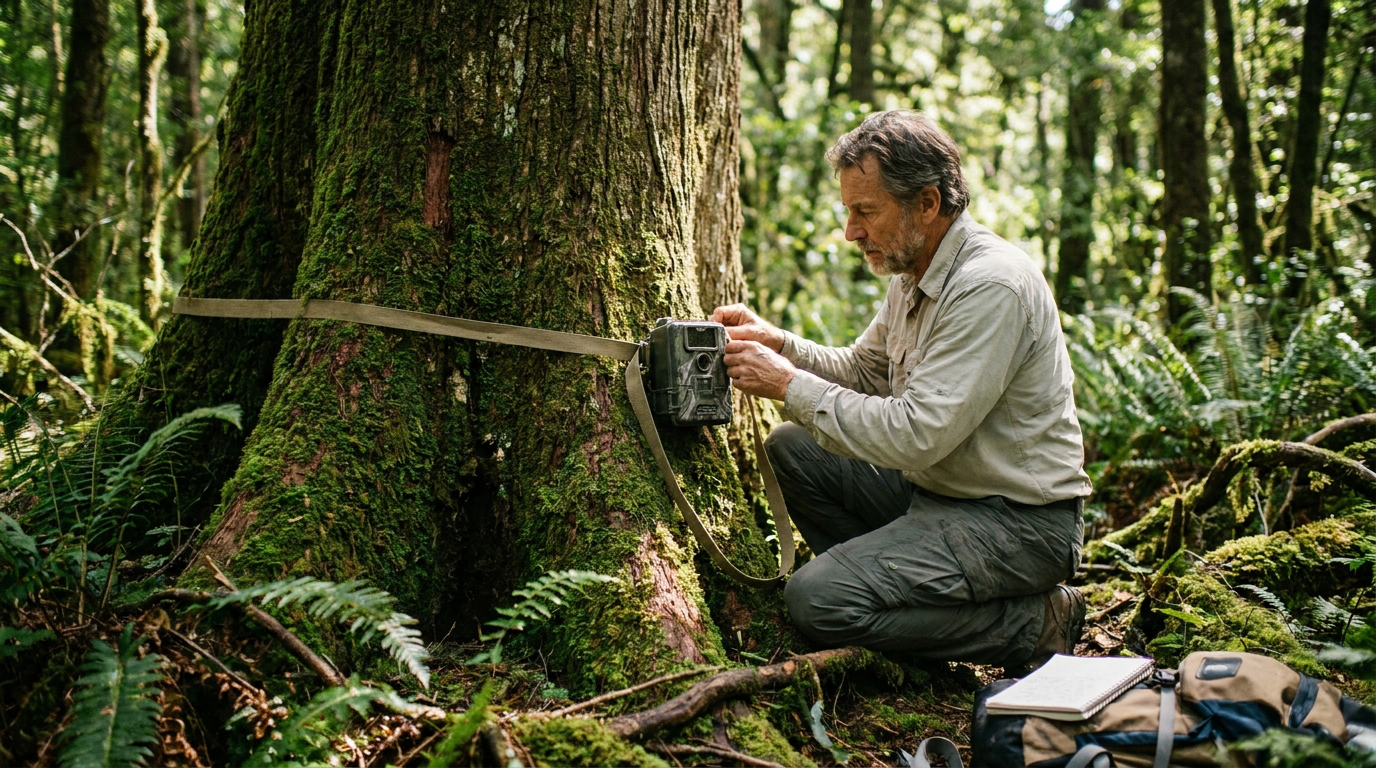
The solution lies in a shift from looking to listening. Passive Acoustic Monitoring (PAM) has emerged as a transformative tool for conservationists. By strapping inexpensive, battery-powered microphones to trees or dropping hydrophones into coral reefs, researchers can continuously capture the ambient soundscape of an environment. These devices operate 24 hours a day, recording the trills of insects, the songs of birds, and the low-frequency rumbles of mammals without disturbing the wildlife they are meant to study.[4][5]
However, this acoustic revolution quickly hit a severe bottleneck: human endurance. A single network of sensors can generate millions of hours of audio in a matter of months. Historically, analyzing this data required graduate students or trained ornithologists to sit with headphones, manually scrubbing through tapes to identify specific calls. The data was piling up exponentially faster than human experts could process it, leaving vast archives of ecological intelligence locked away in unanalyzed hard drives.[1][5]
The breakthrough arrived with the explosive advancement of artificial intelligence. Machine learning models, initially developed to recognize human speech and process natural language, have been retrained on the sounds of the forest and the sea. Instead of relying on human ears, these AI systems can ingest massive datasets, automatically detecting and classifying thousands of species across diverse taxa in a fraction of the time.[1][7]

Google DeepMind’s Perch model exemplifies this leap in capability. Trained on public bioacoustic archives like Xeno-Canto and iNaturalist, Perch can disentangle complex acoustic scenes, isolating the call of a specific bird from the roar of a waterfall or the hum of a distant highway. Because it is a foundation model, it does not need to be rebuilt from scratch for every new ecosystem; it can generalize its understanding of sound to identify mammals, amphibians, and even the intrusion of anthropogenic noise.[1]
The real-world impact of this technology is already saving species from the brink. In the dense forests of Hawaiʻi, native honeycreepers face an existential threat from avian malaria spread by non-native mosquitoes. Biologists desperately needed to map the remaining populations to target their conservation efforts. By deploying Perch, researchers were able to locate honeycreeper vocalizations nearly 50 times faster than their traditional manual methods, radically expanding the area they could effectively monitor.[1]
Beyond simple detection, these algorithms are beginning to unlock deeper ecological insights. Advanced iterations of bioacoustic AI can now track the abundance of a species and even identify individual animals based on microscopic variations in their calls. This capability offers a profound advantage for field biology: it reduces the need for stressful catch-and-release studies, allowing scientists to monitor the health and life stages of a population entirely from a distance.[1]
Beyond simple detection, these algorithms are beginning to unlock deeper ecological insights.
The applications extend far beyond pristine wilderness. In the agricultural sector, platforms like Chirrup.ai are using bioacoustics to measure the success of regenerative farming practices. By recording bird sounds on agricultural land, the AI provides farmers with a continuous, data-driven metric of local biodiversity. This transforms abstract sustainability goals into concrete, verifiable data, proving that ecological stewardship and modern agriculture can coexist.[4]
The most ambitious bioacoustic projects are plunging into the ocean. Project CETI (Cetacean Translation Initiative) represents the world’s largest interspecies communication endeavor. In collaboration with Harvard engineers, the team has developed advanced bio-loggers—suction-cup devices inspired by clingfish that adhere safely to the backs of sperm whales. These loggers record high-fidelity, multi-channel audio alongside behavioral and environmental data, feeding it directly into machine learning pipelines.[3]

Sperm whales communicate using "codas," complex rhythmic patterns of clicks that vary between different clans and regions. Project CETI is not merely trying to count whales; it is attempting to decode the structural grammar of these codas. By applying the same natural language processing techniques used to translate human languages, researchers hope to uncover the syntax and meaning embedded in cetacean communication, fundamentally altering our relationship with marine intelligence.[3]
This pursuit of interspecies understanding is being formalized by organizations like the Earth Species Project. They have developed NatureLM-audio, a state-of-the-art foundation model trained on massive datasets spanning human speech, music, and animal vocalizations. Their hypothesis is that AI can identify shared structural patterns of communication across the entire Tree of Life, moving science from merely identifying what animal is speaking to understanding what they are conveying to one another.[2]
Despite these triumphs, machine listening faces significant technical hurdles. The primary challenge is the "cocktail party problem" of the wild. A rainforest is a chaotic acoustic environment where the calls of hundreds of species overlap simultaneously, further muddied by wind, rain, and the pervasive creep of human noise pollution like chainsaws and shipping vessels.[5][6]
To solve this, engineers are developing sophisticated filtering algorithms that can isolate biological signals from background interference. Datasets like BirdCLEF are crowdsourcing the development of robust classifiers that can maintain high accuracy even in degraded audio conditions. These systems are learning to treat noise not just as a nuisance, but as a data point itself, tracking how human encroachment alters the acoustic behavior of wildlife.[6]

There is also a concerted push to democratize these tools. Historically, advanced AI required massive computing power, limiting its use to well-funded Western institutions. Today, researchers are deploying lightweight AI models on cheap, off-the-shelf hardware like Raspberry Pi computers. This allows conservationists in developing nations to build their own real-time monitoring networks, reducing their reliance on expensive foreign expertise and empowering local ecological management.[5]
Yet, the power of AI bioacoustics carries inherent ethical risks. If an open-source algorithm can perfectly identify and geolocate the call of a critically endangered species, that same tool could theoretically be weaponized by poachers. Bioethicists are currently debating how to balance the need for open scientific collaboration with the imperative to protect vulnerable animals from bad actors who might use "machine eavesdropping" for exploitation.[5][8]
Ultimately, the fusion of artificial intelligence and bioacoustics is building the foundation for a real-time planetary dashboard. By turning the cacophony of nature into structured, actionable data, humanity is gaining an unprecedented ability to listen to the Earth. As these models grow more sophisticated, they offer a hopeful vision for the future: a world where conservation is proactive rather than reactive, guided by the very voices of the ecosystems we are fighting to save.[2][8]
How we got here
2020
Project CETI launches as the world's largest interspecies communication initiative, aiming to decode sperm whale codas.
2024
Researchers publish landmark studies demonstrating AI's ability to monitor animal populations and predict emotional states from vocalizations.
August 2025
Google DeepMind releases an updated, open-source version of its Perch model, accelerating conservation audio analysis.
2026
Foundation models like NatureLM-audio expand beyond simple detection, beginning to analyze complex animal communication patterns across the Tree of Life.
Viewpoints in depth
Conservation Biologists
Focused on rapid species tracking and replacing invasive monitoring methods.
For field biologists, the primary value of AI bioacoustics is speed and scale. Traditional methods like catch-and-release or visual surveys are stressful for animals and labor-intensive for humans. By deploying passive acoustic monitors, conservationists can track population health, migration patterns, and breeding success across vast, inaccessible terrains without ever disturbing the habitat. Their priority is actionable data that can inform immediate policy decisions, such as identifying critical habitats that require urgent protection from development or invasive species.
AI & Linguistics Researchers
Focused on foundation models and the theoretical frontier of decoding non-human communication.
Computer scientists and linguists view the natural world as the ultimate dataset. Organizations like the Earth Species Project and Project CETI are less concerned with simply counting animals and more focused on the structural complexity of their vocalizations. By applying large language models to whale codas and bird songs, they are searching for universal grammatical rules and emotional indicators. This camp believes that proving complex animal intelligence through AI translation could fundamentally shift humanity's philosophical and legal relationship with the natural world.
Agricultural Stewards
Focused on practical biodiversity metrics for land management and regenerative farming.
For farmers and land managers, bioacoustics offers a tangible way to measure the success of sustainable practices. Platforms that track bird and insect sounds provide a verifiable 'ecological credit score' for a piece of land. This perspective values AI not for abstract interspecies translation, but as an auditing tool that proves regenerative agriculture actually works, potentially unlocking new financial incentives and sustainability certifications for farms that actively foster biodiversity.
Bioethics Advocates
Focused on data access, noise pollution, and the ethical risks of democratizing location data.
Ethicists and policy advocates warn that 'machine eavesdropping' comes with significant risks. While open-source AI models democratize research, they also make it dangerously easy for poachers to locate highly prized, endangered species by their calls. Furthermore, this camp emphasizes the issue of 'acoustic colonialism,' arguing that the massive datasets collected in the Global South must remain accessible to local communities rather than being locked behind the proprietary algorithms of Western tech companies.
What we don't know
- Whether AI can ever truly 'translate' animal communication into human concepts, or if non-human intelligence is too fundamentally different to map onto our language.
- How to perfectly secure open-source bioacoustic data so that it empowers local conservationists without inadvertently aiding poachers.
- The full extent to which anthropogenic noise pollution (like shipping lanes and construction) is permanently altering the communication structures of marine and terrestrial life.
Key terms
- Passive Acoustic Monitoring (PAM)
- The practice of leaving autonomous recording devices in habitats to continuously capture environmental sounds without human presence.
- Bioacoustics
- The scientific study of sound production, dispersion, and reception in animals.
- Foundation Model
- A large-scale artificial intelligence system trained on vast amounts of unlabelled data, which can be adapted to various specific tasks like identifying bird calls.
- Coda
- A distinct, rhythmic pattern of clicks used by sperm whales to communicate with one another.
Frequently asked
How does AI identify animals just from sound?
AI models are trained on massive databases of annotated animal recordings. By analyzing the spectrograms (visual representations of audio frequencies), the AI learns the unique acoustic signatures of thousands of species, allowing it to recognize them even when obscured by background noise.
Can this technology actually translate animal languages?
While full translation into human language remains theoretical, projects like CETI are successfully using AI to identify complex grammatical structures, regional dialects, and emotional states in the vocalizations of whales and birds.
Is this technology expensive to deploy in the wild?
The cost has plummeted in recent years. Researchers now use cheap, battery-powered recorders or off-the-shelf microcomputers like Raspberry Pis to capture audio, relying on cloud-based AI models to do the heavy computational lifting.
Sources
Source coverage
8 outlets
4 viewpoints surfaced








[1]Google DeepMindConservation Biologists
How AI is helping advance the science of bioacoustics to save endangered species
Read on Google DeepMind →[2]Earth Species ProjectAI & Linguistics Researchers
The Next Frontier of Understanding Life on Earth
Read on Earth Species Project →[3]Harvard UniversityAI & Linguistics Researchers
Project CETI goals: Industrial-Scale Whale Bioacoustic Data Collection
Read on Harvard University →[4]Chirrup.aiAgricultural Stewards
Listening to the Land: The Rise of Bioacoustics
Read on Chirrup.ai →[5]Premier ScienceBioethics Advocates
Artificial Intelligence in Bioacoustics
Read on Premier Science →[6]arXivBioethics Advocates
Real-time biodiversity monitoring system using acoustic sensors
Read on arXiv →[7]University of CopenhagenConservation Biologists
AI-enhanced monitoring offers new hope for conservation
Read on University of Copenhagen →[8]Factlen Editorial TeamBioethics Advocates
Synthesis by Factlen editorial team
Read on Factlen Editorial Team →

Every angle. Every day.
Get environment stories with full source coverage and perspective breakdowns delivered to your inbox.