
The Local AI Revolution: How Open-Weight Models Are Moving From the Cloud to Your Laptop
In 2026, running powerful artificial intelligence locally has shifted from a niche hobby to a mainstream productivity hack, offering absolute privacy and zero subscription fees.
By Factlen Editorial Team
- Open-Source Ecosystem
- Argues that open-weight models and local inference democratize AI, preventing a few massive tech companies from monopolizing intelligence.
- Enterprise Privacy Advocates
- Values local AI primarily as a compliance and security tool, ensuring proprietary data never leaves the corporate firewall.
- Hardware Enthusiasts
- Focuses on the raw compute requirements, optimizing VRAM and quantization techniques to push consumer silicon to its limits.
What's not represented
- · Cloud AI Providers
- · Non-technical Consumers
Why this matters
By running AI models locally, professionals and developers can process sensitive data without violating privacy policies, eliminate recurring API costs, and work entirely offline.
Key points
- Open-weight AI models can now be run locally on consumer laptops and desktops.
- Local inference guarantees absolute data privacy and eliminates recurring API subscription costs.
- Quantization techniques compress massive models to fit within 16GB of standard memory.
- Apple Silicon's unified memory and high-VRAM NVIDIA GPUs are the preferred hardware for local AI.
- User-friendly tools like Ollama and LM Studio have made installation as simple as downloading an app.
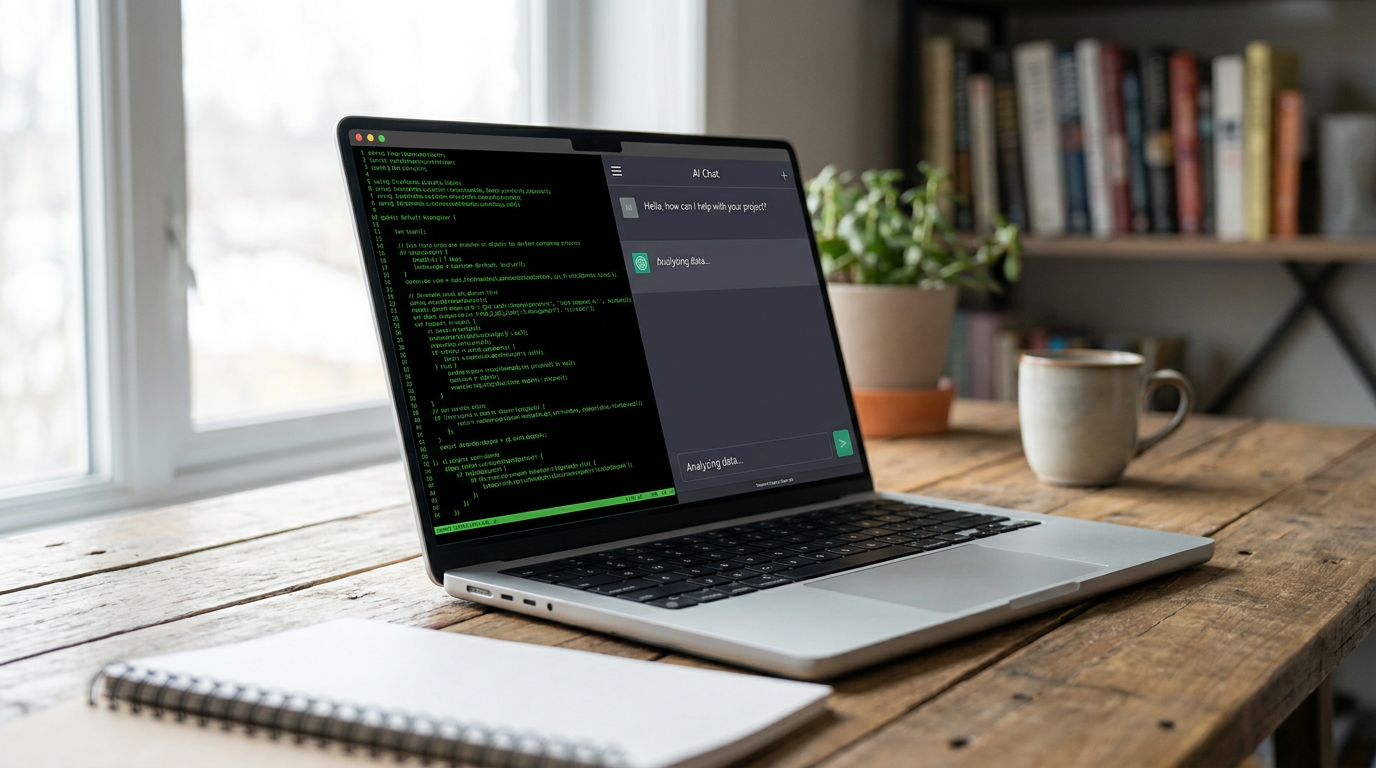
Two years ago, running a capable artificial intelligence model locally required server-grade hardware, a deep understanding of Python dependencies, and immense patience. Today, the landscape has fundamentally transformed. In 2026, local large language models (LLMs) have crossed a critical threshold, moving from weekend hobbyist experiments to daily drivers for developers, researchers, and privacy-conscious professionals.[1][3]
The catalyst for this shift was not a single viral keynote, but a quiet, relentless accumulation of open-weight breakthroughs. Models like Meta's Llama 3.3, Alibaba's Qwen3, and Mistral's Codestral now routinely match or exceed the capabilities of proprietary cloud models from just a year ago. The technical moat that once protected closed-source giants has rapidly evaporated, democratizing access to frontier-level intelligence.[2][7]
For consumers and enterprises alike, the appeal of local AI is rooted in three unassailable advantages: absolute data privacy, zero recurring API costs, and offline availability. When a model runs entirely on a user's local silicon, sensitive corporate documents, proprietary codebases, and personal health data never traverse the internet, eliminating the risk of third-party data harvesting.[3][4]
This guarantee of data sovereignty is driving massive adoption across the tech sector. According to recent industry analyses, local LLM usage among developers has tripled year-over-year. Enterprise IT departments, previously paralyzed by the compliance risks of sending internal data to public cloud chatbots, are now deploying local inference tools to employee laptops as standard issue.[1][7]

But how did these massive neural networks, which originally required clusters of specialized servers, suddenly fit onto everyday laptops? The answer lies in a mathematical compression technique known as quantization.[4][7]
Quantization acts as high-fidelity compression for AI models. By reducing the precision of the model's internal weights—shrinking them from 16-bit floating-point numbers down to 4-bit or even 2-bit integers—developers can reduce a model's memory footprint by up to 80%. Remarkably, this aggressive compression results in only a negligible drop in the model's actual reasoning capabilities.[5][7]
Because of quantization, a model that once demanded 30 gigabytes of memory can now run comfortably in just 6 to 8 gigabytes. This breakthrough means that a standard 8-billion parameter model can operate fluidly on a mid-range consumer laptop, generating text faster than a human can read.[1][3]

Because of quantization, a model that once demanded 30 gigabytes of memory can now run comfortably in just 6 to 8 gigabytes.
Hardware architectures have also evolved to meet the moment. Apple's M-series chips, with their unified memory architecture, have inadvertently become the gold standard for casual local AI. Because the CPU and GPU share the same pool of memory, an M3 Mac with 16GB or 32GB of RAM can load massive models that would otherwise require expensive, specialized graphics cards on a traditional PC.[1][4]
On the PC side, the calculus is heavily dependent on Video RAM (VRAM). NVIDIA's consumer GPUs, particularly the RTX 4070 Ti Super with 16GB of VRAM and the flagship RTX 4090 with 24GB, have become highly sought-after commodities for local AI enthusiasts. AMD is also competing fiercely in this space, offering high-VRAM alternatives for budget-conscious builders who want to maximize their model capacity.[5]
Beyond the hardware, the software ecosystem has matured dramatically, removing the friction that once kept non-technical users away. In 2024, running a local model required navigating complex command-line interfaces. In 2026, tools like Ollama, LM Studio, and GPT4All have consumerized the entire experience.[3][4]
Ollama, for instance, allows users to download and run complex models with a single terminal command, managing all the underlying complexity invisibly. Meanwhile, LM Studio provides a polished, graphical interface that resembles a standard chat application, complete with a built-in model discovery browser that lets users download new AI models as easily as installing a smartphone app.[1][3]
The performance of these local models on rigorous benchmarks is staggering. On SWE-bench, an industry-standard test that requires AI to autonomously resolve real-world GitHub issues, open-weight models like Qwen3-Coder-Next are scoring above 70%. For context, the premium cloud models that developers paid $20 a month for just 18 months ago scored around 48% on the exact same test.[2]

This capability leap is reshaping the economics of software development and content creation. Instead of metering every token and worrying about API bills scaling with usage, professionals can run thousands of queries, generate endless variations of text, and process massive datasets for the flat cost of the electricity powering their machine.[3][4]
However, the local AI ecosystem is not without its limitations. While open-weight models excel at text generation, coding, and summarization, they still lag behind frontier cloud models in complex "tool calling"—the ability to autonomously interact with external APIs, databases, and web browsers to complete multi-step tasks.[2][7]
Furthermore, running heavy AI workloads locally demands significant power. Laptop users frequently report severe battery drain when running inference engines continuously, tethering them to power outlets despite the supposedly mobile nature of their hardware.[7]

There is also the looming threat of hardware obsolescence. As the open-source community pushes toward larger, more capable models, the 16GB of memory that feels spacious today may become a frustrating bottleneck tomorrow, forcing users into a continuous cycle of hardware upgrades.[5]
Despite these hurdles, the trajectory is clear. The democratization of AI inference is shifting power away from centralized server farms and back to the edge. As models become more efficient and consumer hardware grows more capable, the default assumption for everyday AI tasks is increasingly becoming local-first.[6][7]
How we got here
Early 2023
Meta leaks the original LLaMA model weights, sparking the grassroots open-source AI movement.
Late 2023
Tools like Ollama and LM Studio launch, making local model installation accessible to everyday developers.
2024
Apple's M-series chips emerge as a popular platform for local AI due to their unified memory architecture.
Late 2025
Open-weight models begin matching the performance of proprietary cloud APIs on standardized coding and reasoning benchmarks.
Mid 2026
Local LLM adoption triples year-over-year as models like Llama 3.3 and Qwen3 become daily drivers for professionals.
Viewpoints in depth
The Open-Source Developer View
Views local AI as a necessary democratization of technology that prevents corporate monopolies.
For the open-source community, local AI is fundamentally about democratization and resilience. Developers argue that relying on centralized cloud APIs creates a dangerous dependency on a few massive tech corporations, who can change pricing, alter model behavior, or deprecate services without warning. By running open-weight models locally, developers ensure their tools remain permanently available, auditable, and immune to corporate pivot strategies. They view the rapid improvement of models like Llama 3 and Qwen as proof that decentralized, community-driven innovation can outpace closed-door corporate labs.
The Enterprise Security View
Values local AI primarily as a risk mitigation tool to prevent corporate data leaks.
Corporate IT and security teams view local AI primarily through the lens of risk mitigation and compliance. For years, enterprises have struggled with 'shadow AI'—employees quietly pasting sensitive company data, proprietary code, or customer information into public cloud chatbots. Local LLMs solve this by bringing the intelligence inside the corporate firewall. Security advocates argue that the only foolproof way to prevent data leakage is to ensure the data never leaves the physical machine, making local inference an essential requirement for industries like healthcare, finance, and defense.
The Hardware Optimizer View
Focuses on pushing consumer silicon to its absolute limits through memory management and compression.
Hardware enthusiasts and systems engineers focus on the physical constraints and optimization of AI inference. This camp is deeply invested in the mechanics of VRAM allocation, memory bandwidth, and quantization algorithms. They argue that the true bottleneck for AI adoption isn't software intelligence, but silicon availability. Their focus is on pushing consumer hardware to its absolute limits—squeezing 70-billion parameter models onto dual-GPU desktop rigs and advocating for unified memory architectures that blur the line between traditional RAM and dedicated video memory.
What we don't know
- Whether future open-weight models will grow too large for consumer hardware to keep up.
- How cloud providers will adjust their pricing models to compete with free local inference.
- If local models will ever match the complex, multi-step agentic reasoning of massive cloud clusters.
Key terms
- Local LLM
- A Large Language Model that runs entirely on a user's personal computer or local server, rather than in the cloud.
- Open-weight model
- An AI model where the core architecture and trained parameters (weights) are publicly available for anyone to download and use.
- Quantization
- A mathematical compression technique that shrinks an AI model's memory footprint by reducing the precision of its data, allowing it to run on everyday hardware.
- VRAM (Video RAM)
- The dedicated memory on a graphics card, which is crucial for loading and running large AI models quickly on a PC.
- Inference
- The process of a trained AI model generating a response or prediction based on a user's prompt.
Frequently asked
Do I need an expensive graphics card to run local AI?
Not necessarily. While high-end NVIDIA GPUs are ideal for large models, modern Apple Silicon Macs (M1/M2/M3) with 16GB or more of unified memory can run capable models smoothly.
Is running local AI completely free?
Yes, the software tools and open-weight models are generally free to download and use. Your only costs are the initial hardware purchase and the electricity used to run your machine.
Can local AI models connect to the internet?
By default, local models run entirely offline for maximum privacy. However, developers can configure them to search the web or interact with external APIs if desired, using frameworks like LangChain.
What is quantization?
Quantization is a compression technique that reduces the precision of an AI model's internal numbers, shrinking its file size and memory requirements so it can fit on consumer hardware.
Sources
Source coverage
7 outlets
3 viewpoints surfaced







[1]DualiteOpen-Source Ecosystem
The best local LLM tools in 2026
Read on Dualite →[2]MediumOpen-Source Ecosystem
The Local LLM Revolution Already Happened. Most Developers Just Haven't Realized It Yet.
Read on Medium →[3]Dev.toOpen-Source Ecosystem
Top 5 Local LLM Tools and Models in 2026
Read on Dev.to →[4]FungiesEnterprise Privacy Advocates
Running AI on your own hardware isn't just for researchers anymore
Read on Fungies →[5]ViperaTechHardware Enthusiasts
Which GPU should you actually buy for AI in 2026?
Read on ViperaTech →[6]Stanford UniversityHardware Enthusiasts
Artificial Intelligence Index Report 2026
Read on Stanford University →[7]Factlen Editorial TeamEnterprise Privacy Advocates
Synthesis by Factlen editorial team
Read on Factlen Editorial Team →


Every angle. Every day.
Get ai stories with full source coverage and perspective breakdowns delivered to your inbox.