
NASA Tests ERNEST Rover Prototype Capable of Lifting Wheels and Driving 10x Faster
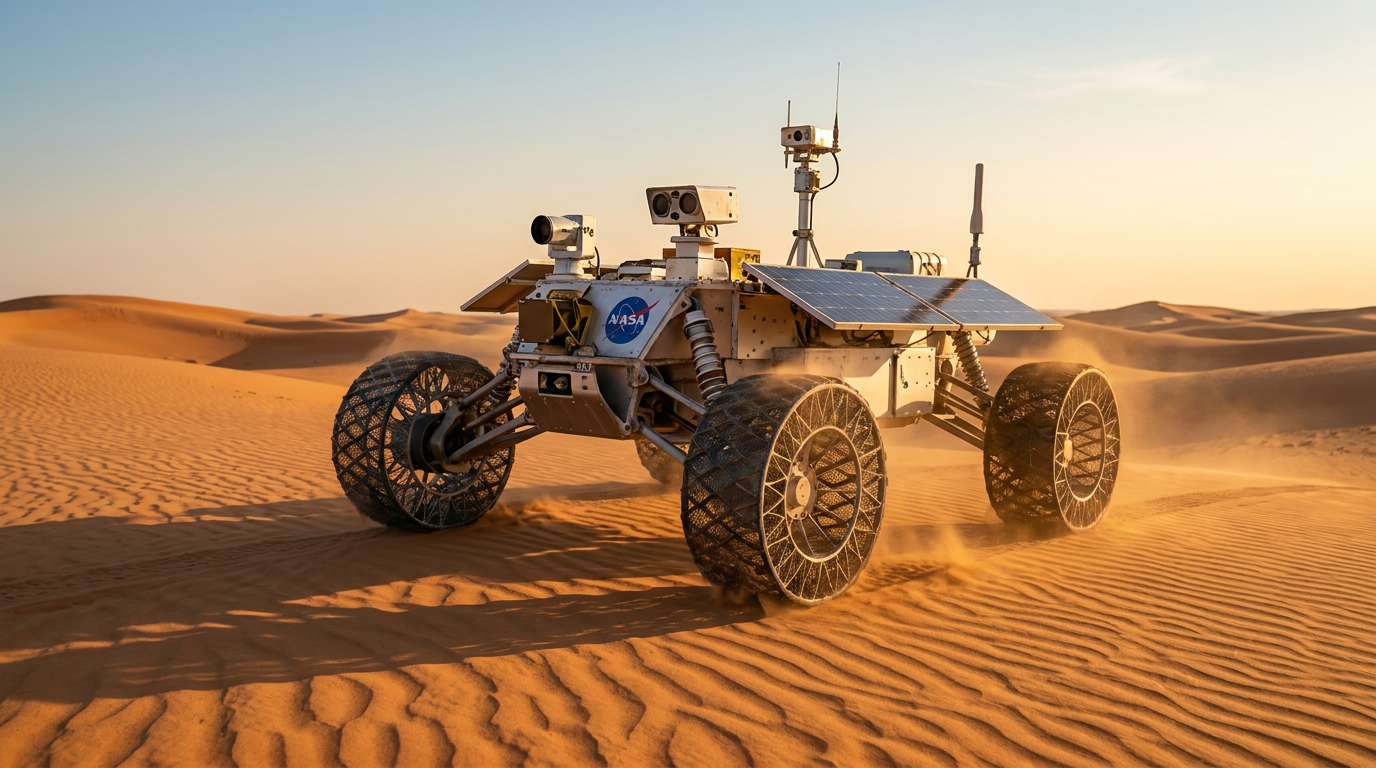
NASA's Jet Propulsion Laboratory has successfully field-tested a new four-wheeled rover prototype that uses active suspension and AI to navigate rugged terrain at unprecedented speeds.
By Factlen Editorial Team
- Robotics Engineers
- Value the mechanical leap from passive to active suspension and the integration of AI for faster autonomous decision-making.
- Planetary Geologists
- Value the ability to access previously unreachable terrain and the potential to cover vast distances for broader sampling.
What's not represented
- · Aerospace Contractors
Why this matters
Current Mars rovers are limited by slow speeds and passive suspension systems that struggle with steep slopes. ERNEST's ability to autonomously step over obstacles and travel ten times faster could revolutionize how quickly we explore the Moon and Mars.
Key points
- NASA's ERNEST prototype rover drove 16 miles in 37 hours during a desert field test.
- The rover reached a top speed of 0.6 mph, roughly 10 times faster than current Mars rovers.
- An active suspension system allows ERNEST to lift individual wheels and step over obstacles.
- The rover uses reinforcement learning AI to make faster autonomous navigation decisions.
- The technology is designed for future missions to the Moon's south pole and rugged Martian terrain.
NASA's Jet Propulsion Laboratory has successfully tested a new prototype rover in the Colorado Desert, showcasing a radical departure from the design of its current Mars explorers. The vehicle, named ERNEST, covered 16 miles in just 37 hours of drive time during a recent seven-day field campaign.[1][2][4]
Hitting a top speed of 0.6 mph, ERNEST is roughly ten times faster than the Perseverance and Curiosity rovers currently operating on Mars. While that pace is a slow walk for a human, it represents a massive leap for planetary exploration, where rovers typically crawl to avoid hazardous terrain.[1][2][3]
Since the Sojourner rover landed in 1997, NASA has relied on a passive 'rocker-bogie' suspension system. While highly reliable, it forces rovers to navigate at around 0.06 mph and take long detours around steep slopes or rocky hazards to avoid getting permanently stuck.[1][3][5]

ERNEST—which stands for Exploration Rover for Navigating Extreme Sloped Terrain—solves this with an active suspension system. Featuring two powered joints in the front, the four-wheeled rover can lift individual mesh wheels to step onto or over obstacles that would halt its six-wheeled predecessors.[1][2][5]
This articulation allows ERNEST to utilize unconventional gaits. NASA engineers describe the rover as being able to 'squirm,' 'wheel-walk,' and climb obstacles. With four steerable wheels, it can even drive sideways to navigate out of tight spots.[1][3][5]
This articulation allows ERNEST to utilize unconventional gaits.
The rover isn't always expending maximum energy. A clutch mechanism allows it to toggle between active and passive suspension on the fly, conserving power on flat terrain and engaging the active joints only when the landscape demands it.[1][4][5]

Speed isn't just about motors; it's about decision-making. Because signal delays between Earth and Mars can take up to 24 minutes, rovers must navigate autonomously. JPL trained ERNEST's navigation system using reinforcement learning in a simulation lab before it ever touched the dirt.[1][4]
During the desert campaign, engineers trailed the 4-foot-long prototype as it navigated the rough terrain with minimal human intervention. They even tested it in darkness to simulate the dim lighting of the lunar south pole, a key target for upcoming Artemis missions.[1][4][5]
While ERNEST is currently a small prototype, the JPL team expects a final flight-ready build to be at least double the size. The project, which began in 2022, has already iterated through multiple suspension designs and AI training models.[3][6]

How we got here
1997
NASA lands Sojourner, introducing the passive rocker-bogie suspension used on all subsequent Mars rovers.
2022
JPL begins internal research and development on the ERNEST active suspension prototype.
March 2026
ERNEST completes a 16-mile autonomous field test in the Colorado Desert.
Viewpoints in depth
NASA Engineers
Focus on the mechanical and software achievements of the prototype.
For the engineering teams at JPL, ERNEST represents a necessary evolution from the trusted rocker-bogie suspension system used for the last 30 years. By integrating active suspension joints and reinforcement learning AI, they aim to build rovers that can make faster autonomous decisions and physically step out of traps that would permanently strand older models.
Planetary Scientists
Focus on the scientific yield of faster, more capable rovers.
Researchers view ERNEST's capabilities as a gateway to unprecedented geological discoveries. A rover that can travel ten times faster and climb steeper slopes means access to previously unreachable crater walls and the ability to sample a much wider variety of terrain in a single mission, turning localized studies into planetary 'road trips.'
What we don't know
- When a full-scale version of ERNEST will be assigned to an official spaceflight mission.
- How the active suspension joints will hold up to the abrasive dust and extreme cold of the lunar or Martian surface over a multi-year lifespan.
Key terms
- Rocker-bogie suspension
- A passive mechanical design used on Mars rovers that keeps weight relatively even across all wheels without using springs.
- Reinforcement learning
- A type of artificial intelligence where a system learns to make decisions by trial and error, receiving rewards for successful actions.
- Lunar regolith
- The layer of loose, dusty, and rocky material covering the solid bedrock of the Moon.
Frequently asked
Why are current Mars rovers so slow?
Rovers like Perseverance are limited by their passive suspension systems and cautious navigation software, topping out at roughly 0.06 mph to avoid getting stuck.
How big is the ERNEST rover?
The current prototype is 4 feet long, though a flight-ready version for an actual mission would likely be twice that size.
Can ERNEST drive sideways?
Yes, the rover features four steerable wheels that allow it to drive in any direction, including sideways.
Sources
Source coverage
6 outlets
2 viewpoints surfaced






[1]NASARobotics Engineers
NASA's ERNEST Rover Prototype Tackles Rugged Terrain
Read on NASA →[2]EngadgetRobotics Engineers
NASA is testing a rover that can drive faster and lift its wheels to climb obstacles
Read on Engadget →[3]GizmodoPlanetary Geologists
NASA's New Rover Prototype Can Lift Its Wheels and Drive Sideways
Read on Gizmodo →[4]The Next WebRobotics Engineers
NASA's ERNEST rover prototype drove 16 miles in 37 hours during desert testing
Read on The Next Web →[5]AstrobiologyPlanetary Geologists
NASA Prototype Rover Tackles Rugged Terrain
Read on Astrobiology →[6]The DebriefPlanetary Geologists
NASA is developing the next generation of surface exploration technology with ERNEST
Read on The Debrief →
Every angle. Every day.
Get technology stories with full source coverage and perspective breakdowns delivered to your inbox.