
OLED vs. Mini-LED in 2026: The Ultimate TV Buying Comparison
As Tandem OLEDs get brighter and RGB Mini-LEDs achieve near-perfect contrast, the 2026 television market offers two distinct paths to flagship performance. We break down the exact trade-offs for gamers, cinephiles, and bright-room viewers.
By Factlen Editorial Team
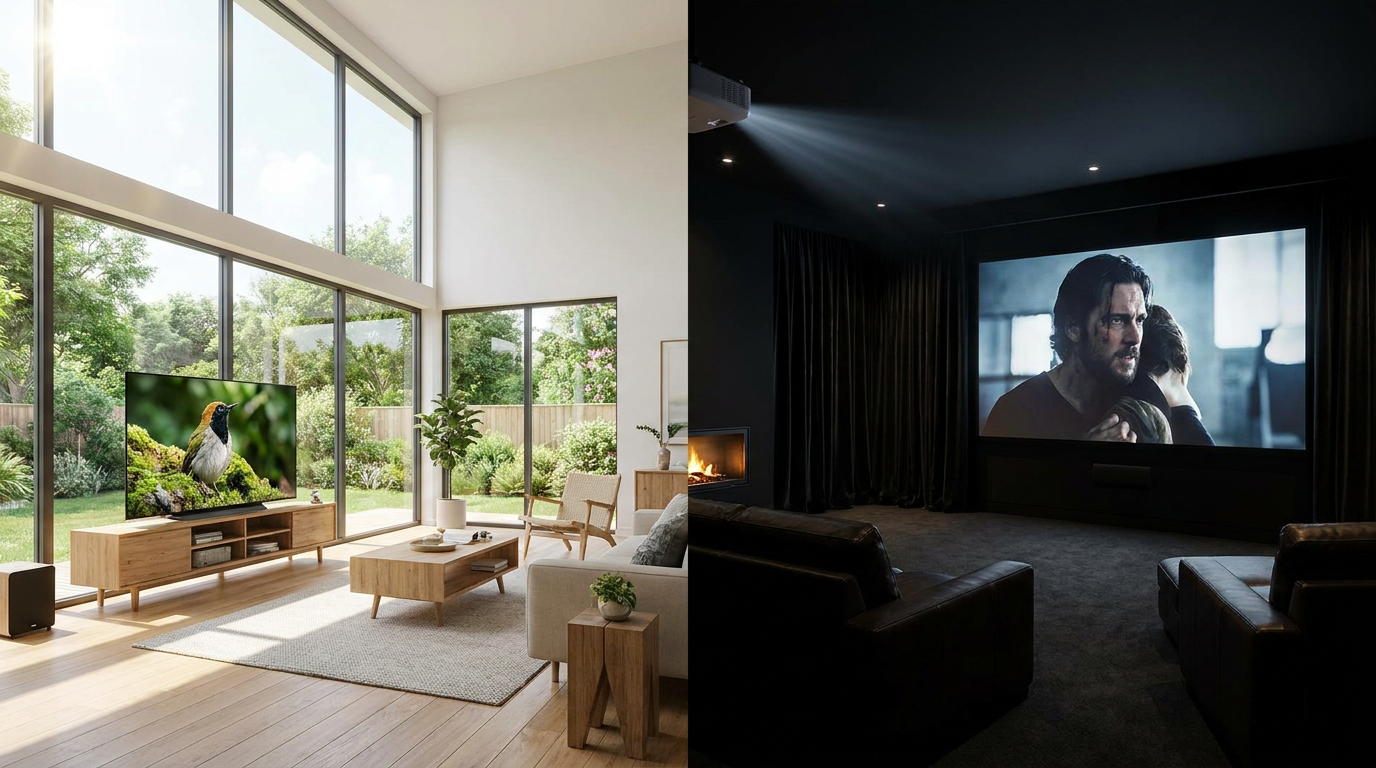
- Home Theater Purists
- Values absolute contrast, perfect black levels, and cinematic accuracy in light-controlled rooms.
- Bright-Room Viewers
- Prioritizes sustained full-screen brightness, glare reduction, and massive screen sizes for daytime sports and family viewing.
- Competitive Gamers
- Focuses on instantaneous pixel response times, high refresh rates, and the long-term durability of the panel against static HUDs.
What's not represented
- · Budget-conscious buyers priced out of flagship models
- · Environmental advocates concerned about power consumption of high-nit displays
Why this matters
A flagship television is a multi-year, multi-thousand-dollar investment. Choosing the wrong panel technology for your specific room lighting and viewing habits can result in frustrating glare, aggressive automatic dimming, or permanent burn-in.
Key points
- Tandem OLEDs have significantly boosted peak brightness while maintaining perfect pixel-level black levels.
- RGB Mini-LEDs can now hit up to 10,000 nits, making them the undisputed choice for sunlit living rooms.
- OLEDs still suffer from automatic dimming during bright, full-screen sports broadcasts to protect the panel.
- Mini-LEDs offer a massive economic advantage for buyers seeking 85-inch or larger screens.
- Gamers must weigh OLED's instantaneous 0.03ms response time against Mini-LED's immunity to permanent HUD burn-in.
In 2026, the television market has reached what industry analysts are calling the "Great Convergence." For years, the buying advice was simple: purchase an OLED for pitch-black home theaters and a Mini-LED for sunlit living rooms. But a wave of engineering breakthroughs has blurred those traditional boundaries, making the choice both more difficult and more rewarding for consumers. Shoppers are no longer choosing between a flawed bright TV and a flawed dark TV; they are choosing between two distinct flagship engineering paths that have largely solved their historical weaknesses. Whether upgrading a family room for the upcoming World Cup or building a dedicated gaming cave, understanding the precise trade-offs between 2026's Tandem OLEDs and RGB Mini-LEDs is the only way to ensure a perfect fit.[2][4][6]
The technological leap in 2026 centers on two major panel innovations. On the OLED side, manufacturers have mainstreamed "Tandem OLED" architecture, which stacks multiple layers of light-emitting diodes to drastically increase brightness without accelerating pixel degradation. On the Mini-LED side, brands have shifted to "RGB Mini-LED" backlights, utilizing microscopic inorganic Gallium Nitride LEDs that eliminate the need for traditional color filters. This allows Mini-LEDs to push unprecedented light output while utilizing up to 20,000 local dimming zones to mimic OLED's black levels with surgical precision.[3][4][6][7]
When evaluating peak and sustained brightness, the case for Mini-LED is overwhelming. These inorganic panels are built to withstand massive amounts of heat and current, allowing them to push specular highlights—like on-screen explosions or direct sunlight—to staggering levels. Premium 2026 Mini-LED flagships are now capable of hitting between 5,000 and 10,000 nits of peak brightness, effectively overpowering any ambient glare in a room with massive, unshaded windows. For daytime viewing, this raw luminance ensures that the image remains vibrant, punchy, and fully saturated regardless of the environment.[2][6][7]

Conversely, the case against OLED in high-ambient-light environments comes down to a software protection mechanism known as the Auto Brightness Limiter. Because OLED pixels are organic and susceptible to heat damage, the television's processor will aggressively dim the entire screen if a bright, static image is displayed for too long. While Tandem OLEDs have raised the ceiling significantly—hitting up to 2,800 nits in small highlight windows—they still cannot sustain full-screen brightness at the levels required to fight intense daytime glare.[3][5][6]
The evidence for this brightness disparity is most obvious during sports broadcasts or winter-sports content. If a viewer watches a hockey game or a cricket match played on a bright, sunlit field, an OLED panel will eventually pull back its luminance to keep the organic pixels cool, resulting in a noticeably dimmer image. A Mini-LED, unburdened by an aggressive Auto Brightness Limiter, can hold a full-field white screen at maximum brightness indefinitely, making it the undisputed champion for daytime sports viewing and high-luminance commercial content.[5][6]
Shifting to contrast and cinematic precision, the case for OLED remains the gold standard for home theater purists. Because an OLED panel lacks a backlight entirely, it achieves its image by turning individual pixels completely off. This delivers effectively infinite contrast and absolute blacks measured at 0.0005 nits, according to VESA DisplayHDR True Black standards. For shadow-critical narrative films, this pixel-level control ensures that a starfield against a black sky looks perfectly crisp, with zero light bleeding into the surrounding darkness.[5][7]
The case against Mini-LED in pitch-black rooms centers on the persistent, albeit reduced, phenomenon of blooming. Despite featuring tens of thousands of microscopic dimming zones, a Mini-LED TV still relies on algorithmic backlight control. When a bright object—like white subtitles or a glowing streetlamp—appears against a dark background, the zones illuminating that object inevitably spill a faint blue or gray haze into the adjacent black pixels, breaking the cinematic illusion for discerning viewers.[4][6][7]
The case against Mini-LED in pitch-black rooms centers on the persistent, albeit reduced, phenomenon of blooming.
The evidence supporting OLED's superiority in dark environments is heavily backed by professional colorists. In dim studios focused on grading shadow-critical narrative work, OLED's perfect blacks deliver the most reliable and accurate judgment of near-black detail. While 2026 Mini-LEDs have utilized advanced algorithms to minimize blooming to near-imperceptible levels in mixed lighting, a trained eye in a fully darkened room will still spot the algorithmic limitations that an OLED naturally bypasses.[4][5]
For the gaming demographic, the case for OLED is built on unparalleled motion clarity. Because organic pixels change state almost instantaneously, OLED panels boast a response time of roughly 0.03 milliseconds. This is exponentially faster than the liquid crystal transitions of a Mini-LED, resulting in zero ghosting and zero motion blur during fast-paced action. Competitive esports players and fans of high-speed shooters often view this instantaneous pixel response as a massive competitive advantage.[6][7]

However, the case against OLED for heavy gamers involves the lingering anxiety of permanent image retention, commonly known as burn-in. While 2026 models feature robust heat sinks and pixel-shifting software to mitigate the risk, the organic nature of the panel means that static elements—like a game's heads-up display, health bars, or minimaps—still pose a long-term threat during marathon gaming sessions that stretch for thousands of hours.[4][6]
The evidence points to Mini-LED as the ultimate peace-of-mind choice for power users. Modern Mini-LEDs have countered OLED's motion advantage by offering native 144Hz and even 240Hz refresh rates, delivering an experience so smooth that the vast majority of players will never notice the slightly slower 1-millisecond pixel response. More importantly, the inorganic LEDs allow gamers to play the same title for twelve hours straight without a single worry about a static HUD becoming permanently etched into their expensive display.[6][7]
When evaluating value at scale, the case for Mini-LED becomes an economic reality. Over the last few years, consumer demand has shifted dramatically toward massive screens, with 75-inch, 85-inch, and even 100-inch models becoming the new standard for living rooms. Manufacturing massive sheets of organic OLED material remains an incredibly expensive and low-yield process, keeping ultra-large OLEDs firmly in the luxury price bracket.[2][4][7]
The evidence is clear in the 2026 pricing landscape: Mini-LED has completely dominated the 85-inch and larger market. Buyers can secure a flagship-tier, 85-inch RGB Mini-LED with blinding brightness and premium gaming features for a fraction of the cost of an equivalently sized OLED. For shoppers looking to maximize their screen real estate without sacrificing high-end HDR performance, Mini-LED offers an unbeatable return on investment.[4][6][7]

Ultimately, the OLED architecture fits well when the television is placed in a light-controlled or fully darkened room, such as a dedicated home theater or a cozy basement. It is the definitive choice for cinephiles who prioritize perfect shadow detail, absolute black levels, and wide viewing angles for horseshoe-shaped seating arrangements. It also remains the premium pick for gamers who play a wide variety of titles and demand the absolute fastest pixel response times available.[5][6][7]
Conversely, OLED does not fit well when the television is destined for a sun-drenched living room with unshaded windows. It is a poor match for viewers who leave news channels with static tickers running all day, or for gamers who exclusively play a single HUD-heavy title for thousands of hours. Furthermore, it is not the right choice for sports fanatics who want maximum full-screen brightness during daytime watch parties, as the automatic dimming will inevitably dull the experience.[5][6]
On the other side of the aisle, Mini-LED fits well when the display needs to overpower ambient glare in a bright, open-concept living space. It is the ultimate everyday workhorse for mixed-use family rooms, offering zero burn-in risk for static content and sustaining massive brightness for daytime sports broadcasts. It is also the only logical choice for buyers who want an 85-inch or larger cinematic experience without paying a staggering ultra-premium tax.[2][4][6][7]
Finally, Mini-LED does not fit well when the primary use case is watching moody, high-contrast films in a pitch-black room, as the subtle blooming around bright objects will break the cinematic illusion for discerning viewers. It is also less ideal for exceptionally wide seating arrangements, as the liquid crystal display inherently loses color accuracy and contrast when viewed from extreme off-center angles compared to its organic counterpart.[6][7]

How we got here
2013
The first large-screen OLED TVs enter the consumer market, establishing a new gold standard for contrast but struggling with low brightness.
2019
Mini-LED technology debuts in premium televisions, using thousands of miniaturized LEDs to drastically improve LCD black levels.
2022
QD-OLED and Micro Lens Array (MLA) technologies are introduced, giving OLEDs their first major brightness boost to combat Mini-LED.
2026
The 'Great Convergence' arrives as Tandem OLEDs hit 2,800 nits and RGB Mini-LEDs eliminate color filters, bringing both technologies to near-parity.
Viewpoints in depth
The Home Theater Purist's View
Why absolute black levels still trump peak brightness for cinematic viewing.
For cinephiles and professional colorists, the television is a canvas meant to perfectly replicate a director's vision in a controlled, darkened environment. From this perspective, OLED remains the undisputed king. Purists argue that while Mini-LEDs can push blinding highlights, their reliance on algorithmic local dimming inevitably crushes subtle shadow details or introduces blooming around bright objects. To this camp, the ability to turn a single pixel completely off—achieving a true 0.0005-nit black right next to a bright star—creates a sense of depth and three-dimensionality that no amount of raw Mini-LED brightness can replicate.
The Bright-Room Viewer's View
Why sustained luminance and glare reduction are the true markers of a premium TV.
For the vast majority of consumers placing a television in a sun-drenched living room, peak brightness is the ultimate metric of performance. This camp argues that OLED's perfect blacks are entirely wasted if the screen acts as a mirror for ambient room light. Furthermore, they point to OLED's Auto Brightness Limiter (ABL) as a fatal flaw for daytime viewing, noting that the TV will aggressively dim during bright sports broadcasts or snow scenes. To these viewers, the RGB Mini-LED's ability to sustain 5,000+ nits indefinitely without burn-in anxiety makes it the only logical choice for a modern, mixed-use family space.
The Competitive Gamer's View
Balancing instantaneous response times against the anxiety of permanent HUD burn-in.
The gaming community is fiercely divided between the two technologies, weighing motion clarity against panel durability. One faction of gamers swears by OLED's 0.03-millisecond response time, which eliminates ghosting and provides a tangible competitive edge in fast-paced shooters. However, power users who grind the same titles for thousands of hours argue that Mini-LED is the superior investment. They emphasize that modern Mini-LEDs offer 144Hz to 240Hz refresh rates that are smooth enough for 99% of players, while completely eliminating the anxiety of burning a static health bar or minimap into a $3,000 display.
What we don't know
- Whether the long-term lifespan of Tandem OLED panels will truly match manufacturer claims under heavy daily use.
- If future software updates can further refine Mini-LED local dimming to completely eliminate blooming in pitch-black rooms.
Key terms
- Auto Brightness Limiter (ABL)
- A software mechanism in OLED TVs that automatically dims the screen during bright, full-screen scenes to protect the organic pixels from overheating.
- Local Dimming Zones
- Specific clusters of LEDs behind the screen that can independently turn on or off to improve contrast and black levels in LCD and Mini-LED televisions.
- Tandem OLED
- An advanced panel design that stacks multiple organic light-emitting layers to increase overall brightness and lifespan.
- Gallium Nitride (GaN)
- A highly durable, inorganic semiconductor material used in modern Mini-LED backlights to safely push extreme levels of brightness.
- Nits
- A standard unit of measurement for screen brightness, roughly equivalent to the light of one candle per square meter.
Frequently asked
Does OLED still suffer from burn-in in 2026?
While 2026 Tandem OLEDs use advanced heat sinks and pixel-shifting to drastically reduce the risk, permanent image retention remains a possibility if static elements like news tickers or gaming HUDs are displayed for thousands of hours.
What is a Tandem OLED?
Tandem OLED is a new panel architecture that stacks multiple layers of light-emitting diodes. This allows the TV to achieve much higher brightness levels without putting excessive strain on the organic materials.
Why do Mini-LEDs look better in bright rooms?
Mini-LEDs use inorganic GaN LEDs that can sustain massive full-screen brightness indefinitely, easily overpowering sunlight and glare without triggering the automatic dimming software that protects OLEDs.
What is blooming on a TV?
Blooming is a faint halo of light that bleeds into dark areas of the screen around bright objects, like subtitles. While 2026 Mini-LEDs have minimized it with thousands of dimming zones, it is still slightly visible in pitch-black rooms.
Sources
Source coverage
7 outlets
3 viewpoints surfaced






[1]RTINGSCompetitive Gamers
The Best OLED and Mini-LED TVs of 2026
Read on RTINGS →[2]TechRadarBright-Room Viewers
Mini-LED vs OLED: Which TV technology wins in 2026?
Read on TechRadar →[3]Data Wire SolutionsHome Theater Purists
Best TVs for 2026: 10 OLED and Mini-LED Picks by Room, Brightness, and Install Reality
Read on Data Wire Solutions →[4]Alibaba Market InsightsBright-Room Viewers
2026 TV Market Report: The Great Convergence of OLED and Mini-LED
Read on Alibaba Market Insights →[5]KTC PlayHome Theater Purists
OLED vs. Mini-LED for 2026 Creative Pros: Which Panel Wins for Color Grading?
Read on KTC Play →[6]Let Sal ExplainCompetitive Gamers
OLED vs Mini-LED in 2026 — The Truth They Don't Tell You
Read on Let Sal Explain →Mini LED vs OLED - The REAL Winner in 2026
Read on Pixel Prime →
Every angle. Every day.
Get shopping stories with full source coverage and perspective breakdowns delivered to your inbox.