
Heat Pumps vs. Gas Furnaces: The 2026 Homeowner's Guide to Electrification
As federal rebates roll out and cold-climate technology matures, heat pumps are rapidly replacing traditional gas furnaces as the default choice for home climate control.
By Factlen Editorial Team
- Electrification Advocates
- Argue that transitioning to heat pumps is an environmental necessity and a financial win due to their 300% efficiency.
- HVAC Traditionalists
- Maintain that gas furnaces or dual-fuel hybrid systems remain the safest choice in regions with extreme cold and high electricity rates.
- Budget-Conscious Homeowners
- Focus on the daunting upfront costs and the complexity of navigating state and federal rebate programs.
What's not represented
- · Renters unable to upgrade their building's HVAC
- · Electrical grid operators managing increased winter load
Why this matters
Choosing between a heat pump and a gas furnace dictates a home's comfort, carbon footprint, and utility bills for the next two decades. With up to $10,000 in federal rebates available in 2026, understanding the technology is critical to avoiding an expensive, outdated heating mistake.
Key points
- Heat pumps are now outselling traditional gas furnaces in the United States.
- Modern cold-climate heat pumps can operate efficiently in temperatures as low as -15°F.
- Heat pumps provide both heating and cooling, replacing the need for a separate AC unit.
- Federal tax credits and HEEHRA rebates can offset installation costs by up to $10,000.
- Because they move heat rather than create it, heat pumps are up to 300% efficient.
- Year-round operation means heat pumps require strict biannual maintenance and frequent filter changes.
For over a century, the gas furnace has been the undisputed king of residential winter comfort. But the landscape of home heating has fundamentally shifted. Over the past few years, heat pumps have quietly surpassed gas and oil furnaces in total U.S. shipments, marking a historic transition in how homes are climate-controlled.[5]
The year 2026 represents a tipping point for this technology. A convergence of mature cold-climate engineering and the widespread deployment of federal electrification rebates has transformed the heat pump from a niche eco-upgrade into the financially pragmatic default for millions of homeowners.[1][4]
To understand why, it helps to look at the mechanism. A traditional gas furnace operates on a simple principle: it burns fossil fuels inside a combustion chamber to generate heat. Even the most advanced, high-efficiency gas furnaces max out at an Annual Fuel Utilization Efficiency (AFUE) of roughly 98 percent, meaning two cents of every dollar spent on fuel is inevitably lost as exhaust.[3][6]
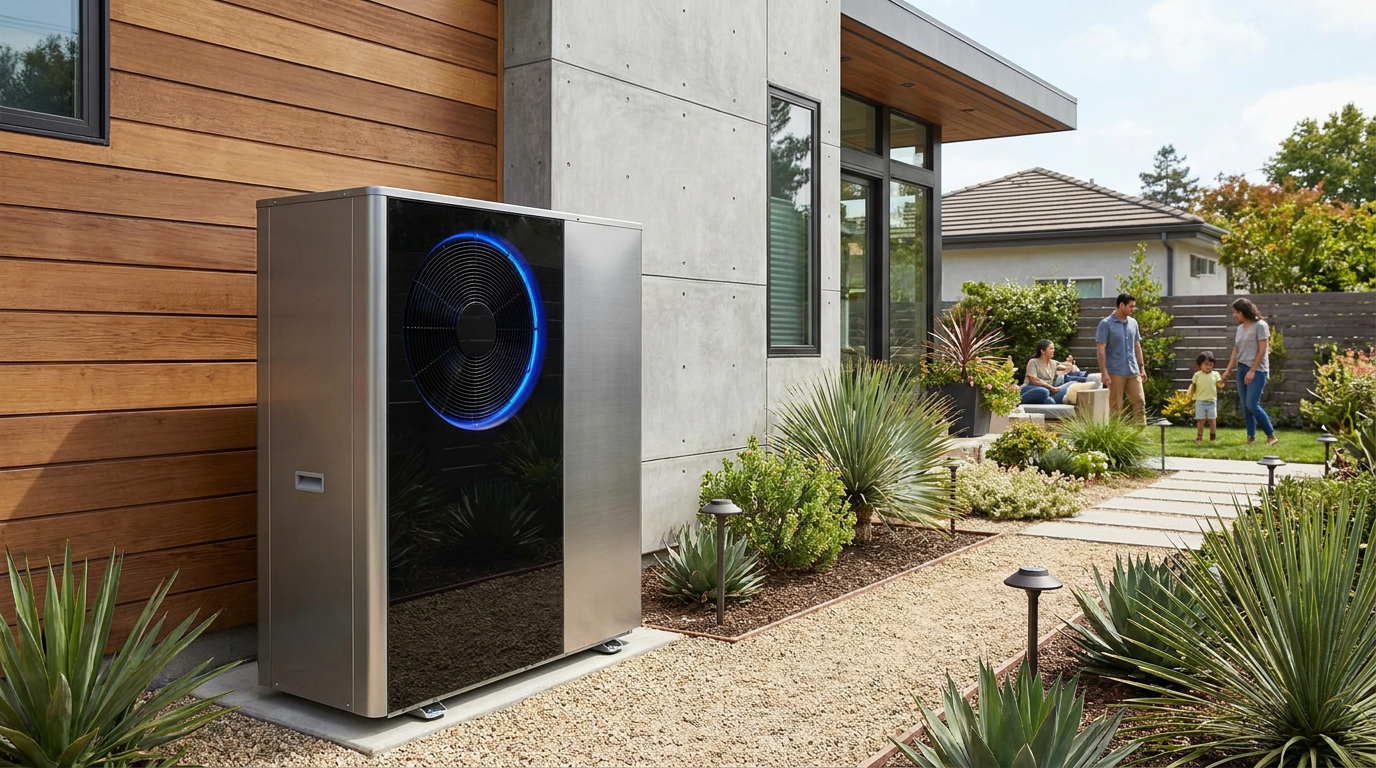
A heat pump, by contrast, does not burn anything to create heat. Instead, it operates like a refrigerator running in reverse. Using electricity and advanced refrigerants, it extracts ambient thermal energy from the outdoor air, compresses it to raise the temperature, and moves that heat inside the home.[2][3]
Because moving heat requires significantly less energy than generating it from scratch, a modern heat pump boasts a Coefficient of Performance (COP) of 3.0 or higher. In practical terms, this means the system delivers three units of heat for every one unit of electricity it consumes, achieving an effective efficiency rate of 300 percent—a thermodynamic advantage that combustion systems simply cannot match.[6][7]

Historically, the primary argument against heat pumps was their inability to handle harsh winters. Older models notoriously struggled when temperatures dropped below freezing, forcing homeowners to rely on expensive, inefficient electric resistance "emergency heat" strips.[1][2]
In 2026, that limitation is largely obsolete. Modern cold-climate heat pumps, equipped with variable-speed inverter compressors, are engineered to extract trace amounts of thermal energy from freezing air. Leading models can now operate at full capacity down to -15 degrees Fahrenheit, and continue producing usable heat even at -25 degrees Fahrenheit.[1][3]
Modern cold-climate heat pumps, equipped with variable-speed inverter compressors, are engineered to extract trace amounts of thermal energy from freezing air.
However, physics still dictates that as temperatures plummet, the system must work harder, which temporarily lowers its efficiency. For homeowners in extreme northern climates, or those with poorly insulated houses, a "dual-fuel" hybrid system remains a popular compromise. These systems pair an electric heat pump for moderate winter days with a backup gas furnace that automatically kicks on during severe blizzards.[5][6]

The most significant hurdle to heat pump adoption is the upfront price tag. A standard gas furnace replacement typically costs between $5,500 and $7,500. In contrast, a whole-home ducted heat pump installation in 2026 often ranges from $9,500 to $17,000, depending on the home's size and the complexity of the ductwork.[2][5]
Yet, comparing those two numbers directly is misleading. Because a heat pump reverses its cycle in the summer to provide air conditioning, installing one replaces both an aging furnace and a central AC unit simultaneously. When viewed as a two-for-one appliance replacement, the initial premium becomes much easier to justify.[2][5]
The financial equation flips entirely when factoring in 2026 incentives. Under the Inflation Reduction Act, the federal 25C tax credit offers a universal, non-income-restricted deduction of up to $2,000 for qualifying heat pump installations, immediately lowering the effective cost.[4][6]
Furthermore, the state-administered Home Electrification and Appliance Rebate (HEEHRA) program provides massive point-of-sale discounts. Low- and moderate-income households can qualify for up to $8,000 off a heat pump, plus additional funds for necessary electrical panel upgrades, drastically lowering the barrier to entry.[4][6]

Once installed, the operating costs heavily favor electrification. While a homeowner's electricity usage will naturally increase, their natural gas or heating oil bill drops to near zero. Depending on local utility rates and the fuel being replaced, households typically save 30 to 50 percent on overall energy costs annually.[2][3]
To protect those savings, strict maintenance is non-negotiable. Because a heat pump operates year-round to provide both heating and cooling, it endures twice the mechanical wear and tear of a standalone winter furnace.[2][7]
HVAC professionals stress that a clogged air filter forces the compressor to work harder, which can quickly erase efficiency gains and shorten the system's expected 15-to-20-year lifespan. Changing high-quality pleated filters every 60 to 90 days is the single most important action a homeowner can take to protect their investment.[2]

How we got here
August 2022
The Inflation Reduction Act is signed, allocating billions for home electrification rebates.
2023-2024
Heat pumps officially surpass gas furnaces in total U.S. annual shipments.
January 2026
State-administered HEEHRA point-of-sale rebates become widely available, drastically lowering upfront costs for low- and moderate-income households.
Viewpoints in depth
Electrification Advocates
Believe the transition away from fossil fuel heating is an environmental necessity and a financial win.
This camp argues that the 150-year reign of fossil fuel heating must end to meet global climate goals. They cite the 300% efficiency of heat pumps and the unprecedented availability of federal rebates as proof that transitioning is no longer just an eco-conscious luxury, but a financially superior choice. By moving away from natural gas, they argue, homeowners insulate themselves from volatile global energy markets while significantly reducing their household carbon footprint.
HVAC Traditionalists
Caution against pure electrification in regions with harsh winters and high electricity rates.
While acknowledging the advancements in cold-climate technology, this group maintains that the math doesn't always favor pure electrification. In areas where electricity is expensive and natural gas is cheap, the operating savings of a heat pump can be negligible. Furthermore, they argue that relying entirely on the electrical grid during a severe winter blizzard introduces a single point of failure, making dual-fuel hybrid systems the safest and most reliable option for extreme northern climates.
Budget-Conscious Homeowners
Focus on the daunting upfront costs and the complexity of accessing promised rebates.
For many homeowners, the immediate out-of-pocket expense remains a massive barrier. While they acknowledge the long-term utility savings and environmental benefits, they point out that a $15,000 initial price tag is difficult to swallow compared to a $6,000 furnace replacement. This camp frequently expresses frustration with the bureaucratic complexity of navigating state-administered HEEHRA rebates, noting that the promised funds require extensive paperwork and certified contractors to unlock.
What we don't know
- How quickly the remaining states will fully deploy their allocated HEEHRA rebate funds.
- Whether local electrical grids in extremely cold climates are fully prepared for the surge in winter electricity demand.
- The exact long-term impact of new, environmentally friendly refrigerants on system maintenance costs.
Key terms
- Heat Pump
- An HVAC system that provides both heating and cooling by transferring thermal energy between the indoors and outdoors rather than burning fuel.
- Coefficient of Performance (COP)
- A ratio measuring a heat pump's efficiency; a COP of 3.0 means it produces three units of heat for every one unit of electricity used.
- AFUE
- Annual Fuel Utilization Efficiency, the standard measurement for gas furnace efficiency, representing the percentage of fuel successfully converted into usable heat.
- HEEHRA
- The Home Electrification and Appliance Rebate program, a federal initiative providing point-of-sale discounts for energy-efficient home upgrades to income-qualifying households.
- Inverter Compressor
- Advanced technology that allows a heat pump to run continuously at variable speeds, maintaining precise temperatures without constantly turning on and off.
Frequently asked
Do I still need a separate air conditioner if I buy a heat pump?
No. A heat pump provides both heating and cooling by reversing its refrigerant cycle in the summer, effectively replacing both a furnace and a central AC unit.
How long does a heat pump last compared to a furnace?
Heat pumps typically last 15 to 20 years, while gas furnaces can last 20 to 30 years. Heat pumps endure more mechanical wear because they run year-round for both heating and cooling.
What is a dual-fuel system?
A dual-fuel system is a hybrid setup that uses an electric heat pump for moderate weather and automatically switches to a backup gas furnace during extreme cold snaps.
Are the 2026 federal heat pump rebates available to everyone?
The $2,000 federal tax credit is available to all taxpayers, but the up to $8,000 HEEHRA point-of-sale rebates are restricted by household income limits.
Sources
Source coverage
7 outlets
3 viewpoints surfaced







[1]The Daily ExplainerElectrification Advocates
Is a heat pump right for your home? Complete 2026 guide
Read on The Daily Explainer →[2]Foxes Sell FasterHVAC Traditionalists
Maintenance and Lifespan: Heat Pump vs Traditional HVAC Reliability
Read on Foxes Sell Faster →[3]Switch TogetherElectrification Advocates
Heat pump vs furnace: compare 2026 costs and energy efficiency
Read on Switch Together →[4]Energy.govElectrification Advocates
Home Energy Rebates and Tax Credits
Read on Energy.gov →[5]EnergySageHVAC Traditionalists
Heat pump vs oil furnace: Which is right for you?
Read on EnergySage →[6]AC DirectBudget-Conscious Homeowners
State-by-State Guide to Heat Pump Rebates in 2026
Read on AC Direct →[7]Factlen Editorial TeamBudget-Conscious Homeowners
Synthesis by Factlen editorial team
Read on Factlen Editorial Team →

Every angle. Every day.
Get home stories with full source coverage and perspective breakdowns delivered to your inbox.