
The Science of the Reverse Sear: Why Low-and-Slow Before High-Heat is the Ultimate Grilling Technique
By flipping the traditional grilling script, the reverse sear method uses thermodynamics to guarantee edge-to-edge perfection and a superior crust. Here is the science behind why starting low and finishing hot transforms thick cuts of meat.
By Factlen Editorial Team
- Thermodynamic Advocates
- Argue that heat transfer physics dictate a low-and-slow approach for even cooking.
- Barbecue Innovators
- Focus on adapting scientific principles to live-fire cooking environments.
- Culinary Chemists
- Emphasize the molecular importance of surface moisture reduction for optimal browning.
What's not represented
- · Vegetarian grillers adapting the technique for thick plant-based meat alternatives
- · Commercial steakhouse chefs operating high-volume broilers where reverse searing is logistically difficult
Why this matters
Mastering the reverse sear eliminates the guesswork and stress of grilling expensive cuts of meat. By understanding the underlying thermodynamics, home cooks can consistently achieve restaurant-quality results without specialized equipment.
Key points
- Traditional high-heat searing creates an overcooked gray band because the exterior cooks much faster than the interior.
- The reverse sear starts meat at a low temperature (225°F) to ensure edge-to-edge evenness.
- The low-heat phase dries the surface of the meat, which is critical for a good crust.
- Moisture prevents the surface from reaching the 284°F required to trigger the Maillard reaction.
- The technique is best suited for steaks at least one and a half inches thick.
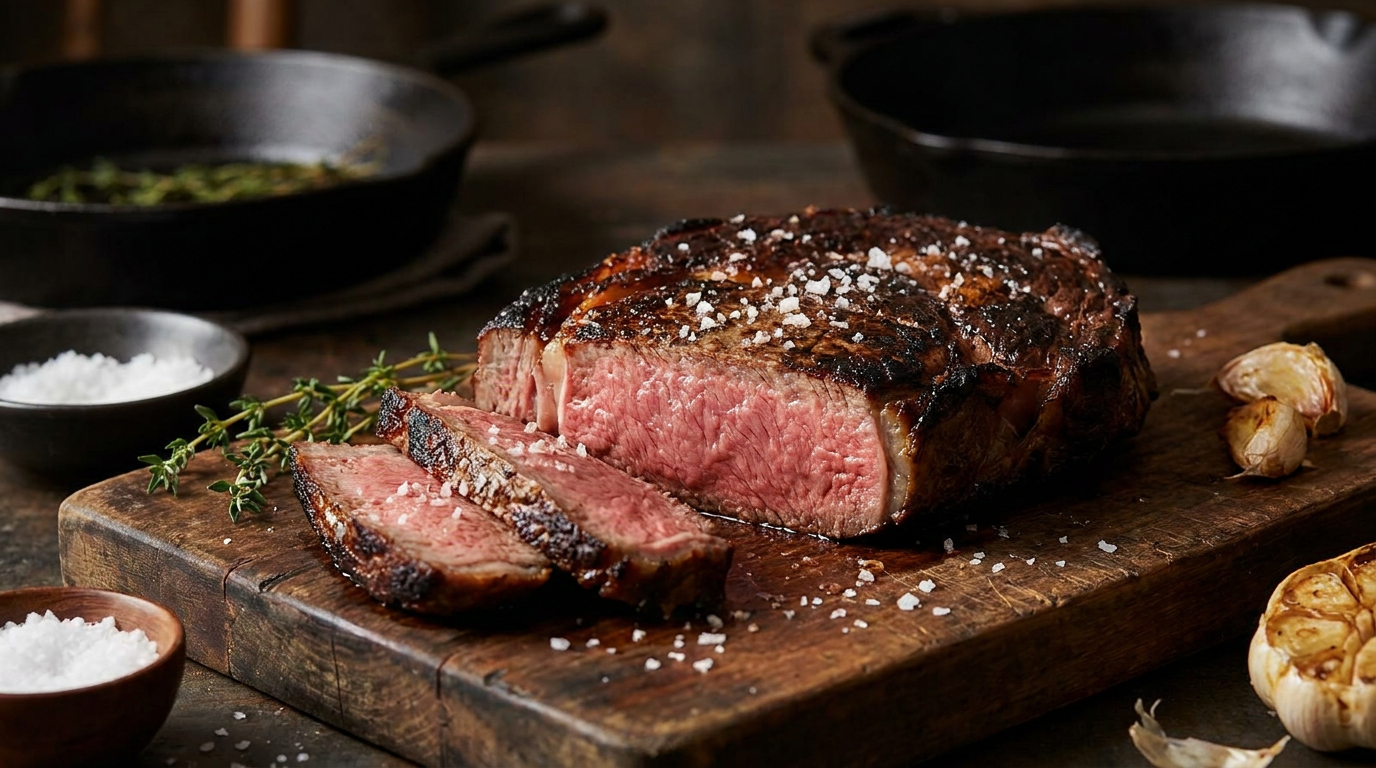
The backyard grill is often a site of culinary heartbreak. You invest in a beautiful, two-inch-thick ribeye, get the grill screaming hot, and sear it aggressively. But when you slice into it, the result is a "bullseye"—a small circle of perfect pink meat surrounded by a thick, unappetizing band of gray, overcooked beef.[6]
For generations, conventional culinary wisdom dictated that meat must be seared over high heat first to "lock in the juices," before finishing at a lower temperature. However, modern food science has thoroughly debunked this myth. Searing does not seal moisture inside a steak; in fact, the intense heat of a traditional sear forces muscle fibers to contract violently, squeezing juices out.[1][3]
The flaw in the traditional method comes down to the thermodynamics of cooking. As heat transfers from the air to the exterior of the meat, the exterior then acts as the heat source for the interior. By the time the very center of a thick steak reaches a medium-rare 130°F (54°C), the outer layers have been subjected to intense heat for so long that they inevitably push past 160°F (71°C), turning tough and gray.[1][5]

To solve this temperature gradient problem, pitmasters and food scientists championed a technique that flips the script entirely: the reverse sear. By starting the meat in a low-temperature environment and saving the blazing-hot sear for the very end, cooks can achieve edge-to-edge perfection with a vastly superior crust.[2][3]
The first phase of the reverse sear requires patience. The grill or oven is set to a gentle 225°F (107°C). The meat is placed in this indirect heat zone, allowing the ambient temperature to slowly and evenly penetrate the cut. Because the heat differential between the air and the meat is relatively low, the entire steak warms up uniformly.[1][2][5]
During this low-and-slow phase, enzymatic tenderization also kicks into overdrive. The natural enzymes present in the beef break down tough muscle proteins more effectively at lower temperatures, resulting in a noticeably more tender bite. The meat is pulled from the gentle heat when its internal temperature is roughly 10 to 15 degrees Fahrenheit below the final target doneness.[2][6]

While the even internal temperature is a major victory, the reverse sear's true genius lies in how it sets the stage for the second phase: the crust. A great steak crust is the result of the Maillard reaction, a complex chemical process where amino acids and reducing sugars react under high heat to create hundreds of new flavor compounds and melanoidins, which provide the signature brown color.[4]
While the even internal temperature is a major victory, the reverse sear's true genius lies in how it sets the stage for the second phase: the crust.
The Maillard reaction is named after French chemist Louis-Camille Maillard, who first described the phenomenon in 1912. For this reaction to occur rapidly and effectively, the surface of the food must reach at least 284°F (140°C).[4]
Here is where traditional grilling fails and the reverse sear triumphs. Moisture is the ultimate enemy of the Maillard reaction. Because water evaporates at 212°F (100°C), any surface moisture on a steak will prevent the meat from exceeding that temperature until the water has completely boiled off.[6]

When you sear a raw, wet steak, a massive amount of thermal energy is wasted just evaporating surface moisture, delaying the Maillard reaction and giving the heat more time to overcook the interior. But during the low-and-slow phase of a reverse sear, the gentle circulating air thoroughly dries out the surface of the meat.[5][6]
By the time the steak is ready for the final sear, its exterior is a dry, tacky canvas. When it hits a screaming-hot cast iron pan or the direct-heat zone of a charcoal grill, the Maillard reaction triggers almost instantly.[1]
Because the surface is already dry, it takes only a minute or two per side to develop a deep, mahogany crust. This rapid browning means the interior of the steak is spared from prolonged exposure to extreme heat, completely eliminating the dreaded gray band.[3][5]
To execute this outdoors, cooks utilize a "two-zone" setup. One side of the grill is loaded with hot coals or active gas burners, while the other side remains unlit. The steak starts on the cool side and finishes on the hot side. A reliable digital meat thermometer is considered non-negotiable for tracking the precise transition point.[2][3]
The technique does have limitations. It is designed specifically for thick cuts of meat—ideally one and a half to two inches thick. For thin cuts like skirt steak, flank steak, or thin pork chops, the traditional hot-and-fast method remains superior, as the meat will cook through entirely in the time it takes to develop a crust.[1]
Ultimately, the reverse sear represents a triumph of science over culinary dogma. By understanding how heat moves through food and what conditions favor flavor development, backyard cooks can consistently produce results that rival the finest steakhouses, completely removing the guesswork from the grill.[6]
How we got here
1912
French chemist Louis-Camille Maillard first describes the chemical reaction responsible for browning food.
1970s
French chefs pioneer sous-vide cooking, laying the groundwork for low-temperature meat preparation.
2001
Pitmaster Chris Finney develops the "Finney Method" for kamado grills, an early iteration of the reverse sear.
2010s
Food scientists and writers like Meathead Goldwyn and J. Kenji López-Alt popularize the reverse sear technique for home cooks.
Viewpoints in depth
Thermodynamic Advocates
Argue that heat transfer physics dictate a low-and-slow approach for even cooking.
For food scientists and thermodynamic advocates, the traditional method of searing first is fundamentally flawed because it ignores how heat moves through solid mass. They point out that the exterior of the meat acts as the heat source for the interior. When the exterior is blasted with 600°F heat, it inevitably overcooks the outer layers long before the center reaches a safe and palatable temperature. By lowering the ambient cooking temperature to 225°F, the heat differential is minimized, allowing the entire cut to warm uniformly and eliminating the overcooked gray band entirely.
Barbecue Innovators
Focus on adapting scientific principles to live-fire cooking environments.
Pitmasters and barbecue innovators have adapted the reverse sear for the backyard by championing the "two-zone" grill setup. Rather than relying on precise oven dials, they manipulate charcoal and airflow to create distinct temperature zones within a single grill. They argue that finishing a reverse-seared steak over live wood or charcoal provides a complex, smoky flavor profile that indoor stovetop searing simply cannot replicate, marrying modern thermal control with primal fire.
Culinary Chemists
Emphasize the molecular importance of surface moisture reduction for optimal browning.
From a chemical perspective, the reverse sear is less about the internal temperature and more about setting the ideal conditions for the Maillard reaction. Culinary chemists note that water's boiling point of 212°F acts as a thermal ceiling, preventing the meat's surface from reaching the 284°F required for rapid browning. The low-and-slow phase of the reverse sear acts as a prolonged dehydration session for the steak's exterior. When the dry steak finally hits the searing heat, the Maillard reaction occurs almost instantaneously, creating a superior crust without giving the heat enough time to penetrate and overcook the interior.
What we don't know
- Whether the exact flavor compounds produced by a reverse sear differ chemically from those produced by a traditional sear.
- The precise degree to which low-temperature enzymatic tenderization improves the texture of different grades of beef.
Key terms
- Maillard Reaction
- A chemical reaction between amino acids and reducing sugars under high heat that gives browned food its distinctive flavor and color.
- Temperature Gradient
- The difference in temperature between the overcooked exterior and the cooler interior of a piece of meat during cooking.
- Two-Zone Grilling
- Setting up a grill with a hot, direct-heat side for searing and a cooler, indirect-heat side for gentle roasting.
- Melanoidins
- Complex polymer compounds formed during the Maillard reaction that create the desirable brown color on the surface of seared meat.
Frequently asked
Can I reverse sear a steak indoors?
Yes. You can slowly roast the steak in a low-temperature oven (around 225°F) and finish it by searing in a smoking-hot cast-iron skillet on the stovetop.
Do I need to rest a reverse-seared steak?
Unlike traditionally cooked steaks, reverse-seared steaks require very little to no resting time. The gentle cooking process prevents the muscle fibers from contracting violently, meaning the juices are already evenly distributed.
What cuts of meat work best for this method?
Thick cuts like ribeye, tomahawk, thick-cut pork chops, and whole roasts benefit the most. Thin cuts (under one inch) will overcook during the process and should be grilled hot and fast.
Sources
Source coverage
6 outlets
3 viewpoints surfaced






[1]AmazingRibsBarbecue Innovators
Cooking Temperatures and the Reverse Sear
Read on AmazingRibs →[2]ThermoWorksThermodynamic Advocates
Grilled Rib Eye Steak: Reverse Sear and Thermal Principles
Read on ThermoWorks →[3]ForbesBarbecue Innovators
Why The Reverse Sear Is The Best Way To Grill
Read on Forbes →[4]WikipediaCulinary Chemists
Maillard reaction
Read on Wikipedia →[5]Boston University EngineeringThermodynamic Advocates
The Science of a Perfect Steak
Read on Boston University Engineering →[6]Factlen Editorial TeamThermodynamic Advocates
Synthesis by Factlen editorial team
Read on Factlen Editorial Team →
Every angle. Every day.
Get food drink stories with full source coverage and perspective breakdowns delivered to your inbox.