
The Rise of Astrotourism: Why Travelers Are Chasing the Dark in 2026
As light pollution erases the stars for 80% of North Americans, a booming astrotourism industry is turning pristine night skies into highly sought-after travel destinations.
By Factlen Editorial Team
- Conservationists and Astronomers
- View light pollution as an existential threat to nocturnal ecosystems and observational science, advocating for strict preservation.
- Tourism and Economic Boards
- Focus on the financial windfall of dark skies, viewing natural darkness as a monetizable resource that revitalizes rural economies.
- Local Communities and Researchers
- Seek to balance the influx of tourist dollars with the need to prevent overtourism and protect local infrastructure.
What's not represented
- · Urban planners struggling to balance public safety lighting with dark-sky initiatives.
- · Hospitality developers facing strict lighting regulations in emerging dark-sky zones.
Why this matters
The erasure of the night sky is a quiet environmental crisis affecting human health and wildlife. Astrotourism provides a powerful economic incentive for communities to reverse light pollution, proving that conservation can be highly profitable.
Key points
- Astrotourism has emerged as a major travel trend in 2026, driven by a desire to escape widespread light pollution.
- Nearly 80% of North Americans can no longer see the Milky Way from their homes due to artificial skyglow.
- The global nighttime tourism market is projected to double to $20 billion by 2035, providing massive economic boosts to rural areas.
- To attract astrotourists, communities are retrofitting streetlights to be dark-sky compliant, which also benefits nocturnal wildlife.
When NASA's Artemis II crew splashed down in the Pacific Ocean in April 2026, completing the first crewed lunar mission in half a century, it catalyzed a cultural shift. Millions of people looked up, reminded of the vastness of the cosmos. But for the vast majority of those looking skyward, the view was profoundly empty. The modern world has quietly engineered an environmental crisis that most people accept as normal: the erasure of the night sky.[1]
In response, a rapidly accelerating travel trend has taken hold in 2026. "Astrotourism"—travel specifically centered on experiencing dark skies, stargazing, and celestial phenomena—has transitioned from a niche hobby for amateur astronomers into a mainstream economic powerhouse. Travelers are no longer just seeking sunny beaches or historic cities; they are journeying to remote deserts, high-altitude plateaus, and certified dark-sky sanctuaries simply to see what humanity has lost.[4]
The urgency driving this trend is rooted in stark atmospheric data. Between 2011 and 2022, the brightness of the night sky grew by an average of 9.6 percent annually, effectively doubling every seven years. This phenomenon, known as skyglow, is the diffuse luminance of the night sky caused by artificial light scattering in the atmosphere.[2][4]
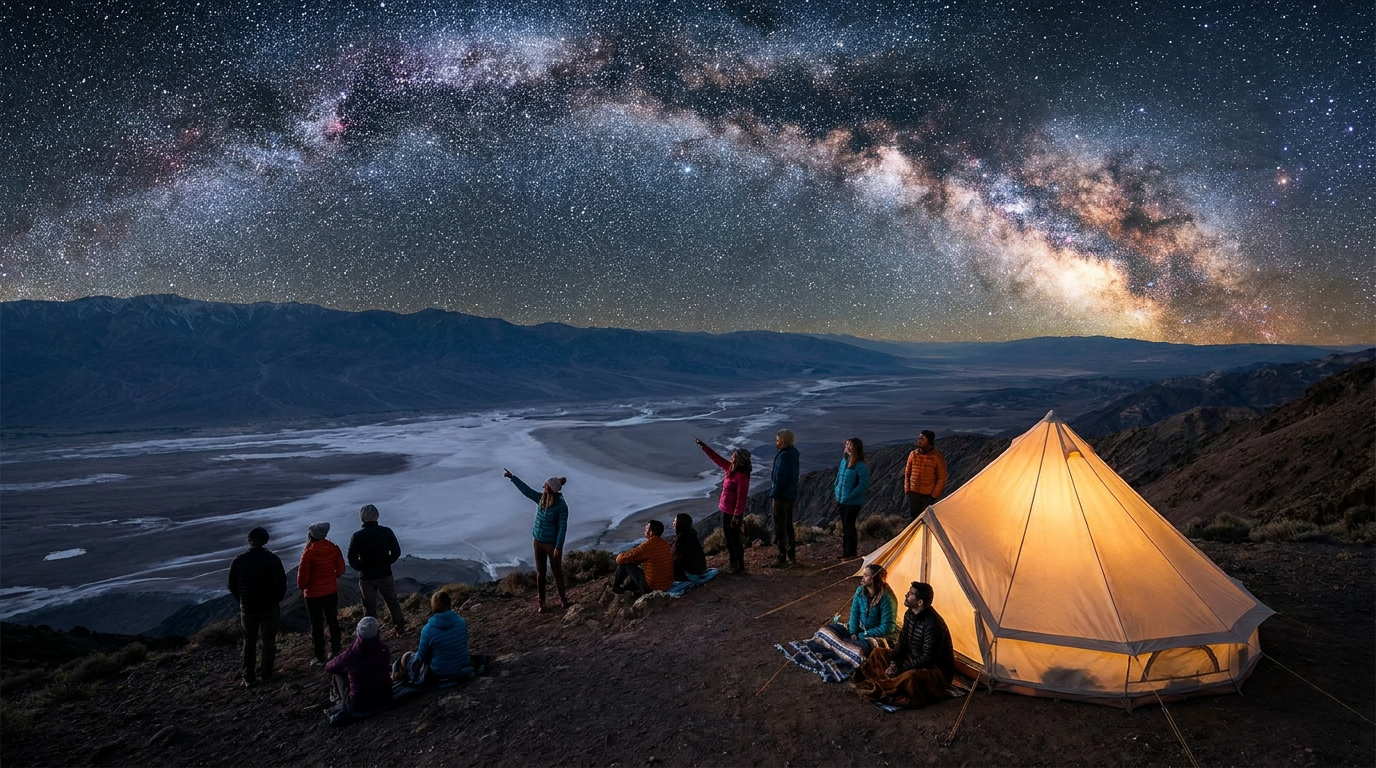
Today, research from DarkSky International reveals that 99 percent of people in the United States and Europe live under skies polluted by artificial light. For 80 percent of North Americans, the Milky Way—the glowing, textured band of our home galaxy—is completely invisible from their doorsteps. A truly dark sky has become a rare, vanishing resource.[2]
To quantify this loss, astronomers and astrotourists rely on the Bortle Scale. Created in 2001 by amateur astronomer John E. Bortle, the nine-level numeric scale measures the night sky's brightness at a specific location. A Class 9 sky represents an inner-city environment where only the moon and a few bright planets are visible. A Class 1 sky, conversely, represents pristine darkness where the Milky Way is so brilliant it casts faint shadows on the ground, and the zodiacal light—sunlight reflecting off interplanetary dust—is clearly visible.[3]

Finding a Class 1 or Class 2 sky increasingly requires intentional travel to protected areas. Enter the International Dark Sky Places program. Managed by DarkSky International, the program certifies parks, reserves, and communities that possess exceptional starry nights and a dedicated commitment to protecting them. In late 2025, the organization celebrated a major milestone, certifying its 250th location globally, bringing the total protected area to over 196,000 square kilometers.[2]
Finding a Class 1 or Class 2 sky increasingly requires intentional travel to protected areas.
Achieving this certification is not merely about geographic isolation; it requires rigorous local legislation. Communities and parks must implement strict lighting ordinances to prevent light trespass. This includes mandating fully shielded outdoor fixtures that direct light downward, utilizing motion sensors, and restricting light color temperatures to a maximum of 2700 Kelvin to minimize the scattering of blue light, which is particularly detrimental to night sky visibility.[7]
These stringent requirements are paying massive dividends. Astrotourism is now recognized as a highly lucrative economic engine, particularly for rural and remote communities. Analysts project that the global nighttime tourism market, currently valued around $10 billion, could double by 2035.[4]
The economic mechanics of astrotourism are uniquely beneficial to local municipalities. Unlike traditional tourists who might drive through a scenic area in a single afternoon, astrotourists are fundamentally required to stay overnight. A 2019 economic impact study conducted by Missouri State University focused on the Colorado Plateau—a region spanning parts of Utah, Colorado, Arizona, and New Mexico. The study projected that over a ten-year period, astrotourism would generate $5.8 billion in visitor spending, supporting over 10,000 jobs annually.[6]

States are aggressively capitalizing on this data. In June 2026, Colorado officially launched the "Colorado Stargazing Trail," a statewide map linking certified Dark Sky Parks, communities, and stargazing events. The initiative, backed by the state's Office of Economic Development, signals that dark-sky preservation is no longer just an environmental crusade—it is a critical infrastructure priority designed to capture high-value tourism dollars.[7]
The benefits of this dark-sky infrastructure extend far beyond human economics. Artificial light at night is a severe ecological disruptor. It disorients migratory birds that navigate by starlight, disrupts the feeding patterns of nocturnal predators, and alters the reproductive cycles of amphibians. By retrofitting lighting to meet astrotourism standards, communities inadvertently create vital sanctuaries for local wildlife.[1][2]
The demographic driving this boom is also shifting. While eclipse-chasers and retired amateur astronomers have long populated the astrotourism ranks, a new wave of younger travelers is entering the market. Driven by viral "SpaceTok" videos on TikTok and a broader cultural desire for authentic, unplugged experiences, Gen Z travelers are increasingly booking twilight canoeing trips, Indigenous-led aurora hunts, and stays at remote observatories.[4]

However, the rapid commercialization of the night sky presents a paradox. As remote areas become popular astrotourism destinations, the demand for infrastructure—hotels, restaurants, and roads—inevitably increases. The central challenge for the industry in the late 2020s is whether these regions can build the necessary accommodations to house tourists without introducing the very light pollution those tourists are traveling to escape.[1]
For now, the movement represents a rare alignment of economic incentives and environmental conservation. By assigning a high monetary value to natural darkness, astrotourism provides a powerful, market-driven rationale for turning off the lights. In an era defined by digital saturation and environmental anxiety, traveling to see the stars offers a profound shift in perspective—a reminder of our small, quiet place in a vast universe.[1][4]
How we got here
2001
The Bortle Scale is published, and Flagstaff, Arizona becomes the world's first certified Dark Sky Community.
2007
Natural Bridges National Monument in Utah is certified as the world's first International Dark Sky Park.
2026
Astrotourism surges as a top global travel trend, with DarkSky International surpassing 250 certified locations worldwide.
Viewpoints in depth
Conservationists and Astronomers
Advocates for the ecological and scientific necessity of preserving natural darkness.
For scientists and environmentalists, the fight against light pollution is about much more than a pretty view. Artificial light at night is an existential threat to nocturnal ecosystems, disrupting the migratory patterns of birds, the hunting habits of predators, and the reproductive cycles of insects and amphibians. Furthermore, astronomers argue that the night sky is a shared human heritage; erasing it severs our cultural and scientific connection to the wider universe.
Tourism and Economic Boards
Views natural darkness as a highly lucrative, monetizable resource for rural economies.
Economic development offices see astrotourism as a unique financial engine because it inherently requires overnight stays. Unlike day-trippers who might visit a national park and leave without spending much locally, stargazers need hotels, late-night dining, and guided tours. By adopting dark-sky lighting ordinances, rural communities can transform their geographic isolation into a premium tourism asset, generating billions in regional revenue.
Local Communities and Researchers
Focuses on balancing the influx of tourist dollars with sustainable, low-impact development.
While the economic benefits of astrotourism are clear, local residents and researchers are cautious about the infrastructure required to support it. Building new hotels and roads to accommodate stargazers risks introducing the very light pollution the tourists are coming to escape. Communities are working to ensure that astrotourism development remains low-impact, often prioritizing Indigenous-led tours and community-owned lodging to keep the economic benefits local without sacrificing the sky.
What we don't know
- Whether rural infrastructure can expand to meet astrotourism demand without introducing new light pollution.
- The exact global economic value of the astrotourism market, as many regions are just beginning to track nighttime visitor data.
Key terms
- Astrotourism
- Travel centered on experiencing dark skies, stargazing, and celestial phenomena.
- Bortle Scale
- A nine-level numeric scale that measures the night sky's brightness and the observability of celestial objects at a specific location.
- Skyglow
- The diffuse luminance of the night sky caused by artificial light scattering in the atmosphere, which obscures the stars.
- Dark Sky Park
- A protected public land area certified for its exceptional quality of starry nights and a nocturnal environment that is specifically protected for its scientific, natural, or educational value.
Frequently asked
What exactly is astrotourism?
Astrotourism is a form of travel focused on experiencing the night sky, including stargazing, watching meteor showers, and observing celestial events like auroras or eclipses.
Why is light pollution increasing so fast?
The global transition to cheap, bright LED lighting and ongoing urban expansion has caused the night sky's brightness to grow by nearly 10% annually over the last decade.
How does a park become a certified Dark Sky Place?
Parks must apply through DarkSky International, proving they have exceptional starry nights and implementing strict outdoor lighting ordinances to prevent future light pollution.
Sources
Source coverage
7 outlets
3 viewpoints surfaced







[1]Factlen Editorial TeamLocal Communities and Researchers
Synthesis by Factlen editorial team
Read on Factlen Editorial Team →[2]DarkSky InternationalConservationists and Astronomers
DarkSky International Announces 250th Certified Dark Sky Place
Read on DarkSky International →[3]Sky & TelescopeConservationists and Astronomers
Light Pollution and Astronomy: The Bortle Dark-Sky Scale
Read on Sky & Telescope →[4]OutsideTourism and Economic Boards
Why Astrotourism Is the Travel Trend of the Decade
Read on Outside →[5]ForbesTourism and Economic Boards
10 Best U.S. National Park Sites For Stargazing
Read on Forbes →[6]Missouri State UniversityLocal Communities and Researchers
Studying Dark Sky Tourism's Potential Economic Impacts
Read on Missouri State University →[7]Access FixturesTourism and Economic Boards
What the New Colorado Stargazing Trail Means for Outdoor Lighting
Read on Access Fixtures →
Every angle. Every day.
Get travel stories with full source coverage and perspective breakdowns delivered to your inbox.