
German Startup NEURA Robotics Secures $1.4 Billion to Bring 'Physical AI' into the Real World
Backed by a coalition including Amazon, Nvidia, and the European Investment Bank, the Metzingen-based firm aims to manufacture millions of cognitive robots by 2030.
By Factlen Editorial Team
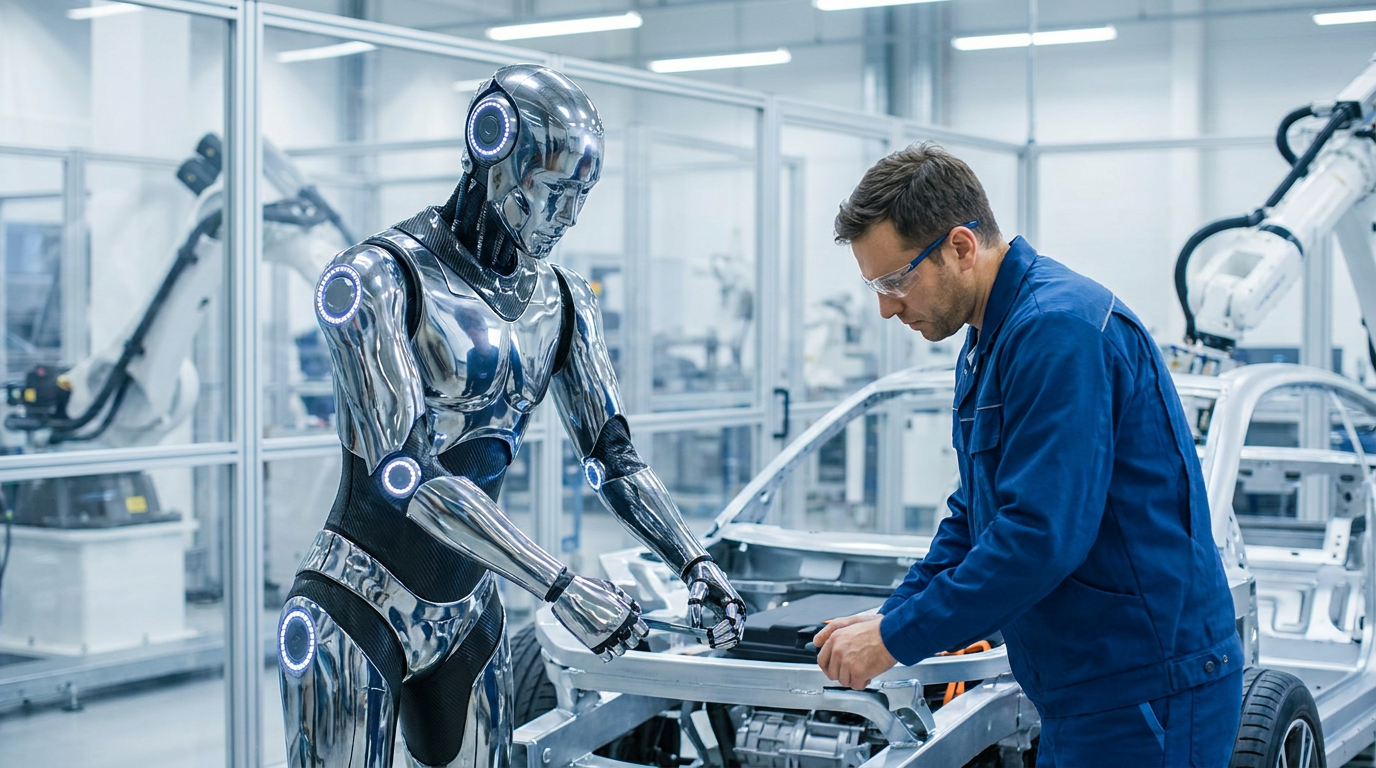
- European Tech Ecosystem
- Views the record-breaking round as a massive win for European technological sovereignty, proving the continent can build globally competitive AI infrastructure.
- Industrial & Manufacturing Sector
- Focuses on the immediate commercial applications of Physical AI in factories, emphasizing the $1 billion order backlog and the urgent need to scale hardware production.
- Big Tech & Strategic Investors
- Treats the investment as a strategic land-grab for the next computing platform, betting that the future of AI lies in edge-computing and physical machines.
What's not represented
- · Labor Unions
- · Regulatory Bodies
Why this matters
Artificial intelligence is rapidly moving from chatbots on screens to physical machines that can navigate factories, hospitals, and homes. This record-breaking investment signals that the infrastructure for a robotic workforce is moving from research labs to mass commercial production.
Key points
- NEURA Robotics raised up to $1.4 billion in Series C funding, the largest ever for a European full-stack robotics firm.
- The round was backed by Tether, Amazon, Nvidia, Qualcomm, Bosch, and the European Investment Bank.
- The company is building a 'Physical AI' platform to allow robots to learn and operate in real-world human environments.
- NEURA already has an orderbook exceeding $1 billion and aims to produce millions of robots annually by 2030.
- The robots will train in specialized 'NEURA Gyms' and share skills globally via a unified software architecture.
Artificial intelligence is preparing to step off the screen and into the physical world. NEURA Robotics, a startup based in Metzingen, Germany, has secured up to $1.4 billion in Series C financing to accelerate the mass production of cognitive robots. The historic round marks the largest capital injection ever recorded for a full-stack robotics company in Europe, instantly positioning the firm as a heavyweight in the global race to automate physical labor.[4][5]
The funding coalition reflects a rare convergence of industries betting on the future of physical AI. Big Tech hyperscalers like Amazon and Nvidia joined forces with semiconductor giant Qualcomm Technologies, industrial stalwarts Bosch and Schaeffler, and the European Investment Bank. Tether, the cryptocurrency stablecoin issuer, led the round, bringing both capital and edge-computing technology to the table.[1][7]
"The future of AI will not only live on screens," said NEURA founder and CEO David Reger. "It will move, interact, learn, and work beside us in the real world." The company's vision centers on what it calls "Physical AI"—machines equipped with the sensors, edge computing, and learning infrastructure necessary to safely navigate and adapt to human environments.[2][4]

NEURA's product lineup spans multiple form factors designed for different sectors. Its portfolio includes the MAiRA robotic arm for industrial automation, the MiPA mobile manipulator for healthcare and household assistance, and the 4NE-1, a bipedal humanoid robot designed to operate in spaces built for people.[3][6]
Rather than operating as isolated machines, these robots are connected through a unified software architecture called the "Neuraverse." This shared intelligence ecosystem allows a robot learning a new skill in a logistics center in Germany to instantly share that capability with a robot operating in a hospital in Japan.[2][3]
To accelerate this learning process, NEURA is using its fresh capital to expand a global network of "NEURA Gyms." These specialized, large-scale training environments combine real-world physical interaction with simulation, allowing robots to practice complex tasks safely before they are deployed into active commercial service.[4][6]
The commercial demand for these systems is already materializing. NEURA reports that its existing orderbook and strategic deployment pipeline exceed $1 billion in value. The primary bottleneck is no longer customer interest, but supply-side execution. The Series C funding will be heavily directed toward scaling manufacturing capacity in Germany and India, with the ambitious target of producing several million robots annually by 2030.[1][7]

The commercial demand for these systems is already materializing.
For the European tech ecosystem, the mega-round is a watershed moment. Historically, the continent has struggled to match the late-stage capital available to AI and robotics firms in the United States and China. NEURA's $1.4 billion raise is roughly 5.8 times larger than the previous European robotics funding record, proving that globally relevant AI infrastructure companies can emerge outside of Silicon Valley.[1][5]
The strategic investors are already integrating their own technologies into NEURA's ecosystem. Amazon views the investment as a natural extension of its ongoing partnership with the startup, while Tether plans to embed its "QVAC" edge AI runtime into the robots, allowing the machines to process information and make decisions locally without relying on constant cloud connectivity.[1][3]

As the company moves toward mass production, the implications extend far beyond factory floors. While initial deployments will focus on manufacturing, logistics, and inspection, the ultimate goal of cognitive robotics is to create machines capable of assisting with eldercare, household chores, and daily services—a shift that could fundamentally reshape the global labor market over the next decade.[2][6]
How we got here
2019
David Reger founds NEURA Robotics in Metzingen, Germany, with a focus on cognitive robotic systems.
January 2025
NEURA raises $123.5 million in Series B funding to advance its robotics platforms.
January 2026
The company announces a collaboration with Bosch to develop software specifically for humanoid robots.
June 2026
NEURA secures up to $1.4 billion in Series C funding, marking the largest round ever for a European robotics firm.
2030
The company's target date to reach scaled manufacturing capacity of several million robots annually.
Viewpoints in depth
European Tech Ecosystem
Views the record-breaking round as a massive win for European technological sovereignty.
For years, European technology advocates have lamented the continent's inability to match the late-stage venture capital available in the United States and China, particularly in capital-intensive fields like artificial intelligence and hardware. NEURA's $1.4 billion raise shatters previous ceilings, proving that Europe can incubate and fund globally competitive AI infrastructure. Ecosystem watchers argue that maintaining a domestic robotics champion is critical for the EU's industrial future, ensuring that European factories aren't entirely dependent on foreign-owned automation platforms.
Industrial & Manufacturing Sector
Focuses on the immediate commercial applications of Physical AI in factories and logistics.
Industrial partners like Bosch and Schaeffler view cognitive robotics not as a futuristic novelty, but as an immediate solution to severe labor shortages and supply chain bottlenecks. From their perspective, the true value of NEURA's platform lies in its $1 billion order backlog and its ability to deploy robots that can safely work alongside human employees without requiring expensive, rigid safety cages. The sector's primary concern is execution: ensuring NEURA can actually scale its manufacturing to meet the promised target of millions of units by 2030.
Big Tech & Strategic Investors
Treats the investment as a strategic land-grab for the next computing platform.
Hyperscalers like Amazon and chipmakers like Nvidia and Qualcomm are betting that the next major frontier for artificial intelligence is the physical world. By investing heavily in NEURA, these companies are securing distribution channels for their own underlying technologies—whether that's Nvidia's AI chips, Amazon's cloud infrastructure, or Tether's edge-computing frameworks. They view cognitive robots as the ultimate edge devices, capable of generating massive amounts of real-world training data that will be essential for the next generation of AI models.
What we don't know
- Whether NEURA can successfully scale its manufacturing operations to meet the ambitious target of producing millions of robots by 2030.
- How quickly regulatory frameworks in different countries will adapt to allow fully autonomous cognitive robots to operate in public and household spaces.
- The specific performance benchmarks NEURA must hit to unlock the full $1.4 billion in funding tranches.
Key terms
- Cognitive Robotics
- Robots equipped with artificial intelligence that allows them to perceive their environment, learn from experience, and adapt to new situations rather than just following pre-programmed instructions.
- Edge Computing
- Processing data locally on the device (like a robot) rather than sending it back and forth to a centralized cloud server, allowing for faster decision-making and operation without internet connectivity.
- Full-Stack Robotics
- A company that builds both the physical hardware (the robot) and the underlying software and AI systems required to operate it.
- Series C Funding
- A stage of venture capital financing typically aimed at helping a successful startup scale its manufacturing, expand globally, or acquire other companies.
Frequently asked
What is 'Physical AI'?
Physical AI refers to artificial intelligence systems that operate in the real world through robots, rather than just existing as software on a screen. These machines use sensors and edge computing to navigate, interact with, and learn from physical environments.
What kind of robots does NEURA build?
NEURA builds a range of cognitive robots, including the MAiRA robotic arm for industrial use, the MiPA mobile robot for healthcare and services, and the 4NE-1 humanoid robot designed to work in spaces built for humans.
Who invested in this funding round?
The $1.4 billion round was led by cryptocurrency firm Tether, with major participation from Amazon, Nvidia, Qualcomm, Bosch, Schaeffler, and the European Investment Bank.
Sources
Source coverage
7 outlets
3 viewpoints surfaced







[1]QuartzBig Tech & Strategic Investors
German humanoid robotics startup raises $1.4 billion from Amazon, Nvidia, and Tether
Read on Quartz →[2]The Robot ReportIndustrial & Manufacturing Sector
NEURA Robotics to raise up to $1.4B in Series C funding for physical AI
Read on The Robot Report →[3]Manufacturing DiveIndustrial & Manufacturing Sector
Robotics startup backed by Nvidia, Amazon and others raises $1.4B
Read on Manufacturing Dive →[4]Trending TopicsEuropean Tech Ecosystem
Neura: German Robotics Unicorn Secures $1.4 Billion From Tether, Nvidia, Amazon
Read on Trending Topics →[5]AI World EUEuropean Tech Ecosystem
Neura Robotics announces $1.4bn Series C
Read on AI World EU →[6]VestbeeEuropean Tech Ecosystem
NEURA Robotics closes $1.4B Series C to build global physical AI robotics platform
Read on Vestbee →[7]AI WeeklyBig Tech & Strategic Investors
Neura Robotics Closes Record $1.4B Series C Round
Read on AI Weekly →



Every angle. Every day.
Get business stories with full source coverage and perspective breakdowns delivered to your inbox.