
How Local AI Works: The Rise of Small Language Models on Phones and PCs
Massive cloud-based AI models are being joined by a new generation of 'Small Language Models' designed to run entirely on consumer hardware. This shift brings zero-latency, privacy-first artificial intelligence directly to laptops and smartphones.
By Factlen Editorial Team
- Privacy & Security Advocates
- Focus on data sovereignty and the elimination of cloud-based surveillance.
- Open-Source Developers
- Champion the democratization of AI models away from big tech monopolies.
- Hardware Manufacturers
- View local AI as the primary driver for a new super-cycle of device upgrades.
What's not represented
- · Cloud Service Providers
- · Enterprise IT Compliance Officers
Why this matters
Running AI locally means your personal data, private documents, and daily queries never have to be sent to a corporate cloud server. It also enables offline functionality and eliminates subscription fees, shifting the power of AI from centralized data centers directly into the hands of users.
Key points
- Small Language Models (SLMs) bring highly capable AI directly to consumer devices.
- Local AI ensures complete data privacy, as sensitive information never leaves the hardware.
- Quantization compresses massive models to fit within standard laptop memory limits.
- Dedicated Neural Processing Units (NPUs) allow devices to run AI efficiently without draining batteries.
- Open-source tools like Ollama and LM Studio make running local AI accessible to everyday users.
For the past few years, the artificial intelligence industry has been obsessed with scale. The prevailing wisdom dictated that more parameters meant more intelligence, leading to massive models that required football-field-sized data centers to operate. But in 2026, the narrative has fundamentally shifted. The new frontier isn't just bigger; it's smaller, faster, and entirely private.[6]
Welcome to the era of On-Device AI and Small Language Models (SLMs). Rather than sending every query, document, or photo to a remote server, users are increasingly running highly capable AI models directly on their own laptops and smartphones. This transition is transforming AI from a cloud-based rental service into a localized utility, much like a calculator or a word processor.[1][7]
How does an AI model shrink without losing its mind? The secret lies in a technique called "knowledge distillation." In a teacher-student dynamic, a massive cloud model (the teacher) is used to train a much smaller model (the student) to mimic its reasoning patterns.[1]
Instead of memorizing the entire internet, the SLM learns the underlying logic and structure of language. This results in a compact model—typically containing between 1 billion and 10 billion parameters—that excels at specific tasks without the trillion-parameter overhead of frontier models.[6]

But even a 7-billion-parameter model is naturally too large for a standard laptop, requiring around 14 gigabytes of memory at full precision. To solve this, developers use a mathematical compression technique known as "quantization."[2]
By reducing the mathematical precision of the model's neural weights—often from 16-bit floating-point numbers down to 4-bit integers—the model's memory footprint shrinks dramatically. A quantized 7B model fits comfortably into just 4 to 6 gigabytes of RAM, running smoothly on consumer hardware with minimal loss in output quality.[2]

Software efficiency is only half the equation; the hardware has also caught up. In the Windows ecosystem, 2026 has been defined by the proliferation of "Copilot+ PCs."[4]
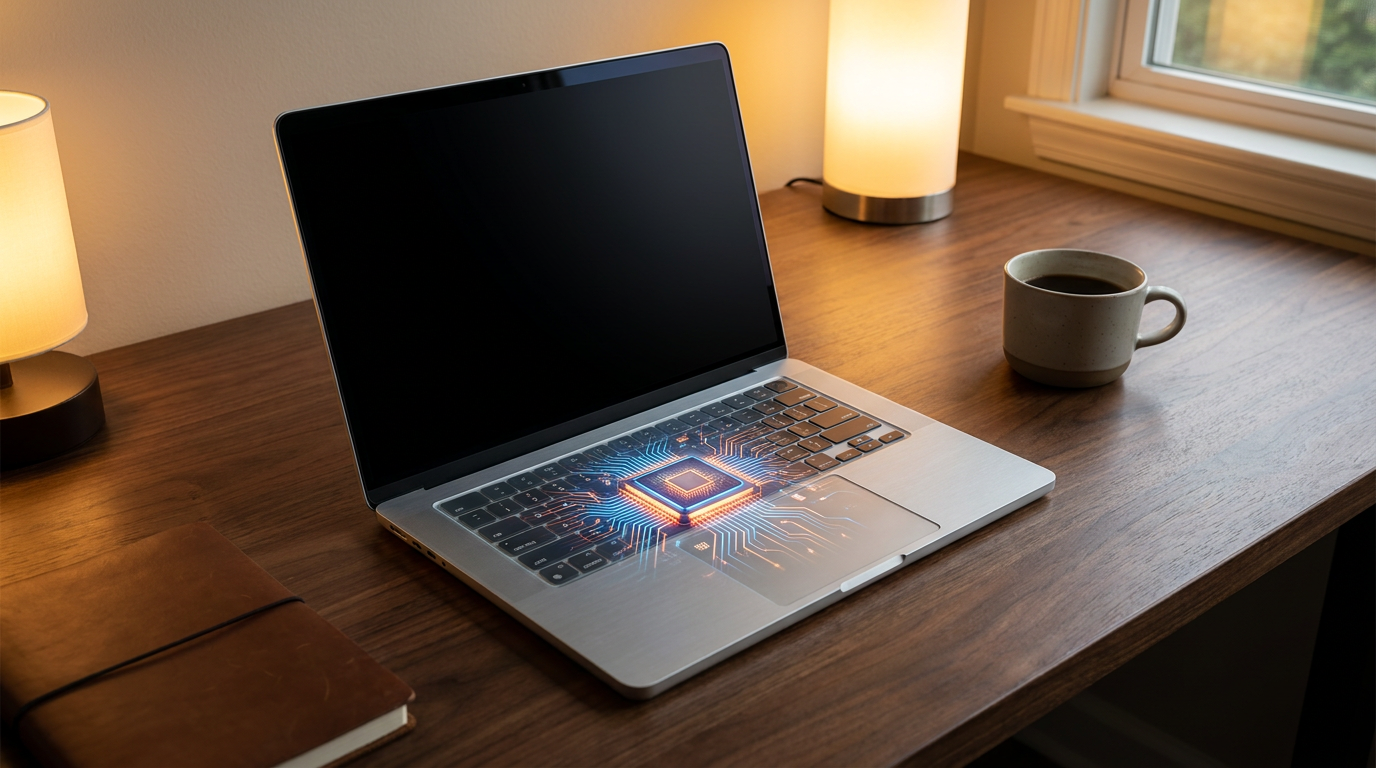
These laptops feature a dedicated piece of silicon called a Neural Processing Unit (NPU). Unlike a standard CPU, an NPU is purpose-built to handle the specific tensor operations required by neural networks, operating at a minimum of 40 Trillion Operations Per Second (TOPS). This allows the computer to run AI tasks like live translation and semantic search locally without draining the battery or spinning up loud cooling fans.[4]
These laptops feature a dedicated piece of silicon called a Neural Processing Unit (NPU).
Apple has taken a similar localized approach with its Apple Intelligence rollout. Leveraging the Neural Engine built into its A-series and M-series chips, Apple processes the vast majority of user requests directly on the device.[3]
When a user asks Siri to summarize a chaotic text thread or find a specific photo, the on-screen awareness and language processing happen locally. Only when a task exceeds the device's capabilities does it securely ping Apple's "Private Cloud Compute" servers, ensuring that everyday actions remain strictly on-device.[3]
Beyond built-in operating system features, a thriving open-source ecosystem has emerged to let anyone run custom SLMs. Tools like Ollama have democratized local AI hosting for developers. Ollama operates as a lightweight background service that allows users to run models like Meta's Llama 3 or Microsoft's Phi-3 via simple terminal commands, integrating seamlessly into coding workflows.[2]
For those who prefer a visual interface, LM Studio offers a polished desktop application. Users can browse a repository of thousands of quantized models, download them with a single click, and chat with them completely offline.[2]

This separation of tools—Ollama for developers building applications, and LM Studio for everyday users exploring AI—mirrors the maturation of the local AI software stack. It proves that running an AI locally is no longer a complex chore reserved for advanced engineers.[7]
The most profound impact of this shift is privacy. When a professional uses a cloud-based AI to summarize a legal contract or analyze financial data, they are transmitting sensitive information over the internet.[6]
With on-device SLMs, data sovereignty is guaranteed. The proprietary data never leaves the physical hardware, eliminating the risk of cloud leaks and making AI viable for highly regulated industries like healthcare, finance, and legal services.[1]
Furthermore, local execution eliminates the "API round-trip." Because the model doesn't have to beam a request to a server hundreds of miles away and wait for a response, the AI can react with sub-millisecond latency.[1]

This speed is critical for real-time applications, from live audio transcription to agentic workflows where the AI is actively navigating the user's screen and executing tasks across multiple applications simultaneously.[3]
As the ecosystem evolves, the strict hardware requirements for local AI are already beginning to blur. While Microsoft initially restricted its flagship local AI features to laptops with dedicated NPUs, the company recently confirmed that traditional high-end graphics cards (GPUs) will soon be able to run these local language models as well.[5]
Whether powered by a specialized NPU, a raw GPU, or a highly optimized smartphone chip, the trajectory of the industry is clear. The future of everyday artificial intelligence is not just in the cloud—it is offline, private, and sitting right on your desk.[7]
How we got here
2023-2024
Massive cloud-based Large Language Models (LLMs) dominate the AI landscape, requiring constant internet connectivity.
Mid 2024
Microsoft introduces the 'Copilot+ PC' standard, mandating dedicated NPUs for local AI processing.
Late 2024
Apple announces Apple Intelligence, heavily emphasizing on-device processing via its Neural Engine.
2025
Open-source tools like Ollama and LM Studio gain massive traction, making it easy to run quantized models on standard hardware.
Mid 2026
Small Language Models (SLMs) become the enterprise standard for privacy-first, offline AI applications.
Viewpoints in depth
Privacy Advocates
Focus on data sovereignty and the elimination of cloud-based surveillance.
For privacy-focused organizations and individuals, local AI is the only acceptable path forward. By ensuring that sensitive documents, personal photos, and daily queries never leave the device, SLMs eliminate the risk of third-party data harvesting and cloud breaches. This camp views on-device processing not just as a technical feature, but as a fundamental digital right.
Open-Source Developers
Champion the democratization of AI models away from big tech monopolies.
The open-source community sees local AI as a crucial counterbalance to the centralized power of massive tech conglomerates. By building tools like Ollama and sharing quantized models freely, this group ensures that powerful AI capabilities remain accessible to hobbyists, researchers, and startups without requiring expensive API subscriptions or reliance on closed-source cloud providers.
Hardware Manufacturers
View local AI as the primary driver for a new super-cycle of device upgrades.
For companies like Apple, Microsoft, and chipmakers, the shift to on-device AI represents a massive commercial opportunity. They argue that dedicated Neural Processing Units (NPUs) are essential for the next generation of computing, using features like live translation and agentic screen-awareness to convince consumers and enterprise IT departments to upgrade their aging hardware fleets.
What we don't know
- Whether cloud providers will aggressively lower API costs to compete with free local models.
- How quickly legacy software applications will integrate local SLMs into their existing codebases.
Key terms
- Small Language Model (SLM)
- A compact AI model, typically between 1 billion and 10 billion parameters, designed to run efficiently on consumer hardware rather than cloud servers.
- Quantization
- A technique that reduces the mathematical precision of an AI model's weights, drastically shrinking its memory footprint so it can run on standard laptops.
- Knowledge Distillation
- A training method where a massive, highly capable AI model is used to teach a smaller model, transferring reasoning skills without the massive size.
- Neural Processing Unit (NPU)
- A specialized computer chip designed specifically to handle the complex mathematical operations required by artificial intelligence efficiently.
- TOPS
- Trillions of Operations Per Second; a metric used to measure the processing speed of an NPU.
Frequently asked
Do I need an internet connection to use a Small Language Model?
No. Once the model is downloaded to your device, it runs entirely offline, ensuring complete privacy and zero latency.
Can my current laptop run local AI?
It depends. While dedicated NPUs offer the best battery life and efficiency, tools like LM Studio can run quantized models on many modern CPUs and standard graphics cards, provided you have at least 8GB to 16GB of RAM.
Are Small Language Models as smart as ChatGPT?
SLMs are not as broad in their general knowledge as massive cloud models, but they are highly capable at specific tasks like summarizing text, drafting emails, and coding, especially when fine-tuned for a particular domain.
Sources
Source coverage
7 outlets
3 viewpoints surfaced







[1]MediumPrivacy & Security Advocates
Beyond the 'Bigger is Better' Fallacy: How SLMs Redefine Performance
Read on Medium →[2]DevToolReviewsOpen-Source Developers
Ollama vs LM Studio vs LocalAI: Best Local LLM Hosting 2026
Read on DevToolReviews →[3]AppleHardware Manufacturers
Apple introduces Apple Intelligence, powered by on-device processing
Read on Apple →[4]MicrosoftHardware Manufacturers
What is a Copilot+ PC and what sets them apart?
Read on Microsoft →[5]Windows LatestHardware Manufacturers
Microsoft says you'll be able to run Windows 11's local Language Model APIs on non-Copilot+ PCs
Read on Windows Latest →[6]Ruh.aiPrivacy & Security Advocates
Small Language Models (SLMs): The Efficient Future of AI in 2026
Read on Ruh.ai →[7]Factlen Editorial TeamOpen-Source Developers
Synthesis by Factlen editorial team
Read on Factlen Editorial Team →



Every angle. Every day.
Get ai stories with full source coverage and perspective breakdowns delivered to your inbox.