
Is Climate Change Supercharging El Niño? The Evidence Behind the 2026 Debate
As a potentially record-breaking El Niño begins, scientists are vigorously debating whether climate change is altering the phenomenon's mechanics or simply amplifying its destructive impacts.
By Factlen Editorial Team
- Consensus Climatologists
- Argue that climate change amplifies the impacts of El Niño by raising the baseline temperature, even if the frequency of the cycle remains unchanged.
- Mechanistic Researchers
- Investigate whether uneven ocean warming is fundamentally altering the temperature gradients and trade winds that drive the ENSO cycle itself.
- Impact Forecasters
- Focus on the immediate physical consequences—heat transfer, disrupted jet streams, and extreme weather—regardless of the underlying atmospheric mechanics.
What's not represented
- · Agricultural economists modeling the specific crop yield impacts in the Global South.
- · Local emergency management officials preparing for the anticipated shift in flood and wildfire risks.
Why this matters
El Niño fundamentally rewires global weather patterns, dictating everything from agricultural yields and food prices to the severity of hurricane and wildfire seasons. Understanding whether this cycle is becoming permanently more extreme is crucial for long-term economic and infrastructure planning.
Key points
- Meteorological agencies have officially declared the onset of a new El Niño event for 2026.
- NOAA estimates a 63% probability that the event will become 'very strong' by the winter.
- Scientists agree that background global warming will amplify the heat and extreme weather impacts of this El Niño.
- A vigorous debate remains over whether climate change is altering the actual mechanics of the ENSO cycle.
- New metrics like the Relative Operational Niño Index (RONI) are being used to separate natural anomalies from background warming.
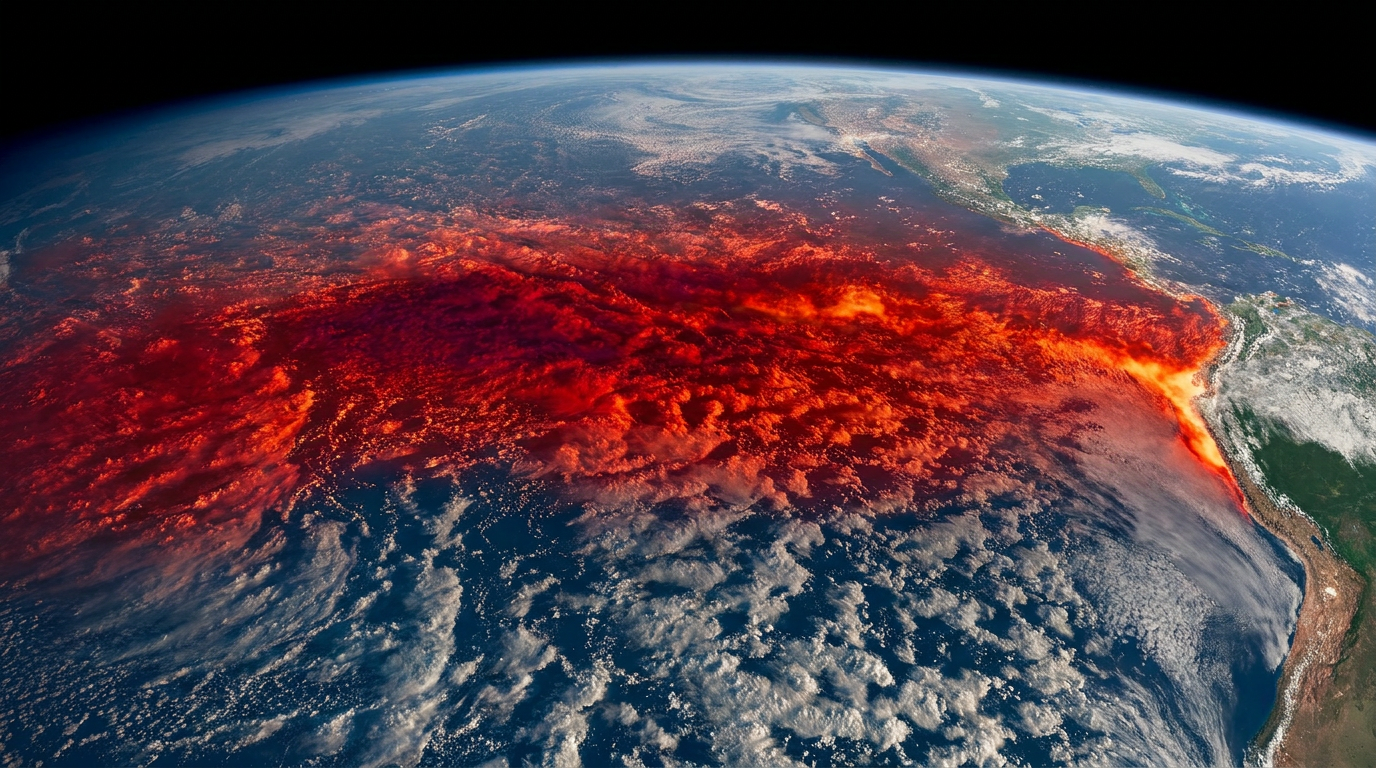
In June 2026, the world's leading meteorological agencies officially declared the arrival of a new El Niño event. Sea surface temperatures in the central and eastern Pacific Ocean have surged past the critical thresholds required to trigger the phenomenon, signaling a major shift in global climate patterns.[2][3]
The forecasts are stark. The National Oceanic and Atmospheric Administration (NOAA) currently estimates a 63% probability that this event will develop into a "very strong" El Niño by the Northern Hemisphere winter. If realized, this would rank among the most powerful episodes in the historical record, potentially rivaling the historic disruptions of 1997-1998 and 2015-2016.[3]
As the Pacific warms, a vigorous debate has emerged within the scientific community. The core question is profound: Is human-driven climate change fundamentally altering the mechanics of El Niño, or is it simply raising the baseline temperature upon which this natural cycle operates?[1][5]
To evaluate the evidence, it is necessary to understand the mechanics of the El Niño-Southern Oscillation (ENSO). Under normal conditions, strong trade winds blow west across the equatorial Pacific, pushing warm surface water toward Asia and allowing cold, nutrient-rich water to upwell off the coast of South America.[4][5]

During an El Niño, these trade winds weaken. The massive pool of warm water sloshes back eastward toward the Americas. This shift fundamentally alters atmospheric circulation, moving the jet stream and transferring immense amounts of oceanic heat into the global atmosphere.[3][4]
The most robust consensus among climatologists is the "baseline amplification" theory. The World Meteorological Organization (WMO) states clearly that while there is currently no definitive evidence that climate change increases the frequency of El Niño events, it undeniably amplifies their impacts.[2]
The logic of baseline amplification is strictly additive. The planet's oceans and atmosphere are already approximately 1.4°C warmer than pre-industrial levels due to greenhouse gas emissions. Because a strong El Niño typically adds an additional 0.2°C to global average temperatures, the combined effect is expected to shatter existing heat records.[2][5]
The planet's oceans and atmosphere are already approximately 1.4°C warmer than pre-industrial levels due to greenhouse gas emissions.
This additive effect means the 2026-2027 period is highly likely to temporarily breach the 1.5°C warming threshold established by the Paris Agreement. The WMO warns that this dynamic will "pour fuel on the fire of a warming world," supercharging the energy available for extreme weather events.[2]

However, a more fiercely debated hypothesis suggests that climate change is actively "supercharging" the ENSO mechanism itself. Researchers investigating this angle argue that uneven warming across the Pacific—where certain regions heat faster than others—is altering the fundamental temperature gradients that drive the trade winds.[1][5]
Proponents of this view point to the fact that recent El Niño and La Niña events have exhibited more extreme swings than historical averages. However, isolating the anthropogenic signal from the immense natural variability of the Pacific Ocean remains a formidable statistical challenge, leading to the current vigorous debate.[1]
Complicating the debate is the very metric used to measure El Niño. Because the entire ocean is warming, traditional sea surface temperature anomalies can trigger an "El Niño" reading simply due to background global warming, even if the atmospheric coupling hasn't fully materialized.[3][5]
To correct for this, agencies like NOAA are increasingly utilizing the Relative Operational Niño Index (RONI). This metric attempts to strip out the accelerating oceanic warming of recent decades to isolate the true, natural ENSO anomaly.[3]

Interestingly, when applying the RONI metric, some dynamic models suggest a divergence. While the oceanic heat content is at near-record levels, the atmospheric response—the actual shift in weather patterns—might be less intense than the raw temperature data implies.[3][5]
Forecasters also caution about the "spring predictability barrier," a well-known phenomenon where climate models struggle to accurately predict ENSO development during the Northern Hemisphere spring and early summer. While confidence improves after June, the exact peak intensity of the 2026 event remains uncertain.[2]
Regardless of whether the mechanism itself is supercharged or merely operating on a hotter planet, the physical consequences are largely the same. The European Space Agency's satellite data confirms a massive transfer of heat is underway, which will inevitably disrupt global precipitation patterns.[4][5]
The evidence pack currently points to a clear verdict on impacts: the 2026 El Niño will be exceptionally disruptive due to the compounded effects of background warming. However, the verdict on whether climate change has permanently rewired the ENSO engine remains an open, vigorously investigated frontier in climate science.[1][5]

How we got here
1997-1998
One of the strongest El Niño events on record causes massive global weather disruptions and record temperatures.
2015-2016
Another 'very strong' El Niño pushes global temperatures to new heights, severely impacting coral reefs and global agriculture.
2023-2024
A strong El Niño contributes to making 2023 and 2024 the hottest years recorded up to that point.
April 2026
The protracted La Niña/neutral phase ends as subsurface heat in the Pacific begins rising rapidly.
June 2026
NOAA and the WMO officially declare the onset of a new El Niño event, warning of potential record-breaking intensity.
Viewpoints in depth
Consensus Climatologists
Focus on the additive threat of El Niño operating on a hotter planet.
Organizations like the WMO and NOAA emphasize that the primary danger of the 2026 El Niño lies in 'baseline amplification.' They argue that while the ENSO cycle itself may not be fundamentally changing in frequency, the fact that it is occurring on an ocean that is already 1.4°C warmer than pre-industrial levels means its impacts will be unprecedented. In this view, the natural 0.2°C temperature boost provided by El Niño is simply the final push needed to shatter the 1.5°C threshold, supercharging the energy available for droughts, floods, and heatwaves.
Mechanistic Researchers
Investigate whether greenhouse gases are rewiring the ENSO engine itself.
A growing subset of climate researchers is investigating whether the actual mechanics of El Niño are being altered by human activity. This camp points out that the Pacific Ocean is not warming evenly; certain regions are heating faster than others, which could permanently alter the delicate temperature gradients that drive the equatorial trade winds. If this hypothesis holds true, climate change is not just raising the baseline temperature, but actively 'supercharging' the ENSO mechanism, potentially leading to more frequent 'very strong' events.
Impact Forecasters
Prioritize the immediate physical consequences over the underlying atmospheric debate.
For agencies monitoring satellite data and agricultural yields, the debate over the exact mechanics is secondary to the immediate physical reality. Organizations like the European Space Agency observe the massive transfer of oceanic heat into the atmosphere in real-time. Their focus is on how this energy will disrupt the jet stream, alter winter storm tracks, and trigger cascading economic impacts—from crop failures in Asia to flooding in the Americas—regardless of whether the El Niño engine itself has been permanently altered.
What we don't know
- Whether the atmospheric response (changes in wind and rainfall) will fully match the record-breaking heat currently stored in the Pacific Ocean.
- Exactly how much of the current sea surface temperature anomaly is driven by the natural El Niño cycle versus background anthropogenic warming.
- Whether the 2026 event will officially surpass the 1997-1998 and 2015-2016 events to become the strongest El Niño on record.
Key terms
- El Niño-Southern Oscillation (ENSO)
- The overarching coupled ocean-atmosphere system that includes both the warm El Niño phase and the cool La Niña phase.
- Trade Winds
- The permanent east-to-west prevailing winds that flow in the Earth's equatorial region, which weaken during an El Niño event.
- Relative Operational Niño Index (RONI)
- A newer metric used by meteorologists to measure El Niño strength by stripping out the background warming of the oceans to isolate the true natural anomaly.
- Sea Surface Temperature (SST) Anomaly
- The difference between the current temperature of the ocean's surface and the long-term historical average for that specific region and time of year.
Frequently asked
What exactly is El Niño?
It is a natural climate pattern characterized by unusually warm ocean temperatures in the central and eastern equatorial Pacific, which disrupts global weather patterns.
Is climate change causing this El Niño?
No, El Niño is a naturally occurring cycle. However, climate change is raising the baseline global temperature, making the heat and extreme weather associated with El Niño much more severe.
What is the 'spring predictability barrier'?
It is a period during the Northern Hemisphere spring when climate models have the hardest time accurately predicting how an El Niño event will develop and how strong it will become.
How will this affect global temperatures?
Because El Niño releases massive amounts of oceanic heat into the atmosphere, scientists expect 2026 and 2027 to break existing global heat records, potentially temporarily breaching the 1.5°C Paris Agreement limit.
Sources
Source coverage
5 outlets
3 viewpoints surfaced





[1]The New York TimesMechanistic Researchers
Is Climate Change Supercharging El Niño?
Read on The New York Times →[2]World Meteorological OrganizationConsensus Climatologists
WMO El Niño/La Niña Update: June 2026
Read on World Meteorological Organization →[3]National Oceanic and Atmospheric AdministrationConsensus Climatologists
ENSO Diagnostic Discussion: June 2026
Read on National Oceanic and Atmospheric Administration →[4]European Space AgencyImpact Forecasters
Satellite measurements show early signals of El Niño
Read on European Space Agency →[5]Factlen Editorial TeamMechanistic Researchers
Synthesis by Factlen editorial team
Read on Factlen Editorial Team →

Every angle. Every day.
Get science stories with full source coverage and perspective breakdowns delivered to your inbox.