
How Enhanced Geothermal Systems Are Unlocking the Earth's Heat
By repurposing oil and gas drilling techniques, next-generation geothermal technology is creating artificial underground reservoirs to provide clean, 24/7 baseload power anywhere on the planet.
By Factlen Editorial Team
- Geothermal Innovators
- Startups and developers view EGS as a highly scalable, immediate solution to the clean energy baseload problem.
- Energy Policymakers
- Government agencies see next-generation geothermal as a critical pillar for national energy security and grid reliability.
- Subsurface Researchers
- Geophysicists and seismologists emphasize the need for rigorous monitoring to manage the risks of altering deep rock formations.
- Industry Analysts
- Market observers are evaluating whether EGS can overcome its high upfront capital costs to compete broadly.
What's not represented
- · Local communities near EGS sites
- · Water conservation advocates
Why this matters
As the world transitions away from fossil fuels, power grids desperately need clean energy that runs 24/7 when the sun isn't shining and the wind isn't blowing. Enhanced Geothermal Systems could unlock enough firm, carbon-free power to meet the entire world's electricity demand.
Key points
- Enhanced Geothermal Systems (EGS) create artificial underground reservoirs to extract the Earth's heat in areas without natural hydrothermal resources.
- The technology relies on horizontal drilling and hydraulic fracturing techniques pioneered by the oil and gas industry.
- Fervo Energy's Cape Station in Utah is set to become the world's largest EGS project, aiming to deliver 500 MW of power.
- The U.S. Department of Energy estimates EGS could eventually provide over 5,000 gigawatts of clean, 24/7 baseload electricity.
The holy grail of the energy transition isn't just clean power—it's clean, "firm" power. While solar and wind have scaled exponentially over the last decade, their inherent intermittency requires massive battery storage installations or fossil-fuel backups to keep electrical grids stable when the weather doesn't cooperate.
For decades, geothermal energy has offered a tantalizing alternative: a renewable resource that runs continuously, immune to weather, seasons, or the time of day. Yet, despite its obvious advantages, geothermal currently accounts for less than half a percent of global electricity generation.[2]
The limitation has always been strictly geographical. Traditional "hydrothermal" power plants require a rare geological trifecta to function: extreme subterranean heat, naturally occurring fluid, and highly permeable rock. If you don't live in a volcanic hotspot like Iceland, Kenya, or parts of California, geothermal simply hasn't been a viable option.[1][2]
That geographic lottery is now being rewritten by a breakthrough known as Enhanced Geothermal Systems (EGS). By engineering artificial reservoirs deep underground, EGS promises to unlock the Earth's ambient heat virtually anywhere on the planet, untethering the technology from natural hot springs.[1]

The potential scale of this shift is staggering. The U.S. Department of Energy estimates that next-generation geothermal technologies could expand domestic capacity to over 5,000 gigawatts—more than enough to meet the entire electricity demand of the United States several times over.[4]
The mechanism behind EGS is elegantly simple in concept, though technically daunting in execution. Engineers drill thousands of feet into hot, dry rock formations that lack the natural water or permeability required for traditional geothermal extraction.[1]
Once the target depth is reached, they use hydraulic stimulation—injecting water under high pressure—to create a vast network of millimeter-thick fractures in the solid granite or basement rock.[1][5]
Cold water is then pumped down an injection well and forced through this newly created artificial radiator. As the water percolates through the fractured rock, it absorbs the Earth's intense ambient heat.[1]
A second well, known as the production well, intersects the fracture network to bring the superheated water back to the surface. There, the thermal energy is transferred to a working fluid that spins a turbine, generating electricity before the cooled water is reinjected in a continuous, closed loop.[1][2]

A second well, known as the production well, intersects the fracture network to bring the superheated water back to the surface.
Ironically, the technologies making this clean energy revolution possible were perfected by the fossil fuel industry. The shale boom of the 2010s drove massive advancements and cost reductions in horizontal drilling, fiber-optic sensing, and hydraulic fracturing.[4][5]
Startups are now repurposing those exact techniques. Instead of extracting hydrocarbons, companies are using horizontal drilling and "plug-and-perf" stimulation to harvest pure heat, creating massive underground heat exchangers that act like giant subterranean batteries.[4][5]
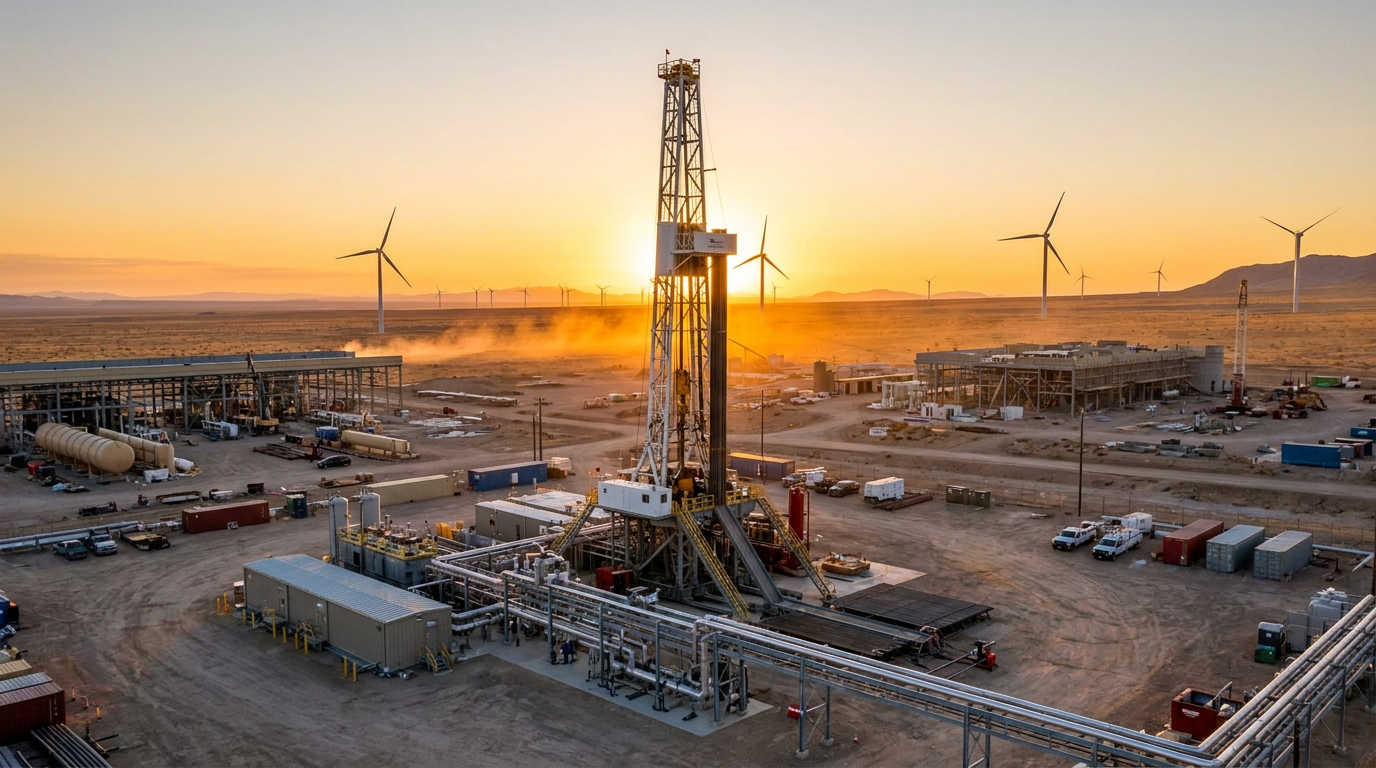
The results are moving rapidly from theory to commercial reality. In Utah, Houston-based Fervo Energy is constructing Cape Station, which is slated to be the world's largest EGS development.[4][5]
Situated adjacent to the Department of Energy's FORGE research site, Cape Station is scheduled to bring its first 100 megawatts of power online in 2026, with plans to scale to 500 megawatts by 2028—enough firm power to supply hundreds of thousands of homes.[4][5]
The project has already demonstrated remarkable efficiency gains. Drilling times have plummeted by 70 percent over the last two years, and capital expenditures are falling rapidly as the industry moves down the learning curve and standardizes its well designs.[5]

While EGS dominates current commercial efforts, another next-generation approach known as Advanced Geothermal Systems (AGS) is also gaining traction. AGS uses a completely sealed underground loop where the fluid never touches the rock itself.[4]
In an AGS setup, the working fluid circulates entirely within a closed pipe system embedded in the hot rock, conducting heat through the pipe walls. Because it requires no fracking, it virtually eliminates seismic risks, though it currently faces engineering challenges in matching the thermal output of EGS.[4]
Engineering the subsurface is not without risks, and the primary concern with EGS remains induced seismicity—the creation of micro-earthquakes during the hydraulic stimulation process.[3]
To mitigate this, operators and researchers are deploying advanced monitoring tools. At the Utah site, geophysicists from Lawrence Berkeley National Laboratory recently deployed custom seismometers nearly 7,000 feet underground, capable of withstanding extreme temperatures exceeding 338°F.[3]

This continuous, high-temperature seismic monitoring allows engineers to track fracture development in real-time, optimizing fluid injection while minimizing the risk of larger seismic events that could be felt by local communities at the surface.[3]
Looking ahead, the success of early commercial sites like Cape Station could trigger a massive influx of capital. Tech giants are already signing power purchase agreements for EGS to fuel their energy-hungry data centers with carbon-free baseload power, signaling that geothermal may finally be ready to step out of its geographic niche and power the broader grid.[5][6]
How we got here
2006
MIT publishes a landmark report estimating EGS could provide 100,000 MW of power by 2050.
2010s
The oil and gas shale boom drives massive cost reductions in horizontal drilling and hydraulic fracturing technologies.
2023
Fervo Energy's Project Red in Nevada successfully demonstrates commercial-scale EGS using horizontal drilling.
2024
The US Department of Energy announces $171.5 million to support next-generation geothermal field tests.
2026
Phase 1 of Fervo Energy's Cape Station in Utah is scheduled to begin delivering 100 MW of EGS power to the grid.
Viewpoints in depth
Geothermal Innovators
Startups and developers view EGS as a highly scalable, immediate solution to the clean energy baseload problem.
Companies pioneering EGS argue that the technology is ready for massive commercial deployment right now. By leveraging the existing supply chains, workforce, and technological advancements of the oil and gas industry, they believe EGS can scale faster than nuclear power or long-duration battery storage. Their primary focus is on driving down drilling costs through repetition and standardized well designs, proving to utility buyers that geothermal is a cost-competitive, zero-carbon alternative to natural gas plants.
Energy Policymakers
Government agencies see next-generation geothermal as a critical pillar for national energy security and grid reliability.
For the Department of Energy and international energy bodies, EGS solves the 'firm power' dilemma of the renewable transition. Policymakers emphasize that while solar and wind are cheap, the system-level costs of managing their intermittency are skyrocketing. They view EGS as a strategic asset that justifies significant public investment—such as the FORGE observatory and hundreds of millions in grants—to de-risk the technology until it reaches commercial liftoff and can be deployed nationwide, far beyond traditional volcanic hotspots.
Subsurface Researchers
Geophysicists and seismologists emphasize the need for rigorous monitoring to manage the risks of altering deep rock formations.
While supportive of the energy potential, the scientific community remains highly focused on the mechanics of induced seismicity. Researchers point out that injecting high-pressure fluids into fault-prone basement rock has historically caused problematic earthquakes in other industries. They advocate for slow, heavily monitored scaling, arguing that public acceptance of EGS hinges entirely on the industry's ability to map subsurface stresses accurately and control fracture growth without triggering seismic events that affect local communities.
Industry Analysts
Market observers are evaluating whether EGS can overcome its high upfront capital costs to compete broadly.
Financial analysts and energy economists acknowledge the technical breakthroughs but remain cautious about the economic viability of EGS outside of premium markets. Because drilling deep into hard granite is exceptionally expensive, the upfront capital expenditure for an EGS plant is massive compared to a solar farm. Analysts note that while tech companies are willing to pay a premium for 24/7 clean power to run data centers, EGS will need to see continued, aggressive cost reductions before it can replace coal or natural gas on a purely economic basis for everyday ratepayers.
What we don't know
- Whether the artificial fracture networks will maintain their thermal output over decades, or if the rock will cool faster than anticipated.
- How the regulatory framework for induced seismicity will evolve if EGS scales to thousands of sites near populated areas.
- Whether Advanced Geothermal Systems (AGS) will eventually surpass EGS by eliminating the need for hydraulic fracturing entirely.
Key terms
- Enhanced Geothermal Systems (EGS)
- A technology that generates electricity by creating artificial reservoirs in hot, dry rock formations that lack natural permeability.
- Hydraulic Stimulation
- The process of injecting high-pressure fluid into rock to create or widen fractures, allowing water to flow through.
- Baseload Power
- The minimum amount of electric power needed to be supplied to the electrical grid at any given time; power sources that run continuously 24/7.
- Induced Seismicity
- Minor earthquakes and tremors that are caused by human activity, such as fluid injection or extraction from the Earth's crust.
- Advanced Geothermal Systems (AGS)
- A closed-loop geothermal technology where fluid circulates entirely within sealed underground pipes, never touching the rock directly.
Frequently asked
What is the difference between traditional geothermal and EGS?
Traditional geothermal relies on naturally occurring hot water and permeable rock. EGS creates artificial reservoirs by fracturing hot, dry rock and injecting water into it.
Does EGS cause earthquakes?
The hydraulic stimulation process creates micro-earthquakes (induced seismicity) deep underground to fracture the rock. While these are typically too small to be felt at the surface, continuous monitoring is required to prevent larger seismic events.
Why are oil and gas technologies being used for geothermal?
The shale boom perfected horizontal drilling and hydraulic fracturing techniques. Geothermal startups are repurposing these exact tools to drill into hot rock and create heat-exchange networks instead of extracting fossil fuels.
Is geothermal energy renewable?
Yes. The Earth's internal heat is continuously replenished by the decay of radioactive isotopes in the mantle, and EGS plants operate in a closed loop, recycling the water they use.
Sources
Source coverage
6 outlets
4 viewpoints surfaced






[1]U.S. Department of EnergyEnergy Policymakers
Enhanced Geothermal Systems
Read on U.S. Department of Energy →[2]Massachusetts Institute of TechnologySubsurface Researchers
Geothermal Energy Explainer
Read on Massachusetts Institute of Technology →[3]Lawrence Berkeley National LaboratorySubsurface Researchers
Advancing reliable tools for next-generation geothermal
Read on Lawrence Berkeley National Laboratory →[4]Columbia University Center on Global Energy PolicyEnergy Policymakers
Pathways to Commercial Liftoff: Next-Generation Geothermal Power
Read on Columbia University Center on Global Energy Policy →[5]Information Technology and Innovation FoundationGeothermal Innovators
Accelerating Advanced Geothermal
Read on Information Technology and Innovation Foundation →[6]Factlen Editorial TeamIndustry Analysts
Synthesis by Factlen editorial team
Read on Factlen Editorial Team →


Every angle. Every day.
Get guides stories with full source coverage and perspective breakdowns delivered to your inbox.