
Deep Atmospheric Gas Discovery Confirms Uranus is a True Ice Giant
A first-of-its-kind detection of carbon monoxide deep in Uranus's atmosphere has resolved a long-standing planetary debate, confirming the world's interior is packed with water ice rather than solid rock.
By Factlen Editorial Team
- Observational Astronomers
- Focus on the ALMA data and the triumph of detecting the faint carbon monoxide signal through the thick atmosphere.
- Solar System Theorists
- Focus on the carbon monoxide ice line and how this unifies the formation models for both ice giants.
- In Situ Probe Advocates
- Argue that remote sensing has limits and a physical atmospheric probe is required to definitively prove bulk composition.
What's not represented
- · Space Agency Mission Planners (evaluating the cost and feasibility of a future Uranus orbiter)
Why this matters
For decades, astronomers have been unable to explain why Uranus and Neptune looked so different despite their similar sizes. This discovery unifies our understanding of the outer solar system, proving both planets formed through the same icy mechanisms and paving the way for future probe missions.
Key points
- Astronomers have detected carbon monoxide in Uranus's lower atmosphere for the first time.
- The discovery was made using the ALMA telescope array in Chile between 2022 and 2024.
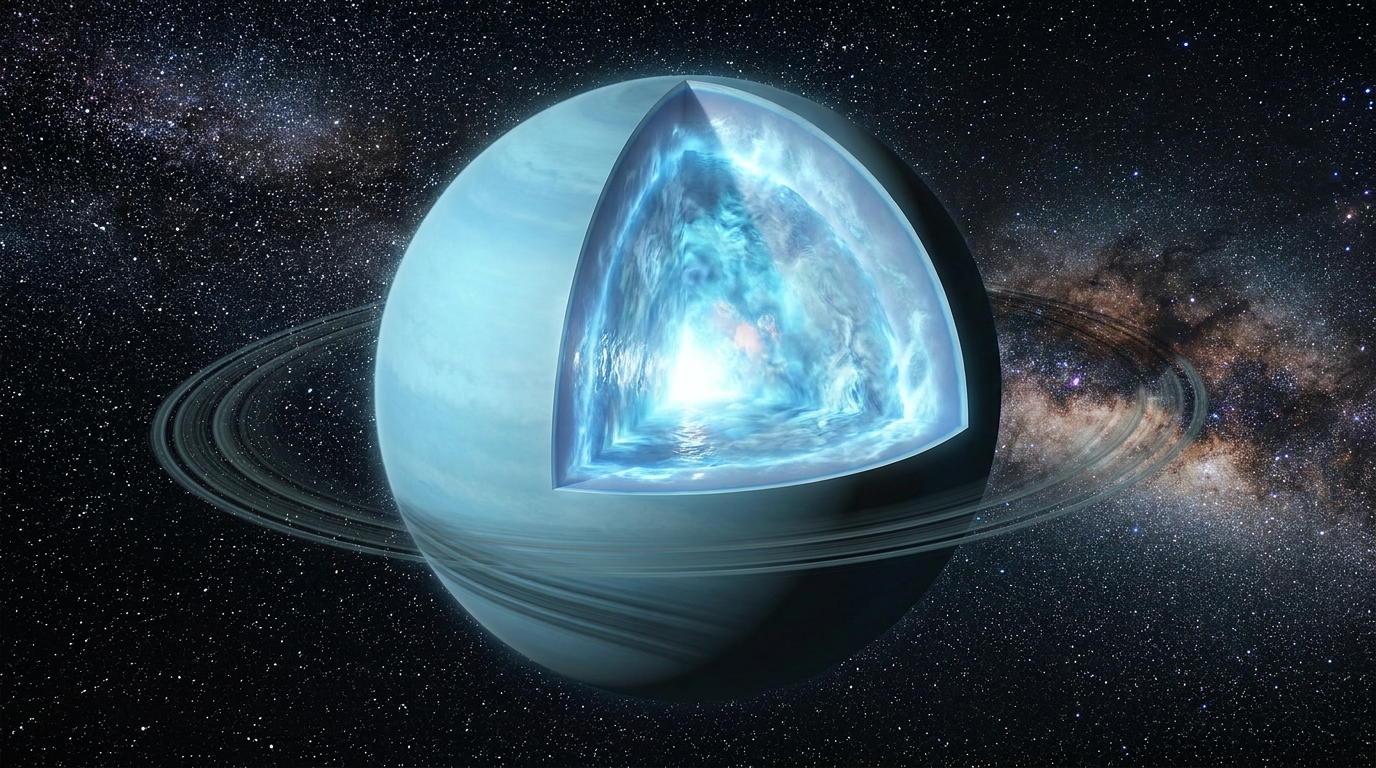
- Computer models show this gas abundance is only possible if Uranus has a massive, water-rich icy interior.
- The finding resolves a long-standing debate, confirming Uranus is a true ice giant like Neptune.
- The data supports the theory that both planets formed at the 'carbon monoxide ice line' in the early solar system.
Uranus and Neptune stand as the solar system's outermost sentinels, two massive worlds that share remarkably similar sizes, masses, and deep blue hues. Yet, for decades, anomalous atmospheric readings have driven a wedge between the two, leading some astronomers to question whether Uranus was actually an "ice giant" at all. While Neptune's atmosphere provided clear chemical signatures of a water-rich interior, Uranus remained stubbornly opaque, hiding its internal composition beneath featureless clouds. This discrepancy birthed a persistent theory that Uranus might actually be a "rock giant," possessing a fundamentally different internal structure than its closest planetary neighbor.[1][2]
The core of this planetary debate centered on a single molecule: carbon monoxide. In the high-pressure environments of giant planets, planetary scientists use carbon monoxide as a crucial chemical tracer. Its presence in the deep atmosphere strongly correlates with a bulk interior loaded with water and other volatile "ices." Neptune's atmosphere is rich in this gas, which perfectly aligns with its ice giant classification. Uranus, however, appeared completely depleted of deep-atmospheric carbon monoxide, prompting theorists to wonder if it formed under entirely different, rock-heavy conditions in the early solar nebula.[2][3]
Now, a breakthrough observation has finally settled the controversy, providing the missing piece of the chemical puzzle. Using the Atacama Large Millimeter/submillimeter Array (ALMA) in Chile, a team of astronomers led by Thibault Cavalié at the University of Bordeaux has detected carbon monoxide in Uranus's lower atmosphere for the very first time. This unprecedented detection pierces the veil of the planet's upper cloud decks, revealing the chemical makeup of the troposphere where gases well up from the deep interior.[2][3]

Securing this detection required pushing ALMA's radio-frequency sensitivity to its absolute limits. The research team observed the distant planet repeatedly between 2022 and 2024, carefully filtering out the immense background noise of the solar system to read the incredibly faint spectral signatures of the lower troposphere. Because Uranus is so cold and its atmosphere so thick, the millimeter-wavelength light emitted by carbon monoxide molecules is easily scattered, making this a triumph of modern observational astronomy.[2]
However, finding the gas is only the first step of the evidence pack; interpreting what that gas means for the planet's bulk composition requires complex thermodynamic modeling. Once the researchers quantified the exact abundance of carbon monoxide in the lower atmosphere, they ran those measurements through a battery of interior simulations. These computer models tested various internal structures, systematically varying the assumed ratios of solid rock to water ice to see which combination would produce the observed atmospheric chemistry.[1][2]
The results of these simulations were unambiguous. Models that assumed a rocky, ice-poor interior completely failed to reproduce the newly observed abundance of carbon monoxide, consistently predicting gas levels far lower than what ALMA detected. Only the simulations featuring a massive, water-rich icy mantle could match the observational data, aligning Uranus's internal structure closely with Neptune's and confirming its status as a true ice giant.[1][2]
"We find that Uranus is more on the ice-giant side than on the rock-giant side," Cavalié noted in the findings, which were recently published on the preprint server arXiv. The data strongly suggests that the long-running controversy over Uranus's fundamental classification is finally resolved. By proving that the planet's core is wrapped in a massive layer of frozen volatiles, the study effectively closes the book on the rock giant hypothesis.[2][3]

The data strongly suggests that the long-running controversy over Uranus's fundamental classification is finally resolved.
This discovery has profound implications for our broader understanding of how the solar system formed. If Uranus and Neptune share a similar icy bulk composition, it supports the leading hypothesis that both planets coalesced in the same distant, freezing region of the primordial solar nebula. It suggests a unified origin story for the outer solar system, rather than requiring separate, highly specific formation mechanisms for two neighboring planets.[4][5]
Specifically, solar system theorists point to the "carbon monoxide ice line"—a specific radius in the early protoplanetary disk where temperatures dropped low enough for carbon monoxide gas to freeze into solid grains. At approximately 25 Kelvin, this freezing boundary would have created a massive reservoir of carbon-rich ice. If Uranus and Neptune both formed in this exact zone, they would have swept up these specific materials as they grew.[4]
Accreting these carbon-rich, icy building blocks would naturally produce planets with the exact chemical signatures we now see in both Uranus and Neptune. It elegantly explains why both worlds are highly enriched in carbon but relatively depleted in nitrogen, which freezes at an even colder temperature further out in the disk. The ALMA detection provides the physical evidence needed to anchor these theoretical models of planetary migration and accretion.[4][5]

However, the evidence pack still contains areas of transparent uncertainty. Atmospheric readings are inherently limited because they only sample the outermost envelope of a planet. Extrapolating the bulk composition of a world 14.5 times the mass of Earth from the trace gases in its cloud tops always carries a margin of error. While the models strongly favor an icy interior, the exact ratio of rock to ice in the deepest layers remains an estimate.[5][6]
Furthermore, the researchers also detected carbon monoxide in Uranus's upper stratosphere. Unlike the deep-atmospheric gas, which wells up from the interior, this high-altitude carbon monoxide is likely the remnant of an external event, such as a massive comet impact hundreds of years ago. Disentangling the chemical signatures of an ancient comet crash from the planet's innate internal chemistry requires incredibly precise spectral modeling.[3][5]
Skeptics in the planetary science community also point out that computer models of supercritical "ices" under extreme pressure remain highly theoretical. The water and ammonia inside Uranus do not exist as solid blocks of ice like we have on Earth. Instead, the extreme heat and pressure crush them into a supercritical fluid—a bizarre state of matter that blurs the line between liquid and gas, making its chemical interactions difficult to simulate perfectly.[5][6]

To definitively close the case and erase the remaining uncertainties, the scientific consensus points to a single, expensive solution: a dedicated Uranus orbiter and atmospheric probe. Dropping a mass spectrometer directly into the Uranian atmosphere would provide ground-truth measurements of the carbon monoxide profile down to 10 bar of pressure, bypassing the limitations of remote telescopes entirely.[5]
Until such a flagship mission launches—which space agencies project will likely not happen before the 2030s—the ALMA observations stand as the strongest evidence to date. By finally finding the missing carbon monoxide, astronomers have restored Uranus to its rightful place as a true ice giant, bringing chemical harmony to the outer solar system's family tree and solving one of planetary science's most enduring mysteries.[1][2][5]
How we got here
1986
Voyager 2 performs the only spacecraft flyby of Uranus, raising questions about its internal heat and composition.
2014
Theorists propose that Uranus and Neptune formed at the 'carbon monoxide ice line,' predicting specific chemical signatures.
2022–2024
Astronomers use the ALMA telescope in Chile to conduct deep spectral observations of Uranus.
June 2026
Researchers announce the first detection of carbon monoxide in Uranus's lower atmosphere, confirming its ice-rich interior.
Viewpoints in depth
Observational Astronomers
Focus on the ALMA data and the triumph of detecting the faint carbon monoxide signal through the thick atmosphere.
For observational astronomers, the detection of carbon monoxide on Uranus represents a triumph of modern radio astronomy. Uranus is incredibly cold, and its thick atmosphere scatters the millimeter-wavelength light that molecules emit. By pushing the Atacama Large Millimeter/submillimeter Array (ALMA) to its limits over a two-year observation window, researchers were able to filter out the noise and isolate the specific spectral signature of carbon monoxide welling up from the troposphere, proving that Earth-based telescopes can still unlock deep planetary secrets.
Solar System Theorists
Focus on the carbon monoxide ice line and how this unifies the formation models for both ice giants.
Theorists view this discovery as the missing puzzle piece that unifies the origin story of the outer solar system. For years, the lack of carbon monoxide on Uranus forced modelers to invent complex, divergent formation scenarios for Uranus and Neptune. With the new data, theorists can confidently place the formation of both planets at the 'carbon monoxide ice line'—a specific freezing boundary in the primordial solar nebula. This elegant solution explains the carbon enrichment and nitrogen depletion seen in both worlds, streamlining our models of planetary migration.
In Situ Probe Advocates
Argue that remote sensing has limits and a physical atmospheric probe is required to definitively prove bulk composition.
While acknowledging the importance of the ALMA data, this camp emphasizes the inherent limitations of remote sensing. Extrapolating the bulk composition of a massive planet from trace gases in its upper cloud layers involves significant theoretical assumptions, particularly regarding how supercritical fluids behave under extreme pressure. To definitively close the case on Uranus's interior, they argue that space agencies must prioritize a flagship mission to drop a physical mass spectrometer directly into the Uranian atmosphere to take ground-truth measurements.
What we don't know
- Whether the carbon monoxide detected in the upper stratosphere originated from a historical comet impact or internal upwelling.
- The exact ratio of rock to ice in the deepest layers of the planet's core.
- How the supercritical fluids inside Uranus behave dynamically to generate its unusual magnetic field.
Key terms
- Ice Giant
- A class of giant planet composed primarily of elements heavier than hydrogen and helium, such as oxygen, carbon, nitrogen, and sulfur (traditionally called 'ices' in planetary science).
- Protoplanetary Disk
- The rotating disk of dense gas and dust that surrounded the newly formed Sun, from which the planets coalesced.
- Ice Line
- The specific distance from a star where temperatures drop low enough for a particular volatile compound (like water or carbon monoxide) to freeze into solid grains.
- Supercritical Fluid
- A state of matter that occurs at extreme temperatures and pressures, where distinct liquid and gas phases do not exist.
Frequently asked
Why is carbon monoxide important for understanding Uranus?
Carbon monoxide acts as a chemical tracer; its presence deep in the atmosphere indicates that the planet's interior is rich in water ice rather than just solid rock.
Are the 'ices' inside Uranus solid like ice on Earth?
No. Due to extreme heat and pressure deep inside the planet, the water and ammonia exist as a supercritical fluid, which behaves like a hybrid between a liquid and a gas.
How did scientists detect the gas from Earth?
They used the ALMA radio telescope array in Chile, which is sensitive enough to detect the faint millimeter-wavelength light emitted by molecules in Uranus's lower atmosphere.
Sources
Source coverage
6 outlets
3 viewpoints surfaced






[1]New ScientistSolar System Theorists
Gas from Uranus reveals it has an icy centre
Read on New Scientist →[2]Daily GalaxyObservational Astronomers
Scientists Just Found Evidence That Uranus May Have An Ice Rich Interior After All
Read on Daily Galaxy →[3]Daily StarObservational Astronomers
Scientists sniffing around Uranus discover massive icy secret in its deep interior
Read on Daily Star →[4]arXivSolar System Theorists
The measured compositions of Uranus and Neptune from their formation on the CO iceline
Read on arXiv →[5]Royal Society PublishingIn Situ Probe Advocates
Neptune and Uranus: ice or rock giant?
Read on Royal Society Publishing →[6]Sky at Night MagazineIn Situ Probe Advocates
Uranus: facts about the ice giant planet
Read on Sky at Night Magazine →

Every angle. Every day.
Get science stories with full source coverage and perspective breakdowns delivered to your inbox.