
Hidden Gas Discovery Suggests Uranus is a True Ice Giant After All
A new detection of carbon monoxide deep in Uranus’s atmosphere indicates the planet contains significantly more water ice than recent models suggested, reshaping our understanding of the solar system's outer reaches.
By Factlen Editorial Team
- Planetary Modelers
- Researchers who argue the new data confirms Uranus is a traditional ice giant.
- Skeptical Astrophysicists
- Scientists who caution that atmospheric gases may not perfectly reflect the deep core.
- Observational Astronomers
- Experts focused on the capabilities of next-generation arrays like ALMA to gather empirical data through thick atmospheres.
What's not represented
- · Mission Planners advocating for a dedicated Uranus Orbiter to gather in-situ data.
Why this matters
Understanding the true composition of Uranus isn't just planetary trivia—it dictates our models for how the entire solar system formed. If Uranus is ice-rich, it confirms theories about how planets migrated through the primordial solar nebula billions of years ago.
Key points
- Scientists detected carbon monoxide in the lower atmosphere of Uranus for the first time.
- The discovery was made using the ALMA radio telescope array in Chile.
- Carbon monoxide acts as a chemical tracer, indicating the presence of deep water ice.
- The findings challenge recent theories that Uranus might be composed primarily of rock.
- Carbon monoxide found higher in the atmosphere is likely debris from an ancient comet impact.
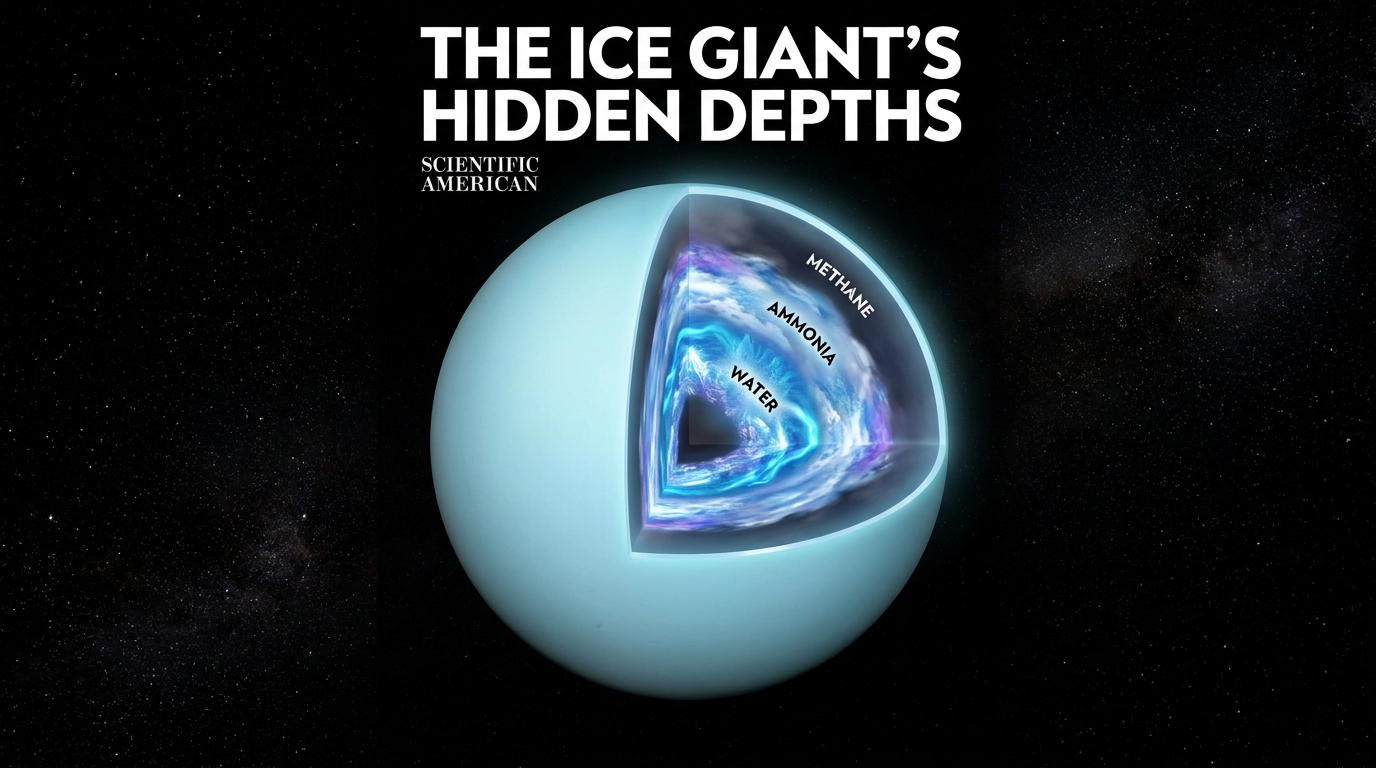
For decades, the two outermost planets of our solar system have been grouped together under a single, evocative title: the ice giants. But while Neptune has long displayed the chemical signatures expected of a water-rich world, Uranus has stubbornly refused to cooperate. Its thick, hazy atmosphere seemed devoid of the specific gases that would prove it was actually made of ice, leading a growing faction of planetary scientists to propose a radical alternative: Uranus might actually be a 'rock giant' masquerading in an icy neighborhood.[1][3]
The discrepancy between the two neighbors has been one of the most enduring mysteries in planetary science since the Voyager 2 flybys in the late 1980s. Neptune's atmosphere is rich in carbon monoxide, a gas that scientists use as a proxy to infer the presence of deep, water-rich materials. Uranus, despite being similar in size and mass, showed no such signature. This absence forced researchers to wonder if the two planets formed in fundamentally different ways, despite their outward similarities.[1][6]
This uncertainty gave rise to the 'rock giant' hypothesis. Just a year ago, studies published in major astronomy journals suggested that both Uranus and Neptune might contain up to 60 percent heavy-element rock. Under this model, the planets' interiors were dominated by silicate clouds and rocky mantles rather than frozen water and ammonia. It was a theory that threatened to rewrite the textbooks on how the outer solar system coalesced from the primordial nebula.[5][6]

That paradigm is now shifting back, thanks to unprecedented observations from the ground. A team of researchers led by Thibault Cavalié at the University of Bordeaux has successfully peered deeper into the Uranian atmosphere than ever before. To pierce the planet's thick, freezing cloud decks, the team utilized the Atacama Large Millimeter/submillimeter Array (ALMA), a sprawling network of radio antennas situated in the high desert of northern Chile.[2][4]
Observing a planet 1.8 billion miles away is a formidable challenge, especially when searching for trace gases hidden beneath layers of methane haze. Over the course of three distinct observation campaigns between 2022 and 2024, the ALMA network was trained on Uranus, capturing high-resolution millimeter-wave data. The extreme sensitivity of the array allowed the researchers to map the thermal emissions from the planet's lower atmosphere with unprecedented clarity.[2][4]
The data yielded a crucial, missing puzzle piece: the definitive detection of carbon monoxide gas lurking deep within the Uranian atmosphere. This marked the first time the gas had been identified in the lower regions of the planet, fundamentally altering the chemical profile that scientists had relied on for decades. The discovery immediately reignited the debate over what truly lies at the center of the seventh planet from the Sun.[1][2]

The data yielded a crucial, missing puzzle piece: the definitive detection of carbon monoxide gas lurking deep within the Uranian atmosphere.
The presence of carbon monoxide deep beneath the cloud tops is far more than a chemical curiosity. In the extreme, high-pressure environments of giant planets, carbon monoxide acts as a vital chemical tracer. Its existence is strongly linked to the presence of oxygen, which in turn points to vast quantities of water-rich material—or 'ice'—hidden in the planetary mantle. Until now, the lack of this gas had been the primary evidence supporting the rock-heavy models.[1][3]
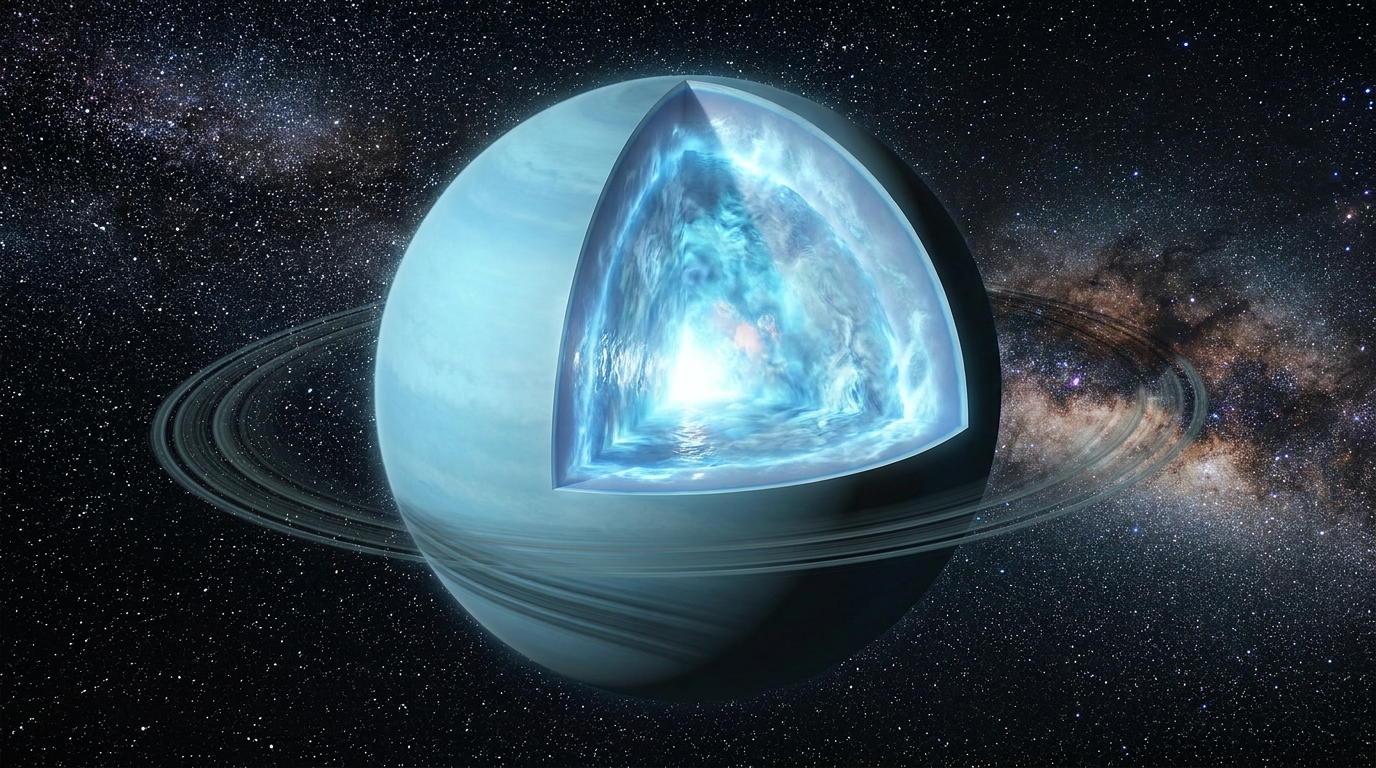
To understand what the new ALMA data meant for the planet's interior, Cavalié's research team ran a series of complex thermochemical simulations. They tested various hypothetical versions of Uranus, altering the internal ratios of rock to ice to see how the chemistry would behave under immense pressure and heat. By simulating the planet's envelope, mantle, and core, they could predict what gases should naturally rise to the observable lower atmosphere.[2][4]
The results of these simulations were stark. The team found that only the models assuming a highly ice-rich interior could reproduce the specific concentrations of carbon monoxide that ALMA had observed. Models that favored a rocky core and mantle consistently failed to match the empirical data, producing far less carbon monoxide than the telescope had detected. The data strongly suggested that Uranus is, in fact, a true ice giant.[2][3]

Interestingly, the team also detected carbon monoxide in the upper layers of the Uranian atmosphere, but researchers believe this high-altitude gas tells a completely different story. Cavalié suggests that the upper-atmosphere carbon monoxide is likely the remnant of a massive comet impact that occurred centuries ago. Because the upper and lower atmospheres of Uranus do not mix rapidly, the deep carbon monoxide is considered a genuine reflection of the planet's primordial composition, untainted by external debris.[2][4]
Despite the compelling new data, the debate is not entirely settled. Interpreting the deep interior of a distant planet relies heavily on theoretical physics. Skeptics, including researchers like Vanesa Ramirez of Leiden University, caution that linking a surface gas to a solid core requires assumptions about how a planet's internal layers circulate and mix over billions of years. If the internal convection of Uranus behaves differently than our current models predict, the atmospheric carbon monoxide might not be a perfect mirror for the mantle below.[2][5][6]

The stakes of this debate extend far beyond the classification of a single planet in our solar system. Uranus and Neptune serve as the local templates for a vast number of exoplanets discovered across the galaxy; 'sub-Neptunes' and 'mini-Neptunes' are among the most common types of worlds we have found orbiting other stars. If our models for how these mid-sized giants form are fundamentally flawed, it skews our understanding of planetary formation universe-wide.[3][6]
Ultimately, the definitive answer to the ice-versus-rock debate may require a much closer look. While next-generation observatories like ALMA and the James Webb Space Telescope are pushing the boundaries of remote sensing, planetary scientists are increasingly advocating for a dedicated Uranus Orbiter and Probe mission. Until a spacecraft can physically drop a sensor into the Uranian clouds, researchers will continue to decode the faint, frozen whispers of gas that manage to escape the planet's mysterious depths.[2][6]
How we got here
1986
NASA's Voyager 2 probe flies past Uranus, providing the first close-up data but leaving its deep interior a mystery.
2020s
Astronomers note the lack of carbon monoxide on Uranus compared to Neptune, sparking the 'rock giant' theory.
2022–2024
A research team uses the ALMA telescope array to conduct three highly sensitive observation campaigns of Uranus.
May 2026
Separate modeling studies suggest Uranus and Neptune might contain up to 60 percent rock.
June 2026
The ALMA data is published, revealing deep carbon monoxide and swinging the consensus back toward an ice-rich interior.
Viewpoints in depth
Planetary Modelers
Researchers who argue the new data confirms Uranus is a traditional ice giant.
This camp views the ALMA detection of carbon monoxide as the 'smoking gun' that aligns Uranus with Neptune. Because carbon monoxide requires oxygen to form in these high-pressure environments, its presence in the lower atmosphere is seen as a direct chemical proxy for a massive, water-rich mantle. For these modelers, the data cleanly resolves the anomaly of Uranus's composition, proving that both of the solar system's outermost planets formed through similar processes of ice accretion.
Skeptical Astrophysicists
Scientists who caution that atmospheric gases may not perfectly reflect the deep core.
While acknowledging the ALMA data is groundbreaking, skeptical astrophysicists argue that the leap from 'atmospheric gas' to 'solid interior composition' is fraught with assumptions. This viewpoint emphasizes that we still do not fully understand the convection currents and chemical mixing that occur inside giant planets. If the layers of Uranus are highly stratified and do not mix efficiently, the carbon monoxide seen in the lower atmosphere might be generated by localized chemistry rather than upwelling from a deep, icy mantle.
What we don't know
- Whether the carbon monoxide in the lower atmosphere perfectly mixes with the deep mantle, or if it represents a localized chemical layer.
- The exact ratio of rock to ice in the planet's deepest core, which cannot be directly observed from Earth.
- Why Uranus's internal heat and convection patterns differ so drastically from those of Neptune.
Key terms
- Ice Giant
- A class of planets composed primarily of elements heavier than hydrogen and helium, such as oxygen, carbon, nitrogen, and sulfur, which exist as hot, dense fluids in the planet's interior.
- Carbon Monoxide
- A gas composed of one carbon atom and one oxygen atom; in giant planets, its presence deep in the atmosphere is a strong indicator of water-rich material below.
- ALMA
- The Atacama Large Millimeter/submillimeter Array, a powerful network of radio telescopes located in the high desert of Chile.
- Thermochemical Model
- A computer simulation used by scientists to predict how different chemicals will react and distribute themselves under specific temperatures and pressures.
Frequently asked
Why couldn't scientists see the carbon monoxide before?
Uranus has a thick, freezing upper atmosphere that obscures its deeper layers. It required the extreme sensitivity of the ALMA radio telescope array to detect the faint signature of the gas lower down.
Does 'ice' on Uranus mean frozen water like on Earth?
No. Because of the extreme pressures and temperatures deep inside the planet, the 'ice' is actually a hot, dense, fluid mixture of water, ammonia, and methane.
Why does it matter if Uranus is made of rock or ice?
A planet's composition tells scientists where and how it formed. An ice-rich Uranus confirms theories that it formed further out in the cold regions of the early solar system, helping us understand planetary formation as a whole.
Sources
Source coverage
6 outlets
3 viewpoints surfaced






[1]New ScientistPlanetary Modelers
Gas from Uranus reveals it has an icy centre
Read on New Scientist →[2]Daily GalaxyPlanetary Modelers
Scientists Just Found Evidence That Uranus May Have An Ice Rich Interior After All
Read on Daily Galaxy →[3]arXivPlanetary Modelers
Pre-print repository for planetary science models
Read on arXiv →[4]ALMA ObservatoryObservational Astronomers
Atacama Large Millimeter/submillimeter Array
Read on ALMA Observatory →[5]Astronomy & AstrophysicsSkeptical Astrophysicists
Journal of Astronomy and Astrophysics
Read on Astronomy & Astrophysics →[6]Factlen Editorial TeamSkeptical Astrophysicists
Synthesis by Factlen editorial team
Read on Factlen Editorial Team →

Every angle. Every day.
Get science stories with full source coverage and perspective breakdowns delivered to your inbox.