
How the Human Brain Builds Sentences Neuron by Neuron
Using high-resolution microelectrodes, scientists have tracked the electrical activity of individual brain cells in real time, revealing the exact cellular sequence that turns a thought into spoken language.
By Factlen Editorial Team
- Neuroscientists
- Focused on the fundamental biological discovery of how the cortex organizes and processes language at the cellular level.
- Neuroprosthetics Developers
- Focused on leveraging this cellular data to build advanced brain-computer interfaces for paralyzed patients.
- Clinical Neurologists
- Focused on the diagnostic and therapeutic implications for treating speech and language disorders.
What's not represented
- · Linguists studying abstract grammar
- · Patients with locked-in syndrome
Why this matters
This breakthrough not only solves a long-standing mystery of human biology, but it paves the way for advanced brain-computer interfaces that could restore fluid, natural speech to paralyzed patients.
Key points
- Researchers have successfully tracked the electrical activity of individual brain cells in real time during natural human conversation.
- Using high-resolution Neuropixels probes, scientists discovered that specific neurons plan the phonetic components of a word before it is spoken.
- The brain utilizes a highly structured assembly line, with different neurons handling consonants, vowels, syllables, and grammatical context.
- AI models were able to accurately predict the grammar and meaning of a sentence based solely on pre-speech neuronal firing.
- The breakthrough paves the way for advanced brain-computer interfaces that could restore fluid, natural speech to paralyzed patients.
Human speech is a computational miracle. In the time it takes to draw a breath, the brain retrieves a concept, selects the precise vocabulary to express it, arranges the words according to complex grammatical rules, and orchestrates the rapid-fire muscle movements of the jaw, tongue, and larynx. We perform this feat at an average rate of three words per second, with remarkably few errors. Yet, for all of our advances in neuroscience, the fundamental cellular machinery that makes this possible has remained a black box. Scientists have long known which broad regions of the brain handle language, but the exact process by which a thought becomes a spoken sentence, neuron by neuron, has eluded observation.[7]
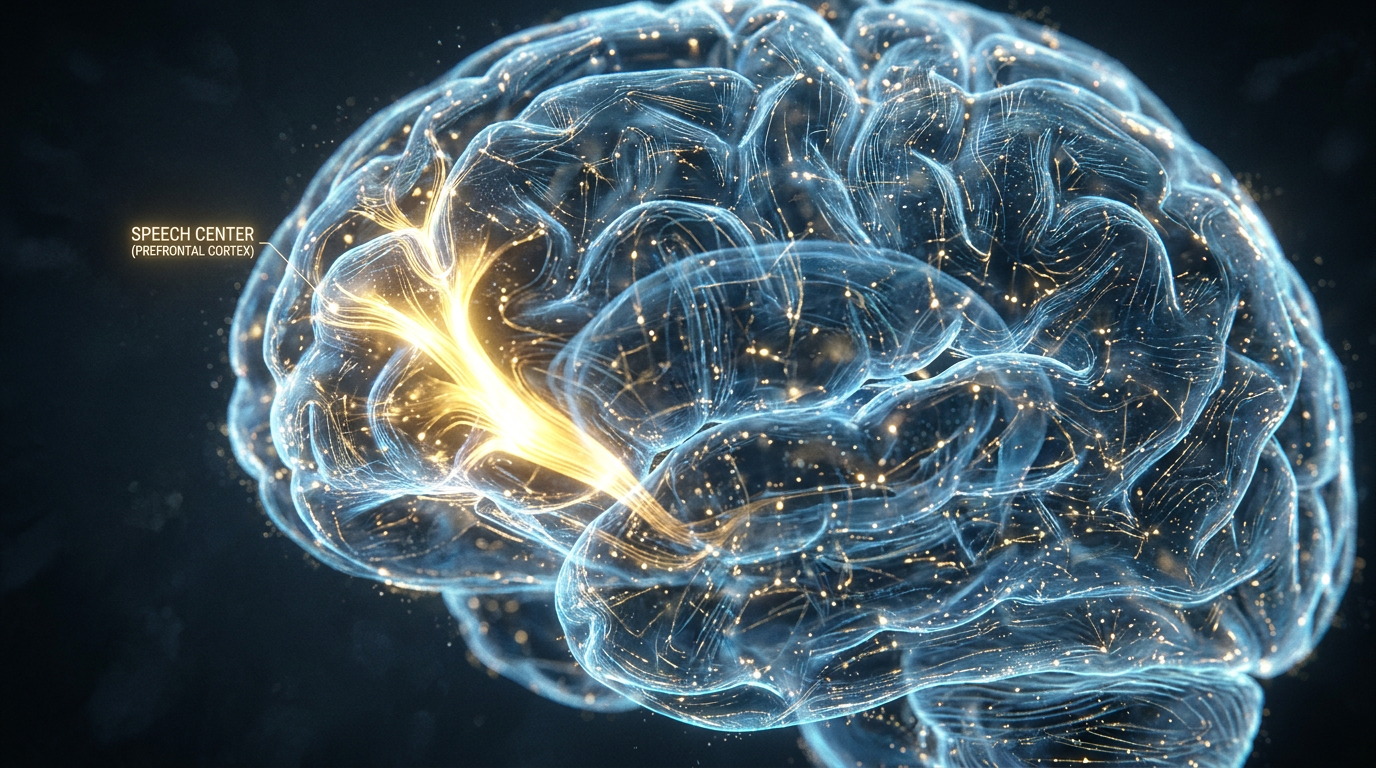
That black box has just been opened. In a landmark paper published in the journal Nature, a consortium of researchers has provided the most detailed picture yet of how the human brain processes and produces language. By tracking the electrical activity of individual brain cells in real time during natural conversation, scientists have mapped the exact sequence of events that occurs before a word is ever spoken. The findings reveal a highly structured assembly line within the brain, where specific neurons are tasked with planning individual sounds, while others group those sounds into syllables, and still others weave them into context-rich sentences.[1][2]
The breakthrough was made possible by a revolutionary piece of technology known as the Neuropixels probe. For decades, human brain mapping relied primarily on electrocorticography (ECoG), which involves placing electrode grids on the surface of the brain. While ECoG is excellent at showing which general neighborhoods of the cortex are active, it is too coarse to see what individual houses are doing. The Neuropixels probe changes that. Roughly the length and width of a human eyelash, the device packs nearly 1,000 individual electrode sensors onto a miniscule silicon chip. When inserted into the brain, it traverses the five-millimeter depth of the cortex, allowing researchers to "listen in" on hundreds of individual neurons across multiple cortical layers simultaneously.[4][7]

While Neuropixels probes have transformed animal research over the past five years, adapting them for human use required immense precision. The data for this new study came from patients who were already undergoing planned neurosurgical procedures, such as epilepsy monitoring or tumor removal. Researchers from Massachusetts General Hospital (MGH) and the University of California, San Francisco (UCSF) capitalized on this rare window of access. They engaged the awake patients in naturally flowing conversations on a wide range of topics, recording both the audio of the speech and the real-time firing of hundreds of neurons in the prefrontal and temporal cortices.[2][3][4]
What they discovered was a division of labor far more granular than previously imagined. The researchers found that long before a patient actually articulated a word, specific neurons in the prefrontal cortex began firing to plan the phonetic components of that word. For example, if a patient was about to say the word "dog," a distinct set of neurons would activate to prepare the consonant sound "da"—a sound that requires touching the tongue to the hard palate behind the teeth. These neurons represent the fundamental building blocks of speech, encoding the specific order and structure of articulatory events before any physical movement occurs.[3][5]
But the brain does not just plan isolated sounds; it must string them together fluidly. The recordings revealed that as the phonetic planning neurons did their job, a separate population of neurons took over to handle more complex morphological tasks. These higher-order cells were responsible for grouping the planned phonemes into distinct syllables and structuring them according to the rules of grammar. The researchers observed a temporally ordered dynamic: a cascading wave of electrical activity that transitioned seamlessly from the abstract planning of a word to the physical execution of speech.[2][3][5]

Perhaps most remarkably, the neural activity captured the unique context of the sentences being spoken. The researchers found that certain neurons acted as context monitors, distinguishing between similar phrases and words based on the broader meaning of the conversation. This suggests that the brain's language centers are not just mechanical translation engines converting thoughts into sounds; they are deeply integrated with the cognitive processes that govern meaning, memory, and social interaction. The neurons were not simply reacting to prompts; they were actively constructing the narrative flow of the conversation.[2][7]
Perhaps most remarkably, the neural activity captured the unique context of the sentences being spoken.
The study also highlighted a strict separation of duties between speaking and listening. While some neurons were dedicated exclusively to the production of speech, others were tuned entirely to perception. When participants listened to spoken sentences, researchers recorded from 685 neurons in the superior temporal gyrus, a high-level auditory region. They found that individual neurons had distinct preferences for certain speech sounds—some responded only to vowels, others to consonants, and some to the relative pitch of the speaker's voice. This physical proximity of highly specialized neurons may explain why humans can understand complex speech so effortlessly and instantaneously.[3][4]
To make sense of this mountain of cellular data, the research team turned to artificial intelligence. By feeding the single-cell brain recordings into advanced machine-learning models, the scientists were able to uncover hidden relationships between the neuronal firing patterns and the transcribed conversations. The AI models proved remarkably adept at decoding the brain's linguistic architecture. In fact, by analyzing the neuronal recordings from just before a participant spoke, the AI could accurately predict the grammar, meaning, and phonetic composition of the upcoming sentence.[2]

This predictive capability represents a monumental leap forward for the field of neuroprosthetics. Currently, individuals who have lost the ability to speak due to conditions like amyotrophic lateral sclerosis (ALS), brainstem stroke, or locked-in syndrome must rely on slow, cumbersome communication devices. These systems often require the user to spell out words letter by letter using eye movements or basic brain-computer interfaces, yielding only a few words per minute. The frustration of being cognitively intact but unable to communicate fluidly is one of the most devastating aspects of these conditions.[6][7]
The new findings offer a blueprint for a radically different approach. Because researchers can now identify the exact neurons responsible for planning phonemes and syllables, it is theoretically possible to bypass the damaged muscle pathways entirely. Future brain-computer interfaces could intercept these phonetic planning signals at the cellular level and route them directly to a speech synthesizer. Instead of spelling words, a paralyzed patient could simply think about speaking naturally, and the prosthetic device would instantly generate fluid, synthetic speech at a normal conversational speed.[5][6]

"This level of granularity is necessary for us to more completely understand how the brain generates speech and, ultimately, how we can develop technologies to restore it for individuals with communication disorders," noted Dr. Debara Tucci, director of the National Institute on Deafness and Other Communication Disorders (NIDCD), which helped fund the research. The ability to translate neural activity into machine-generated speech beyond current capabilities is no longer a matter of science fiction, but a tangible engineering challenge.[2][6]
Beyond the clinical applications, the research provides a profound philosophical insight into the nature of human cognition. Language is arguably the defining characteristic of our species, the tool that allows us to share knowledge, build societies, and express our inner lives. For centuries, philosophers and scientists have debated how the physical matter of the brain gives rise to the abstract realm of language. Now, for the first time, we are able to watch that translation happen in real time, observing the precise cellular choreography that turns a silent thought into a spoken word.[7]
The researchers emphasize that this is only the beginning. Having identified the fundamental building blocks of speech production at the cellular scale, scientists have "set the table" to answer even more complex questions about how the brain works. Future studies will likely explore how these neuronal networks adapt when learning a new language, how they degrade in neurodegenerative diseases like Alzheimer's, and how they interact with the brain's emotional centers to produce tone and inflection.[2][7]
As Neuropixels technology continues to evolve and become more accessible, the mapping of the human cortex will only accelerate. The discovery that the brain builds sentences neuron by neuron is a testament to the staggering complexity of our biology. It is a reminder that every conversation, every uttered sentence, and every whispered word is the result of a microscopic symphony playing out across thousands of cells—a symphony we are finally learning how to hear.[1][7]
How we got here
Prior to 2023
Brain mapping relies on surface electrodes (ECoG), tracking broad regional activity but missing single-neuron detail.
Late 2023
UCSF researchers successfully use Neuropixels probes in humans to track single neurons during speech listening.
Early 2024
MGH researchers map the prefrontal cortex, demonstrating how neurons plan phonemes before a word is spoken.
June 2026
Nature publishes comprehensive data showing AI can predict full sentence grammar and context from single-cell recordings.
Viewpoints in depth
The Biological Mechanism
How the brain's layered architecture enables rapid speech processing.
For neuroscientists, the most significant aspect of this breakthrough is the validation of the cortex's 'third dimension.' Previously, brain mapping focused on the surface area, identifying broad regions responsible for language. The Neuropixels data proves that the depth of the cortex—its layered structure—is equally critical. Neurons across these layers form highly specialized columns that handle distinct phonetic tasks, explaining how the brain can process the immense computational load of natural speech in milliseconds without becoming overwhelmed.
The Neuroprosthetic Future
Translating cellular signals into synthetic speech for paralyzed patients.
Engineers and BCI developers view this cellular-level data as the missing link for next-generation prosthetics. Current communication devices for patients with ALS or locked-in syndrome rely on tracking eye movements or broad brain waves to spell words letter by letter—a frustratingly slow process. By intercepting the specific neurons that plan phonemes and syllables before articulation, future devices could bypass paralyzed muscles entirely, translating a patient's neural intent directly into fluid, real-time synthetic speech.
What we don't know
- How these specific neuronal networks adapt and rewire when a person learns a second language.
- The exact mechanism by which these speech-production neurons interact with the brain's emotional centers to produce tone and inflection.
- How these cellular processes degrade in the early stages of neurodegenerative diseases like Alzheimer's or primary progressive aphasia.
Key terms
- Phoneme
- The smallest unit of sound in speech, such as the 'da' sound in 'dog'.
- Neuropixels probe
- A hair-thin, high-density microelectrode device used to record the electrical activity of hundreds of individual brain cells simultaneously.
- Prefrontal cortex
- A region at the front of the brain involved in complex cognitive behavior, decision making, and the planning of speech.
- Brain-computer interface (BCI)
- A system that connects the brain to external technology, allowing neural signals to control devices like computers or speech synthesizers.
- Electrocorticography (ECoG)
- A technique that uses electrodes placed directly on the exposed surface of the brain to record electrical activity.
Frequently asked
What is a Neuropixels probe?
It is a microscopic silicon sensor, roughly the size of a human eyelash, packed with nearly 1,000 electrodes that can record the electrical activity of individual neurons deep within the brain.
Can this technology read my thoughts?
No. The technology requires surgically implanted electrodes and is currently only capable of decoding specific motor-planning signals related to speech production, not abstract internal monologues.
How will this help people who cannot speak?
By identifying the exact brain signals that plan speech, scientists hope to build brain-computer interfaces that can translate those signals directly into synthetic speech, bypassing damaged muscles.
Why couldn't scientists do this before?
Previous brain-mapping tools, like ECoG grids, sat on the surface of the brain and could only record the aggregate activity of millions of cells, rather than the precise firing of individual neurons.
Sources
Source coverage
7 outlets
3 viewpoints surfaced






[1]NatureNeuroscientists
The brain builds a sentence neuron by neuron
Read on Nature →[2]National Institutes of HealthNeuroprosthetics Developers
With neuronal data, AI models predicted grammar, meaning, and context of spoken sentences
Read on National Institutes of Health →[3]Massachusetts General HospitalNeuroprosthetics Developers
Researchers determine how neurons represent fundamental elements of spoken words
Read on Massachusetts General Hospital →[4]UCSFNeuroscientists
How do individual neurons in your brain allow you to understand the sounds of speech?
Read on UCSF →[5]ScienceDailyClinical Neurologists
How neurons in the human brain work together to produce speech
Read on ScienceDaily →[6]National Institute on Deafness and Other Communication DisordersClinical Neurologists
Understanding how the brain generates speech to develop technologies to restore it
Read on National Institute on Deafness and Other Communication Disorders →[7]Factlen Editorial TeamNeuroscientists
Synthesis by Factlen editorial team
Read on Factlen Editorial Team →
Every angle. Every day.
Get science stories with full source coverage and perspective breakdowns delivered to your inbox.