
Uruguay’s 2026 World Cup Outlook: How Marcelo Bielsa’s High-Octane System Could Disrupt the Tournament
Under the obsessive direction of Marcelo Bielsa, a revamped Uruguayan squad enters the 2026 World Cup as a dangerous dark horse. Blending relentless pressing with their traditional fighting spirit, La Celeste aims for a deep run in North America.
By Factlen Editorial Team
- Tactical Optimists
- Believe Bielsa's high-octane pressing system maximizes Uruguay's athletic midfield and can overwhelm elite opponents.
- Cautious Realists
- Worry about the defensive gaps, squad depth, and the physical toll of Bielsa's demanding style over a short tournament.
- Data & Fantasy Analysts
- Focus on the underlying metrics, noting Uruguay's massive turnover numbers but highlighting their recent struggles to score against low blocks.
What's not represented
- · Saudi Arabian and Cape Verdean tactical analysts preparing to face Uruguay's press.
- · Domestic Uruguayan club managers whose players were entirely bypassed for the European-based squad.
Why this matters
Uruguay's performance under Marcelo Bielsa offers a fascinating tactical experiment on the world's biggest stage, combining the nation's historic grit with a fiercely demanding attacking philosophy. For football fans, La Celeste represents the ultimate wild card—capable of overwhelming the tournament's heavyweights with a style that guarantees high-octane entertainment.
Key points
- Marcelo Bielsa has completely overhauled Uruguay's tactical approach, implementing a relentless, high-pressing 4-3-3 system.
- Real Madrid's Federico Valverde captains the squad, serving as the vital midfield engine for Bielsa's demanding style.
- The team recorded a CONMEBOL-high 147 attacking-third turnovers during qualification, showcasing their disruptive off-the-ball nature.
- Despite statement wins over Brazil and Argentina, Uruguay has occasionally struggled to break down deep defensive blocks.
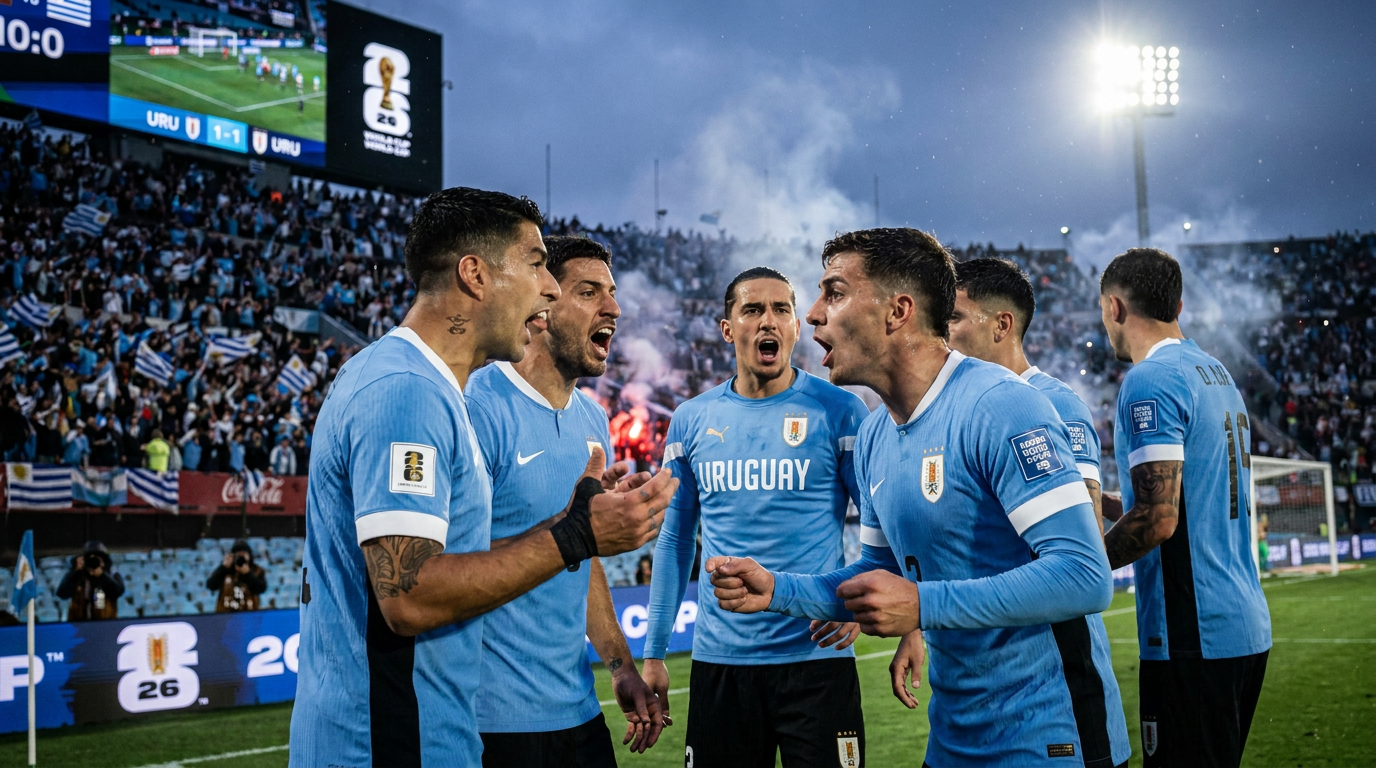
The 2026 FIFA World Cup marks a profound generational shift for Uruguay, a nation that has consistently punched above its weight on the global stage. The legendary era defined by the prolific striking duo of Luis Suárez and Edinson Cavani has officially concluded, leaving behind a younger, highly athletic roster. In their place steps Marcelo Bielsa, the enigmatic 70-year-old Argentine manager managing at his third World Cup, who has been tasked with modernizing La Celeste's approach. Bielsa’s arrival has fundamentally shifted Uruguay from the gritty, reactive football of the Óscar Tabárez era into something far more extreme and demanding. Fans and analysts alike now view this revamped squad as a dangerous dark horse, capable of making a deep run in North America if they can successfully execute their manager's complex tactical vision.[1][2][3]
Bielsa has completely overhauled the national team's tactical blueprint, implementing a high-intensity, transitional 4-3-3 system that relies on relentless counter-pressing. There is no letup in attacking intent when Uruguay has possession; the system is built for direct, vertical football, allowing the side to press opponents high up the field and chase the ball relentlessly. During their CONMEBOL qualifying campaign, Uruguay recorded an astonishing 147 high turnovers—26 more than next-best Argentina—and averaged nearly 18 tackles per game, showcasing their disruptive nature off the ball. Once possession is regained, the focus immediately shifts to exploiting spaces with rapid vertical attacks before the opposition can reset their defensive shape.[1][2][4]
This demanding tactical framework pairs surprisingly well with the traditional "Garra Charrúa"—the indigenous fighting spirit and tenacity that has long defined Uruguayan football. Bielsa’s system requires an elite level of physical conditioning and absolute commitment, traits that are deeply ingrained in the nation's footballing culture. The midfield engine room is the clearest manifestation of this synergy, led by the 27-year-old Real Madrid star Federico Valverde. Now the undisputed captain and heartbeat of the team, Valverde possesses the elite engine, tactical intelligence, and technical quality required to execute Bielsa's vision, ensuring that nearly every attacking sequence flows through him.[1][2][3]

Partnering Valverde in the center of the pitch is a formidable supporting cast designed to maintain the team's relentless tempo. Manuel Ugarte operates as the more fixed central defensive midfielder, anchoring the structure and breaking up opposition attacks, while Rodrigo Bentancur adds vital dynamism and back-and-forth movement in a double-pivot arrangement. This midfield trio frequently drops deep during the build-up phase to create numerical advantages, allowing Uruguay to progress the ball efficiently through the thirds. Their ability to dominate the center of the pitch will be crucial against possession-heavy opponents, dictating the rhythm of the game and shielding a defensive line that is often left exposed by the team's aggressive posture.[2][3][5]
Partnering Valverde in the center of the pitch is a formidable supporting cast designed to maintain the team's relentless tempo.
Defensively, Uruguay operates with an aggressive man-oriented structure that inherently carries significant risk. Because Bielsa’s system commits so many bodies forward and demands high pressing, it often leaves massive gaps at the back that opponents can exploit on the counter-attack. The responsibility of managing these vulnerable spaces falls heavily on the shoulders of Barcelona center-back Ronald Araújo. Araújo’s exceptional recovery pace and his ability to win isolated one-on-one duels are essential components in preventing Uruguay from bleeding goals in transition. He is supported by a restructured backline that includes Guillermo Varela on the right flank and Mathías Olivera on the left, combining European experience with the tactical discipline required to survive Bielsa's demanding defensive assignments.[2][3][4][5]
In the attacking third, the goalscoring burden now rests squarely on Darwin Núñez. The explosive forward serves as the primary focal point, utilizing his physical presence and verticality to stretch opposition defenses and finish the rapid counter-attacks generated by the midfield's high pressing. However, Uruguay occasionally struggles to break down stubborn, low-block defenses, highlighting the need for secondary goalscoring threats. To address this, Bielsa has placed significant trust in wide players like Maximiliano Araújo, who is tasked with providing offensive width, beating defenders one-on-one, and overloading the flanks to create high-quality chances for Núñez in the penalty area.[1][2][3][5]

The journey to North America has been a rollercoaster ride that perfectly encapsulates the highs and lows of the Bielsa experience. Uruguay's qualifying campaign featured spectacular statement victories over continental heavyweights Argentina and Brazil, demonstrating that when the system clicks, La Celeste can dismantle the best teams in the world. Yet, the campaign also exposed vulnerabilities, particularly a stretch where the team struggled creatively, resulting in five goalless draws. This inconsistency, coupled with dressing room unrest and Bielsa's astonishingly honest admission that his intense, fear-driven methods can sometimes be "toxic," underscores the fragile balance within the squad as they navigate the pressures of a major tournament.[1][2][4]
Drawn into Group H alongside Spain, Saudi Arabia, and Cape Verde, Uruguay faces a fascinating tactical test. The opening fixtures against Saudi Arabia and Cape Verde present opportunities for Bielsa's side to establish their rhythm and rack up goals, provided they can effectively break down the anticipated defensive blocks. The marquee matchup against Spain will be a clash of contrasting philosophies—Spain's methodical possession against Uruguay's chaotic, vertical pressing. Ignacio Alonso, the president of the Uruguayan Football Association, has publicly set the target of reaching the quarter-finals, emphasizing that the team must aspire to solidify its place among the world's top ten nations.[1][2][4][5][6]

Beyond the tactical intrigue, Uruguay will benefit from a significant psychological advantage: the fervent support of their traveling fans. Roughly 10,000 passionate Uruguayan expatriates are expected to flood the stadiums in North America, creating a hostile, home-like atmosphere for their opponents. This vocal backing, combined with the squad's inherent resilience and Bielsa's obsessive preparation, makes Uruguay one of the most compelling narratives of the 2026 World Cup. Whether they achieve a historic deep run or succumb to the physical and emotional demands of their own system, La Celeste guarantees a spectacle that will captivate the global footballing audience.[1][2]
How we got here
May 2023
Marcelo Bielsa is appointed as head coach, signaling a radical tactical shift for the national team.
Autumn 2023
Uruguay secures statement 2-0 victories over both Brazil and Argentina in World Cup qualifying.
Late 2024
The team experiences a creative slump, playing out five 0-0 draws amid reports of dressing room friction.
June 2026
Uruguay arrives in North America for the World Cup, drawn into Group H alongside Spain, Saudi Arabia, and Cape Verde.
Viewpoints in depth
Tactical Purists
Analysts who view Bielsa's high-risk, high-reward system as a necessary evolution for Uruguay.
For tactical analysts and proponents of modern pressing football, Marcelo Bielsa’s appointment was a masterstroke that dragged Uruguay out of a reactive, defensive era. This camp argues that the traditional 'Garra Charrúa' is perfectly suited for a high-intensity pressing game, pointing to the dominant qualifying victories over Argentina and Brazil as proof of concept. They believe that by maximizing the physical attributes of players like Federico Valverde and Manuel Ugarte, Uruguay can overwhelm possession-based teams and dictate the terms of engagement against superior technical opposition.
Skeptical Traditionalists
Critics who worry that Bielsa's demanding methods will lead to physical burnout and defensive fragility.
Conversely, a vocal contingent of traditionalists and cautious observers worry that Bielsa's uncompromising philosophy is ill-suited for the grueling format of a World Cup. This perspective highlights the massive defensive gaps left by the aggressive man-marking system, noting that elite counter-attacking teams can easily exploit the space behind Ronald Araújo. Furthermore, they point to the dressing room friction and Bielsa's own admission of his 'toxic' intensity as warning signs that the squad could suffer from physical and mental burnout before reaching the latter stages of the tournament.
What we don't know
- Whether the squad can sustain the extreme physical demands of Bielsa's system throughout a condensed tournament schedule.
- How effectively the defense can cover the massive spaces left exposed by their aggressive man-oriented pressing structure.
- If Darwin Núñez and the supporting wingers can consistently convert chances when facing stubborn, low-block defenses.
Key terms
- Garra Charrúa
- A term deeply embedded in Uruguayan culture referring to the indigenous fighting spirit, tenacity, and never-say-die attitude of their football teams.
- High Turnovers
- Instances where a team successfully wins back possession of the ball in the attacking third of the pitch through aggressive pressing.
- Double-pivot
- A tactical setup featuring two central defensive midfielders who operate closely together to shield the defense and initiate attacks.
- Low-block
- A defensive strategy where a team defends deep in their own half, prioritizing a compact shape to deny the opposition space behind the defensive line.
Frequently asked
Who is the captain of the Uruguay national team?
Real Madrid midfielder Federico Valverde is the captain and central tactical figure for Uruguay at the 2026 World Cup.
Are Luis Suárez and Edinson Cavani playing in 2026?
No, the legendary striking duo has moved on from the national team, marking a generational shift for the squad.
What group is Uruguay in for the 2026 World Cup?
Uruguay is in Group H, where they will face Spain, Saudi Arabia, and Cape Verde.
How does Marcelo Bielsa's system work?
Bielsa employs a highly demanding 4-3-3 formation focused on relentless high pressing, rapid vertical attacks, and aggressive man-to-man defending.
Sources
Source coverage
6 outlets
3 viewpoints surfaced






[1]The GuardianTactical Optimists
Uruguay World Cup 2026 team guide
Read on The Guardian →[2]World Soccer TalkTactical Optimists
Uruguay World Cup 2026 team preview
Read on World Soccer Talk →[3]FourFourTwoCautious Realists
Uruguay World Cup 2026 squad: The final selection
Read on FourFourTwo →[4]Fantasy Football ScoutData & Fantasy Analysts
Fantasy FIFA World Cup 2026 team previews: Uruguay
Read on Fantasy Football Scout →[5]beIN SPORTSData & Fantasy Analysts
The Possible Lineup of Uruguay to Face Saudi Arabia in the FIFA World Cup 2026
Read on beIN SPORTS →[6]ESPNCautious Realists
World Cup 2026 Group H Preview
Read on ESPN →
More in sports
See all 7 stories →Standings
Dodgers and Yankees Set Blistering Pace as Mariners Surge in 2026 MLB Standings
7 sources

Injury
NWSL Summer Injury Report: Key Returns on the Horizon as Teams Navigate Roster Depth
6 sources
Standings
Nashville SC and Vancouver Whitecaps Set the Pace in 2026 MLS Standings
6 sources
WNBA Economics
The WNBA's 2026 Economic Leap: How the New CBA and Expansion Are Transforming Women's Basketball
6 sources
Every angle. Every day.
Get sports stories with full source coverage and perspective breakdowns delivered to your inbox.