
Deep-Earth Seismic Waves Moved All of Japan 15 Minutes After 2011 Earthquake
Researchers have solved a 15-year-old geological mystery, proving that seismic waves from the 2011 Tohoku earthquake bounced off the Earth's core and returned to shift the entire country by five millimeters.
By Factlen Editorial Team
- Lead Researchers
- The geophysicists who modeled the core-bounce mechanism.
- Observational Seismologists
- The scientists who maintain and analyze the global network of seismic instruments.
- Global Hazard Analysts
- Researchers focused on what this mechanism means for future mega-quakes.
What's not represented
- · Engineers designing early-warning systems for secondary seismic triggers.
- · Geologists studying the long-term structural integrity of the core-mantle boundary.
Why this matters
This discovery solves a 15-year-old geological mystery and proves that the Earth's surface and deep core are dynamically linked. Understanding how deep-Earth echoes can reactivate fault lines could eventually help scientists better predict the secondary effects of massive earthquakes.
Key points
- Japan's GPS network recorded a 5-millimeter eastward shift 15 minutes after the 2011 Tohoku earthquake.
- The anomaly remained unexplained for 15 years until researchers modeled deep-Earth seismic waves.
- Shear waves from the quake traveled 2,890 kilometers down, bounced off the liquid outer core, and returned.
- The returning waves retained enough energy to physically nudge four tectonic plates simultaneously.
- This is the first documented case of deep-Earth seismic echoes reactivating plate boundaries.
For 15 years, a tiny, unexplained wiggle sat buried in the data of one of the most thoroughly documented natural disasters in history. On March 11, 2011, the magnitude-9.0 Tohoku earthquake devastated Japan, permanently altering the landscape and triggering a catastrophic tsunami. But hidden in the aftermath was a secondary anomaly that defied conventional seismology. Approximately 15 minutes after the main shock subsided, high-precision GPS stations across the entire Japanese archipelago registered a sudden, simultaneous shift. The entire country moved eastward by about five to six millimeters.[3][4]
The movement was microscopic—far too small to be felt by humans and completely harmless in the context of the day's destruction. Yet, to geophysicists, it was a glaring impossibility. The shift occurred too late to be part of the initial rupture, and it did not match the seismic signature of any known aftershock. More baffling was its scale: the uniform displacement spanned 3,000 kilometers, nearly seven times the length of the main earthquake fault line.[2][5][6]
For over a decade, this 5-millimeter step was treated as an unresolved quirk in the archives, a ghost in the machine of Japan's dense geodetic network. Standard models of tectonic behavior could not explain how four distinct tectonic plates could collectively lurch eastward without a massive, localized trigger. Now, a team of researchers led by University of Chicago geophysicist Sunyoung Park has finally solved the mystery, publishing their findings in the journal Science.[1][2][4]

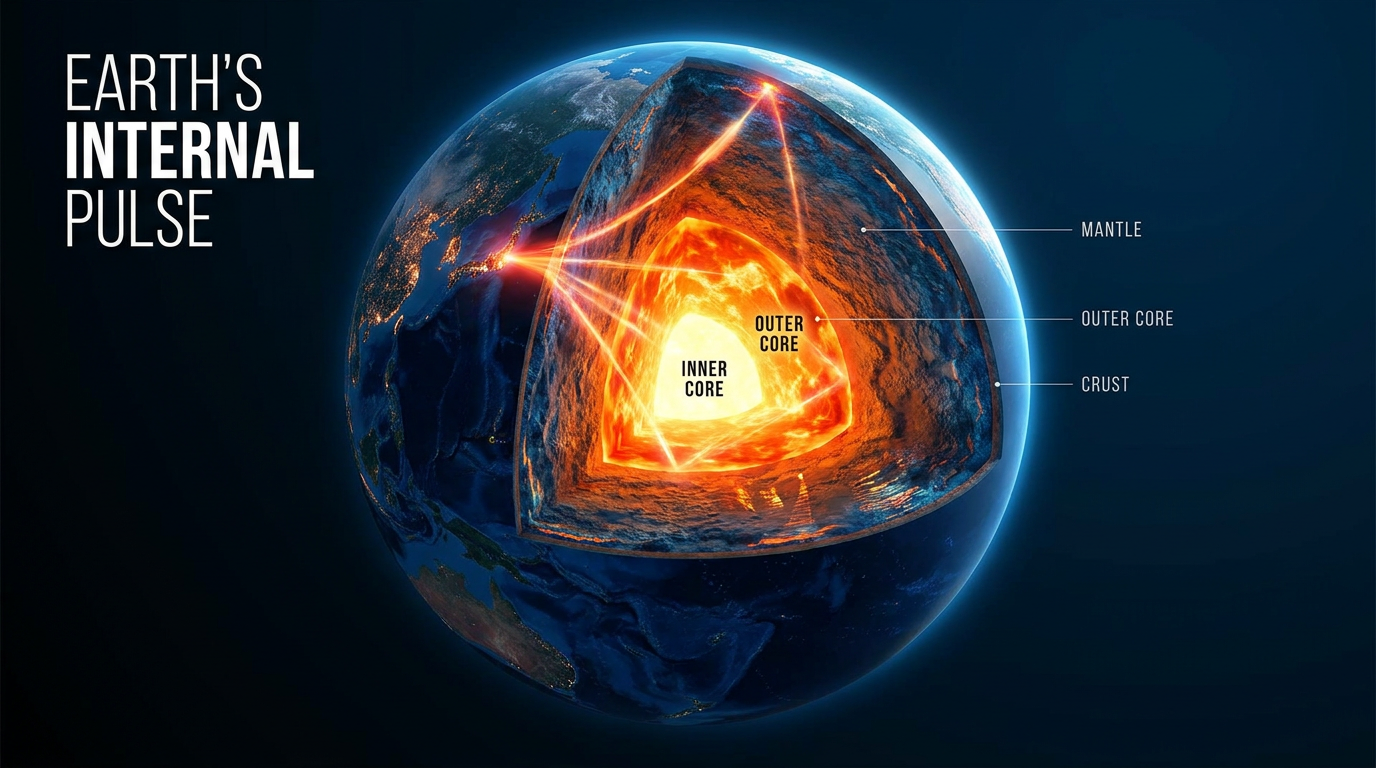
The answer, it turns out, lies nearly 3,000 kilometers beneath our feet. The research team discovered that the 15-minute delay was exactly the time required for a specific type of seismic wave to travel from the Japanese coast down to the Earth's core, bounce off, and return to the surface. This phenomenon represents the first documented instance of deep-Earth seismic echoes retaining enough energy to physically move tectonic plates.[1][5][6]
To understand the mechanics of this planetary billiard shot, one must look at how energy travels through the Earth. When a massive earthquake strikes, it releases different types of seismic waves. Among these are shear waves, or S-waves, which ripple through the Earth's solid rocky mantle by moving material perpendicular to the direction of travel.[4][5]
As these S-waves plunge deeper into the planet, they eventually hit the core-mantle boundary, located roughly 2,890 kilometers below the surface. Here, the solid rock of the mantle gives way to the Earth's outer core, a swirling ocean of liquid iron and nickel. Because shear waves cannot propagate through liquids, they cannot enter the core. Instead, they strike the boundary and reflect back upward, much like light bouncing off a mirror.[2][4]
Seismologists call these returning signals ScS waves. Under normal circumstances, by the time an ScS wave completes its 5,800-kilometer round trip, it has lost almost all its energy. It might register as a faint tremor on highly sensitive equipment, but it is generally considered too weak to influence the crust.[5][6]

Under normal circumstances, by the time an ScS wave completes its 5,800-kilometer round trip, it has lost almost all its energy.
The 2011 Tohoku earthquake, however, was not a normal circumstance. The sheer violence of the magnitude-9.0 rupture sent an unusually powerful ScS wave hurtling toward the core. When this wave reflected and raced back to the surface, it retained a massive amount of kinetic energy.[5][6]
By aligning the archival GPS data with records from seismometers, Park's team found a perfect match. The exact moment the ScS waves arrived back at the surface coincided precisely with the 5-millimeter eastward shift across Japan. The 15-minute gap was simply the wave's transit time through the deep Earth.[2][5][6]
But a returning wave alone is rarely enough to move an entire landmass. The researchers theorize that the initial Tohoku quake had already done the heavy lifting by severely weakening the friction along the boundaries of the four tectonic plates that intersect beneath Japan.[2][6]
The intense shaking from the initial earthquake likely weakened the plate boundaries, making them highly prone to movement once the core-reflected wave arrived. The returning ScS wave acted as the final nudge, providing just enough stress to cause the already-destabilized plates to slip collectively.[2][6]

The scale of this secondary slip is unprecedented in the observational record. Because the returning wave radiated upward across a massive geographic footprint, it triggered movement over a 3,000-kilometer stretch, extending far beyond the localized zone of the original earthquake. It pushed the entire archipelago, from the northern tip of Hokkaido down to the southern islands, in a single, synchronized motion.[3][6]
This discovery fundamentally alters how scientists view the aftermath of mega-quakes. It proves that the Earth's surface and its deep interior are far more dynamically linked than previously understood. An event on the crust can reach down to the liquid core and return to reshape the map, albeit by just a few millimeters.[4][5]
The findings also underscore the immense value of long-term data preservation. If Japan did not possess such a dense, high-fidelity network of GPS and seismic sensors, this subtle, country-wide shift would have been lost to history. The anomaly sat in a spreadsheet for 15 years, waiting for computational models and scientific curiosity to catch up.[4][5]

Looking forward, the research opens a new frontier in hazard assessment. Geophysicists are now combing through archival data from other magnitude-9 events, such as the 2004 Sumatra-Andaman earthquake and the 1960 Valdivia earthquake in Chile, to see if similar core-bouncing waves triggered delayed tectonic slips.[4]
While the 5-millimeter shift in Japan was harmless, understanding how returning waves reactivate faults could eventually refine early-warning systems and post-quake structural assessments. For now, the resolution of this 15-year-old mystery stands as a testament to the elegance of planetary physics—a reminder that the Earth rings like a bell, echoing its most violent moments from the crust to the core and back again.[1][2][4]
How we got here
March 11, 2011
A magnitude-9.0 earthquake strikes off the coast of Tohoku, Japan.
+15 minutes
GPS stations across a 3,000-kilometer stretch of Japan register a sudden 5-millimeter eastward shift.
2011–2025
The tiny GPS anomaly sits unresolved in archival data, unexplained by standard aftershock models.
June 2026
Researchers publish findings in Science proving the shift was caused by a seismic wave bouncing off the Earth's core.
Viewpoints in depth
Lead Researchers
The geophysicists who modeled the core-bounce mechanism.
For the team at the University of Chicago, the 15-year-old GPS anomaly was a puzzle that standard fault mechanics couldn't solve. By correlating the exact timing of the 5-millimeter shift with the arrival of ScS waves on seismometers, they proved that the Earth's core acted as a massive reflector. They argue that the sheer magnitude of the Tohoku quake allowed these deep-Earth echoes to retain enough energy to physically nudge four tectonic plates upon their return.
Observational Seismologists
The scientists who maintain and analyze the global network of seismic instruments.
This camp emphasizes the triumph of long-term data preservation. The 5-millimeter shift was entirely harmless and easily could have been dismissed as instrument noise or a minor local aftershock. However, because Japan operates one of the most densely instrumented seismic networks on the planet, the uniformity of the shift across 3,000 kilometers was preserved in the archives, waiting for computational models advanced enough to explain it.
Global Hazard Analysts
Researchers focused on what this mechanism means for future mega-quakes.
For hazard modelers, the confirmation that returning deep-Earth waves can reactivate plate boundaries opens a new frontier in earthquake forecasting. Their immediate focus is applying this model to other historical magnitude-9 events, such as the 2004 Sumatra and 1960 Chile quakes. If core-bouncing waves consistently trigger secondary slips, early-warning systems may eventually need to account for these 15-minute delayed echoes.
What we don't know
- Whether this core-bounce phenomenon occurs during all magnitude-9 earthquakes, or if it was unique to the Tohoku event.
- If returning deep-Earth waves have the potential to trigger larger, more destructive secondary earthquakes.
Key terms
- ScS wave
- A type of seismic shear wave that travels downward from an earthquake, bounces off the Earth's liquid outer core, and returns to the surface.
- Core-mantle boundary
- The dividing line approximately 2,890 kilometers deep where the Earth's solid rocky mantle meets its liquid iron outer core.
- Shear wave (S-wave)
- A seismic wave that moves the ground back and forth perpendicular to the direction the wave is traveling; it cannot pass through liquids.
- Tectonic slip
- The relative movement of geological plates along a fault line, often releasing energy.
Frequently asked
Did people feel the 5-millimeter shift?
No. The movement was far too small and gradual to be felt by humans, though it was clearly captured by high-precision GPS instruments.
Why did the wave bounce off the core?
The Earth's outer core is made of liquid iron and nickel. Because shear waves (S-waves) cannot travel through liquids, they reflect off the core-mantle boundary like light hitting a mirror.
Could this returning wave cause a dangerous aftershock?
In this case, the returning wave only caused a harmless 5-millimeter slip. However, scientists are now studying whether these core-reflected waves could trigger more significant secondary quakes.
Sources
Source coverage
6 outlets
3 viewpoints surfaced






[1]ScienceLead Researchers
Deep-Earth seismic waves reactivate plate boundaries
Read on Science →[2]University of ChicagoLead Researchers
Powerful seismic waves from Japan's 2011 earthquake struck Earth's core and bounced back up, moving island eastward
Read on University of Chicago →[3]New ScientistLead Researchers
Almost the whole of Japan moved eastward after 2011 earthquake
Read on New Scientist →[4]Space DailyObservational Seismologists
Japan moved eastward after 2011 earthquake
Read on Space Daily →[5]The Chosun IlboObservational Seismologists
Deep-Earth Seismic Waves Moved Japan After 2011 Quake
Read on The Chosun Ilbo →[6]ARY NewsGlobal Hazard Analysts
Japan moved eastward after 2011 earthquake
Read on ARY News →



Every angle. Every day.
Get science stories with full source coverage and perspective breakdowns delivered to your inbox.