
How AI and Smart Boots Are Eradicating Non-Contact Injuries in Professional Soccer
Artificial intelligence platforms and micro-sensor wearables are predicting injury risks with up to 75% accuracy, allowing clubs to intervene before players get hurt. The technology is extending careers and fundamentally changing how teams manage athlete health.
By Factlen Editorial Team
- Sports Scientists & Medical Staff
- View AI as a revolutionary diagnostic tool that provides empirical backing for load management and rest decisions.
- Players & Unions
- Champion the technology for extending careers and protecting long-term physical health, though some navigate data privacy concerns.
- Club Management
- Value the predictive systems as financial safeguards that protect massive roster investments by keeping star players available.
What's not represented
- · Data Privacy Advocates
- · Traditionalist Coaches
Why this matters
For decades, devastating non-contact injuries like ACL tears and muscle strains ended seasons and shortened careers. By shifting sports medicine from reactive treatment to proactive prevention, this technology keeps the world's best athletes on the pitch and protects the long-term physical health of players at all levels.
Key points
- AI platforms can now forecast a soccer player's injury risk up to seven days in advance with 75% accuracy.
- Smart boots equipped with micro-sensors are replacing traditional GPS vests, tracking foot impact 1,000 times per second.
- Clubs using AI load management have reported up to a 66% reduction in days lost to injury.
- The technology shifts sports medicine from reactive treatment to proactive prevention, extending player careers.
- Data-driven risk scores remove the emotional friction between coaches and medical staff regarding when to rest star players.
For generations, the cruelest opponent in professional soccer wasn't a rival team—it was the sudden, silent snap of a ligament or the sharp tear of a hamstring. The grueling demands of a 50-game season placed immense biomechanical stress on athletes, making non-contact injuries seem like an inevitable byproduct of the beautiful game.[6]
Careers were shortened, championship runs derailed, and millions of dollars lost to the treatment table. Medical staffs were forced to operate reactively, treating structural damage only after the player had already collapsed on the pitch.[3]
In 2026, the age of guesswork and reactive medicine has effectively ended. A quiet revolution powered by artificial intelligence and micro-sensor wearables has transformed player health into a computational discipline, allowing clubs to predict and prevent injuries before they ever occur.[5]
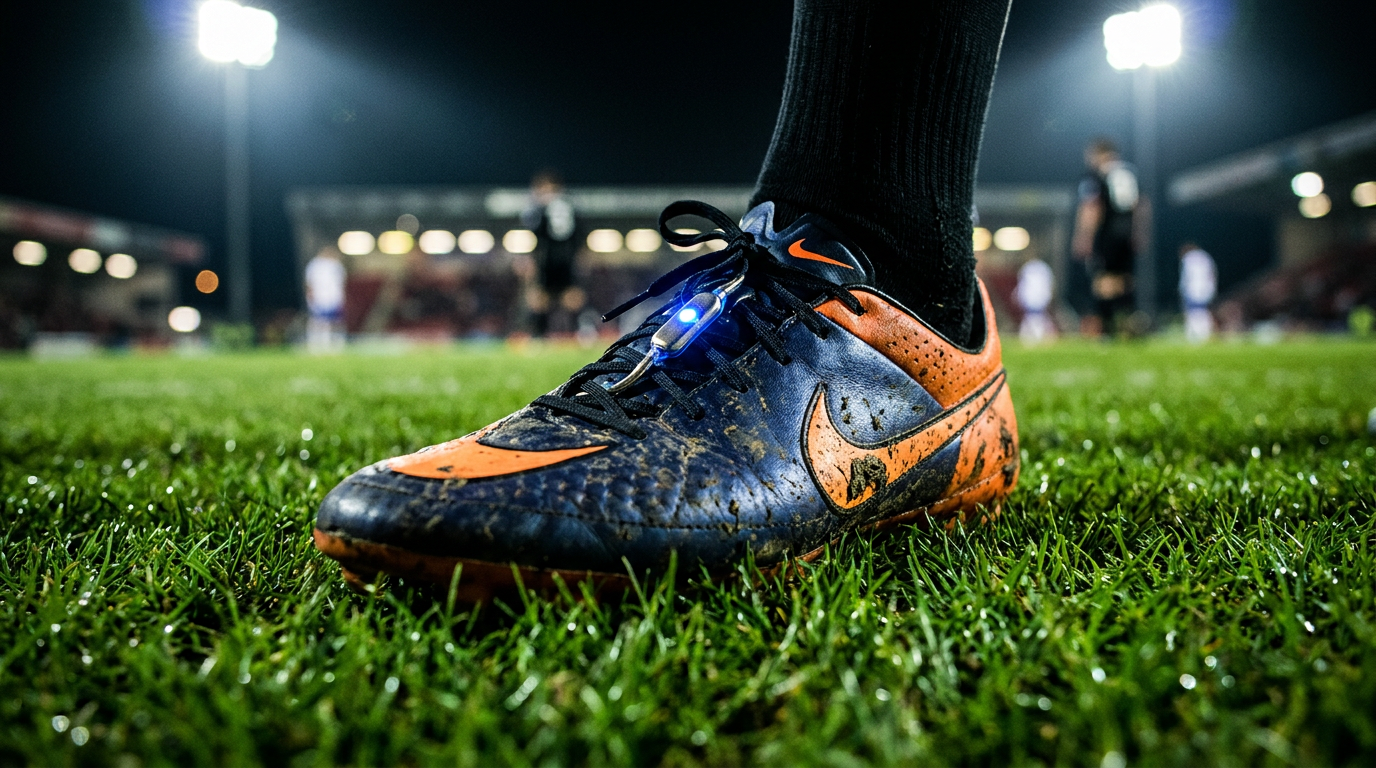
The shift begins at the ground level—literally. Traditional GPS tracking vests, which players have worn like sports bras for the past decade, are being supplemented or replaced by smart boots. Companies like Playermaker have developed six-gram sensors that strap directly onto a player's cleats, capturing data from the exact point of impact.[2]

These boot-mounted sensors sample micro-movements 1,000 times per second using high-precision gyroscopes and accelerometers. They track a player's speed, deceleration, change of direction, and the exact force generated by each foot during a strike or a sprint.[2]
By moving the sensor from the upper body to the foot, sports scientists gain unprecedented insight into gait asymmetries. If a player begins favoring their right leg by a fraction of a percent due to microscopic muscle fatigue, the smart boot registers the imbalance immediately.[2]
But raw data is only as useful as the system interpreting it. This is where AI platforms like Zone7 step in, acting as the central nervous system for a club's medical department. These platforms ingest massive datasets, including GPS tracking, biomechanical force, sleep quality, and even saliva and blood markers.[1]
But raw data is only as useful as the system interpreting it.
The AI cross-references this daily influx of data against a historical database of hundreds of millions of hours of athletic action. By recognizing the subtle, invisible patterns that precede physical breakdowns, the system creates a predictive 'digital twin' of every player on the roster.[1][3]

The results have been staggering. In extensive validation studies, AI models have demonstrated the ability to forecast increased injury risk one to seven days prior to the occurrence of an injury with nearly 75% accuracy.[1]
When the system detects a dangerous workload pattern or a spike in biomechanical stress, it flags the player as high-risk. This gives the coaching staff a critical window to intervene—whether by modifying the player's training intensity, adjusting their recovery protocol, or resting them for the upcoming match.[4]
The real-world impact is already reshaping league tables. Clubs that integrated these AI engines early reported up to a 40% reduction in injury volume during their first year, with some seeing those numbers improve to a 66% reduction as the machine learning algorithms became more sophisticated over time.[1][5]

This predictive infrastructure fundamentally changes the conversation between coaches and medical staffs. Historically, resting a star player relied on a coach's gut feeling or a player's self-reported soreness—a flawed metric, given that elite athletes are notoriously conditioned to play through pain.[5]
Today, that decision is backed by empirical evidence. An AI model that has processed thousands of data points across a player's career can issue a specific risk score, removing the emotional friction from load management and protecting players from their own competitive drive.[5][6]
The implications extend far beyond the financial balance sheets of massive clubs. For the athletes themselves, avoiding a major injury means avoiding months of grueling, isolated rehabilitation and the severe psychological toll that accompanies being sidelined from the sport they love.[3][6]

This technological leap is not isolated to soccer. The NFL's Digital Athlete program utilizes similar AWS-backed high-performance computing to run millions of simulations, predicting injury risks and even informing league-wide rule changes to protect players.[5]
As the technology scales, it is rapidly democratizing. What began as a secret weapon for Champions League contenders is now trickling down to youth academies and amateur leagues, ensuring that the next generation of players will grow up in a sport where devastating injuries are the exception, rather than the rule.[2][6]
How we got here
2017
AI platforms like Zone7 are founded, beginning the process of logging millions of hours of athletic data to train predictive models.
2021
Wearable tech companies introduce boot-mounted micro-sensors, moving biomechanical tracking beyond traditional chest-worn GPS vests.
2024
Major European clubs report up to a 66% reduction in injury volume after integrating AI predictive models into their daily training.
2026
AI-driven injury forecasting becomes standard infrastructure across top-tier soccer leagues, fundamentally altering how teams manage player health.
Viewpoints in depth
Sports Scientists & Medical Staff
Medical professionals view AI as a revolutionary diagnostic tool that provides empirical backing for load management.
For decades, club doctors faced an uphill battle convincing ambitious coaches to rest star players based on subjective soreness or general fatigue. AI platforms have fundamentally changed this dynamic by providing hard, empirical risk scores. When a digital twin model flags a 75% probability of a hamstring tear within the next week due to microscopic gait asymmetries, medical staff finally have the undeniable data required to mandate rest, shifting their role from treating injuries to engineering availability.
Players & Unions
Athletes champion the technology for extending careers, while navigating the new realities of biometric data privacy.
From the player's perspective, avoiding a non-contact injury means avoiding the physical agony of a torn ACL, the isolation of a six-month rehabilitation, and the potential loss of future contract earnings. While players overwhelmingly support tech that keeps them on the pitch, player unions are increasingly focused on how this granular biometric data is stored, who owns it, and ensuring that a high 'injury risk score' isn't weaponized against an athlete during contract negotiations.
Club Management
Executives value predictive systems as financial safeguards that protect massive roster investments.
Professional soccer clubs invest hundreds of millions of dollars into player acquisition and wages. When a star player is sidelined, the club loses both competitive advantage on the pitch and return on investment off it. For front offices, spending on AI infrastructure and smart wearables is viewed as a highly efficient insurance policy. A system that reduces injury volume by even 30% pays for itself exponentially by keeping the team's most valuable assets healthy and available for crucial matches.
What we don't know
- How player unions will ultimately regulate the ownership and contractual use of an athlete's predictive biometric data.
- Whether the widespread adoption of AI injury prevention will lead to even faster, more physically demanding tactical styles of play.
Key terms
- Biomechanical stress
- The physical forces and loads exerted on the body's muscles, joints, and ligaments during athletic movement.
- Digital twin
- A virtual, data-driven replica of an athlete used to run simulations and predict how their body will respond to different training loads.
- Load management
- The practice of carefully monitoring and adjusting an athlete's training and playing time to prevent fatigue and minimize injury risk.
- Non-contact injury
- An injury, such as a pulled hamstring or torn ACL, that occurs from running, jumping, or changing direction, rather than from a collision with another player.
Frequently asked
Do these sensors affect how players kick the ball?
No. Devices like Playermaker weigh just 6 grams and sit snugly on the outer shell of the cleat, designed to be completely unobtrusive to a player's touch and movement.
Can AI predict contact injuries like tackles?
AI primarily forecasts non-contact injuries like muscle strains and ligament tears caused by fatigue and biomechanical stress, though it can flag when a fatigued player is moving sluggishly and is therefore more vulnerable to impact.
Is this technology only for professional teams?
While pioneered by elite Champions League clubs, the technology is rapidly becoming accessible to youth academies and amateur players through consumer-facing apps and affordable wearable kits.
Sources
Source coverage
6 outlets
3 viewpoints surfaced






[1]Zone7 ResearchSports Scientists & Medical Staff
Validation Study: Injury Risk Forecasting with Zone7 AI
Read on Zone7 Research →[2]PlayermakerPlayers & Unions
AI Soccer Performance Tracker: The Science of Data Collection
Read on Playermaker →[3]W.MediaClub Management
How AI is Revolutionizing Player Health and Injury Prevention in Football
Read on W.Media →[4]SportsmithSports Scientists & Medical Staff
The Future of AI for Injury Prevention in Elite Sports
Read on Sportsmith →[5]MEF AIClub Management
The Honest Picture of AI in Professional Sports in 2026
Read on MEF AI →[6]Factlen Editorial TeamPlayers & Unions
Synthesis by Factlen editorial team
Read on Factlen Editorial Team →
More in sports
See all 14 stories →Tactics
Spain's Tactical Evolution: How Luis de la Fuente Built 'Tiki-Taka 2.0' for the 2026 World Cup
6 sources

Preview
Uruguay’s 2026 World Cup Outlook: How Marcelo Bielsa’s High-Octane System Could Disrupt the Tournament
6 sources

Roster
World Cup 2026 Rosters Defined by Teenage Breakout Stars and Late Call-Ups
8 sources

Women's Football
Bay Collective Completes Majority Takeover of Sunderland Women
7 sources

Every angle. Every day.
Get sports stories with full source coverage and perspective breakdowns delivered to your inbox.