
How the Human Brain Builds a Sentence, Neuron by Neuron
Researchers have successfully tracked the electrical activity of individual brain cells in real time during unscripted conversations, revealing that distinct neurons act as specialized linguistic building blocks.
By Factlen Editorial Team
- Neuroscientists
- Focus on the fundamental biological discovery of how the brain processes information.
- Medical Technologists
- View the findings as a critical roadmap for building next-generation medical prosthetics.
- AI Researchers
- Intrigued by the parallels between biological brains and artificial neural networks.
What's not represented
- · Patients with severe speech impairments who stand to benefit from the resulting technologies.
- · Bioethicists concerned with the privacy implications of decoding brain activity.
Why this matters
Understanding the exact cellular mechanics of how humans generate language paves the way for advanced brain-computer interfaces. This could eventually allow patients who have lost the ability to speak due to stroke or neurodegenerative disease to communicate fluidly through synthetic speech.
Key points
- Researchers tracked individual neurons in the frontotemporal cortex during unscripted conversations.
- Distinct neurons act as specialized building blocks, handling specific tasks like grammar or phrase transitions.
- The findings challenge the old belief that language is solely a diffuse, whole-network phenomenon.
- AI models successfully predicted the grammar and context of sentences based on neuronal data.
- The discovery paves the way for advanced brain-computer interfaces to help paralyzed patients speak.
In the fraction of a second before a person speaks, their brain weaves together complex grammar, precise vocabulary, and the underlying meaning of language. For decades, scientists believed this process was a diffuse, whole-network phenomenon, with broad regions of the brain lighting up in unison to produce a single thought. The exact cellular mechanics of how a sentence is constructed remained largely a mystery.[1][3]
Now, a groundbreaking study published in the journal Nature has upended that assumption. Researchers have successfully tracked the electrical crackle of individual brain cells in real time during unscripted conversations, capturing exactly how sentences are built before a single word is spoken aloud.[1]
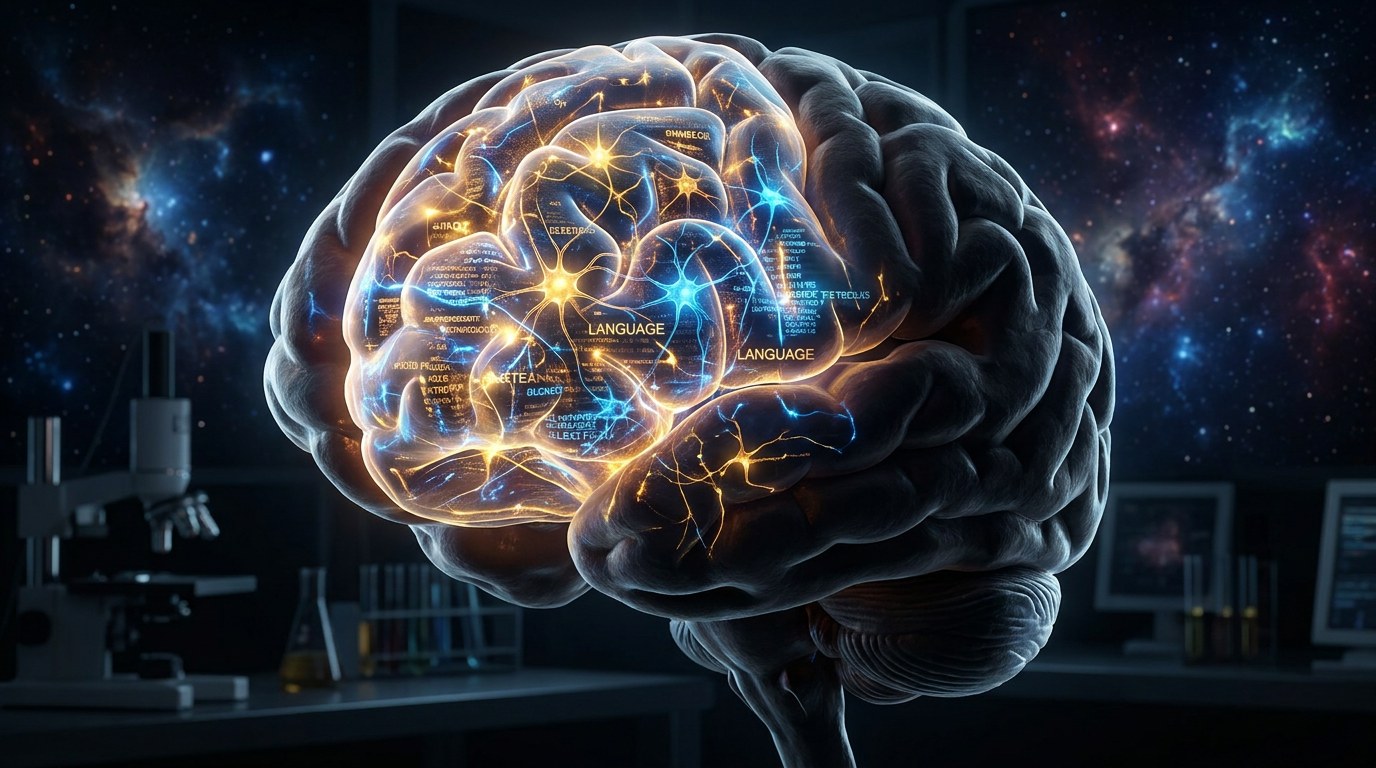
By observing neurons in a region of the human brain called the frontotemporal cortex, the team discovered that individual brain cells act as highly specialized linguistic building blocks. Rather than a generalized wave of activity, the brain relies on specific cells assigned to highly specific grammatical tasks.[1][2]
"We used to think language was this diffuse, whole-network phenomenon," said Ziv Williams, a neurosurgeon at Massachusetts General Hospital and co-author of the study. "But it turns out you have specific neurons that only care if a word is a noun, or only care if a phrase is ending."[1]

The research team, led by first author Jing Cai, utilized high-density microelectrode arrays to record the activity of single neurons in human participants. This technology allowed them to observe the language production process at an unprecedented cellular resolution, capturing the firing of hundreds of individual cells simultaneously.[1][2]
They found a remarkable division of labor among the neurons. While some cells were responsible for reflecting basic information, such as the meaning and roles of specific words, others tackled much more complex cognitive tasks.[2]
They found a remarkable division of labor among the neurons.
These higher-order neurons tracked the detailed grammatical relationships between words, managed phrase transitions, and maintained the overall syntactic structure of the sentence as it was being formed in the speaker's mind.[1][2]
To make sense of the massive amount of neuronal data, the researchers employed advanced natural language processing models—the same type of artificial intelligence architecture that powers modern chatbots and translation software.[1][2]
By comparing the brain's biological activity with the AI's artificial neural networks, they discovered striking similarities. The models could accurately predict the grammar, meaning, and context of the sentences the participants were about to speak, based entirely on the neuronal recordings captured just milliseconds prior.[2]

"For the first time we're describing processes not only at the regional but cellular scale that produce speech," Cai noted. "Having identified these fundamental building blocks, we've set the table for us to begin answering some really interesting questions."[2]
The implications of this discovery extend far beyond basic neuroscience. By mapping the exact cellular architecture of language, researchers are laying the groundwork for transformative medical technologies that could restore lost abilities.[2][3]
The most immediate application lies in the development of advanced brain-computer interfaces (BCIs). For patients who have lost the ability to speak due to conditions like stroke, traumatic brain injury, or amyotrophic lateral sclerosis (ALS), these findings offer a tangible beacon of hope.[2][3]

If scientists can reliably decode the specific neuronal signals that represent intended words and grammar, they could build prosthetic devices capable of translating those thoughts into fluid, natural-sounding synthetic speech in real time, bypassing the damaged physical pathways of the vocal tract.[2][3]
Ultimately, the study bridges a critical gap between biology and artificial intelligence. It reveals that the human brain's approach to organizing language may share fundamental organizational principles with the very AI models we have built to mimic it, opening a new frontier in both neuroscience and computer science.[1][3]
How we got here
Early 2000s
Functional MRI studies identify broad regions of the brain involved in language, but lack the resolution to see individual cells.
Jan 2024
Researchers at Mass General publish findings showing neurons can predict specific speech sounds (phonemes) before they are spoken.
Jun 2026
The team publishes a breakthrough in Nature, proving that individual neurons also encode complex grammar, syntax, and sentence structure.
Viewpoints in depth
Neuroscientists & Researchers
Focus on the fundamental biological discovery of how the brain processes information.
For neuroscientists, the discovery that individual neurons handle specific grammatical tasks is a paradigm shift. Historically, functional MRI (fMRI) scans could only show broad regions of the brain lighting up during speech, leading to the belief that language was a distributed, network-wide process. The ability to record at the single-cell level proves that the brain has a highly granular, modular architecture for language, fundamentally changing how researchers model human cognition.
Brain-Computer Interface Developers
View the findings as a critical roadmap for building next-generation medical prosthetics.
Engineers working on BCIs see this cellular map as the key to unlocking fluid communication for paralyzed patients. Current speech prosthetics often rely on spelling out words letter-by-letter or selecting from pre-set phrases, which is slow and frustrating. By tapping directly into the neurons that govern syntax and phrase transitions, future BCIs could decode a patient's intended sentence structure instantly, allowing for natural, conversational speech synthesis.
AI & Machine Learning Theorists
Intrigued by the parallels between biological brains and artificial neural networks.
The fact that the researchers successfully used Large Language Models (LLMs) to decode the brain's activity highlights a fascinating convergence. AI theorists argue that the similarities between how the human brain organizes linguistic building blocks and how artificial neural networks process language suggest that we may be uncovering universal mathematical principles of communication that apply to both biological and artificial intelligence.
What we don't know
- How these specific language neurons develop and wire themselves during early childhood language acquisition.
- Whether the exact cellular mapping of grammar differs significantly between individuals who speak structurally different languages.
- How long it will take to translate these fundamental biological discoveries into FDA-approved, consumer-ready brain-computer interfaces.
Key terms
- Frontotemporal Cortex
- A region of the brain located near the front and sides of the head, known to be heavily involved in language production and comprehension.
- Neuron
- A specialized cell transmitting nerve impulses; the fundamental building block of the brain and nervous system.
- Brain-Computer Interface (BCI)
- A system that connects the brain directly to an external device, allowing brain signals to control computers or prosthetics.
- Syntax
- The arrangement of words and phrases to create well-formed sentences in a language.
- Natural Language Processing (NLP)
- A branch of artificial intelligence that helps computers understand, interpret, and manipulate human language.
Frequently asked
Did the researchers read the participants' minds?
No. The researchers recorded electrical activity in the brain regions responsible for speech production just milliseconds before the participants voluntarily spoke aloud.
How did they record individual brain cells?
They used high-density microelectrode arrays, which are tiny sensors implanted in the brain that can detect the electrical firing of single neurons.
Why is this discovery important for medicine?
By understanding exactly how the brain builds sentences, engineers can design better brain-computer interfaces to help people who have lost the ability to speak communicate naturally again.
Sources
Source coverage
3 outlets
3 viewpoints surfaced



[1]NatureNeuroscientists
Mapping the neuronal building blocks of human language with language models
Read on Nature →[2]National Institutes of HealthMedical Technologists
With neuronal data, AI models predicted grammar, meaning, and context of spoken sentences
Read on National Institutes of Health →[3]Factlen Editorial TeamAI Researchers
Synthesis by Factlen editorial team
Read on Factlen Editorial Team →


Every angle. Every day.
Get science stories with full source coverage and perspective breakdowns delivered to your inbox.