
How Multimodal AI Tutors Are Finally Solving Education's '2 Sigma' Problem
After decades of struggling to scale the benefits of one-on-one tutoring, multimodal AI platforms are delivering unprecedented learning gains. But as adoption surges across U.S. school districts, experts warn that poor implementation and data privacy risks could undermine the technology's promise.
By Factlen Editorial Team
- EdTech Developers
- Argue that AI is the only scalable solution to democratize elite, mastery-based education and close achievement gaps.
- Educational Researchers
- Emphasize that implementation, consistent engagement, and preventing cognitive offloading are just as important as the technology itself.
- Privacy & Security Advocates
- Warn that the depth of behavioral data collected by AI requires fundamentally new architectural safeguards and strict regulatory compliance.
What's not represented
- · Underfunded School Districts
- · Students
Why this matters
The ability to deliver personalized, mastery-based instruction at scale could fundamentally close achievement gaps and reshape the global workforce. However, the aggressive rollout of these tools requires parents and educators to navigate complex new data privacy landscapes.
Key points
- Multimodal AI platforms are successfully replicating the benefits of one-on-one tutoring, addressing Bloom's 40-year-old '2 Sigma Problem.'
- Early pilots show significant academic gains, prompting states like Arizona to roll out AI tutors to hundreds of thousands of public school students.
- Researchers warn that inconsistent use and poorly designed AI can lead to 'cognitive offloading,' where students bypass actual learning.
- The collection of deep behavioral data has triggered new privacy regulations, including a January 2025 update to federal COPPA rules.
- The ultimate goal of AI in education is to automate mass personalization, freeing human teachers to focus on mentorship and critical thinking.
In 1984, educational psychologist Benjamin Bloom published a finding that would haunt researchers for four decades. He discovered that students who received one-on-one tutoring performed two standard deviations better than those taught in conventional classrooms—meaning the average tutored student outperformed 98% of their peers. This phenomenon, dubbed the '2 Sigma Problem,' established the holy grail of educational theory: personalized, mastery-based instruction. The problem was entirely structural. While individual tutoring works flawlessly, it is economically impossible to scale a dedicated human tutor for every learner on Earth.[1]
For forty years, the 2 Sigma Problem remained an unsolved mathematical and logistical paradox. But the landscape has shifted dramatically over the last 24 months. Driven by the rapid maturation of large language models, the global online tutoring market surged to $12.8 billion in 2025. Today, the integration of scalable, multimodal artificial intelligence is offering the first concrete solution to Bloom's challenge, transforming devices into infinitely patient, highly adaptive digital mentors.[1][7]
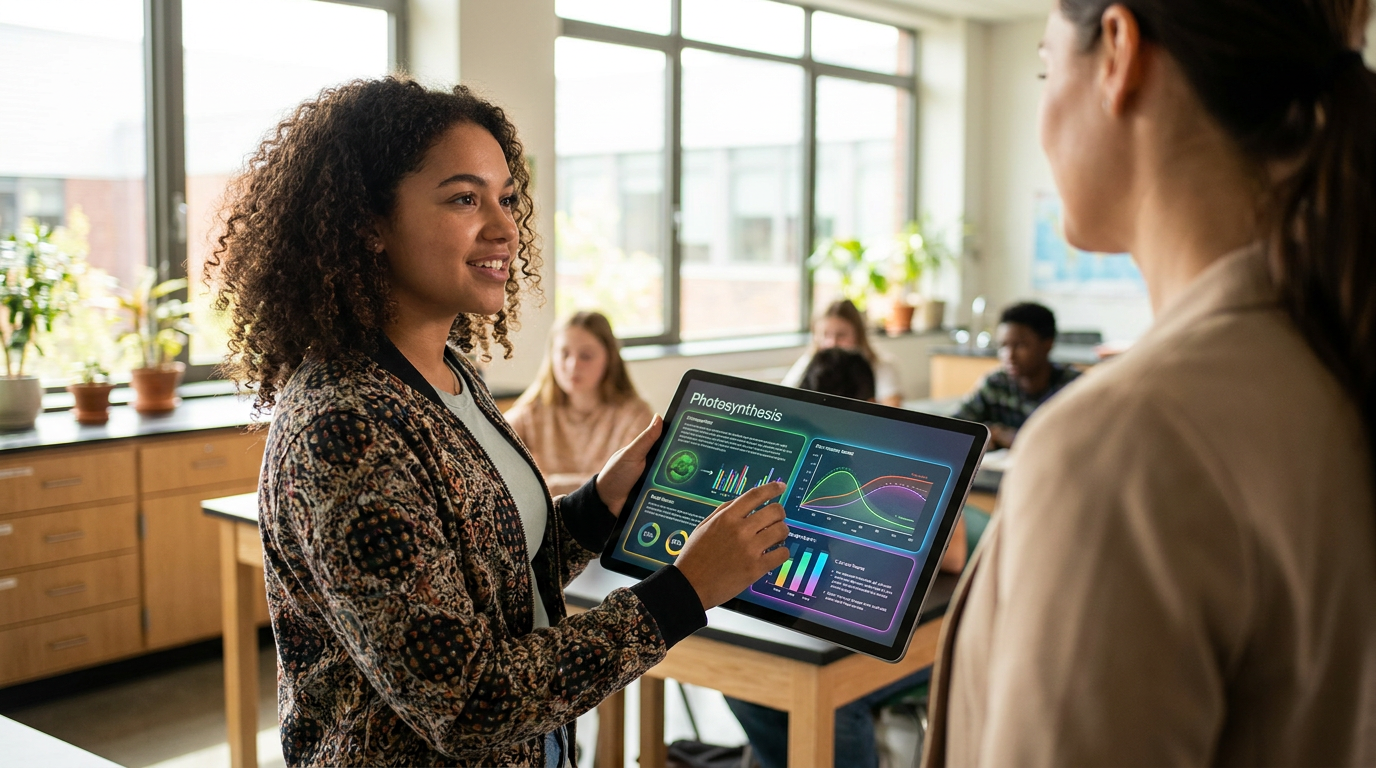
Unlike the rudimentary chatbots of the early 2020s, the class of AI tutors deployed in 2026 operates on a fundamentally different architecture. Modern platforms utilize multimodal interfaces—combining text, voice, and interactive whiteboards—to engage students in real-time. Rather than simply dispensing answers, these systems are engineered around Socratic questioning. They track a student's progress, identify the specific cognitive misconception behind an error, and dynamically adjust their feedback to guide the learner toward genuine understanding.[3][7]

To prevent the AI from hallucinating or deviating from the curriculum, developers now heavily rely on Retrieval-Augmented Generation (RAG). This technique anchors the AI's responses directly to a school's proprietary course materials, ensuring that the vocabulary, problem-solving steps, and pedagogical frameworks match what the human teacher is presenting in the classroom. The result is a seamless extension of the school day, where the AI acts as a localized, curriculum-aligned coach.[7]
The efficacy data emerging from early pilot programs is striking. A 2025 Harvard University study found that AI tutoring outperformed traditional in-class active learning, with the AI group producing median learning gains more than double those of the classroom cohort. Similarly, Khan Academy's Khanmigo platform—which guides learners through subjects ranging from algebra to humanities—reported a 1.4 grade-level improvement across its pilot districts.[1][4]
State education departments have taken notice, moving aggressively from localized pilots to statewide deployments. In October 2025, the Arizona Department of Education announced that 170,000 students—roughly 16% of the state's public school population—were actively using Khanmigo through a $1.5 million state investment. Maryland, Iowa, and Indiana have launched similar multi-year, multi-million-dollar initiatives, effectively embedding AI tutoring into the standard public education infrastructure.[2]

State education departments have taken notice, moving aggressively from localized pilots to statewide deployments.
However, researchers caution that simply purchasing software licenses does not guarantee academic success. A recent study by Stanford University's SCALE Initiative, which analyzed AI tutoring across multiple school districts, revealed that implementation is just as critical as the technology itself. The Stanford researchers found that while AI tutors have the capability to deeply personalize instruction, measurable gains in subjects like reading require a minimum of 30 minutes of consistent weekly use—a threshold many districts struggle to meet without structured integration.[2]
There is also a troubling paradox at the heart of automated education: the risk of 'cognitive offloading.' If an AI tutor is poorly designed, it can inadvertently enable students to bypass the productive struggle required for genuine learning. When technology does the heavy cognitive lifting, students may complete assignments faster but retain less information, ultimately defeating the purpose of the intervention.[1]
To combat this, next-generation platforms are building strict pedagogical guardrails. For example, Aristotle, a voice-first AI tutoring platform designed for middle and high school students, utilizes a multi-agent architecture specifically to prevent students from taking shortcuts. By forcing spoken conversations and requiring students to articulate their reasoning on an interactive whiteboard, the system replicates the friction of a real human interaction, ensuring that the AI acts as a genuine tutor rather than an advanced answer key.[3]

As these systems become more sophisticated, they require increasingly granular data to function. To personalize instruction, an AI must continuously process a student's learning pace, engagement behavior, assessment trends, and concept mastery gaps. This depth of insight fundamentally changes the privacy equation in schools. Unlike traditional academic records, which are static, AI systems interpret behavioral and cognitive patterns over time, creating highly sensitive psychological profiles of minors.[5]
The stakes of this data collection were thrown into sharp relief in December 2025, when the U.S. Federal Trade Commission took action against an EdTech provider following a breach that exposed over 10 million student records. In response to growing vulnerabilities, the FTC strengthened the Children's Online Privacy Protection Act (COPPA) in January 2025. The updated regulations require AI companies to obtain separate parental permission before sharing children's information and strictly prohibit the collection of more data than is reasonably necessary for educational participation.[5][6]

Industry leaders are now advocating for 'Privacy by Design'—an architectural approach where data protection is embedded into the software from the first line of code. Secure platforms utilize session-based configurations that delete data immediately after use, ensuring sensitive information doesn't persist on shared classroom devices. Furthermore, enterprise agreements are increasingly prohibiting vendors from using student input to train external commercial AI models.[5][6]
Ultimately, the rise of AI tutoring is not a story about replacing human educators. It is about shifting the teacher's role from a mass-distributor of content to a high-level mentor. By offloading the repetitive tasks of mass personalization, adaptive reviews, and basic concept remediation to the AI, teachers are freed to focus on what machines cannot do: calibrating cognitive load, neutralizing biases, and fostering the emotional intelligence and critical thinking required for human flourishing.[1][8]
How we got here
1984
Benjamin Bloom publishes his research on the '2 Sigma Problem,' proving the efficacy of 1-to-1 tutoring.
Oct 2023
Khan Academy launches Khanmigo, one of the first major LLM-powered educational assistants.
Jan 2025
The FTC strengthens COPPA requirements, restricting how AI companies handle children's data.
Oct 2025
Arizona announces 170,000 public school students are actively using AI tutoring platforms.
Dec 2025
The FTC takes action against a major EdTech provider following a breach exposing 10 million student records.
Viewpoints in depth
EdTech Developers
Focus on scaling mastery learning and the technical leaps in multimodal LLMs.
Proponents of AI tutoring argue that the technology represents the first genuine opportunity to democratize elite education. By leveraging multimodal interfaces and RAG architecture, developers believe they can finally provide every student on Earth with the equivalent of a world-class, infinitely patient private tutor. They point to pilot data showing massive grade-level improvements as proof that the 2 Sigma Problem is officially solved.
Cognitive Scientists
Focus on the risks of cognitive offloading and the necessity of productive struggle.
Educational researchers and cognitive scientists caution that learning requires friction. They warn against AI platforms that are too eager to provide answers or complete tasks on behalf of the student, a phenomenon known as cognitive offloading. From their perspective, an effective AI tutor must be designed to withhold information, utilizing Socratic questioning to force the student to articulate their own reasoning and build long-term memory.
Data Privacy Advocates
Focus on the unprecedented depth of behavioral data collected by AI systems.
Privacy experts argue that AI tutoring platforms collect a fundamentally different type of data than traditional EdTech tools. Because these systems continuously analyze a student's learning pace, emotional state, and cognitive gaps, they create highly sensitive psychological profiles. Advocates are pushing for strict 'Privacy by Design' architectures, demanding that schools only adopt platforms that utilize session-based data deletion and explicitly refuse to train commercial models on student inputs.
What we don't know
- The long-term effects of AI tutoring on student socialization and peer-to-peer collaboration.
- Whether the cost of premium multimodal AI platforms will exacerbate existing educational inequalities between wealthy and underfunded districts.
Key terms
- Bloom's 2 Sigma Problem
- The educational phenomenon where students receiving one-on-one tutoring perform two standard deviations better than those in traditional classrooms.
- Multimodal AI
- Artificial intelligence systems that can process and generate multiple types of data simultaneously, such as text, voice, and images.
- Cognitive Offloading
- The reliance on external tools to reduce mental effort, which can negatively impact long-term memory and learning if overused.
- Retrieval-Augmented Generation (RAG)
- An AI technique that pulls information from a specific, trusted database (like a school's curriculum) before generating an answer, reducing inaccuracies.
- Privacy by Design
- An engineering philosophy where data protection protocols are built into the foundational architecture of a system, rather than added as an afterthought.
Frequently asked
Will AI tutors replace human teachers?
No. Experts agree that AI is designed to act as a 'copilot,' handling repetitive personalization so teachers can focus on emotional support, complex problem-solving, and mentorship.
Is my child's data safe with an AI tutor?
It depends on the platform. Safe platforms comply with updated COPPA regulations, use session-based data that deletes after use, and explicitly prohibit using student data to train commercial AI models.
How much time does a student need to spend with an AI tutor to see results?
Research from Stanford University indicates that students need a minimum of 30 minutes of consistent weekly use to achieve measurable academic gains.
Sources
Source coverage
8 outlets
3 viewpoints surfaced







[1]AWorldEducational Researchers
Scalable AI tutoring: how AI solves Bloom's 2 Sigma problem
Read on AWorld →[2]K-12 DiveEducational Researchers
As states invest in AI tutoring, Stanford researchers highlight implementation hurdles
Read on K-12 Dive →[3]Stanford National Student Support AcceleratorEdTech Developers
Aristotle: Voice-First AI Tutoring Platform
Read on Stanford National Student Support Accelerator →[4]X-Pilot ResearchEdTech Developers
Case Study: Khan Academy's Khanmigo Efficacy in 2025-2026
Read on X-Pilot Research →[5]TutorCloudPrivacy & Security Advocates
The Privacy Paradox of AI in Education
Read on TutorCloud →[6]SchoolAIPrivacy & Security Advocates
Prioritizing AI Privacy in Education: COPPA Updates
Read on SchoolAI →[7]AICoursifyEdTech Developers
Key Facts and Trends in AI Tutoring for 2026
Read on AICoursify →[8]Factlen Editorial Team
Synthesis by Factlen editorial team
Read on Factlen Editorial Team →
Every angle. Every day.
Get education stories with full source coverage and perspective breakdowns delivered to your inbox.