
How Vehicle-to-Grid Technology is Turning EVs into Mobile Power Plants
Bidirectional charging is reaching mainstream adoption in 2026, allowing electric vehicles to power homes during outages and stabilize the broader energy grid.
By Factlen Editorial Team
- Grid Operators & Utilities
- View EVs as a massive, decentralized battery network essential for stabilizing the grid and integrating intermittent renewable energy without spending billions on infrastructure.
- EV Owners & Consumers
- Value bidirectional charging primarily for home energy resilience during blackouts and the potential to lower daily electricity bills through energy arbitrage.
- Automotive & Fleet Industry
- See V2G as a major selling point and a way to generate new recurring revenue streams, though they remain cautious about managing battery warranties and hardware standardization.
What's not represented
- · Fossil Fuel Generator Manufacturers
- · Independent Battery Storage Companies
Why this matters
As bidirectional charging becomes standard, your car is no longer just a depreciating asset sitting in the driveway. It can act as a whole-home backup generator during blackouts, lower your daily electricity bills, and help prevent neighborhood grid failures.
Key points
- Bidirectional charging allows EVs to send power back to homes (V2H) or the broader electrical grid (V2G).
- Grid operators view parked EVs as a massive, decentralized battery network that can stabilize renewable energy fluctuations.
- Consumers can use their vehicles as whole-home backup generators during blackouts, replacing fossil-fuel alternatives.
- Intelligent software manages 'shallow cycling' to ensure V2G use does not prematurely degrade the vehicle's battery.
- New hardware standards in 2026 are removing technical bottlenecks, though regulatory and utility pricing models are still catching up.
For over a century, the relationship between a vehicle and its fuel source has been strictly one-way: you fill the tank, and the car burns the energy. But in 2026, a quiet revolution in electrical engineering is rewriting that dynamic. Electric vehicles are evolving from passive consumers of electricity into active, mobile power plants capable of feeding energy back into homes and the broader electrical grid.[1][4]
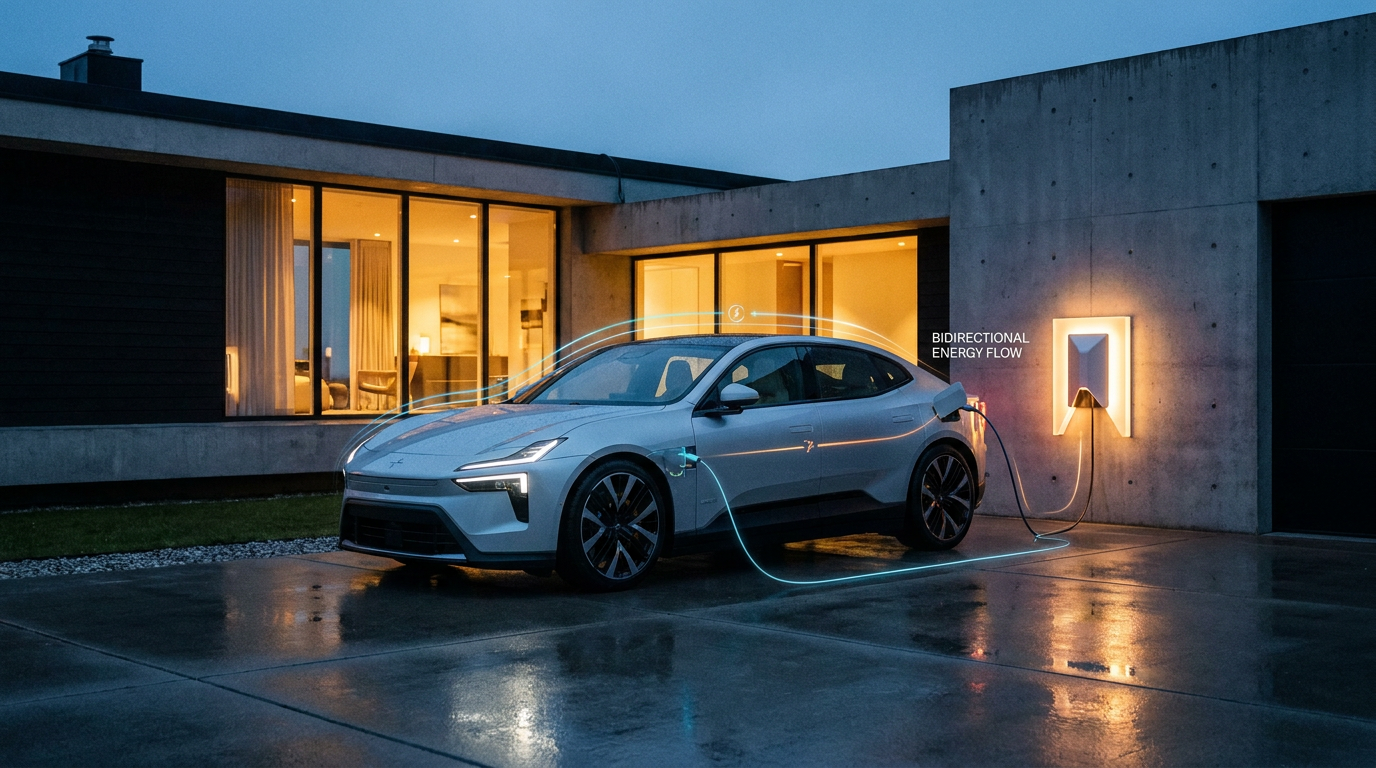
This transformation is driven by bidirectional charging, a technology that allows electricity to flow in two directions. While early EV adopters have long treated their cars as large appliances that draw power from a wall socket, the newest generation of vehicles and chargers can reverse that flow. When parked, an EV can discharge its massive battery pack to run household appliances, power a commercial building, or send electricity back to the local utility company.[1][5]
The industry categorizes this two-way flow into three distinct use cases. Vehicle-to-Load (V2L) is the simplest, allowing users to plug standard appliances directly into the car's outlets—ideal for camping or powering power tools. Vehicle-to-Home (V2H) scales this up, connecting the car to a home's electrical panel to power the entire house during an outage. Finally, Vehicle-to-Grid (V2G) represents the ultimate integration, allowing the car to communicate with the local utility and sell stored energy back to the grid during periods of peak demand.[4][5]

The mechanism behind this magic relies on a specialized piece of hardware: the bidirectional inverter. Batteries store energy as Direct Current (DC), but homes and power grids operate on Alternating Current (AC). A bidirectional charger contains an advanced inverter capable of converting AC to DC when charging the car, and seamlessly flipping DC back to AC when discharging energy to the grid. This requires complex, real-time data interconnection between the vehicle, the charging station, and the utility provider.[1][7]
For utility companies, the widespread adoption of V2G cannot come soon enough. As the world transitions to renewable energy sources like solar and wind, grid operators face a massive storage problem. The sun produces the most energy at midday when demand is relatively low, but demand spikes in the evening when people return home and the sun goes down. Utilities desperately need massive batteries to store that midday surplus and release it during the evening peak.[1][2]
Instead of spending billions to build stationary battery farms, grid operators are realizing that consumers are already buying millions of batteries on wheels. A landmark study by the Fraunhofer Institute found that fully adopting V2G could reduce the European Union's need for stationary battery storage by a staggering 92%. By utilizing the collective storage capacity of parked EVs, the EU could save approximately €22.2 billion annually in energy system costs by 2040.[3]

Instead of spending billions to build stationary battery farms, grid operators are realizing that consumers are already buying millions of batteries on wheels.
The financial incentives for consumers are equally compelling. Through a practice known as energy arbitrage, an EV owner can program their car to charge during the middle of the night when electricity rates are rock-bottom. During the evening peak, when utility rates skyrocket, the car can power the home or sell that cheap energy back to the grid at a premium. Industry models suggest that in favorable regulatory markets, consumers could save between $300 and $400 annually just by leaving their car plugged in.[3][4]
Beyond daily financial savings, bidirectional charging offers unprecedented energy security. When a severe storm knocks out local power lines, a V2H-equipped system automatically isolates the house from the dead grid—a process called "islanding"—and switches to the car's battery. A fully charged modern EV, like a Ford F-150 Lightning or Kia EV9, holds enough energy to power an average home's essential circuits for several days, effectively replacing noisy, fossil-fuel-powered backup generators.[4][7]

Despite the clear benefits, mass adoption has faced persistent skepticism, primarily regarding battery degradation. The central fear among consumers is that constantly draining and refilling their car's battery to support the grid will prematurely destroy a component that costs thousands of dollars to replace. Every lithium-ion battery has a finite number of charge cycles, and owners are naturally protective of their vehicle's lifespan.[6][7]
However, recent field data and advanced Energy Management Systems (EMS) are dispelling this fear. V2G operations rarely drain a battery from 100% to zero. Instead, they rely on "shallow cycling"—drawing perhaps 5% to 10% of the battery's capacity while keeping the overall state-of-charge in the optimal middle range. Counterintuitively, intelligent EMS software that actively manages these shallow cycles can actually minimize wear compared to an EV that sits fully charged at 100% in a hot driveway for days on end.[6]

The technical hurdles are also clearing. Historically, bidirectional charging was largely limited to the CHAdeMO charging standard, favored by early EVs like the Nissan Leaf. However, the global automotive market has overwhelmingly shifted to the Combined Charging System (CCS) and the North American Charging Standard (NACS). In 2026, the rollout of the ISO 15118 standard has finally brought native bidirectional communication to these dominant plug types, removing a major hardware bottleneck.[1][7]
Yet, regulatory and market barriers remain the final frontier. While the technology works flawlessly in pilot programs, many local utilities still lack the digital architecture to handle millions of decentralized power sources. Standardized interconnection rules, dynamic pricing models, and unified communication protocols are still being negotiated across different jurisdictions, leaving the technology trapped in what some industry insiders call "pilot purgatory" in certain regions.[6][8]
Despite these growing pains, 2026 is widely viewed as the tipping point. Major automakers are no longer treating bidirectional charging as a niche gimmick; it is becoming a standard feature. Fleet operators are leveraging V2G to turn their delivery vans into revenue-generating assets overnight, and homeowners are integrating their vehicles with rooftop solar panels to achieve true energy independence.[4][8]
Ultimately, the rise of V2G represents a profound shift in how society views transportation and energy. Cars, which traditionally sat idle and useless for 95% of their lifespan, are being activated as vital nodes in a decentralized, resilient power network. By simply plugging in, drivers are accelerating the transition to renewable energy while keeping the lights on in their own neighborhoods.[1][2][7]
How we got here
Early 2010s
The CHAdeMO charging standard introduces early bidirectional capabilities, largely utilized by the Nissan Leaf in pilot programs.
2022
Ford launches the F-150 Lightning with Intelligent Backup Power, bringing V2H capabilities to the mainstream North American market.
2024
The Fraunhofer Institute publishes data showing EVs could replace up to 92% of Europe's need for stationary grid batteries.
2025
The ISO 15118 standard begins widespread rollout, enabling seamless bidirectional communication for CCS-equipped vehicles.
2026
Bidirectional charging reaches a tipping point as multiple automakers make V2H and V2G capabilities standard across new EV lineups.
Viewpoints in depth
Grid Operators & Utilities
View EVs as a massive, decentralized battery network essential for stabilizing the grid.
For utility companies, the transition to renewable energy presents a massive logistical headache: the sun doesn't always shine, and the wind doesn't always blow. To keep the grid stable, they need massive amounts of battery storage to capture excess midday energy and release it during the evening peak. Instead of spending billions of dollars to build stationary battery farms, grid operators see the millions of EVs sitting idle in driveways as an untapped, decentralized power plant. By incentivizing owners to plug in and share a fraction of their battery capacity, utilities can balance grid loads, prevent blackouts, and integrate more clean energy at a fraction of the infrastructure cost.
EV Owners & Consumers
Value bidirectional charging primarily for home energy resilience and financial savings.
From the consumer's perspective, a car has historically been a depreciating asset that sits unused for 95% of its life. Bidirectional charging flips this equation. Homeowners are primarily excited about Vehicle-to-Home (V2H) capabilities, which turn their car into a silent, emission-free backup generator capable of running a house for days during a storm. Beyond emergency resilience, consumers are drawn to the financial benefits of energy arbitrage—buying electricity from the grid when it's cheap overnight, and using the car to power the house (or selling power back) when evening rates spike. The main hesitation in this camp remains anxiety over whether this constant cycling will void warranties or degrade their expensive vehicle batteries.
Automotive & Fleet Industry
See V2G as a major selling point, though they remain cautious about managing battery warranties.
Automakers and commercial fleet operators recognize that bidirectional capabilities are becoming a mandatory competitive feature in the EV market. For fleet operators—like delivery companies or school bus networks—V2G transforms vehicles from pure operational costs into revenue-generating assets that can sell power back to the grid while parked overnight. However, vehicle manufacturers have historically been the bottleneck for V2G adoption. Because they are on the hook for 8-to-10-year battery warranties, automakers have been highly protective of how their batteries are used. It is only recently, with the advent of advanced, AI-driven Energy Management Systems that guarantee 'shallow cycling' won't harm the cells, that manufacturers have confidently begun unlocking these features for the mass market.
What we don't know
- How quickly local utility companies will update their outdated digital infrastructure to handle millions of decentralized power inputs.
- Whether automakers will adjust long-term battery warranties to explicitly cover or limit heavy V2G usage over a 10-year lifespan.
- How dynamic pricing models will evolve to ensure consumers are fairly compensated for the wear and tear of providing grid services.
Key terms
- Bidirectional Charging
- Technology that allows electricity to flow both into an electric vehicle's battery and out of it, enabling the car to power external devices, homes, or the grid.
- Vehicle-to-Grid (V2G)
- A system where plug-in electric vehicles communicate with the power grid to sell demand response services by either returning electricity to the grid or throttling their charging rate.
- Vehicle-to-Home (V2H)
- The use of an electric vehicle's battery to supply power directly to a residential home, often used as a backup generator during power outages.
- Energy Arbitrage
- The practice of storing energy when electricity prices are low (e.g., overnight) and discharging or selling it when prices are high (e.g., early evening).
- Islanding
- A safety feature that automatically disconnects a home from the main electrical grid during a blackout, allowing the home to be safely powered by an EV without sending dangerous voltage back into downed power lines.
- Inverter
- Hardware that converts Direct Current (DC) electricity stored in a battery into Alternating Current (AC) electricity used by homes and the power grid.
Frequently asked
Will V2G ruin my electric vehicle's battery?
No, if managed correctly. Modern Energy Management Systems use 'shallow cycling'—only drawing small amounts of power while keeping the battery in its optimal charge range—which minimizes wear and can sometimes be healthier than leaving a battery sitting at 100%.
Do I need a special charger to power my home?
Yes. You need a bidirectional charger equipped with a specialized inverter that can convert the car's DC power back into AC power for your home, as well as an isolation switch to safely disconnect your house from the grid during an outage.
Can any electric car use bidirectional charging?
Not all, but the list is growing rapidly in 2026. Vehicles like the Ford F-150 Lightning, Nissan Leaf, Kia EV9, and Mitsubishi Outlander PHEV natively support various forms of bidirectional power flow, and the new ISO 15118 standard is bringing the capability to more models.
How much money can I save with V2G?
Depending on your local utility rates and incentives, industry models suggest consumers could save between $300 and $400 annually by charging during cheap off-peak hours and selling power back during expensive peak hours.
Sources
Source coverage
8 outlets
3 viewpoints surfaced







[1]EV Infrastructure NewsGrid Operators & Utilities
Vehicle-to-Grid technology: How bidirectional charging transforms EVs into grid assets
Read on EV Infrastructure News →[2]BNP Paribas Markets 360Grid Operators & Utilities
EV makers and utilities are investigating vehicle-to-grid (V2G) technology
Read on BNP Paribas Markets 360 →[3]The Mobility HouseGrid Operators & Utilities
The study 'Batteries on Wheels: The Untapped Potential of EVs'
Read on The Mobility House →[4]EcoFlowEV Owners & Consumers
Bidirectional charging technology is finally reaching mainstream adoption in 2026
Read on EcoFlow →[5]Solar ChoiceEV Owners & Consumers
Bidirectional EV chargers are transforming how Australians use and store electricity
Read on Solar Choice →[6]Energy VCAutomotive & Fleet Industry
V2G in 2026: The Barriers That Remain After the Regulatory Breakthrough
Read on Energy VC →[7]ZenCarAutomotive & Fleet Industry
Vehicle-to-Grid (V2G): The Ultimate Guide to EV Energy Integration in 2026
Read on ZenCar →[8]UlandpowerAutomotive & Fleet Industry
Vehicle-to-Grid (V2G) technology is redefining fleet energy management
Read on Ulandpower →
Every angle. Every day.
Get automotive stories with full source coverage and perspective breakdowns delivered to your inbox.