
How Recommerce and Reverse Logistics Are Rewiring Global Retail
Brands are shifting from linear sales to circular e-commerce, driven by a secondhand market projected to reach $393 billion by 2030. Advanced reverse logistics and AI grading are turning product returns and used goods into a massive new revenue stream.
By Factlen Editorial Team
- Value-Driven Consumers
- Shoppers prioritizing secondhand goods to offset inflation and reduce environmental impact.
- Retail Executives
- Brand leaders utilizing recommerce to recover margins and build customer loyalty.
- Circular Infrastructure Providers
- The infrastructure companies building the AI and reverse logistics systems that make recommerce possible.
- Academic & Market Analysts
- Researchers studying the structural evolution of business models and the unit economics of circularity.
What's not represented
- · Third-party resale marketplaces facing new competition from brand-owned platforms.
- · Garment workers in traditional manufacturing hubs whose output may be affected by a shift toward circularity.
Why this matters
For decades, retail operated on a 'take-make-dispose' model that generated massive waste and wrote off returns as a loss. The scaling of recommerce means consumers get cheaper, high-quality goods, brands recover lost margins, and millions of tons of products are diverted from landfills.
Key points
- The global secondhand apparel market is projected to reach $393 billion by 2030.
- Recommerce is growing twice as fast as the overall traditional apparel market.
- Reverse logistics has transformed from a cost center into a major competitive advantage.
- Artificial intelligence is now used to instantly inspect, grade, and price used inventory.
- 148 major brands now operate their own resale platforms, up from just 9 in 2020.
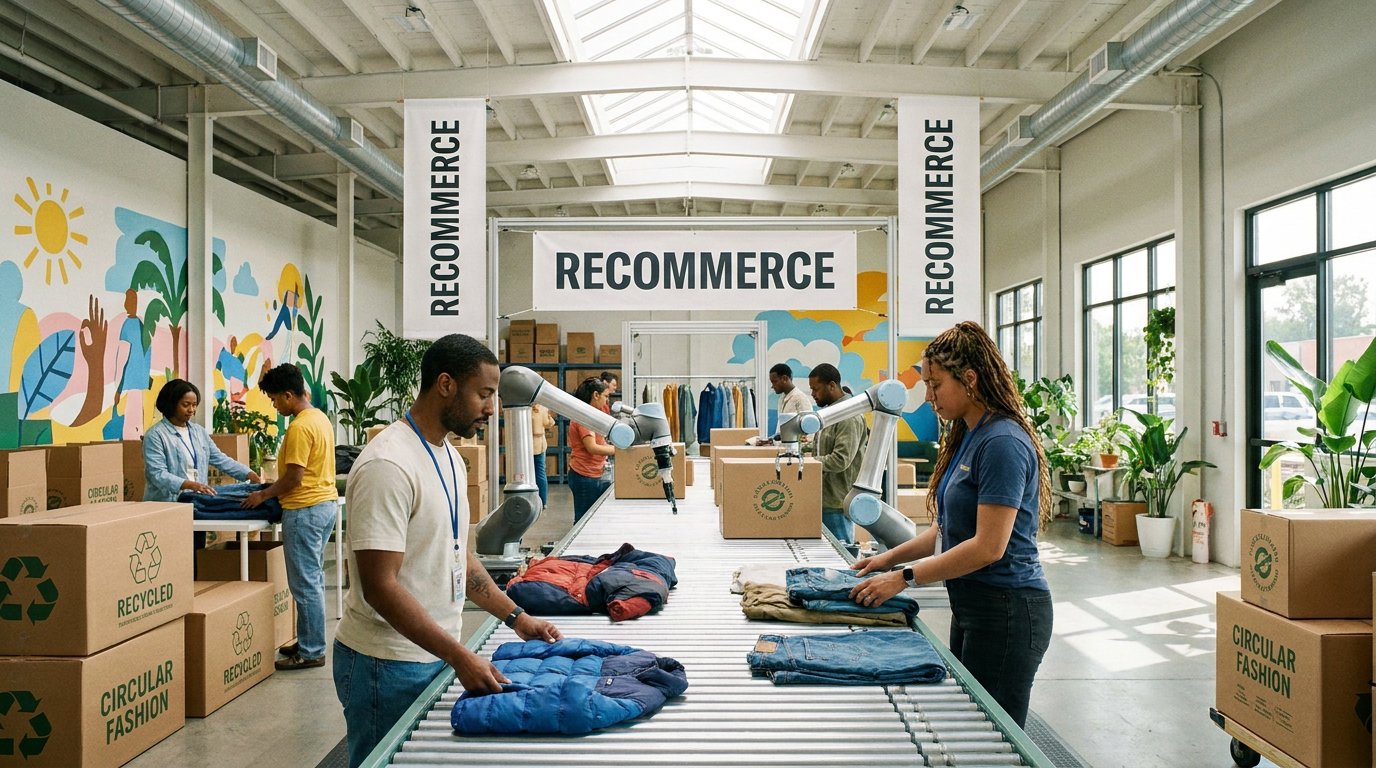
For decades, the global e-commerce supply chain flowed in exactly one direction: from the manufacturer, to the retailer, to the customer, and eventually to the landfill. In this linear model, product returns were viewed as a costly and unavoidable friction point. Returned items were often liquidated for pennies on the dollar, shipped overseas, or simply destroyed outright because processing them was too expensive. But in 2026, the architecture of global retail is fundamentally bending into a circle. Driven by shifting consumer habits, regulatory pressure, and the relentless pursuit of margin recovery, the industry is abandoning the "take-make-dispose" model. Instead, retailers are building sophisticated infrastructures to take products back, refurbish them, and sell them again.[7]
This structural shift is known as "recommerce"—the intentional, scaled buying and selling of previously owned, returned, or refurbished products directly through brand channels. While thrift stores and peer-to-peer marketplaces have existed for years, recommerce represents secondhand retail executed at an enterprise scale. It is the operational engine of the broader circular economy, designed to keep materials in use for as long as possible. By embedding trade-in programs and refurbished product lines into their primary storefronts, brands are transforming what used to be a waste stream into a highly lucrative revenue channel.[2]
The sheer scale of this transition is staggering, and the data indicates it is accelerating. According to ThredUp’s 2026 Resale Report, the global secondhand apparel market alone grew by 13% last year to reach an estimated $257 billion. Projections indicate that this sector will surge to $393 billion by 2030. This is not merely a temporary trend driven by a single demographic; it represents roughly 10% of all global apparel spending. The market has moved past its emerging phase and is now scaling rapidly across multiple continents and product categories.[1]
That growth rate is roughly twice as fast as the broader apparel market. In the United States specifically, the resale sector is expanding four times faster than traditional retail clothing. It is no longer a niche sustainability experiment reserved for eco-conscious shoppers; it is a fundamental shift in how products move through the economy. Consumers are increasingly looking to secondhand options first when seeking value, fundamentally altering the traditional retail hierarchy.[1][2]

The operational mechanism powering this massive shift is known as "reverse logistics." Unlike traditional forward logistics, which focuses on moving pristine boxes from a warehouse to a front porch, reverse logistics manages the complex, unpredictable backward flow of goods. It encompasses return authorization, specialized transportation, detailed inspection, sorting, cleaning, refurbishment, and eventual restocking. Handling a single used jacket or a scratched smartphone is inherently more labor-intensive than shipping a thousand identical new units.[4]
Historically, reverse logistics was viewed strictly as a cost center that brands tried to minimize or outsource entirely. Today, it has become a critical competitive advantage. The global reverse logistics market was valued at nearly $1 trillion in 2025 and is projected to grow at a compound annual growth rate of 17.6% over the next decade. This growth is driven by the urgent need to efficiently process the massive volume of e-commerce returns and consumer trade-ins without bleeding capital.[4]
The recommerce process begins the moment a customer initiates a return or a trade-in through a brand's digital portal. The item is shipped back to a specialized processing facility—often distinct from the brand's primary fulfillment centers. Upon arrival, the product enters the most critical and historically expensive phase of the reverse supply chain: inspection and grading. The ultimate fate of the item—whether it can be restocked as new, sold as refurbished, recycled for parts, or discarded—is decided here.[2][4]

In the past, grading a used or returned item was a slow, highly manual process that was inherently prone to human error and inconsistency. Warehouse workers had to visually inspect every seam, button, or screen, making subjective calls on the item's condition and resale value. Now, artificial intelligence is completely transforming the intake pipeline. Advanced visual recognition algorithms and predictive AI models are being deployed directly on warehouse floors to automate the grading process with pinpoint accuracy.[3]
These AI systems can instantly scan a garment or electronic device, identify microscopic damage, assign a standardized quality grade, and forecast its exact resale value based on real-time market demand. By reducing manual processing time, brands can accelerate the item's journey back to the digital storefront. The same intelligence that powers personalized checkout experiences is now optimizing post-purchase operations, bringing unprecedented precision to the secondhand market.[3]
By reducing manual processing time, brands can accelerate the item's journey back to the digital storefront.
Consumers are also embracing this technology on their end of the transaction, fundamentally changing how supply is generated. ThredUp's data reveals that 66% of consumers are now comfortable letting AI manage their 'digital closets.' These tools can automatically identify which items in a user's wardrobe have high resale value and prompt the user to sell them based on current market trends, effectively automating the supply side of the recommerce equation and removing the friction of manual listing.[1]

Once an item is successfully graded and refurbished, it is listed on a brand-owned resale platform. The adoption of these dedicated platforms has exploded in recent years as companies recognize the financial upside. According to industry data, the number of major brands operating their own dedicated resale channels jumped from just 9 in 2020 to 148 by 2025. Leading fashion brands, electronics manufacturers, and sporting goods companies are all racing to build out their circular infrastructure.[6]
Retail giants like Zara, H&M, and Decathlon have launched dedicated recommerce platforms to capture this market directly, rather than ceding the secondary market to third-party platforms like eBay or Depop. By keeping the resale transaction within their own ecosystem, these brands maintain control over their brand equity, ensure product authenticity, and capture the data associated with the secondary buyer.[5]
For these brands, recommerce solves multiple strategic problems simultaneously. First, it captures cost-conscious consumers who are feeling the pinch of inflation and economic uncertainty. Surveys show that 59% of U.S. consumers shopped for secondhand apparel in 2025, with many citing rising prices as the primary driver of their behavior. Resale allows brands to offer a lower, more accessible price point without discounting their new, full-price inventory and damaging their premium brand perception.[1]
Second, recommerce builds immense customer loyalty and drives repeat purchasing. Internal data from retailers like Decathlon has shown that customers who trade in used equipment end up purchasing from the brand more frequently. When a customer clears out unused gear in exchange for store credit, they are highly likely to immediately reinvest that credit into a new purchase, creating a closed-loop ecosystem of continuous engagement.[5]
Third, building a robust recommerce infrastructure addresses looming regulatory pressures that threaten traditional retail models. Governments worldwide are beginning to mandate circularity to combat climate change. In Europe, lawmakers are aggressively pushing right-to-repair rules, take-back obligations, and strict recycling mandates for major corporations. Brands that proactively launch recommerce programs are building the necessary systems for returns and refurbishment before these rules become legally mandatory, turning compliance into a competitive advantage.[5]

A key component of this regulatory future is the implementation of the Digital Product Passport (DPP). By 2030, the European Union expects all high-impact products to carry these secure digital IDs, which will verify an item's origin, material composition, and repair history. DPPs will force brands to connect their product data systems, closing the loop between sustainability claims and actual evidence, while making it significantly easier to authenticate and price items in the secondhand market.[3]
Despite the massive potential and rapid growth, the transition to circular e-commerce is not without significant friction. The primary challenge for any brand entering this space remains profitability. If a brand cannot tightly control its reverse logistics, transportation, and refurbishment costs, a recommerce program can quickly become a financial liability. The unit economics of processing a single used item are unforgiving, requiring immense operational discipline and scale to generate a meaningful profit margin.[2]
Furthermore, the industry faces a persistent and frustrating supply bottleneck. While consumer demand for secondhand goods is accelerating rapidly, acquiring high-quality used inventory at scale remains difficult. Brands are competing fiercely to convince consumers to clean out their closets and trade in their old items, rather than hoarding them or throwing them away. Without a steady stream of incoming used products, even the most sophisticated recommerce platform will struggle to maintain its momentum.[1]
To solve this critical supply constraint, brands are experimenting with faster payout structures, gamified trade-in programs, and seamless home pickups. Consumer surveys indicate that 36% of shoppers would resell their items more frequently if the financial payouts were faster, and 33% say an easier, AI-automated listing process would motivate them to participate in the circular economy. Removing the friction from the seller's experience is now the top priority for platforms looking to scale.[1]
Ultimately, the brands that master the data and logistics of recommerce will define the next decade of global retail. By turning returns and used goods into a continuous, scalable revenue stream, they are proving that sustainability and profitability are no longer mutually exclusive concepts. The future of commerce is circular, and the infrastructure being built today will ensure that products live multiple, valuable lives before they ever reach the end of their utility.[3][7]
How we got here
2020
Only 9 major brands operate dedicated resale platforms.
2024
The global secondhand fashion market reaches $177 billion.
2025
59% of U.S. consumers shop for secondhand apparel, driven by inflation and sustainability.
2026
Recommerce growth outpaces traditional retail, with the global market hitting $289 billion.
2030 (Projected)
EU mandates Digital Product Passports for high-impact goods to ensure circularity.
Viewpoints in depth
Value-Driven Consumers
Shoppers prioritizing secondhand goods to offset inflation and reduce environmental impact.
For modern consumers, particularly Gen Z and Millennials, secondhand shopping has shed its stigma and become a primary retail channel. Driven by persistent inflation and a desire to reduce their carbon footprint, these shoppers actively seek out recommerce platforms. They view the ability to buy, wear, and resell items as a way to access premium brands without paying full price, treating their wardrobes as liquid assets rather than sunk costs.
Retail Executives
Brand leaders utilizing recommerce to recover margins and build customer loyalty.
From the C-suite perspective, recommerce is a strategic necessity. Executives recognize that traditional retail margins are shrinking and customer acquisition costs are soaring. By bringing resale in-house, brands can capture the secondary market revenue that previously leaked to third-party platforms. Furthermore, trade-in programs create a powerful loyalty loop, as customers who receive store credit for their used items are highly likely to immediately reinvest it into the brand's primary ecosystem.
Logistics and Tech Providers
The infrastructure companies building the AI and reverse logistics systems that make recommerce possible.
For the companies powering the backend of e-commerce, the circular economy is a massive technological challenge. Logistics providers argue that recommerce cannot scale without highly automated reverse logistics facilities. They are investing heavily in AI visual recognition, robotic sorting, and Digital Product Passports to reduce the manual labor required to inspect and grade used goods. To them, the success of resale is entirely dependent on the efficiency of the supply chain.
What we don't know
- Whether smaller, independent brands can afford the high upfront costs of building reverse logistics infrastructure.
- How quickly consumers will adopt AI-managed 'digital closets' to automate the selling of their used goods.
- The exact impact that upcoming European Digital Product Passport regulations will have on global supply chains.
Key terms
- Recommerce
- The structured buying and selling of previously owned, returned, or refurbished products through official brand channels.
- Reverse Logistics
- The supply chain process of moving goods from the consumer back to the retailer for return, repair, or resale.
- Circular Economy
- An economic model focused on extending product lifecycles through reuse and refurbishment, rather than the traditional 'take-make-dispose' model.
- Digital Product Passport (DPP)
- A secure digital ID that tracks a product's origin, materials, and repair history throughout its lifecycle.
Frequently asked
Why are brands launching their own secondhand stores?
Brands want to capture the revenue that previously went to third-party marketplaces like eBay, while also recovering costs from returns and building customer loyalty.
Is buying secondhand actually cheaper?
Yes. For consumers, recommerce offers high-quality, authenticated goods at a discount, which has become increasingly popular due to inflation.
How do brands ensure the quality of used items?
Companies use advanced reverse logistics facilities equipped with AI visual recognition to instantly inspect, grade, and price returned or traded-in items.
Sources
Source coverage
7 outlets
4 viewpoints surfaced







[1]ThredUpValue-Driven Consumers
2026 Resale Market and Consumer Trend Report
Read on ThredUp →[2]ClaimlaneRetail Executives
A Guide for Brands Building Resale Programs (2026)
Read on Claimlane →[3]InriverCircular Infrastructure Providers
Smart data = sustainable growth: Recommerce in 2025
Read on Inriver →[4]Fortune Business InsightsCircular Infrastructure Providers
Reverse Logistic Market Size, Share & Industry Analysis, 2026-2034
Read on Fortune Business Insights →[5]Ulan SoftwareRetail Executives
2026 Recommerce Marketplace Trends and Statistics
Read on Ulan Software →[6]Emerald InsightAcademic & Market Analysts
From preloved to reloved: fashion re-commerce business models
Read on Emerald Insight →[7]Factlen Editorial TeamAcademic & Market Analysts
Synthesis by Factlen editorial team
Read on Factlen Editorial Team →
Every angle. Every day.
Get business stories with full source coverage and perspective breakdowns delivered to your inbox.