
Nobel Laureate John Jumper Leaves Google DeepMind for Anthropic in Major Enterprise AI Shift
The co-creator of AlphaFold is departing Google for Anthropic, following Gemini co-lead Noam Shazeer's move to OpenAI. The high-profile exits highlight an intensifying talent war as frontier AI labs pivot toward biological research and scientific discovery.
By Factlen Editorial Team
- Frontier AI Labs
- Argue that leaner organizational structures and a singular focus on artificial general intelligence make startups the best environment for elite researchers.
- Big Tech Incumbents
- Emphasize their unmatched compute resources, massive scale, and the foundational role they played in incubating breakthroughs like AlphaFold and Transformers.
- Computational Biologists
- Focus on the physical bottlenecks of drug discovery, noting that while AI can predict structures, clinical trials and lab execution remain the ultimate test.
What's not represented
- · Pharmaceutical Executives
- · Venture Capitalists
Why this matters
The departure of the scientist who solved one of biology's hardest problems signals a massive shift in enterprise AI. Frontier labs are no longer just building chatbots; they are assembling the infrastructure to automate scientific discovery and drug development.
Key points
- Nobel laureate John Jumper is leaving Google DeepMind to join the frontier AI lab Anthropic.
- Jumper co-created AlphaFold, an AI system that predicted the 3D structures of over 200 million proteins.
- The move follows the departure of Gemini co-lead Noam Shazeer, who left Google for OpenAI just days prior.
- Anthropic is actively expanding into computational biology, building physical wet labs and partnering with major research institutes.
The enterprise artificial intelligence landscape experienced a seismic shift this week as two of the industry's most consequential researchers departed Google for rival frontier labs. John Jumper, the Nobel laureate who co-created the AlphaFold protein-prediction system, announced on June 19 that he is leaving Google DeepMind after nearly nine years to join Anthropic.[1][6]
Jumper's exit arrived just 24 hours after Noam Shazeer, the co-lead of Google's Gemini models and a foundational architect of modern AI, revealed he was leaving the search giant for OpenAI. The back-to-back departures of a Nobel-winning scientist and a pioneering engineer underscore an intensifying talent war where specialized AI startups are successfully poaching the architects of Big Tech's most celebrated breakthroughs.[2][5]
For Anthropic, landing Jumper is more than a high-profile personnel victory; it is a definitive signal of the company's strategic pivot toward computational biology. While Anthropic is best known for its Claude family of large language models, the startup has spent 2026 quietly assembling the infrastructure required for physical scientific discovery, including opening wet labs and forging partnerships with the Allen Institute and the Howard Hughes Medical Institute.[4][7]
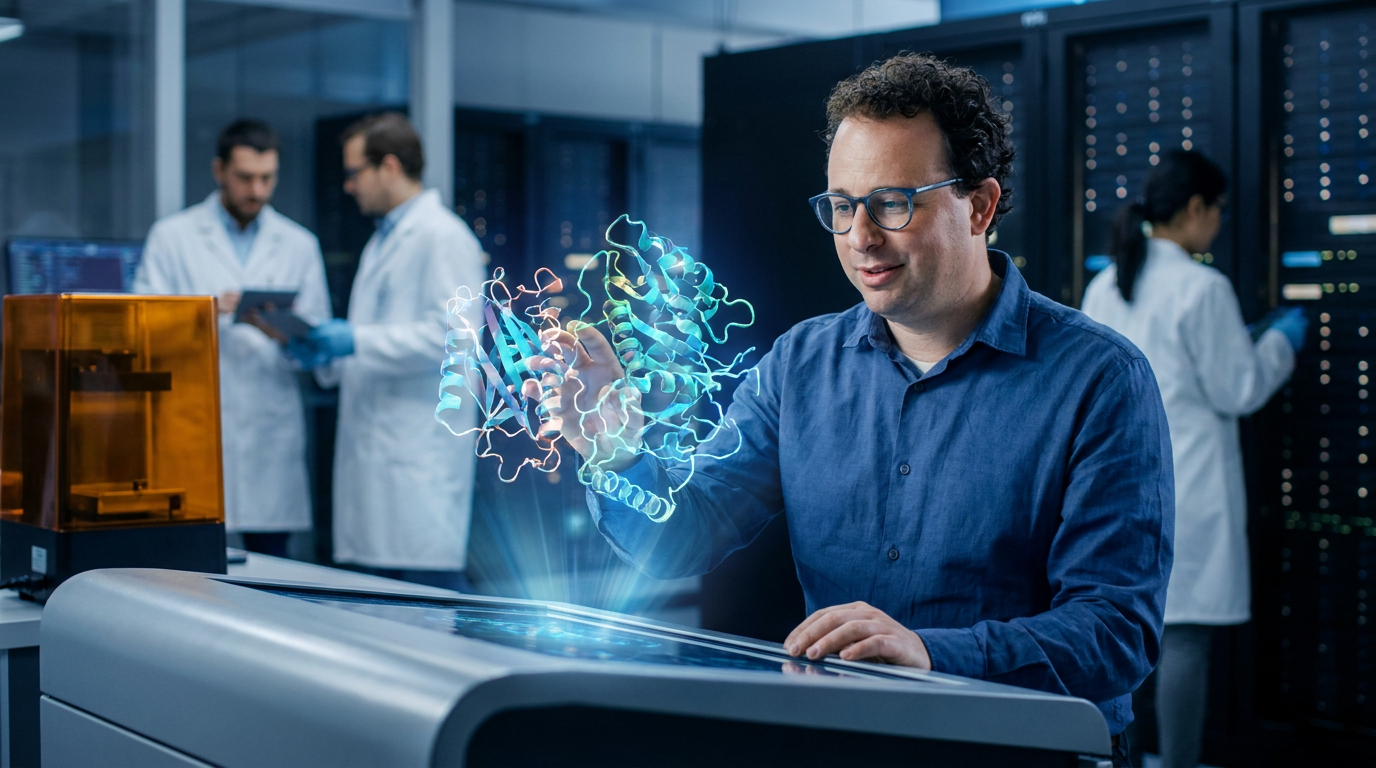
To understand the magnitude of Jumper's move, one must understand the mechanism of AlphaFold. For half a century, biology faced a grand challenge: how to accurately predict the three-dimensional shape a protein will fold into based solely on its one-dimensional sequence of amino acids. Because a protein's shape dictates its function in the human body, solving this puzzle was considered the holy grail of drug discovery and disease research.[1]
Under Jumper's leadership, Google DeepMind's AlphaFold system solved that problem. By training neural networks on vast databases of known protein structures, the AI learned the underlying physical rules of protein folding. It has since predicted the structures of more than 200 million proteins—nearly every protein known to science—accelerating global research timelines by years.[4][6]

That breakthrough earned Jumper and DeepMind CEO Demis Hassabis the 2024 Nobel Prize in Chemistry, alongside computational biologist David Baker. It also established DeepMind as the undisputed leader in "AI for science," proving that artificial intelligence could do more than generate text or win board games; it could unlock fundamental truths about the physical world.[1][6]
Now, the architect of that system is taking his expertise to Anthropic. Industry analysts note that Jumper's transition suggests the era of pure structural prediction is maturing, and the next frontier lies in integrating AI with actual laboratory execution. Anthropic's recent investments in wet labs—physical laboratories where biological matter can be tested—indicate the company intends to close the loop between digital predictions and real-world biological engineering.[4][7]
Now, the architect of that system is taking his expertise to Anthropic.
This shift from digital models to physical science represents a massive new market for enterprise AI. Pharmaceutical companies and biotech startups are increasingly relying on frontier models to design novel therapeutics, engineer enzymes, and optimize clinical trials. By bringing Jumper on board, Anthropic gains immediate "proof-of-work" credibility in a sector where rigorous scientific validation is paramount.[7]
Meanwhile, the departure of Noam Shazeer highlights a different facet of the AI talent migration. Shazeer is a co-author of the landmark 2017 paper "Attention Is All You Need," which introduced the Transformer architecture—the underlying technology that powers virtually all modern generative AI, including ChatGPT, Claude, and Gemini.[2][3]
Shazeer's relationship with Google has been complex. He previously left the company in 2021 to found the consumer chatbot startup Character.AI. In August 2024, Google executed a massive $2.7 billion licensing agreement with Character.AI, a deal widely viewed as an expensive "acqui-hire" designed specifically to bring Shazeer back into the fold to co-lead the development of the Gemini models.[3][5]

His exit to OpenAI less than two years later illustrates the immense leverage held by elite AI researchers. Frontier labs like OpenAI and Anthropic can offer these scientists leaner organizational structures, less bureaucratic friction, and a singular focus on achieving artificial general intelligence, which often proves more appealing than navigating the complex product matrices of a trillion-dollar incumbent.[3]
The corporate dynamic is stark. Big Tech companies possess unmatched compute resources and distribution channels, but they must balance their AI ambitions with legacy search, advertising, and cloud businesses. Startups, fueled by billions in venture capital, can operate with a singular, aggressive focus.[2][4]
However, the transition to AI-driven drug discovery is not without significant physical hurdles. While systems like AlphaFold have revolutionized the early stages of identifying protein targets, the downstream bottlenecks of drug development remain stubbornly grounded in the real world. Clinical trials, regulatory approvals, and manufacturing scale-up still require years of rigorous testing and billions of dollars.[7]
The computational biology community is watching closely to see how Anthropic will navigate these physical constraints. Predicting a protein structure is a computational problem; proving that a novel synthetic protein is safe and efficacious in human patients is a biological one. Anthropic's acquisition of biotech startups and its partnerships with established research institutes suggest the company understands this reality.[4][7]

As the enterprise AI landscape evolves, the definition of a "frontier model" is expanding. It is no longer sufficient for an AI to simply converse fluently or write code; the next generation of models will be judged on their ability to interface with the physical world, design new materials, and cure diseases.[4]
The talent migration of June 2026 serves as a bellwether for this new era. With Jumper at Anthropic and Shazeer at OpenAI, the race to build the most capable artificial intelligence has definitively moved beyond the chatbot paradigm, entering a phase where the ultimate prize is the mastery of science itself.[1][2]
How we got here
2017
The 'Attention Is All You Need' paper is published, introducing the Transformer architecture.
2020
AlphaFold solves the 50-year-old protein folding grand challenge.
August 2024
Google pays $2.7 billion to license Character.AI and bring Noam Shazeer back to the company.
October 2024
John Jumper and Demis Hassabis win the Nobel Prize in Chemistry for their work on AlphaFold.
June 18, 2026
Noam Shazeer announces his departure from Google to join OpenAI.
June 19, 2026
John Jumper announces he is leaving Google DeepMind for Anthropic.
Viewpoints in depth
Frontier AI Labs
Startups argue that their singular focus and agility make them the ideal home for elite researchers.
Companies like Anthropic and OpenAI position themselves as mission-driven organizations unencumbered by the legacy business models of Big Tech. By offering researchers leaner organizational structures and the freedom to build specialized infrastructure—such as Anthropic's new wet labs—these startups argue they can accelerate the path to artificial general intelligence and scientific breakthroughs faster than their corporate counterparts.
Big Tech Incumbents
Incumbents emphasize the massive scale and compute resources required to incubate foundational AI breakthroughs.
Despite the recent talent drain, companies like Google maintain that their unparalleled compute infrastructure, vast data reservoirs, and global distribution networks are essential for scaling AI. They point to the fact that both the Transformer architecture and AlphaFold were incubated within their walls, arguing that true enterprise-grade AI requires the financial stability and integration capabilities that only a trillion-dollar company can provide.
The Computational Biology Community
Biologists caution that AI predictions must ultimately survive the rigorous, physical realities of clinical testing.
While the computational biology sector celebrates the integration of AI into drug discovery, experts warn against treating biology purely as a software problem. Predicting a protein's structure is a massive achievement, but translating that prediction into a safe, efficacious drug requires navigating complex physical bottlenecks, including clinical trials, regulatory approvals, and manufacturing scale-up. The community is watching closely to see if AI labs can successfully bridge the gap between digital models and wet-lab execution.
What we don't know
- It remains unclear exactly what specific biological products or systems Jumper will lead development on at Anthropic.
- The long-term impact of these high-profile departures on Google's upcoming Gemini 3.5 Pro model and its broader AI roadmap is not yet known.
Key terms
- AlphaFold
- An AI system developed by Google DeepMind that accurately predicts the 3D structure of proteins from their amino acid sequences.
- Transformer Architecture
- A deep learning model architecture introduced in 2017 that became the foundation for modern large language models like ChatGPT and Gemini.
- Wet Lab
- A physical laboratory space where biological matter, chemicals, and drugs are tested and analyzed, as opposed to a computational 'dry lab'.
- Frontier Model
- The most advanced, highly capable generation of artificial intelligence models currently in development by leading research labs.
- Acqui-hire
- A corporate acquisition where the primary motivation is to recruit the target company's talented employees rather than its products or services.
Frequently asked
Why did John Jumper win a Nobel Prize?
He co-led the development of AlphaFold, an AI system that solved a 50-year-old biological challenge by predicting the 3D structures of over 200 million proteins.
What is Anthropic doing in biology?
Anthropic is expanding beyond language models by building physical wet labs and partnering with research institutes to apply AI directly to scientific discovery and drug development.
Why are top AI researchers leaving Google?
Many elite researchers are moving to specialized frontier labs like OpenAI and Anthropic, drawn by leaner organizational structures, less bureaucracy, and a singular focus on advancing AI capabilities.
Sources
Source coverage
7 outlets
3 viewpoints surfaced







[1]TechCrunchBig Tech Incumbents
Nobel laureate John Jumper is leaving DeepMind for rival Anthropic
Read on TechCrunch →[2]Business InsiderFrontier AI Labs
A Google Veteran Who Founded Character.AI Is Jumping to OpenAI
Read on Business Insider →[3]Fast CompanyFrontier AI Labs
The AI talent wars are raging on: Noam Shazeer leaves Google for OpenAI
Read on Fast Company →[4]AI WeeklyFrontier AI Labs
DeepMind's AlphaFold Lead John Jumper Joins Anthropic
Read on AI Weekly →[5]9to5GoogleBig Tech Incumbents
Gemini's co-lead is leaving Google to join OpenAI
Read on 9to5Google →[6]Indian TelevisionComputational Biologists
Nobel laureate John Jumper to leave Google DeepMind for Anthropic
Read on Indian Television →[7]SynBioBetaComputational Biologists
Anthropic Is Hiring Biologists, Building Wet Labs, and Betting Big on Drug Discovery
Read on SynBioBeta →


Every angle. Every day.
Get technology stories with full source coverage and perspective breakdowns delivered to your inbox.