
How Towering Steel Sails Are Decarbonizing Global Shipping
The maritime industry is returning to its wind-powered roots, deploying massive spinning rotors and rigid wing sails to cut fuel consumption by up to 30%.
By Factlen Editorial Team
- Maritime Shipowners
- Focuses on the economic viability, fuel savings, and regulatory compliance benefits of retrofitting fleets with wind technology.
- Marine Innovators
- Prioritizes the aerodynamic engineering, AI-driven route optimization, and physical limits of thrust generation.
- Safety Regulators
- Emphasizes the need for updated operational protocols, crew training, and navigational safety as massive sails alter ship handling.
What's not represented
- · Port Authorities
- · Seafarer Unions
Why this matters
Global shipping transports 90% of the world's goods but produces roughly 3% of global carbon emissions. Wind-assisted propulsion offers an immediately deployable, cost-effective way to slash those emissions without waiting decades for alternative green fuels to mature.
Key points
- The maritime industry is rapidly adopting wind-assisted propulsion to meet strict new carbon emission targets.
- Technologies include spinning Flettner rotors and rigid, airplane-like wing sails.
- A single rigid wing can save roughly 1.5 tonnes of fuel per day, cutting daily CO2 emissions significantly.
- With heavy oil prices and new carbon taxes, the systems pay for themselves in three to five years.
- AI-driven fluid dynamics simulators are now being used to optimize ship routes based on real-time wave and wind data.
- The global fleet of wind-assisted commercial vessels is expected to surpass 100 by the end of 2025.
For thousands of years, wind was the only way to move cargo across the oceans. Then came coal, steam, and heavy fuel oil, which allowed ships to grow to monumental sizes and operate on strict, weather-independent schedules. But as the maritime industry faces mounting pressure to decarbonize, shipowners are looking backward to move forward. Wind power is returning to commercial shipping—not as canvas sails rigged to wooden masts, but as towering, automated structures of steel and composite materials.[5][6]
The technology, broadly known as Wind-Assisted Ship Propulsion (WAPS), is rapidly transitioning from experimental prototypes to standard commercial equipment. By the end of 2025, the global fleet of large commercial vessels equipped with wind propulsion is expected to surpass 100, with order books filling up rapidly for 2026 and beyond. Industry analysts project that thousands of ships will feature these systems by the end of the decade.[1][6]
The urgency stems from the sheer scale of maritime emissions. The shipping industry is responsible for roughly 3% of global anthropogenic greenhouse gases. While the sector has pledged to reach net-zero emissions by or around 2050, the transition to alternative green fuels like ammonia or methanol is hampered by high costs and a lack of global bunkering infrastructure. Wind, by contrast, is a free, non-depleting resource available on 70% of global shipping routes.[5][6]
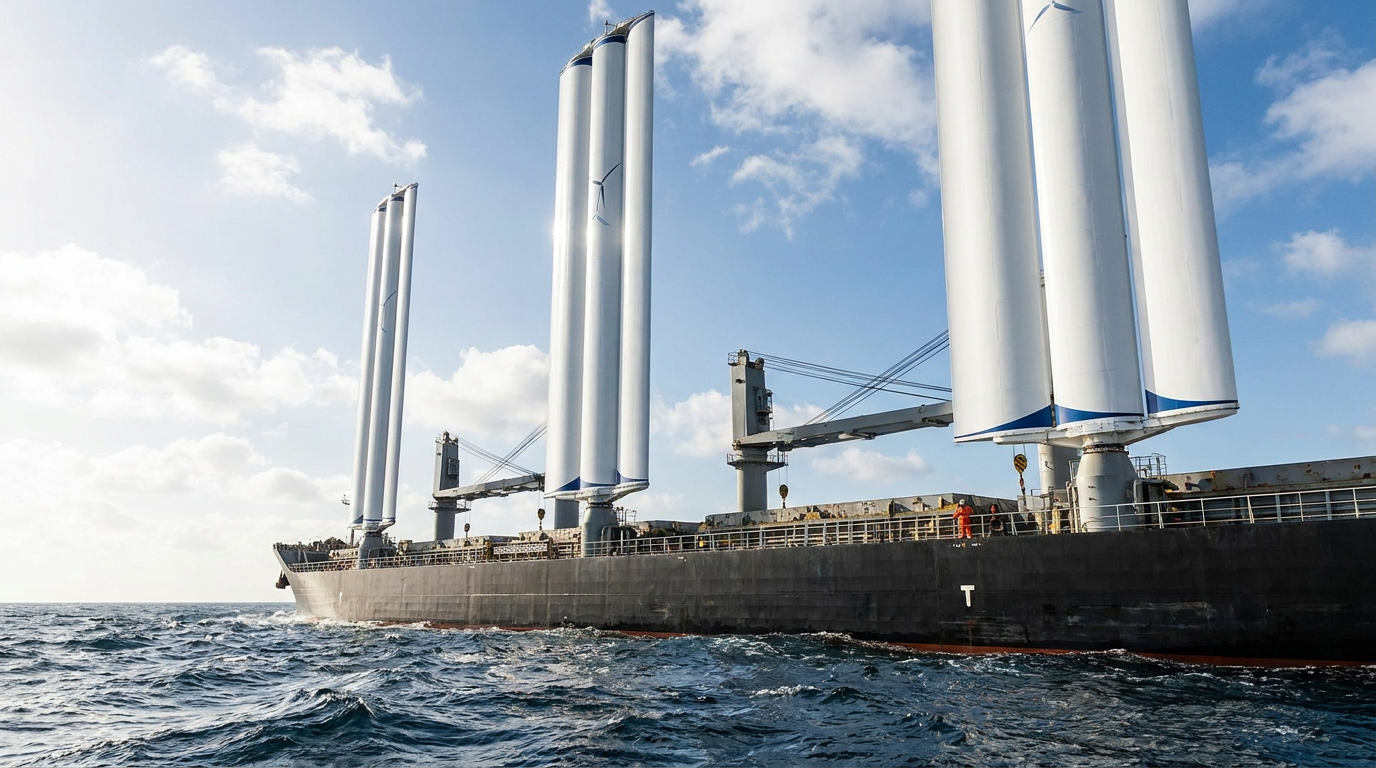
Modern wind propulsion generally falls into two distinct categories. The first is the Flettner rotor, or "rotor sail." Originally invented in the 1920s, these are large vertical cylinders mounted on a ship's deck. Mechanical motors spin the cylinders at high speeds. When crosswinds hit the spinning surface, the air accelerates on one side and decelerates on the other, creating a pressure differential. This phenomenon, known as the Magnus effect, generates a powerful thrust perpendicular to the wind, pushing the ship forward.[2][6]

Rotor sails are currently dominating the retrofit market due to their relatively small deck footprint. In April 2026, engineers at the China State Shipbuilding Corporation unveiled one of the world's largest rotor models, measuring 35 meters in height and 5 meters in diameter, capable of producing over 355 kilonewtons of thrust. Meanwhile, Scottish innovator EcoNavis Solutions recently secured funding to test a "tail-appendage" device that stabilizes the airflow behind the rotor, increasing thrust by up to 10% and widening the range of wind angles in which the system can operate efficiently.[2][7]
The second major technology is the rigid wing sail, which resembles an airplane wing standing upright. Unlike spinning rotors, these wings use traditional aerodynamic lift. They are highly automated, adjusting their angle of attack to optimize wind capture, and can fold down flat to the deck when the ship is navigating under bridges or facing severe storms.[3][5]
The fuel savings generated by these systems are substantial. On the Pyxis Ocean, a bulk carrier retrofitted with 123-foot rigid "WindWings" developed by BAR Technologies, operators report saving roughly 1.5 tonnes of fuel per wing, per day. For a vessel equipped with four wings, that translates to a reduction of up to 20 tonnes of CO2 emissions daily. Depending on the route and whether the ship's hull is optimized for wind, total fuel consumption can drop by 5% to 30%.[5][6]
The fuel savings generated by these systems are substantial.
While the environmental benefits are clear, the current boom in WAPS adoption is primarily driven by hard economics and tightening regulations. The International Maritime Organization (IMO) has introduced the Carbon Intensity Indicator (CII), which grades ships on their operational efficiency. Older, highly polluting ships face severe penalties or forced retirement. Installing rotor sails can instantly improve a vessel's CII rating by one to two levels, extending its commercial lifespan.[6]

Furthermore, regional carbon taxes are changing the math for shipowners. Under the European Union's Emissions Trading System (EU ETS) and FuelEU Maritime regulations, ships must pay for their carbon output. The China Classification Society notes that retrofitting a wind-assisted system costs between 5% and 15% of a ship's total value. However, when heavy fuel oil prices exceed $600 per ton and carbon taxes are factored in, the return on investment shrinks to just three to five years.[6]
This compelling economic case is driving adoption across various vessel types. In January 2026, the Stena Connecta, a "New Max" roll-on/roll-off ferry, arrived in Belfast prepared for Norsepower rotor sails, aiming to cut fuel use by 9% on its Irish Sea routes. Even massive Very Large Crude Carriers (VLCCs) are getting in on the action, with Japan's Idemitsu Tanker group recently ordering rotors for tankers scheduled to launch in 2028.[1][8]
However, integrating wind power into modern logistics is not without challenges. The primary hurdle is predictability. Modern supply chains rely on "just-in-time" delivery, meaning ships cannot afford to wait for favorable winds. To solve this, operators are pairing wind hardware with advanced routing software.[1][4]
In June 2026, researchers from the University of Michigan and Engys unveiled an AI-enhanced Computational Fluid Dynamics (CFD) simulator. Traditional models assumed steady winds and flat seas, but the new AI system models the chaotic, real-world interactions between ocean waves, ship roll, and rotor aerodynamics. By predicting exactly how a ship will behave in specific weather systems, captains can dynamically alter their routes to maximize wind thrust without sacrificing arrival times.[4]

Physical space is another limitation. WAPS technology is highly effective for bulk carriers, oil tankers, and roll-on/roll-off car carriers, which have expansive, flat decks. It is far less practical for container ships, where every square meter of deck space is needed to stack cargo boxes.[1][6]
Safety and crew training also require significant updates. Adding 120-foot spinning cylinders or rigid wings to a deck fundamentally changes a ship's center of gravity, its maneuverability in tight ports, and the bridge crew's line of sight. In May 2026, the maritime association BIMCO published new safety guidelines specifically for WAPS-equipped vessels, emphasizing the need for continuous crew training and updated risk assessments for extreme weather events.[3]
Looking ahead, naval architects are beginning to design ships entirely around wind propulsion, rather than just bolting sails onto existing hulls. Projects like the Bluetech SeaWasp are simulating aerodynamic hull redesigns that maximize the efficiency of the sails, pushing potential fuel savings even higher.[1]

Wind will not replace the internal combustion engine in commercial shipping entirely; vessels will always need reliable mechanical power to navigate ports, canals, and windless doldrums. But as a hybrid solution, wind-assisted propulsion has crossed the threshold from a novelty to a necessity, offering the industry its most powerful tool yet to navigate the transition to a zero-carbon future.[1][5]
How we got here
1920s
German engineer Anton Flettner invents the first rotor sail, though cheap diesel fuel prevents widespread adoption.
August 2023
The Pyxis Ocean bulk carrier embarks on its maiden voyage equipped with 123-foot rigid WindWings.
January 2026
The Stena Connecta ferry arrives in Belfast, prepared for rotor sail installation to service the Irish Sea.
April 2026
China State Shipbuilding Corporation unveils a massive 35-meter-tall rotor sail prototype.
May 2026
BIMCO publishes new international safety guidelines for operating wind-assisted commercial vessels.
June 2026
Researchers debut AI-driven fluid dynamics simulators to optimize rotor performance in complex ocean waves.
Viewpoints in depth
Maritime Shipowners
Focuses on the economic viability, fuel savings, and regulatory compliance benefits of retrofitting fleets with wind technology.
For fleet operators, the transition to wind is fundamentally an economic calculation driven by regulatory pressure. With the IMO's Carbon Intensity Indicator (CII) threatening to penalize older, less efficient ships, and the EU's Emissions Trading System placing a hard price on carbon, shipowners need immediate solutions. Because alternative fuels like green methanol are expensive and lack global infrastructure, wind propulsion offers a plug-and-play retrofit. Operators emphasize that a 5% to 15% upfront capital expenditure on a ship's value can yield a return on investment in just three to five years, making it a rare green technology that actively improves profit margins in the short term.
Marine Innovators
Prioritizes the aerodynamic engineering, AI-driven route optimization, and physical limits of thrust generation.
Naval architects and software engineers view wind propulsion as a complex fluid dynamics challenge. They argue that simply bolting a sail to a deck is insufficient; true efficiency requires integrating the hardware with advanced software. Innovators are deploying AI-driven Computational Fluid Dynamics (CFD) to model how a ship's roll and pitch in ocean waves affect the aerodynamic drag on the sails. By combining these digital twins with real-time weather routing, engineers believe they can push fuel savings past the 30% mark, eventually leading to a new generation of commercial ships where the hull itself is aerodynamically designed to complement the sails.
Safety Regulators
Emphasizes the need for updated operational protocols, crew training, and navigational safety as massive sails alter ship handling.
Organizations like BIMCO and maritime classification societies are focused on the operational risks of placing 120-foot structures on cargo decks. Regulators point out that wind-assisted systems drastically alter a vessel's center of gravity, its radar cross-section, and its maneuverability in high winds. Furthermore, large rigid wings can obstruct the line of sight from the bridge, complicating navigation in crowded ports. Regulators are pushing for standardized, role-specific training for crews, ensuring that seafarers know exactly when to fold down wings or depower rotors during sudden squalls or complex docking procedures.
What we don't know
- How quickly global shipyards can scale up manufacturing to meet the projected demand for thousands of rotor sails by 2030.
- Whether the long-term maintenance costs of complex, automated rigid wings in corrosive saltwater environments will impact their overall ROI.
- How port infrastructure may need to adapt to accommodate vessels with towering, permanent deck structures.
Key terms
- Wind-Assisted Ship Propulsion (WAPS)
- The use of modern aerodynamic technologies, such as rotor sails or rigid wings, to supplement a ship's engine power and reduce fuel consumption.
- Flettner Rotor
- A spinning vertical cylinder mounted on a ship's deck that uses the Magnus effect to generate forward thrust from crosswinds.
- Magnus Effect
- A physical phenomenon where a spinning object drags air around itself, creating a pressure difference that results in a perpendicular force.
- Rigid Wing Sail
- A solid, airplane-like vertical wing mounted on a ship that can be adjusted to capture wind and generate forward momentum.
- Carbon Intensity Indicator (CII)
- An International Maritime Organization rating system that grades ships from A to E based on their operational efficiency and carbon emissions.
Frequently asked
Can wind propulsion replace ship engines entirely?
No. Commercial ships will always require mechanical engines to navigate tight ports, transit canals, and maintain schedules when there is no wind. Wind acts as a hybrid assist to reduce fuel burn.
How much fuel do rotor sails actually save?
Depending on the vessel type, route, and number of sails installed, wind-assisted systems can reduce a ship's total fuel consumption by 5% to 30%.
Why don't container ships use wind sails?
Container ships utilize almost all of their available deck space to stack cargo boxes, leaving no room for the installation of large rotor or wing sails. The technology is best suited for bulk carriers and oil tankers.
What happens to the sails in a severe storm?
Modern rigid wing sails are designed to fold down flat against the deck during extreme weather, while rotor sails can simply be powered down to minimize aerodynamic drag.
Sources
Source coverage
8 outlets
3 viewpoints surfaced






[1]Riviera Maritime MediaMaritime Shipowners
Wind propulsion moves from prototype to scalable impact
Read on Riviera Maritime Media →[2]China DailyMarine Innovators
China's shipbuilding giant develops advanced rotor sails for greener shipping
Read on China Daily →[3]BIMCOSafety Regulators
New guidelines support safe uptake of wind-assisted propulsion
Read on BIMCO →[4]SeaQuipMarine Innovators
How AI-driven CFD is reshaping wind-assisted ship propulsion
Read on SeaQuip →[5]Popular ScienceMarine Innovators
A massive cargo ship is testing 125-foot-tall ‘wing sails’
Read on Popular Science →[6]China Classification SocietyMaritime Shipowners
Heading for A New Era of “Wind Wings”
Read on China Classification Society →[7]World BunkeringMarine Innovators
EcoNavis Solutions develops next generation rotor sail
Read on World Bunkering →[8]NorsepowerMaritime Shipowners
Stena Connecta arrives in Belfast prepared for rotor sails
Read on Norsepower →
Every angle. Every day.
Get transportation stories with full source coverage and perspective breakdowns delivered to your inbox.