
IMAX vs. Dolby Cinema: Comparing the Premium Movie Theater Formats in 2026
As theater chains expand their premium large format offerings, the choice between IMAX's massive scale and Dolby Cinema's technical precision comes down to how a movie was filmed.
By Factlen Editorial Team
- IMAX Loyalists
- Advocates who believe sheer scale and expanded aspect ratios are the ultimate cinematic experience.
- Dolby Cinema Audiophiles
- Tech-focused moviegoers who prioritize perfect contrast, color accuracy, and spatial audio.
- Value-Conscious Moviegoers
- Consumers who weigh the high cost of premium tickets against the actual technical benefits.
What's not represented
- · Independent Theater Owners
- · Home Theater Enthusiasts
Why this matters
With premium movie tickets routinely exceeding $25 in 2026, choosing the wrong format can mean overpaying for a suboptimal experience. Understanding the technical differences ensures audiences get the best possible picture, sound, and comfort for their money.
Key points
- IMAX prioritizes massive scale and expanded aspect ratios, offering up to 40% more vertical image for films shot with IMAX cameras.
- Dolby Cinema focuses on technical precision, utilizing Dolby Vision HDR for a 1,000,000:1 contrast ratio and perfectly deep blacks.
- Dolby Atmos provides 64-channel object-based spatial audio, while IMAX relies on a thunderous 12-channel brute-force sound system.
- Dolby Cinema universally offers premium reclining seats, whereas IMAX typically uses standard stadium seating to maximize sightlines.
In 2026, heading to the movies for a major blockbuster often involves navigating a confusing checkout screen. Beyond standard tickets, theater chains push a dizzying array of premium large format (PLF) upgrades, promising the ultimate viewing experience. The two undisputed heavyweights dominating the premium multiplex landscape are IMAX and Dolby Cinema. Both demand a significant premium—often adding $5 to $10 to the cost of a standard ticket—but they deliver fundamentally different philosophies of what makes a movie immersive. Understanding these differences is crucial for audiences who want to ensure they are getting the best possible return on their entertainment investment.[1][8]
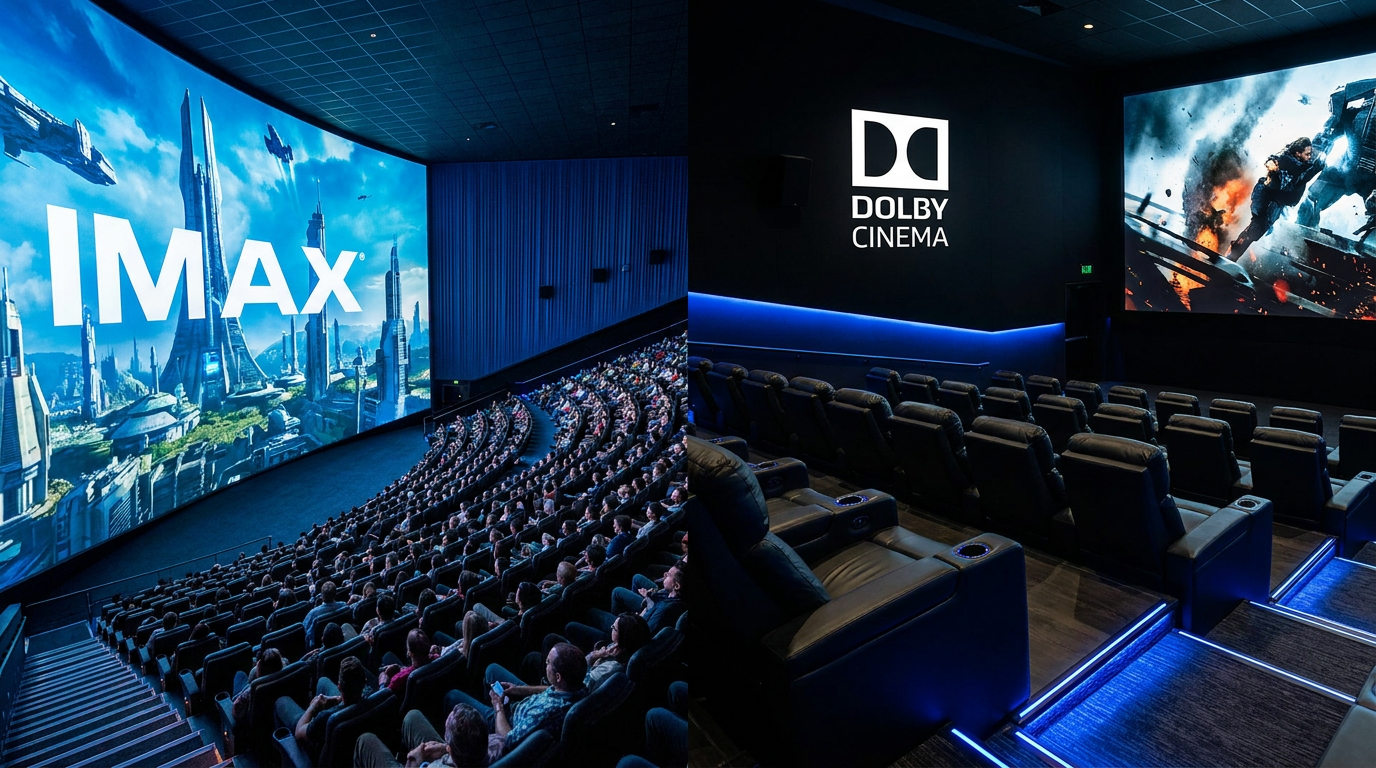
The core difference between the two formats boils down to a battle of scale versus precision. IMAX is explicitly designed to swallow the viewer whole, utilizing massive screens and specialized cameras to create a larger-than-life spectacle that dominates your peripheral vision. Dolby Cinema, conversely, focuses on absolute technical fidelity. It leverages proprietary high-dynamic-range (HDR) projection and object-based spatial audio to create a perfectly calibrated, intimate viewing environment. While both formats represent a massive leap over standard digital projection, they cater to different sensory priorities and are optimized for different types of filmmaking.[1][4]
For IMAX, the defining metric is sheer size and aspect ratio. When a film is shot using IMAX-certified cameras, the format expands vertically to fill the floor-to-ceiling screen. While standard widescreen films are cropped to a 2.40:1 ratio, true IMAX presentations open up to 1.90:1 or even a towering 1.43:1. This expansion provides up to 40 percent more image on the top and bottom of the frame. For sweeping landscapes, massive action sequences, and towering sci-fi environments, this expanded field of view makes the audience feel as though they are stepping inside the movie itself.[2][8]

However, the IMAX brand carries a notable caveat that theater enthusiasts colloquially refer to as 'LieMAX.' While flagship IMAX venues feature dual 4K laser projectors and screens stretching over 70 feet wide, many multiplex IMAX auditoriums are simply retrofitted standard rooms. These locations often feature smaller screens and older 2K xenon projectors. While they still offer an upgrade over standard theaters in terms of brightness and sound, these digital IMAX screens lack the overwhelming, towering scale of purpose-built, true IMAX environments, making it essential for moviegoers to research their local theater's specific technical specifications.[3][6]
Dolby Cinema counters IMAX's sheer size with unparalleled visual precision through its Dolby Vision HDR technology. Utilizing dual 4K laser projectors across all its locations, Dolby Cinema achieves a staggering 1,000,000:1 contrast ratio. This allows the projectors to render true, inky blacks rather than the dark, milky grays often seen in standard theaters. Alongside vibrant color accuracy and brightness levels that can reach up to 10,000 nits, Dolby Vision ensures that every frame looks exactly as the colorist intended. For visually dense films set in dark environments, such as atmospheric horror or deep-space sci-fi, Dolby's color depth is unmatched.[1][4][7]
Dolby Cinema counters IMAX's sheer size with unparalleled visual precision through its Dolby Vision HDR technology.
The audio battle presents a similar contrast in philosophies, with each format taking a distinct approach to immersion. IMAX utilizes a proprietary, channel-based 12-channel sound system designed for raw, chest-thumping power. The audio arrays are laser-aligned to deliver thunderous bass and massive volume that physically shakes the auditorium. This brute-force approach ensures that explosions, roaring engines, and sweeping orchestral scores are felt just as intensely as they are heard, perfectly complementing the overwhelming visual scale of the format. It is an audio experience built for maximum impact rather than subtle nuance.[2][5]

Dolby Atmos, the audio engine behind Dolby Cinema, takes a more surgical and precise approach. Instead of fixed channels, Atmos uses object-based audio mixing across up to 64 individual speakers, including dedicated arrays directly overhead. This allows sound designers to place a specific noise—like a whispering voice, a single raindrop, or a helicopter circling above—in an exact three-dimensional coordinate within the theater. The result is a 360-degree soundscape that wraps around the audience with startling clarity, creating a highly realistic and immersive auditory environment that tracks movement seamlessly across the room.[4][7]
Comfort is another major dividing line between the two premium formats. Because IMAX prioritizes stadium seating to maintain optimal sightlines for its massive, floor-to-ceiling screens, the seats are typically standard, upright theater chairs. Dolby Cinema, by contrast, mandates premium, spacious leather recliners in all of its auditoriums. These luxury seats also feature built-in low-frequency transducers that vibrate in sync with the on-screen action, adding a tactile element to the Atmos audio mix. For a three-hour epic, the physical comfort of Dolby Cinema often gives it a distinct edge for general audiences.[3][7][9]

When analyzing the trade-offs, IMAX fits well when a film is explicitly marketed as 'Filmed for IMAX.' The argument for IMAX centers on its expanded aspect ratio and communal scale, supported by the evidence of up to 40 percent more visual information on screen. However, the argument against it involves the lack of premium recliners and the risk of paying premium prices for smaller, retrofitted 'LieMAX' screens. It does not fit well for standard widescreen releases that cannot utilize the vertical space, as the primary benefit of the format is left entirely unused.[1][4][8]
Conversely, Dolby Cinema fits well when visual fidelity, color depth, and audio precision are paramount. The argument for Dolby rests on its 1,000,000:1 contrast ratio and 64-channel Atmos audio, providing unmatched technical perfection and physical comfort. The argument against it is simply screen size; it cannot replicate the towering, floor-to-ceiling immersion of a true IMAX screen. It does not fit well if your primary goal is the sheer, overwhelming scale of a massive 70-foot projection, but it remains the definitive format for almost every other type of cinematic release.[4][7][8]
Viewpoints in depth
IMAX Loyalists
Advocates who believe sheer scale and expanded aspect ratios are the ultimate cinematic experience.
For IMAX loyalists, the theater experience is entirely about spectacle that cannot be replicated at home. They argue that the 1.43:1 aspect ratio—which fills the viewer's entire peripheral vision—is the only way to truly experience blockbusters shot on IMAX cameras. To this camp, the lack of reclining seats is a worthwhile trade-off for the towering, floor-to-ceiling immersion and the chest-thumping, visceral impact of IMAX's 12-channel audio system.
Dolby Cinema Audiophiles
Tech-focused moviegoers who prioritize perfect contrast, color accuracy, and spatial audio.
This camp argues that size means nothing without fidelity. Dolby Cinema advocates point to the 1,000,000:1 contrast ratio of Dolby Vision, which eliminates the washed-out grays of standard projectors and delivers true, inky blacks. Furthermore, they champion Dolby Atmos as a revolutionary leap in sound design, preferring its precise, 64-channel object-based audio over IMAX's brute-force volume. For these viewers, the addition of vibrating luxury recliners makes Dolby the undisputed king of premium formats.
Value-Conscious Moviegoers
Consumers who weigh the high cost of premium tickets against the actual benefits.
Value-conscious viewers often argue that the $5 to $10 upcharge for premium formats is only justified under specific conditions. They point out the 'LieMAX' problem, noting that paying a premium for a retrofitted, smaller IMAX screen is a poor investment. This camp tends to reserve IMAX tickets strictly for films shot natively in the format, while opting for standard screens or cheaper mid-tier formats (like Cinemark XD) for standard comedy, drama, or dialogue-driven releases.
What we don't know
- Whether theater chains will eventually standardize the IMAX experience to eliminate the smaller, retrofitted 'LieMAX' screens.
- How upcoming advancements in direct-view LED cinema screens might disrupt both the IMAX and Dolby projection models in the late 2020s.
Key terms
- Aspect Ratio
- The proportional relationship between the width and height of an image; standard films are usually 2.40:1, while IMAX expands vertically to 1.90:1 or 1.43:1.
- Dolby Vision
- A proprietary high-dynamic-range (HDR) technology that delivers ultra-vivid colors, extreme brightness, and perfectly deep blacks.
- Dolby Atmos
- An object-based surround sound technology that allows sound designers to place individual audio elements anywhere in a 3D space, including overhead.
- Premium Large Format (PLF)
- An umbrella term for upgraded movie theater auditoriums that offer larger screens, better projection, and advanced sound systems for a higher ticket price.
Frequently asked
What is the difference between IMAX and 'LieMAX'?
'LieMAX' is a fan term for standard multiplex auditoriums that have been retrofitted with IMAX branding. They feature smaller screens and older 2K digital projectors, lacking the towering 70-foot screens and dual 4K lasers of true, purpose-built IMAX theaters.
Does Dolby Cinema have reclining seats?
Yes, Dolby Cinema auditoriums are universally equipped with premium, spacious leather recliners. These seats also feature built-in transducers that vibrate in sync with the movie's audio.
Which format is better for 3D movies?
IMAX is generally considered the superior format for 3D films due to its massive screen size and high-brightness dual laser projectors, which help counteract the dimming effect of 3D glasses. Dolby Cinema primarily focuses on 2D presentations.
Sources
Source coverage
9 outlets
3 viewpoints surfaced









[1]EngadgetDolby Cinema Audiophiles
What's The Difference Between Dolby Cinema And IMAX?
Read on Engadget →[2]Bridging the GeekdomsIMAX Loyalists
Choosing the Best Premium Theater Format for Your Next Movie
Read on Bridging the Geekdoms →[3]TrueSidesValue-Conscious Moviegoers
IMAX vs. Dolby Cinema: The 2025 Showdown - A Detailed Review
Read on TrueSides →[4]AWOL VisionValue-Conscious Moviegoers
Dolby vs. IMAX: What's the Real Difference
Read on AWOL Vision →[5]SZLEDWORLDDolby Cinema Audiophiles
IMAX vs Dolby Cinema: Which Offers the Best Movie Experience?
Read on SZLEDWORLD →[6]tickets.ukValue-Conscious Moviegoers
IMAX, 4DX, Dolby Atmos: Premium Cinema Formats Explained
Read on tickets.uk →[7]The Product AnalystDolby Cinema Audiophiles
Dolby Cinema vs IMAX: Image and Audio Comparison
Read on The Product Analyst →[8]AllYourChoiceIMAX Loyalists
IMAX vs Dolby Cinema: Which is the Best Theatre in 2026?
Read on AllYourChoice →[9]AMC TheatresIMAX Loyalists
Premium Offerings - AMC Theatres
Read on AMC Theatres →

Every angle. Every day.
Get entertainment stories with full source coverage and perspective breakdowns delivered to your inbox.